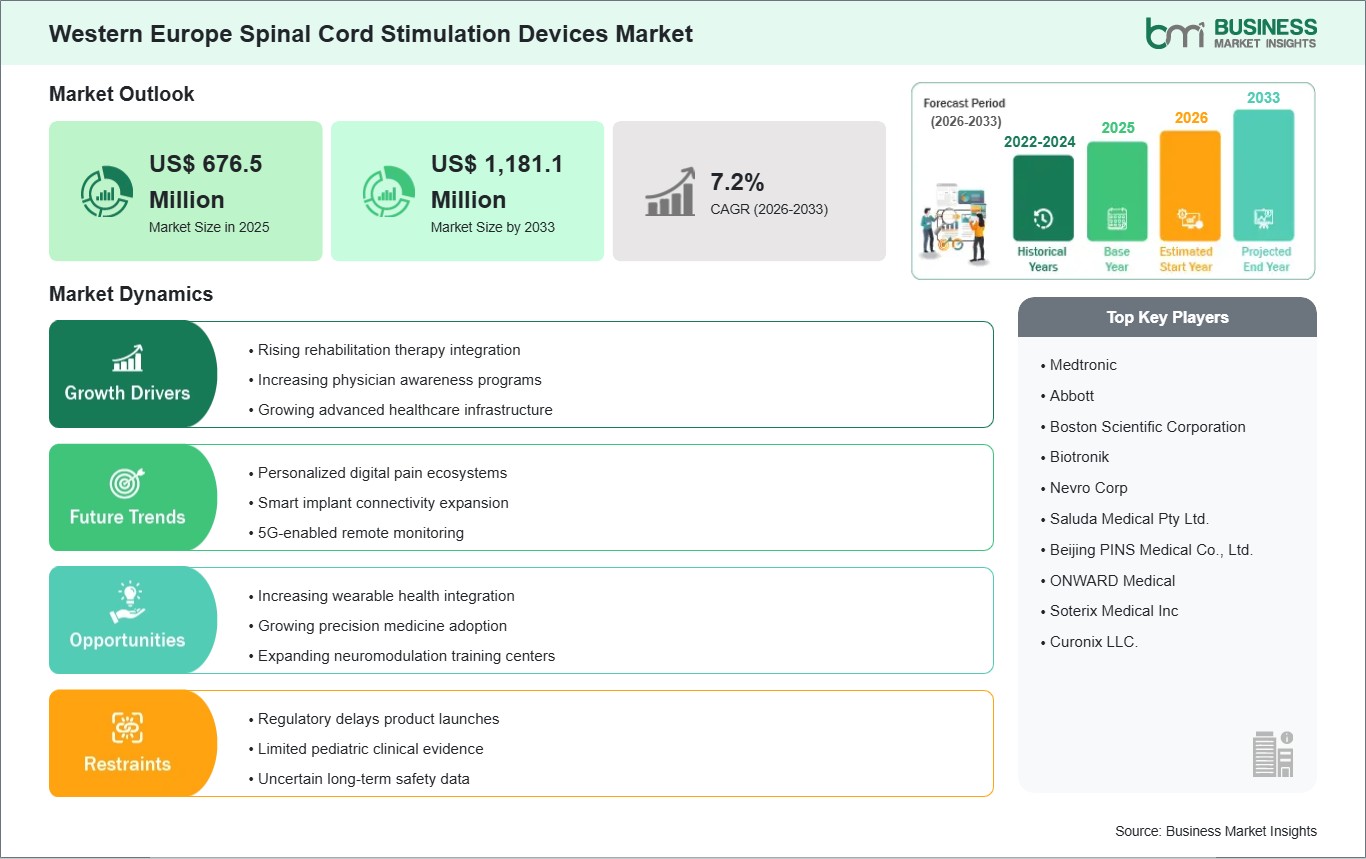
The Western Europe spinal cord stimulation devices market size is expected to reach US$ 1,181.1 million by 2033 from US$ 676.5 million in 2025. The market is estimated to register a CAGR of 7.2% from 2026 to 2033.
The Western Europe spinal cord stimulation (SCS) device market is rapidly evolving within a highly developed and strictly regulated healthcare environment, where clinical decision-making is strongly guided by scientific evidence and patient outcome data. SCS therapy is increasingly being accepted as a preferred treatment option for patients with chronic neuropathic pain, failed back syndrome, and degenerative spine diseases, conditions that are becoming more prevalent in the aging population due to age-related musculoskeletal disorders. At the same time, physicians are gradually shifting away from long-term pharmacological pain management approaches toward neuromodulation-based therapies.
Market growth is further supported by advanced and efficient public healthcare systems that encourage interdisciplinary care involving neurology, orthopedics, and pain medicine. Innovative SCS technologies such as burst stimulation, high-frequency stimulation, and closed-loop feedback systems are being actively introduced across hospitals in Western Europe. In addition, strong clinical training programs and participation in neuromodulation research studies are promoting wider adoption of advanced SCS techniques. The availability of specialized pain management clinics within hospital settings also contributes significantly to market expansion.
Growth is moderated by strict regulatory approval processes and conservative reimbursement frameworks that require extensive clinical validation before widespread adoption. Budget constraints within public healthcare systems also limit the rapid uptake of high-cost implantable pain therapies. In some cases, physician reluctance toward non-traditional pain management approaches may further slow adoption. Despite these challenges, strong demand for non-opioid pain relief solutions continues to support a positive long-term outlook for the spinal cord stimulation market in Western Europe.

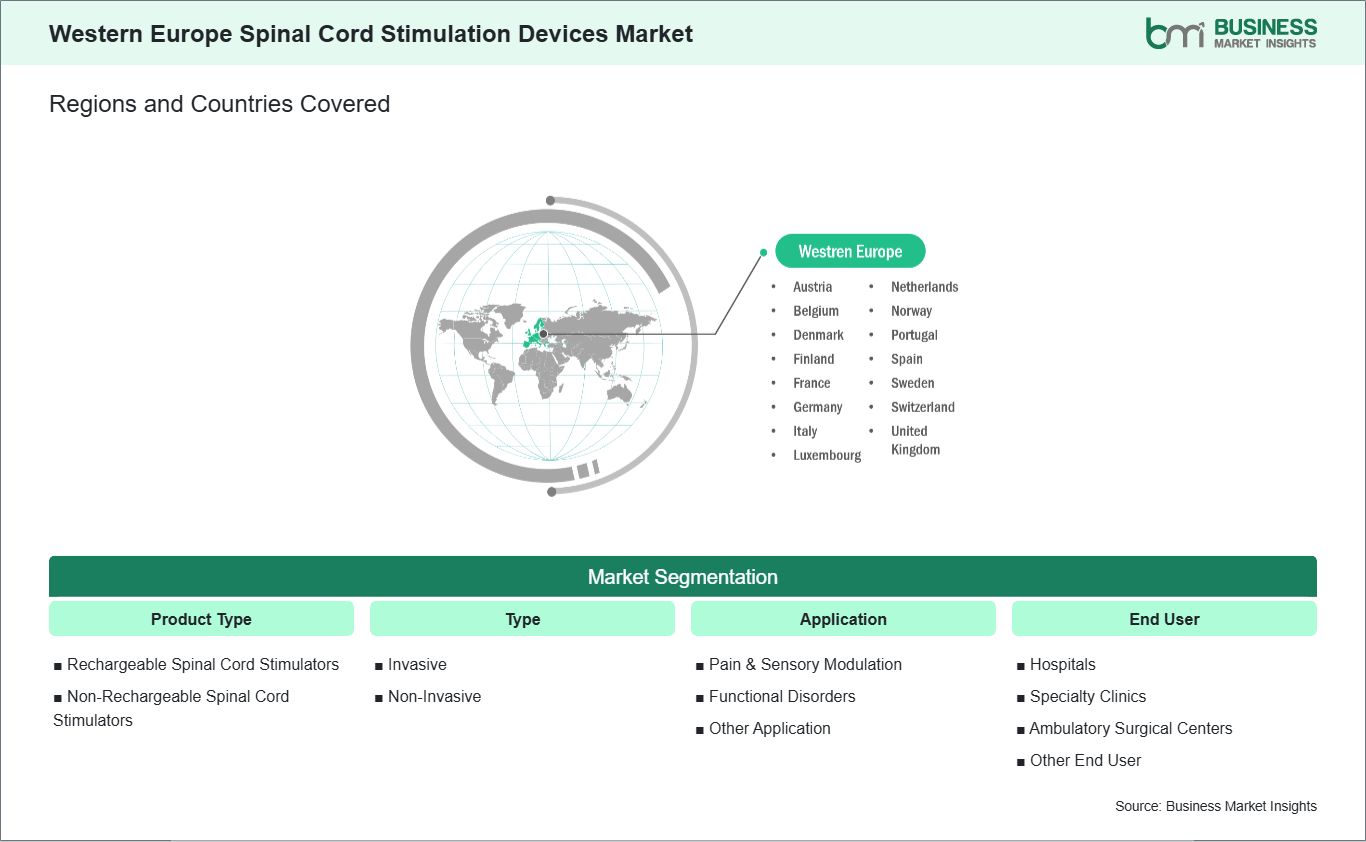
Key segments that contributed to the derivation of the Western Europe spinal cord stimulation devices market analysis are product type, type, application, and end user.
The SCS market in Western Europe will increasingly be shaped by the integration of rehabilitation therapy into post-implant treatment regimens. In countries such as Germany, France, the UK, and the Netherlands, pain management teams are adopting a holistic approach to chronic neuropathic pain and failed back surgery syndrome, where spinal cord stimulation is viewed as one component of a broader functional recovery strategy. Neuromodulation is being combined with physiotherapy, occupational therapy, and cognitive pain rehabilitation to improve mobility and long-term outcomes, with this model being particularly prominent in Germany and France, especially in university hospitals and rehabilitation clinics.
Rehabilitation centers across Western Europe are also incorporating advanced physiotherapy technologies to support spinal cord stimulation outcomes. Robotic rehabilitation systems, gait training devices, and motion analysis tools are being used to improve treatment effectiveness. In Sweden and Denmark, rehabilitation units are closely linked to national pain registries, allowing clinicians to monitor long-term outcomes and adjust rehabilitation intensity based on real-world data.
There is also a clear shift toward outpatient and home-based rehabilitation programs. Healthcare systems across the region are working to reduce hospital dependence while maintaining continuous follow-up through remote monitoring and digital care platforms. Patients receiving spinal cord stimulation are increasingly enrolled in structured rehabilitation programs aimed at improving self-care, mobility, and social functioning. This model is already well established in the UK and the Netherlands.
In countries such as Germany, France, and the UK, wearable devices that track posture, motor activity, and physiological indicators of pain are being used in chronic pain management to provide clinicians with real-time insights into patient mobility and to optimize SCS therapy settings. There is also growing demand for wearable technologies that support outpatient and home-based care models, which are expanding across Western Europe. Patients receiving spinal cord stimulation therapy can be monitored through devices that track physical activity, sleep patterns, and stress levels, with this data increasingly used in rehabilitation programs in countries such as the Netherlands and Sweden to support clinical decision-making.
Digital health ecosystems are enabling wider integration of wearable data through smartphone-linked platforms and cloud-based remote monitoring systems. Spinal cord stimulation devices are increasingly being paired with mobile applications that allow pain tracking and, in some cases, remote parameter adjustments by clinicians. In the UK and Germany, wearable-derived data is also being incorporated into electronic health records, strengthening evidence-based treatment and improving overall patient outcomes.

The Western Europe spinal cord stimulation devices market is experiencing steady growth, with market size and share analysis reflecting evolving treatment preferences and competitive dynamics among key players. The report evaluates important subsegments categorized within product type, type, application, and end user, highlighting their respective contributions to overall market performance.
By product type, the rechargeable spinal cord Stimulators subsegment dominated the market in 2025, because long-term chronic pain treatment requires devices that can operate continuously for several years without frequent replacement. Patients increasingly preferred rechargeable systems as they reduce the likelihood of repeat surgeries and lower overall treatment interruption.
Based on type, the invasive subsegment dominated the market in 2025 because implanted spinal cord stimulators deliver more stable and accurate nerve stimulation compared to external therapies. These systems are widely used for severe chronic pain conditions where medication and physiotherapy provide limited relief.
On the basis of application, the pain and sensory modulation subsegment dominated the market in 2025, because spinal cord stimulation is primarily designed to manage chronic neuropathic and musculoskeletal pain. The growing number of patients suffering from lower back pain, diabetic nerve pain, and post-surgical pain significantly increased demand for neuromodulation therapies.
In terms of end user, the hospitals subsegment dominated the market in 2025 because most spinal cord stimulator procedures require specialized surgical facilities, imaging equipment, and multidisciplinary pain management teams. Patients generally prefer hospitals for implantation procedures due to better emergency support and post-operative monitoring capabilities.
| Report Attribute | Details |
|---|---|
| Market size in 2025 | US$ 676.5 Million |
| Market Size by 2033 | US$ 1,181.1 Million |
| CAGR (2026 - 2033) | 7.2% |
| Historical Data | 2022-2024 |
| Forecast period | 2026-2033 |
| Segments Covered | By Product Type
|
|
Regions and Countries Covered
| |
| Western Europe | Belgium, Netherlands, Luxembourg, Germany, France, Italy, Spain, Switzerland, Sweden, Austria, United Kingdom, Denmark, Portugal, Norway, Finland |
| Market leaders and key company profiles |
|
The "Western Europe Spinal Cord Stimulation Devices Market Size and Forecast (2022-2033)" report provides a detailed analysis of the market covering below areas:
The geographical scope of the Western Europe spinal cord stimulation devices market report is divided into: Belgium, the Netherlands, Luxembourg, Germany, France, Italy, Spain, Switzerland, Sweden, Austria, the UK, Denmark, Portugal, Norway, and Finland. Germany held the largest share in 2025.
Germany dominates the Western Europe spinal cord stimulation (SCS) market due to its advanced hospital infrastructure, strong neurosurgical expertise, and rapid adoption of emerging technologies. The country has a well-established network of university hospitals and specialized pain clinics where SCS is routinely integrated into the treatment of chronic neuropathic pain, spinal cord injuries, and postoperative pain conditions. Germany's healthcare system places strong emphasis on precision medicine, enabling the use of personalized and programmable neuromodulation therapies. Its robust clinical research ecosystem, supported by active collaboration between hospitals and universities, has also contributed to early adoption of next-generation SCS technologies, including closed-loop systems. Physicians in Germany have extensive experience in interventional pain management, which supports better procedural outcomes and higher confidence in implantable devices. In addition, a structured and well-defined reimbursement system provides consistent support for clinically validated SCS treatments, while large hospital networks and specialized spine centers ensure standardized patient selection, implantation, and aftercare processes. Although adoption is moderated by strict cost-effectiveness assessments and cautious introduction of new technologies, Germany continues to lead, driven by strong clinical capability, high patient awareness, and a growing shift toward non-opioid pain management strategies.

The Western Europe spinal cord stimulation devices market is evaluated by gathering qualitative and quantitative data post primary and secondary research, which includes important corporate publications, association data, and databases. A few of the key developments in the Western Europe spinal cord stimulation devices market are:
The Western Europe Spinal Cord Stimulation Devices Market is valued at US$ 676.5 Million in 2025, it is projected to reach US$ 1,181.1 Million by 2033.
As per our report Western Europe Spinal Cord Stimulation Devices Market, the market size is valued at US$ 676.5 Million in 2025, projecting it to reach US$ 1,181.1 Million by 2033. This translates to a CAGR of approximately 7.2% during the forecast period.
The Western Europe Spinal Cord Stimulation Devices Market report typically cover these key segments-
The historic period, base year, and forecast period can vary slightly depending on the specific market research report. However, for the Western Europe Spinal Cord Stimulation Devices Market report:
The Western Europe Spinal Cord Stimulation Devices Market is populated by several key players, each contributing to its growth and innovation. Some of the major players include:
The Western Europe Spinal Cord Stimulation Devices Market report is valuable for diverse stakeholders, including:
Essentially, anyone involved in or considering involvement in the Western Europe Spinal Cord Stimulation Devices Market value chain can benefit from the information contained in a comprehensive market report.
Please tell us your area of interest
(Market Segments/ Regions and Countries/ Companies)