Market Summary
Executive Summary and Market Analysis
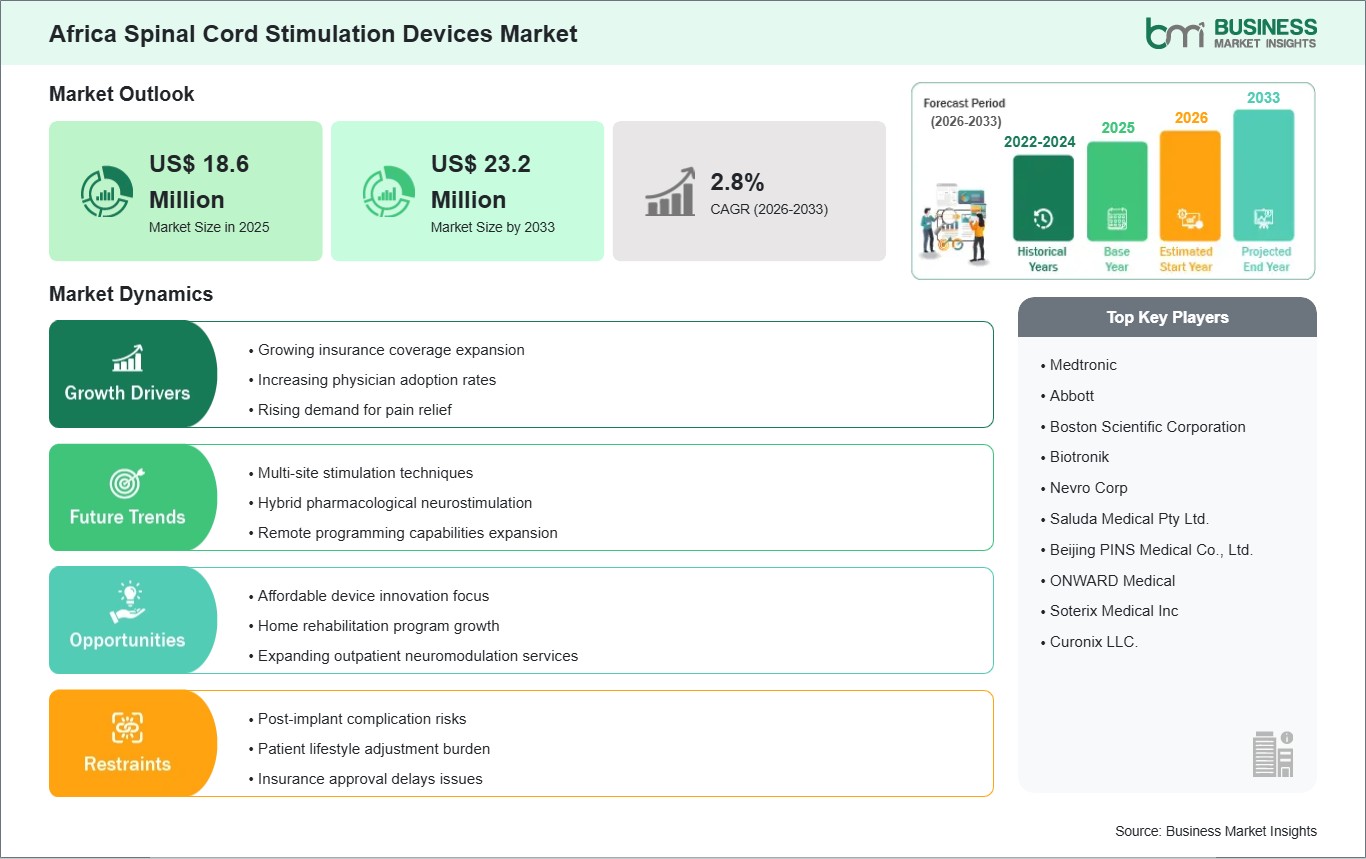
The African spinal cord stimulation (SCS) devices market remains in an early stage of development but is gradually evolving, with select healthcare facilities adopting advanced neuromodulation techniques as part of chronic pain management strategies. Currently, the market is concentrated in a limited number of specialized medical centers located in major urban areas, particularly those with established neurological and spinal care units offering relevant expertise. Rising cases of spinal pain syndromes, injury-related neural damage, and post-surgical pain are driving demand for more advanced pain management options beyond conventional pharmacotherapy.
Private healthcare institutions are increasingly adopting minimally invasive interventional approaches, such as spinal cord stimulation, for patients with refractory neuropathic pain. A key driver of future market growth is the gradual strengthening of private healthcare infrastructure, along with the growing presence of internationally trained specialists in neurosurgery and pain medicine. Some large hospitals are also beginning to implement advanced implantable technologies to enhance treatment capabilities and attract medical tourism from neighboring regions. Additionally, increasing awareness of the adverse effects associated with opioid medications is supporting interest in neuromodulation therapies.
The market faces significant challenges, including limited affordability, weak insurance coverage, and a shortage of specialized healthcare facilities across many African countries. Public healthcare systems continue to prioritize communicable diseases and essential health interventions, leaving limited resources for advanced neuromodulation technologies. Furthermore, a lack of trained personnel and low awareness of spinal cord stimulation among patients further restrict market expansion. Despite these barriers, ongoing healthcare improvements and rising investment in specialized care are expected to support gradual, selective growth in the coming years.
Segment Analysis
Africa Spinal Cord Stimulation Devices Market Segmentation
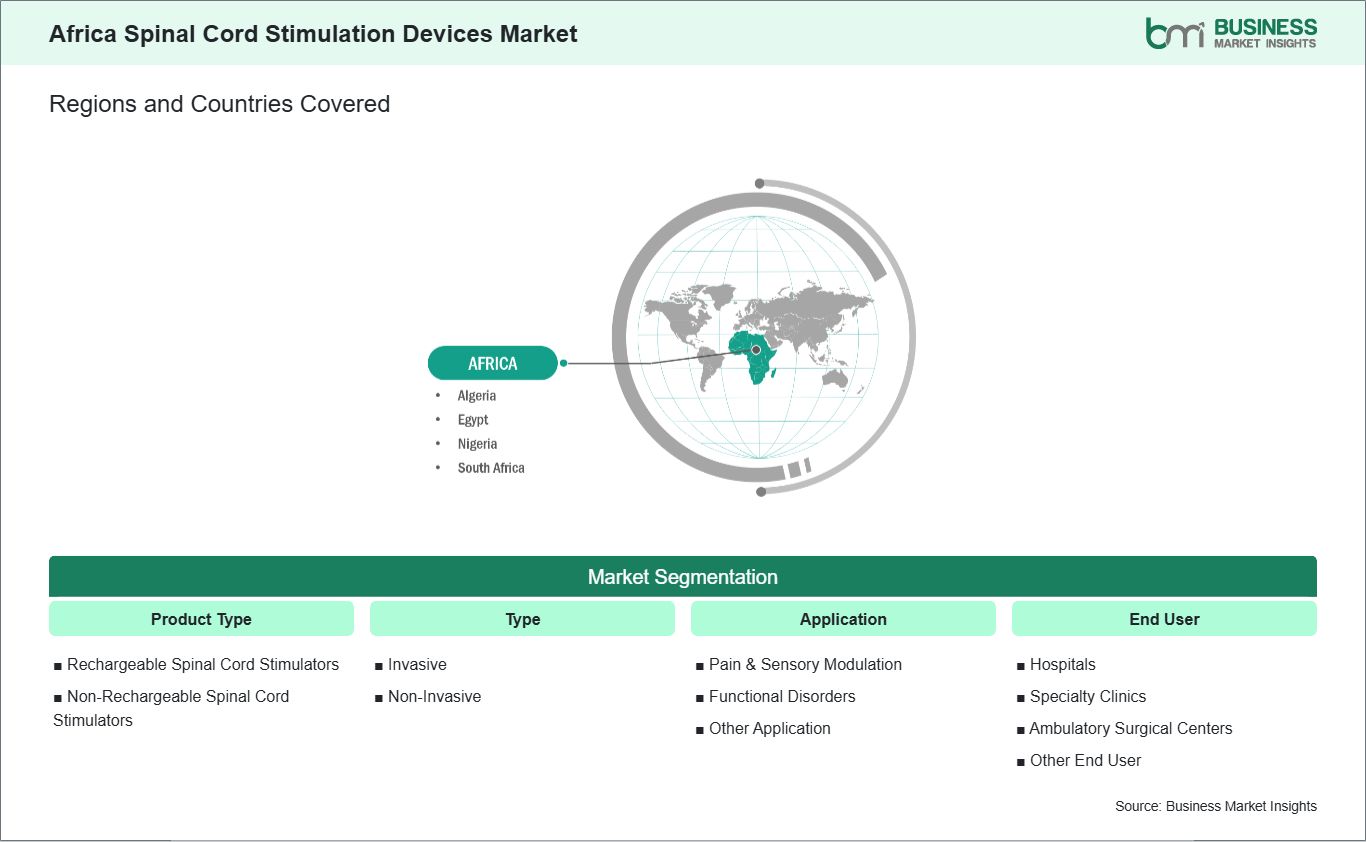
Key segments that contributed to the derivation of the Africa spinal cord stimulation devices market analysis are product type, type, application, and end user.
- By product type, the spinal cord stimulation devices market is segmented into rechargeable spinal cord stimulators and non-rechargeable spinal cord stimulators. The rechargeable spinal cord stimulators segment dominated the market in 2025.
- Based on type, the spinal cord stimulation devices market is segmented into invasive and non-invasive. The invasive segment dominated the market in 2025.
- On the basis of application, the spinal cord stimulation devices market is classified into pain and sensory modulation, functional disorders, and other application. The pain and sensory modulation segment dominated the market in 2025.
- In terms of end user, the spinal cord stimulation devices market is categorized into hospitals, specialty clinics, ambulatory surgical centers, and other end user. The hospitals segment dominated the market in 2025.
Market Forces
Africa Spinal Cord Stimulation Devices Market Drivers and Opportunities
Insurance Coverage Expansion
The African spinal cord stimulation (SCS) devices market is expected to experience steady growth owing to increasing insurance penetration and improved access to advanced pain treatment centers. Previously, neuromodulation treatments were largely limited to a small group of patients, as implantable devices and surgical procedures were unaffordable for most individuals. However, a growing number of private insurance providers and government-supported healthcare initiatives are gradually making neuromodulation more accessible for patients with chronic neuropathic pain and spinal disorders.
In urban areas where private insurance coverage is expanding, many insurers have begun to include partial coverage for advanced pain management procedures such as spinal cord stimulation testing and implantation surgeries. According to major tertiary hospitals, there has been a noticeable increase in patient inquiries regarding insurance coverage for neuromodulation therapies, particularly among middle-class patients seeking alternatives to opioid-based pain management.
The development of employer-sponsored insurance schemes and broader healthcare financing programs is expected to further improve access to neurology specialists. Although reimbursement structures vary across African countries, there has been a gradual rise in the number of spinal cord stimulation implant procedures in major urban centers, driven largely by expanding insurance coverage.
Affordable Device Innovation Focus
The African spinal cord stimulation (SCS) devices market is gaining momentum due to the growing focus on developing low-cost devices to improve affordability in resource-constrained healthcare settings. High implantation costs and limited availability of trained specialists have historically restricted the use of advanced neuromodulation therapies across much of the continent. As a result, manufacturers and healthcare providers are increasingly focusing on cost-effective implant systems, rechargeable stimulators, and simplified programming features.
Rechargeable spinal cord stimulation devices are becoming more widely adopted in hospitals and specialized pain clinics, as they reduce the need for additional surgical procedures such as battery replacement, thereby lowering overall treatment costs. In addition, manufacturers are introducing compact pulse generators and energy-efficient systems designed to enhance device longevity while minimizing maintenance expenses. These innovations are particularly valuable in healthcare settings where patients often bear a significant portion of treatment costs.
Collaborations between global medical device manufacturers and regional healthcare institutions are supporting physician training and the adoption of more efficient neuromodulation technologies. Some healthcare providers have also introduced phased payment models and alternative financing mechanisms to improve patient access. Overall, the adoption of spinal cord stimulation is expected to grow gradually as the availability of affordable devices increases and awareness of non-opioid pain management options expands within Africa's neurology and pain care sector.
Size and Share Analysis
Africa Spinal Cord Stimulation Devices Market Size and Share Analysis
The Africa spinal cord stimulation devices market is experiencing steady growth, with market size and share analysis reflecting evolving treatment preferences and competitive dynamics among key players. The report evaluates important subsegments categorized within product type, type, application, and end user, highlighting their respective contributions to overall market performance.
By product type, the rechargeable spinal cord Stimulators subsegment dominated the market in 2025, because long-term chronic pain treatment requires devices that can operate continuously for several years without frequent replacement. Patients increasingly preferred rechargeable systems as they reduce the likelihood of repeat surgeries and lower overall treatment interruption.
Based on type, the invasive subsegment dominated the market in 2025 because implanted spinal cord stimulators deliver more stable and accurate nerve stimulation compared to external therapies. These systems are widely used for severe chronic pain conditions where medication and physiotherapy provide limited relief.
On the basis of application, the pain and sensory modulation subsegment dominated the market in 2025, because spinal cord stimulation is primarily designed to manage chronic neuropathic and musculoskeletal pain. The growing number of patients suffering from lower back pain, diabetic nerve pain, and post-surgical pain significantly increased demand for neuromodulation therapies.
In terms of end user, the hospitals subsegment dominated the market in 2025 because most spinal cord stimulator procedures require specialized surgical facilities, imaging equipment, and multidisciplinary pain management teams. Patients generally prefer hospitals for implantation procedures due to better emergency support and post-operative monitoring capabilities.
Report Coverage
Africa Spinal Cord Stimulation Devices Market Report Coverage and Deliverables
The "Africa Spinal Cord Stimulation Devices Market Size and Forecast (2022-2033)" report provides a detailed analysis of the market covering below areas:
- Market size and forecast at regional and country levels for all market segments covered under the scope
- Market trends, as well as drivers, restraints, and opportunities
- Market analysis covering key trends, regional framework, major players, regulations, and recent developments
- Market concentration, heat map analysis, prominent players, and recent developments for the Market
- Detailed company profiles, including SWOT analysis
Geographic Insights
Africa Spinal Cord Stimulation Devices Market Geographic Insights
The geographical scope of the Africa spinal cord stimulation devices market report is divided into: Nigeria, Egypt, South Africa, and Algeria. South Africa held the largest share in 2025.
South Africa leads the African spinal cord stimulation (SCS) devices market due to its relatively advanced healthcare infrastructure, strong network of specialists, and well-developed private healthcare sector. It is widely regarded as the primary hub for advanced neurological surgeries on the continent, with numerous hospitals and private healthcare organizations increasingly incorporating spinal cord stimulation into pain management protocols. Patients suffering from neuropathic pain, failed back syndrome, and complex spinal disorders are more likely to access neuromodulation therapies in South Africa than in any other African country.
A key factor supporting the country's dominance is the presence of a robust private hospital network equipped with advanced medical technologies and highly qualified specialists. These facilities are better positioned to perform implantable pain procedures and provide long-term patient follow-up care. Additionally, healthcare providers in South Africa are generally more familiar with global treatment standards and emerging neuromodulation techniques, further strengthening adoption rates.
Medical tourism also contributes to market growth, as patients from neighboring African countries often travel to South Africa to access specialized spinal and neurological treatments that are not readily available in their home countries. However, the use of spinal cord stimulation remains largely concentrated in the private healthcare sector due to high costs and limited public sector reimbursement. In contrast, other African countries are still in the early stages of adoption, constrained by infrastructure gaps and limited awareness of advanced pain management technologies. As a result, South Africa continues to function as the regional center for spinal cord stimulation adoption and development.
Industry Activity
Recent Developments
The Africa spinal cord stimulation devices market is evaluated by gathering qualitative and quantitative data post primary and secondary research, which includes important corporate publications, association data, and databases. A few of the key developments in the Africa spinal cord stimulation devices market are:
- In February 2024, Boston Scientific announced the continued international expansion of its WaveWriter Alpha spinal cord stimulation portfolio, strengthening the company's neuromodulation presence across emerging regions, including Africa, through broader distributor and hospital network engagement for chronic pain management therapies.
- In October 2023, Nevro Corp. announced increased global commercialization activities for its HFX spinal cord stimulation platform, including expansion initiatives targeting underserved international markets, such as Africa, through partnerships with regional healthcare providers and pain management specialists.
Trust & Transparency
Research Methodology
The market analysis combines proprietary research with secondary data from government agencies, company disclosures, regulatory filings, industry databases and expert interviews. Market estimates are validated through data triangulation, cross-market benchmarking and analyst
review.
View Full Research Methodology
Key Sources Referred:
The World BankWorld Health Organization (WHO)Center for Disease Control and Prevention (CDC)Food and Drug Administration (FDA)Centers for Medicare and Medicaid Services (CMS)European CommissionMedicines and Healthcare products Regulatory Agency (MHRA)Company WebsitesCompany Annual ReportsCompany Investor Presentation