Market Summary
Executive Summary and Market Analysis
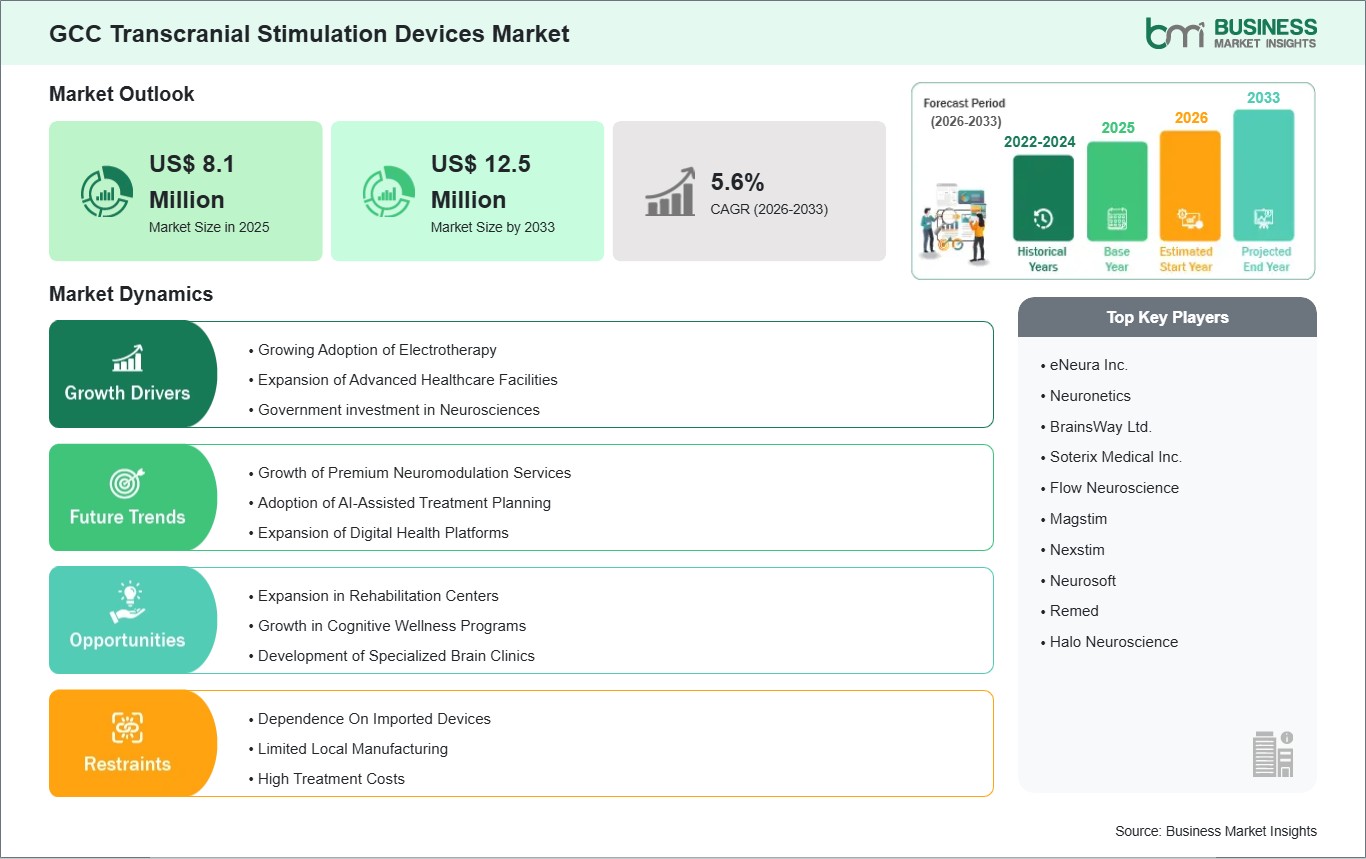
GCC Market Report on Transcranial Stimulation Devices presents an evolving market scenario in the field of neuroscience based on the growing trend of employing non-invasive brain stimulation therapies like transcranial magnetic stimulation and transcranial direct current stimulation. The demand is driven by growing awareness regarding resistant depression, anxiety conditions, and stroke management, which makes it necessary for hospitals and neurology clinics to adopt the therapy within their care process. Another aspect contributing towards demand generation lies in the emerging infrastructures and specialization practices offering brain treatments in various Gulf countries. This is possible due to developments within health care facilities, along with advanced medical equipment and personalized rehabilitation programs adopted by health experts in those regions. Patients' inclination towards minimally invasive treatment methods forms another reason supporting the requirement for the devices. Nevertheless, one limitation for the market is the lack of availability of professionals who have the skills to apply and calibrate the process. The regulatory processes in the Gulf Cooperation Council countries are still developing, and different hospitals and equipment manufacturers are working on the approval process, as well as procurement processes that will affect the speed at which the stimulation systems are implemented within neuropsychiatric hospitals and rehabilitation settings in the GCC.
Segment Analysis
GCC Transcranial Stimulation Devices Market Segmentation
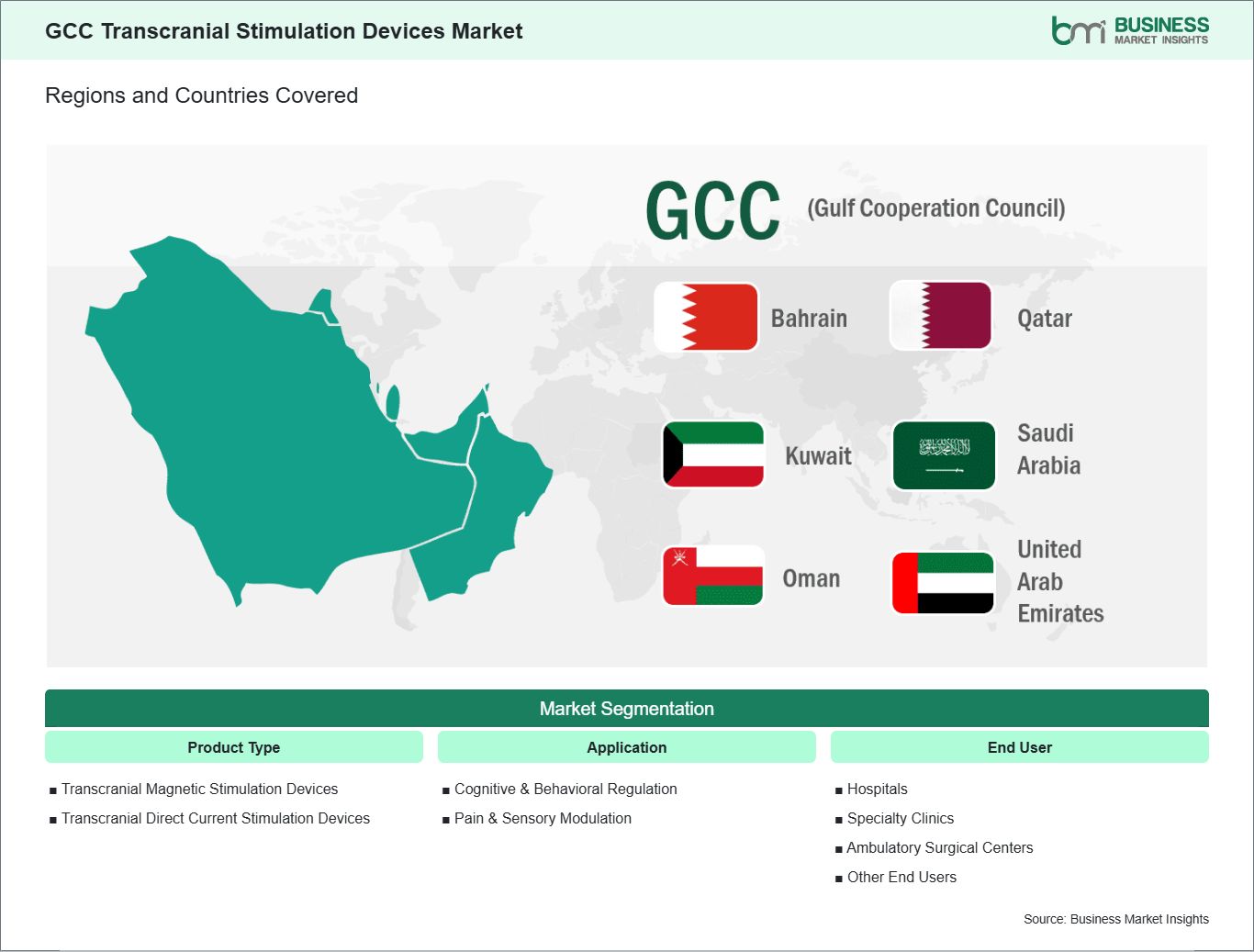
Key segments that contributed to the derivation of the GCC transcranial stimulation devices market analysis are product type, application, and end user.
- By product type, the transcranial stimulation devices market is segmented into transcranial magnetic stimulation devices and transcranial direct current stimulation devices. The transcranial magnetic stimulation devices segment dominated the market in 2025.
- Based on application, the transcranial stimulation devices market is categorized into cognitive & behavioral regulation and pain & sensory modulation. The cognitive & behavioral regulation segment dominated the market in 2025.
- In terms of end user, the transcranial stimulation devices market is categorized into hospitals, specialty clinics, ambulatory surgical centers, and other end users. The hospitals segment dominated the market in 2025.
Market Forces
GCC Transcranial Stimulation Devices Market Drivers and Opportunities
Growing Adoption of Electrotherapy
Brain stimulation through electrotherapy is becoming a common practice in many neuropsychiatric facilities in GCC through the inclusion of the technology into structured clinical protocols used for conditions such as depression and post-stroke cognitive impairment. Typically, clinicians present transcranial stimulators as a supplementary means and incorporate their use into broader treatment programs that include both pharmacological and behavioral therapies.
Stimulation device usage will depend on clinicians' titration procedures that adjust the level of stimulation intensity and frequencies based on a patient's level of response at subsequent follow-up appointments. Clinics in GCC are likely to prefer devices that offer programmable functionality for tracking a patient's response to the treatment and allowing structured documentation. Procurement priorities are expected to be guided by interoperability needs related to hospital IT infrastructures.
Clinician referrals are becoming important determinants of device accessibility, whereby neurologists and psychiatrists practicing in private practices refer patients to undergo electrotherapy stimulation after failing conventional treatments. Acceptance of the technology will depend on the non-invasive characteristics of stimulation treatments and lead clinics to formulate structured patient consultations.
Expansion in Rehabilitation Centers
At rehabilitation centers located within GCC countries, stimulation systems are being integrated into neuro-recovery sessions focusing on motor and cognitive rehabilitative tasks. Medical practitioners incorporate the usage of these systems together with physical therapy systems, whereby stimulation sessions have been set concurrently with exercises for rehabilitation of the patient to ensure neural connections. The coordination of such systems enhances teamwork among the various medical professionals involved in therapy sessions.
Operation of stimulation devices is usually characterized by session scheduling limits since rehabilitation centers organize their sessions according to the schedules that suit both the availability of therapists and fatigue levels of patients during therapy sessions. Utilization of expensive therapeutic machines is enhanced through rotation of patients at both neurostimulation and physical therapy sites.
Usage of stimulator machines in clinics depends on the extent of training acquired by therapists in the use of stimulation parameters and safety limits during therapy sessions. It is common practice at rehabilitation centers to develop a routine system whereby therapists are trained in using different machines to guarantee consistent therapeutic applications.
Size and Share Analysis
GCC Transcranial Stimulation Devices Market Size and Share Analysis
The GCC transcranial stimulation devices market demonstrates steady growth, with size and share analysis highlighting evolving trends and competitive dynamics among key players. The report examines subsegments categorized within product type, application, and end user, offering insights into their contribution to overall market performance.
By product type, the transcranial magnetic stimulation devices subsegment dominated the market in 2025, driven by its strong clinical efficacy in treating major depression and other neurological disorders, along with increasing regulatory approvals and growing adoption in hospital-based neuropsychiatric care.
Based on application, the cognitive & behavioral regulation subsegment dominated the market in 2025, driven by the rising prevalence of mental health disorders and increasing demand for non-invasive therapies that improve cognition, mood, and behavioral outcomes without pharmacological side effects.
In terms of end user, the hospitals subsegment dominated the market in 2025, driven by higher availability of advanced neurostimulation infrastructure, presence of trained specialists, and preference for supervised clinical environments for safe and effective patient treatment.
Report Coverage
GCC Transcranial Stimulation Devices Market Report Coverage and Deliverables
The "GCC Transcranial Stimulation Devices Market Size and Forecast (2022-2033)" report provides a detailed analysis of the market covering below areas:
- Market size and forecast at global, regional, and country levels for all the key market segments covered under the scope
- Market trends, as well as drivers, restraints, and opportunities
- Market analysis covering key trends, global and regional framework, major players, regulations, and recent developments
- Market concentration, heat map analysis, prominent players, and recent developments for the Market
- Detailed company profiles, including SWOT analysis
Geographic Insights
GCC Transcranial Stimulation Devices Market Geographic Insights
The geographical scope of the GCC Transcranial Stimulation Devices Market report is divided into UAE, Bahrain, Saudi Arabia, Oman, Qatar, Kuwait. UAE held the largest share in 2025.
The United Arab Emirates still maintains its supremacy as the main market for transcranial stimulators in the Gulf region, owing to its advanced application of neurotechnologies, a well-developed network of multi-specialist hospitals, and being the destination point for medical tourism in the region. The growth of the market in Bahrain is determined by its efficient healthcare governance and the introduction of specialized neurological treatment procedures in small, efficient clinical settings with an emphasis on outpatient rehabilitation services. Saudi Arabia is characterized by rapid development in healthcare and high rates of need for neurological and psychiatric care, which result in demands for innovative tertiary hospitals. The uptake rate in Oman is rather slow owing to an emphasis on building up public healthcare capacities, organized purchasing practices, and growing clinical competence among clinicians in the implementation of neuromodulation therapy. The development of Qatar is driven by substantial healthcare investment in high-income settings, state-of-the-art research facilities within the country's medical centers, and an increase in the use of neurostimulation treatment in rehabilitation and elite sports medicine clinics. In Kuwait, the growth is achieved via the developed private healthcare system, growing emphasis on managing chronic neurological disorders, and imported devices for therapy.
Industry Activity
Recent Developments
The GCC Transcranial Stimulation Devices Market is evaluated by gathering qualitative and quantitative data post primary and secondary research, which includes important corporate publications, association data, and databases. A few of the key developments in the GCC transcranial stimulation devices market are:
- In November 2025, Neurosoft announced that its Transcranial Magnetic Stimulation (TMS) system was installed at Thumbay Rehabilitation Hospital in the United Arab Emirates through its official UAE distributor Trinity Med Tec, marking the company's entry into clinical neurorehabilitation applications in the Gulf healthcare market.
- In January 2021, BrainsWay announced that it signed an exclusive distribution agreement with Gaelan Medical Trade LLC to introduce its Deep Transcranial Magnetic Stimulation (Deep TMS) system across the United Arab Emirates, expanding access to non-invasive neuromodulation treatments for depression and OCD in the GCC region.
Trust & Transparency
Research Methodology
The market analysis combines proprietary research with secondary data from government agencies, company disclosures, regulatory filings, industry databases and expert interviews. Market estimates are validated through data triangulation, cross-market benchmarking and analyst
review.
View Full Research Methodology
Key Sources Referred:
U.S. Food and Drug Administration (FDA)National Institute of Mental Health (NIMH)National Institute for Health and Care Excellence (NICE)European Medicines Agency (EMA)Medicines and Healthcare products Regulatory Agency (MHRA)American Psychiatric Association (APA)World Health Organization (WHO)International Neuromodulation Society (INS)International Society for Neuroregulation & Research (ISNR)European Society for Magnetic Resonance in Medicine and Biology (ESMRMB)Company WebsitesCompany Annual ReportsCompany Investor Presentations