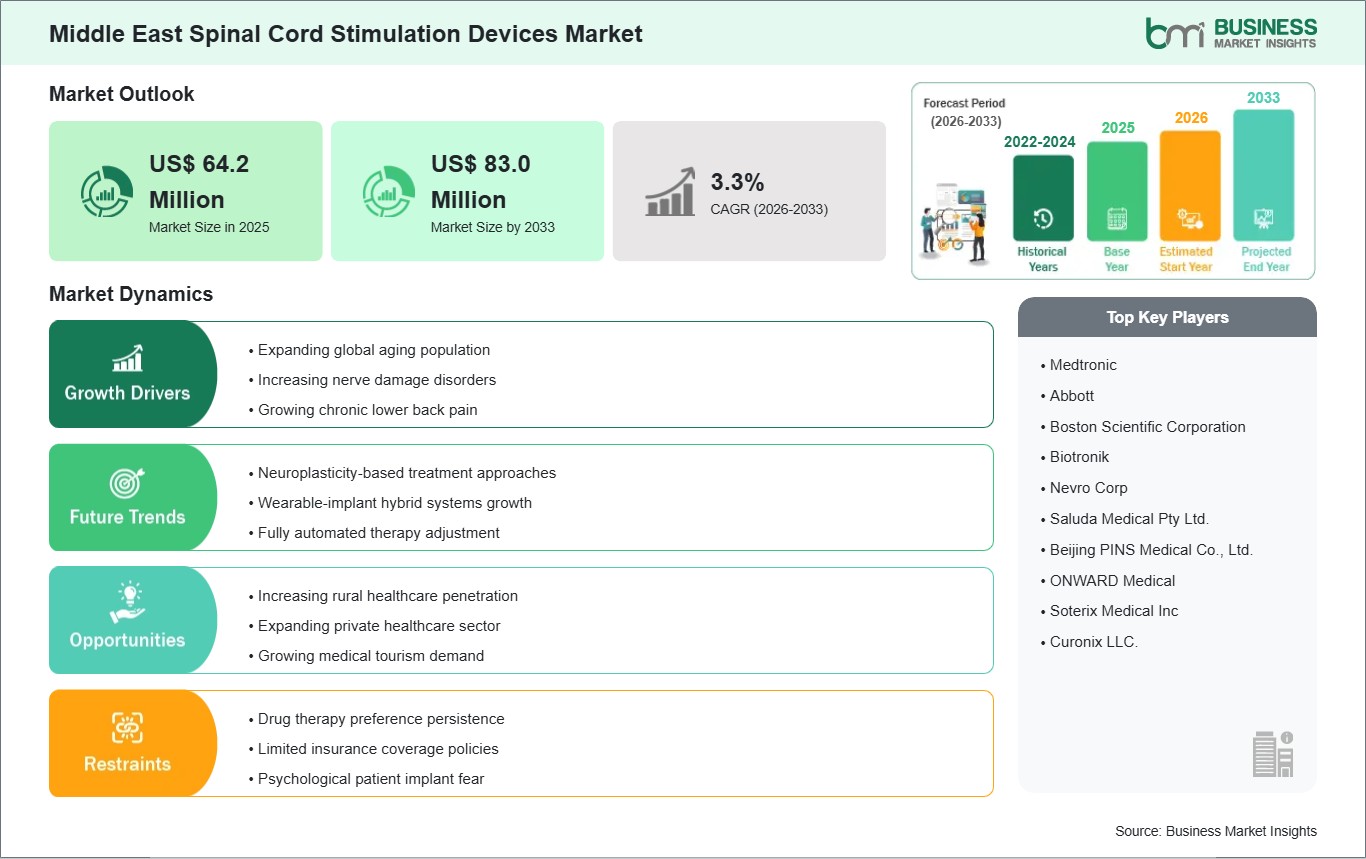
The Middle East Spinal cord stimulation devices market size is expected to reach US$ 83.0 million by 2033 from US$ 64.2 million in 2025. The market is estimated to record a CAGR of 3.3% from 2026 to 2033.
Spinal cord stimulator device usage in the Middle East is growing due to the fact that healthcare systems are focusing more on pain management and neurology treatment practices in order to offer better health service. The increasing number of cases regarding lower back pain, spinal injury, diabetic neuropathy, as well as post-surgery nerve issues, is driving the need for more advanced neuromodulation devices. Many medical facilities are trying to avoid prolonged pain treatments based on medication and looking towards using more innovative methods in helping patients walk normally and have a decent quality of life. Such practices are especially noticeable in major cities. Due to the rapid process of healthcare modernization taking place in the Middle Eastern countries, the implementation of the mentioned devices can be seen more often in specialized hospital departments in tertiary hospitals, as well as neurology practices. The development of new imaging equipment, surgery robots, as well as multi-disciplinary pain treatment approaches, makes physicians feel more confident about performing implantation surgeries and using stimulators. Patients are starting to be more interested in solutions other than opioids and more willing to use rechargeable and programmable spinal cord stimulators. However, some limitations persist in the current scenario. For instance, high costs of therapy and limited reimbursement models constitute notable challenges, especially with regard to public healthcare facilities in which neuromodulation treatment is regarded as a luxury treatment option. Uneven distribution of skilled practitioners also constitutes another challenge, especially within small Middle Eastern countries and rural regions. Another limitation involves cultural reluctance to utilize implantable medical devices by some target patients. Nonetheless, increased investments in neurology care and improved knowledge about pain management should ensure continued growth of the regional market.

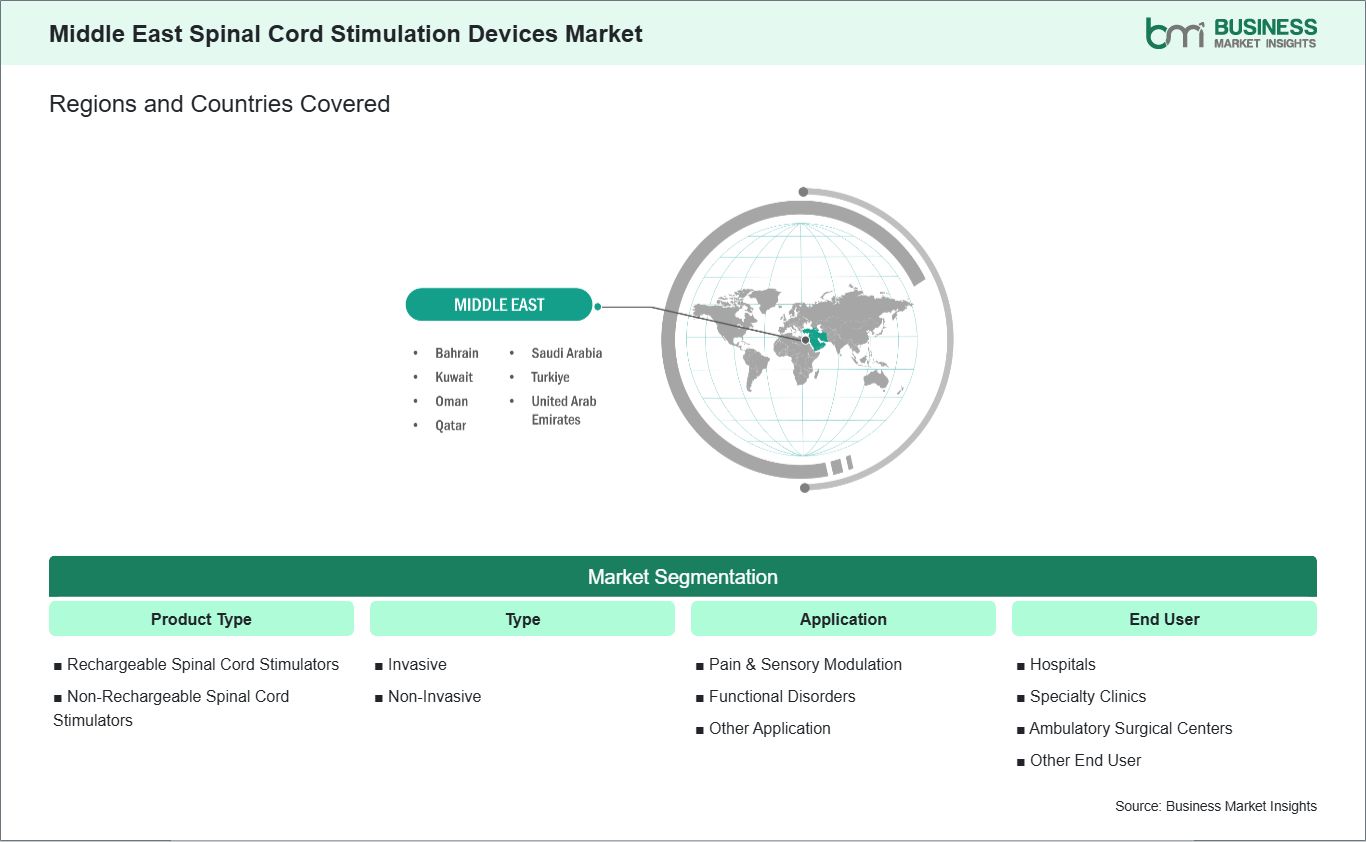
Key segments that contributed to the derivation of the Middle East spinal cord stimulation devices market analysis are product type, type, application, and end user.
There has been notable progress made in the Middle Eastern market for spinal cord stimulation (SCS) devices as a result of an increasing number of age-induced chronic pains cases among the population of the region. The improved access to quality healthcare services coupled with enhanced living standards has seen increased life expectancy in various countries in the Middle East including Saudi Arabia, the UAE, Oman, and Kuwait. The rising number of aged individuals in the region increases the occurrence of spinal diseases, lower back pain, as well as neuropathic pain that is associated with diabetes and lack of physical activities. There is an increasing need for more effective treatment measures than conventional pain medications thus an inclination towards neuromodulation techniques such as spinal cord stimulation.
The increase in the incidence rate of degenerative spine diseases among the aging population of the Middle East is prompting hospitals in the most important cities in the region to offer advanced treatment solutions for elderly patients. Some of the medical institutions in Riyadh, Dubai, and Doha are now offering minimally invasive spine treatment facilities where spinal cord stimulation therapy is recommended to patients that may have difficulties undergoing repeated surgeries.
Moreover, the healthcare system has been focusing on the management of chronic diseases for an extended period compared to their immediate treatments. Spinal cord stimulation techniques with rechargeable systems, extended battery life, and the ability to control remotely have also gained importance among older populations that need to be followed up for a prolonged period of time. With more emphasis placed on managing chronic diseases at home, spinal cord stimulation becomes even more valuable since it will minimize the number of hospital visits while providing effective treatment.
Expanding healthcare coverage to include rural and semi-urban regions is generating new growth prospects in the Middle East spinal cord stimulation devices market. In the past, high-end neuromodulation treatments could only be received at specialized hospitals located in major city centers like Dubai, Riyadh, and Doha. Nonetheless, there is an ongoing effort by various state governments to ensure the provision of accessible healthcare services for disadvantaged groups through regional hospital network development and the integration of electronic healthcare services. Saudi Arabia and Oman have been allocating funds to build more secondary-level healthcare centers and develop telemedicine technologies for improved neurological and chronic pain disease care in outlying regions.
The implementation of telemedicine services has emerged as an essential factor facilitating the growth of rural health penetration. In fact, many regional health delivery systems have integrated the use of digital consultation tools for linking rural patients with specialist physicians stationed at major metropolitan hospitals. Such approaches are particularly beneficial for managing cases involving chronic pain syndrome since the treatment process involves monitoring and fine-tuning devices. Moreover, with enhanced internet access and higher levels of digital health literacy amongst rural populations, patient knowledge regarding neuromodulation therapies has significantly increased.
There is additional growth potential in the infrastructure modernization for the market. Some Middle Eastern nations are making provisions to build new rehabilitation centers, outpatient facilities, and mobile hospitals in small towns to help lessen the load on crowded city hospitals. Rural healthcare development has special significance for large countries that face problems related to distance and time required for specialist consultations in remote locations. The government is also promoting partnerships between private firms and the government to ensure the provision of advanced technology outside the capitals. With rural healthcare systems becoming better connected, spinal cord stimulation treatments are likely to benefit from it.

The Middle East spinal cord stimulation devices market is experiencing steady growth, with market size and share analysis reflecting evolving treatment preferences and competitive dynamics among key players. The report evaluates important subsegments categorized within product type, type, application, and end user, highlighting their respective contributions to overall market performance.
By product type, the rechargeable spinal cord Stimulators subsegment dominated the market in 2025, because long-term chronic pain treatment requires devices that can operate continuously for several years without frequent replacement. Patients increasingly preferred rechargeable systems as they reduce the likelihood of repeat surgeries and lower overall treatment interruption.
Based on type, the invasive subsegment dominated the market in 2025 because implanted spinal cord stimulators deliver more stable and accurate nerve stimulation compared to external therapies. These systems are widely used for severe chronic pain conditions where medication and physiotherapy provide limited relief.
On the basis of application, the pain and sensory modulation subsegment dominated the market in 2025, because spinal cord stimulation is primarily designed to manage chronic neuropathic and musculoskeletal pain. The growing number of patients suffering from lower back pain, diabetic nerve pain, and post-surgical pain significantly increased demand for neuromodulation therapies.
In terms of end user, the hospitals subsegment dominated the market in 2025 because most spinal cord stimulator procedures require specialized surgical facilities, imaging equipment, and multidisciplinary pain management teams. Patients generally prefer hospitals for implantation procedures due to better emergency support and post-operative monitoring capabilities.
| Report Attribute | Details |
|---|---|
| Market size in 2025 | US$ 64.2 Million |
| Market Size by 2033 | US$ 83.0 Million |
| CAGR (2026 - 2033) | 3.3% |
| Historical Data | 2022-2024 |
| Forecast period | 2026-2033 |
| Segments Covered | By Product Type
|
|
Regions and Countries Covered
| |
| Middle East | UAE, Saudi Arabia, Bahrain, Oman, Kuwait, Qatar, Turkiye |
| Market leaders and key company profiles |
|
The "Middle East Spinal Cord Stimulation Devices Market Size and Forecast (2022-2033)" report provides a detailed analysis of the market covering below areas:
The geographical scope of the Middle East spinal cord stimulation devices market report is divided into: the UAE, Saudi Arabia, Bahrain, Oman, Kuwait, Qatar, and Turkey. Turkey held the largest share in 2025.
The Turkiye spinal cord stimulation market holds significant dominance in the Middle East region, thanks to the country's robust healthcare system, growing neurosurgical capabilities, and adoption of innovative medical technologies. As a healthcare center for the region, the country possesses numerous private and university-owned hospitals that can conduct complicated neuromodulation procedures. Key cities like Istanbul, Ankara, and Izmir are currently experiencing rising demands for spinal cord stimulation among individuals afflicted with chronic neuropathic pain, failed back surgery syndrome, and spinal degeneration. Some of the key reasons behind the countrys market supremacy include the rapid growth of specialized pain management and rehabilitation centers. The Turkish hospitals are incorporating spinal cord stimulations within their multidisciplinary treatment protocols with the aim of reducing dependency on prescription drugs for pain management. Doctors in Turkey are currently attending neurology seminars and surgery training programs at an international level, enhancing their understanding of innovative stimulation techniques such as high-frequency and rechargeable technologies. The nation also reaps the advantage of being home to a very competitive market segment of medical tourism, which brings together patients from neighboring regions such as Middle East, Europe, and Central Asia to avail affordable treatment options in the form of neurological treatment. Advanced treatments using spinal treatments have been incorporated into the service portfolio by private hospitals, adding to the attractiveness of the devices. Nonetheless, the market continues to face problems concerning importation of the latest stimulation devices and inequity in accessing such technology in healthcare facilities in urban versus rural areas.

The Middle East Spinal cord stimulation devices market is evaluated by gathering qualitative and quantitative data post primary and secondary research, which includes important corporate publications, association data, and databases. A few of the key developments in the Middle East Spinal cord stimulation devices market are:
The Middle East Spinal Cord Stimulation Devices Market is valued at US$ 64.2 Million in 2025, it is projected to reach US$ 83.0 Million by 2033.
As per our report Middle East Spinal Cord Stimulation Devices Market, the market size is valued at US$ 64.2 Million in 2025, projecting it to reach US$ 83.0 Million by 2033. This translates to a CAGR of approximately 3.3% during the forecast period.
The Middle East Spinal Cord Stimulation Devices Market report typically cover these key segments-
The historic period, base year, and forecast period can vary slightly depending on the specific market research report. However, for the Middle East Spinal Cord Stimulation Devices Market report:
The Middle East Spinal Cord Stimulation Devices Market is populated by several key players, each contributing to its growth and innovation. Some of the major players include:
The Middle East Spinal Cord Stimulation Devices Market report is valuable for diverse stakeholders, including:
Essentially, anyone involved in or considering involvement in the Middle East Spinal Cord Stimulation Devices Market value chain can benefit from the information contained in a comprehensive market report.
Please tell us your area of interest
(Market Segments/ Regions and Countries/ Companies)