Market Summary
Executive Summary and Global Market Analysis
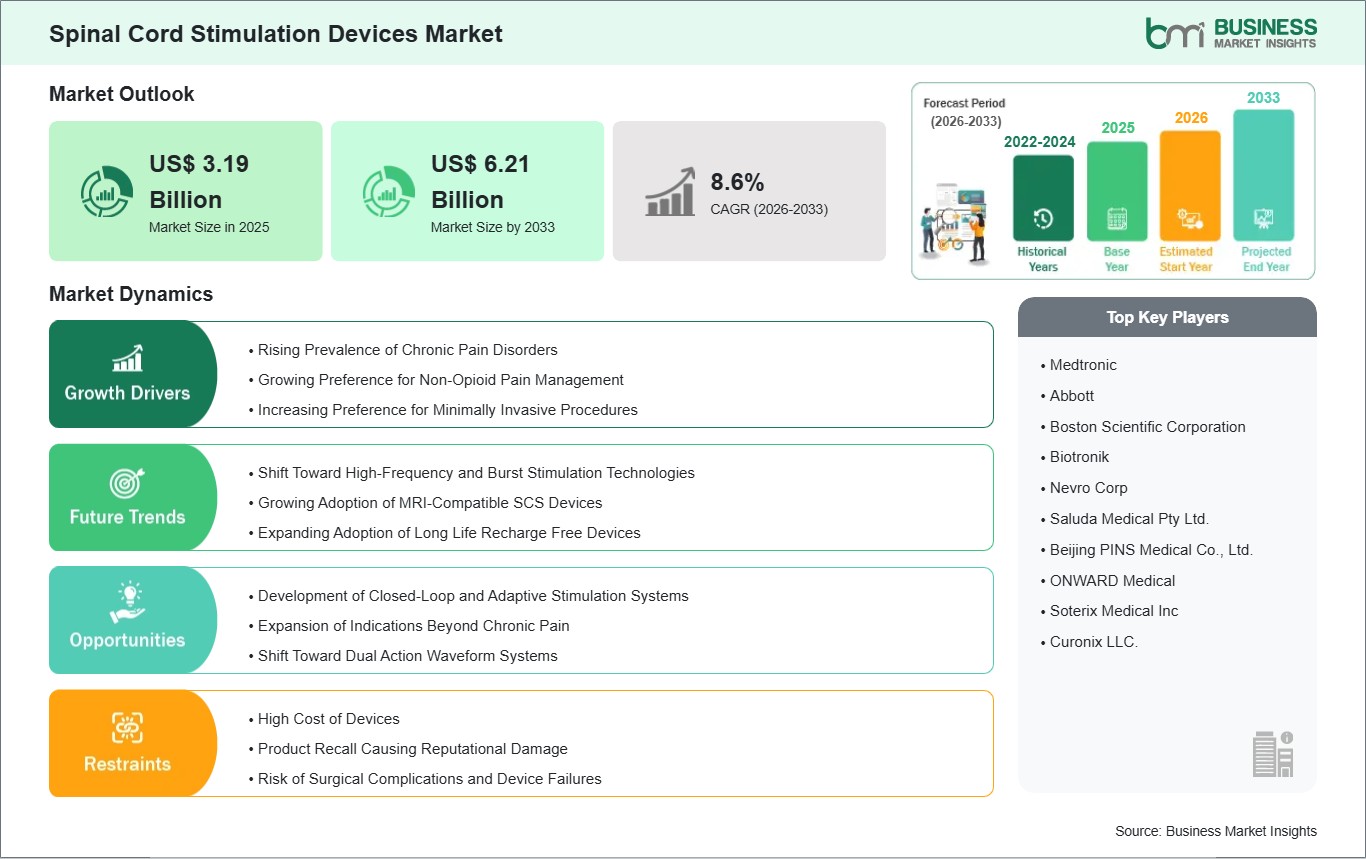
The demand for spinal cord stimulation (SCS) devices is being shaped by a broader shift toward minimally invasive pain management approaches, particularly in response to increasing concerns over long-term opioid dependency and its associated side effects. The high prevalence of complex spine disorders, failed back surgery syndrome, and neuropathic pain conditions continues to drive the need for SCS therapies. Technological advancements are expected to play a key role in market expansion, as ongoing innovations are enabling more sophisticated yet effective devices with improved stimulation precision, enhanced programmability, rechargeable systems, and greater patient comfort. As a result, physicians are increasingly recommending neuromodulation earlier in the treatment pathway, rather than reserving it as a last-line option. However, several challenges still limit broader adoption, including the requirement for surgical implantation, potential side effects, and variability in patient response. Additionally, the high cost of both the procedure and the device restricts accessibility in cost-sensitive healthcare systems. Despite these constraints, the long-term outlook for the field remains highly promising.
Segment Analysis
Spinal Cord Stimulation Devices Market Segmentation
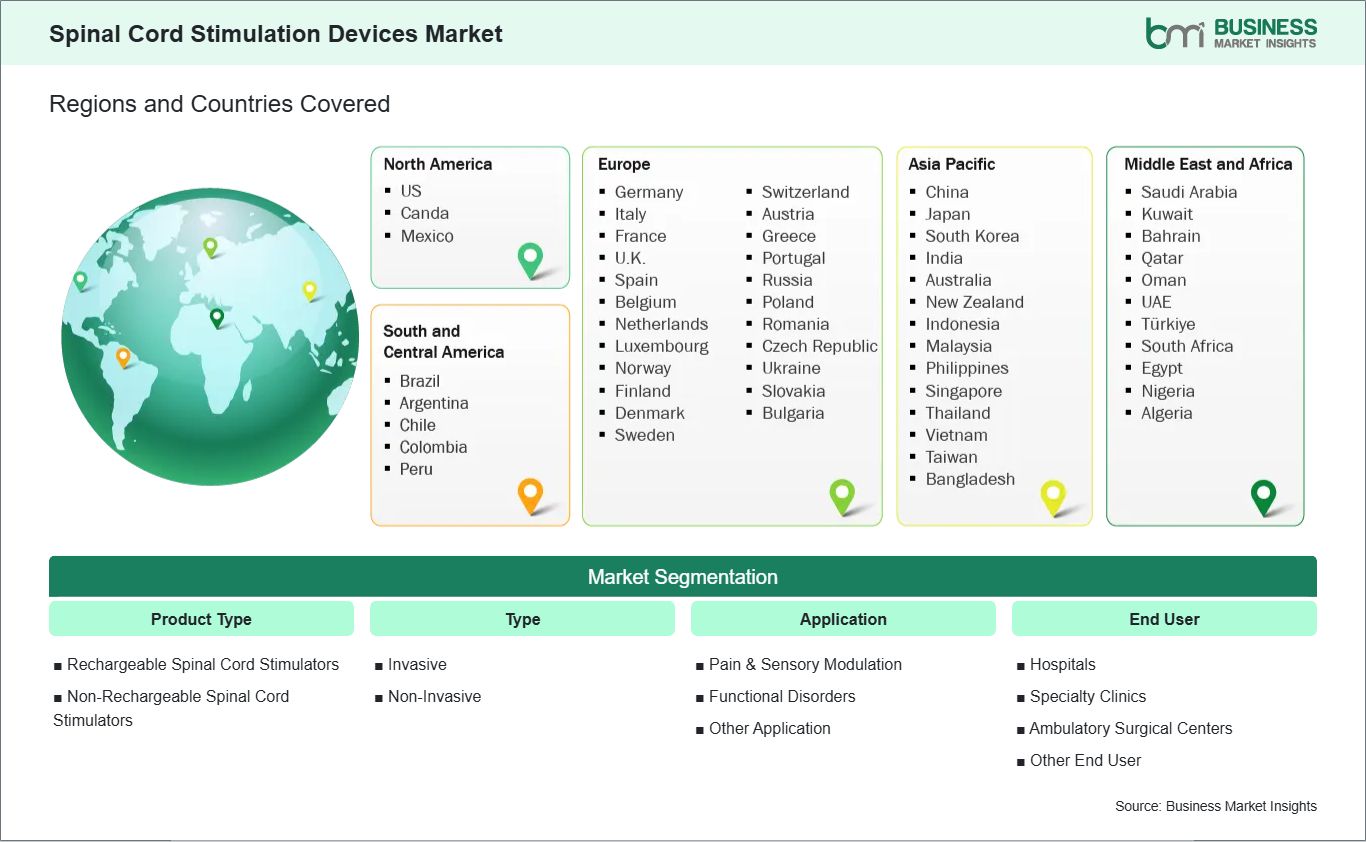
Key segments that contributed to the derivation of the spinal cord stimulation devices market analysis are product type, type, application, and end user.
- By product type, the spinal cord stimulation devices market is segmented into rechargeable spinal cord stimulators and non-rechargeable spinal cord stimulators. The rechargeable spinal cord stimulators segment dominated the market in 2025.
- Based on type, the spinal cord stimulation devices market is segmented into invasive and non-invasive. The invasive segment dominated the market in 2025.
- On the basis of application, the spinal cord stimulation devices market is classified into pain and sensory modulation, functional disorders, and other application. The pain and sensory modulation segment dominated the market in 2025.
- In terms of end user, the spinal cord stimulation devices market is categorized into hospitals, specialty clinics, ambulatory surgical centers, and other end user. The hospitals segment dominated the market in 2025.
Market Forces
Spinal Cord Stimulation Devices Market Drivers and Opportunities
Rising Prevalence of Chronic Pain Disorders
The global spinal cord stimulators market is fueled by growing incidences of chronic pain syndromes such as neuropathic pain, failed back syndrome, and spinal degeneration problems. Chronic pain is one of the significant causes of disability, primarily affecting aging patients or patients suffering from several spinal procedures. Developed healthcare markets have noted an increase in patients who need neuromodulation treatments after failing to get relief from pharmacological drugs.
In South Asia and the Middle East, urbanization trends and sedentary living behaviors have been the major factors contributing to spinal and neural complications. Growing instances of desk jobs and manual labor have led to increased cases of lower back pain and radiculopathies. There is high demand for minimally invasive approaches such as spinal cord stimulation, especially in urban health facilities.
Chronic pain remains underdiagnosed in many parts of Latin America and Africa, although awareness is gradually increasing due to improvements in healthcare infrastructure and diagnostic capabilities. Neuromodulation is becoming more commonly available in public hospitals and specialized clinics for patients suffering from persistent and treatment-resistant pain conditions. While access to these therapies still varies significantly by region, growing healthcare investments are steadily improving their availability and integration into pain management programs.
Development of Closed-Loop and Adaptive Stimulation Systems
A transformation in the global spinal cord stimulation devices market has emerged due to the development of closed-loop and adaptive stimulation systems, which enable real-time adjustment of therapy dosage based on neural feedback. These adaptive systems enhance treatment precision by automatically modifying stimulation strength in response to individual spinal cord activity. Such advanced technologies are increasingly being adopted in highly developed medical institutions.
In technologically advanced hospitals, clinicians are integrating spinal cord stimulation therapy with remote monitoring of treatment outcomes. This approach is expected to improve results for patients with complex chronic pain conditions, while the introduction of artificial intelligence solutions further supports the advancement of personalized treatment strategies.
In developing regions of the global healthcare market, the adoption of adaptive spinal cord stimulation is gradually increasing, primarily within specialized private clinics. Growing collaboration between neuromodulation device manufacturers and healthcare providers is also accelerating the development and availability of more affordable AI-enabled implant technologies.
Size and Share Analysis
Spinal Cord Stimulation Devices Market Size and Share Analysis
The spinal cord stimulation devices market is experiencing steady growth, with market size and share analysis reflecting evolving treatment preferences and competitive dynamics among key players. The report evaluates important subsegments categorized within product type, type, application, and end user, highlighting their respective contributions to overall market performance.
By product type, the rechargeable spinal cord Stimulators subsegment dominated the market in 2025, because long-term chronic pain treatment requires devices that can operate continuously for several years without frequent replacement. Patients increasingly preferred rechargeable systems as they reduce the likelihood of repeat surgeries and lower overall treatment interruption.
Based on type, the invasive subsegment dominated the market in 2025 because implanted spinal cord stimulators deliver more stable and accurate nerve stimulation compared to external therapies. These systems are widely used for severe chronic pain conditions where medication and physiotherapy provide limited relief.
On the basis of application, the pain and sensory modulation subsegment dominated the market in 2025, because spinal cord stimulation is primarily designed to manage chronic neuropathic and musculoskeletal pain. The growing number of patients suffering from lower back pain, diabetic nerve pain, and post-surgical pain significantly increased demand for neuromodulation therapies.
In terms of end user, the hospitals subsegment dominated the market in 2025 because most spinal cord stimulator procedures require specialized surgical facilities, imaging equipment, and multidisciplinary pain management teams. Patients generally prefer hospitals for implantation procedures due to better emergency support and post-operative monitoring capabilities.
Report Coverage
Spinal Cord Stimulation Devices Market Report Coverage and Deliverables
The "Spinal Cord Stimulation Devices Market Size and Forecast (2022-2033)" report provides a detailed analysis of the market covering below areas:
- Market size and forecast at the regional and country levels for segments covered under the scope
- Market trends, as well as drivers, restraints, and opportunities
- Market analysis covering key trends, regional framework, major players, regulations, and recent developments
- Market concentration, heat map analysis, prominent players, and recent developments for the Market
- Detailed company profiles, including SWOT analysis
Geographic Insights
Spinal Cord Stimulation Devices Market Geographic Insights
The geographical scope of the spinal cord stimulation devices market report is divided into: North America, Asia Pacific, Europe, Middle East and Africa, and South and Central America. North America held the largest share in 2025.
North America currently leads the spinal cord stimulation (SCS) devices market in terms of market share, driven by the presence of a well-established pain management framework and the widespread adoption of advanced neuromodulation solutions. The region benefits from a large network of specialized pain clinics, neurosurgeons, and rehabilitation centers that routinely use SCS to treat chronic neuropathic pain, failed back surgery syndrome, and other spine-related conditions, ensuring steady technology uptake. Another key driver is the growing shift toward non-opioid pain management strategies, as increasing concerns over the side effects and dependency risks associated with opioid drugs are encouraging greater reliance on neuromodulation therapies, thereby boosting adoption rates. North America also benefits from early access to technologically advanced solutions and rapid clinical adoption, with next-generation SCS devices featuring adaptive stimulation and enhanced programmability gaining significant traction in recent years. However, the region also faces challenges such as high treatment costs and variability in insurance coverage for implantable neuromodulation devices. Despite these limitations, strong reimbursement frameworks in major markets, continuous innovation, and high patient and physician awareness are expected to sustain North America's position as a leading hub for SCS device development and adoption in the coming years.
Industry Activity
Recent Developments
The spinal cord stimulation devices market is evaluated by gathering qualitative and quantitative data post primary and secondary research, which includes important corporate publications, association data, and databases. A few of the key developments in the Spinal Cord Stimulation Devices Market are:
- In November 2024, Nevro Corp's HFX iQ spinal cord stimulation platform received CE Mark certification in Europe, enabling the company to commercially expand its AI-enabled SCS system across European regions, including its adoption in hospitals treating patients with chronic back and leg pain through personalized, adaptive neuromodulation therapy.
- In September 2023, ONWARD Medical completed the first-in-human implantation of its ARC-IM spinal cord stimulation system, integrated with advanced neurotechnology designed to restore movement function in individuals with spinal cord injury. This milestone represents a significant step forward in the development and clinical validation of neurostimulation-based rehabilitation therapies, supporting their potential expansion across Europe and other global research sites.
Trust & Transparency
Research Methodology
The market analysis combines proprietary research with secondary data from government agencies, company disclosures, regulatory filings, industry databases and expert interviews. Market estimates are validated through data triangulation, cross-market benchmarking and analyst
review.
View Full Research Methodology
Key Sources Referred:
The World Bank World Health Organization (WHO) Center for Disease Control and Prevention (CDC) Food and Drug Administration (FDA) Centers for Medicare and Medicaid Services (CMS) European Commission Medicines and Healthcare products Regulatory Agency (MHRA) Company Websites Company Annual Reports Company Investor Presentation