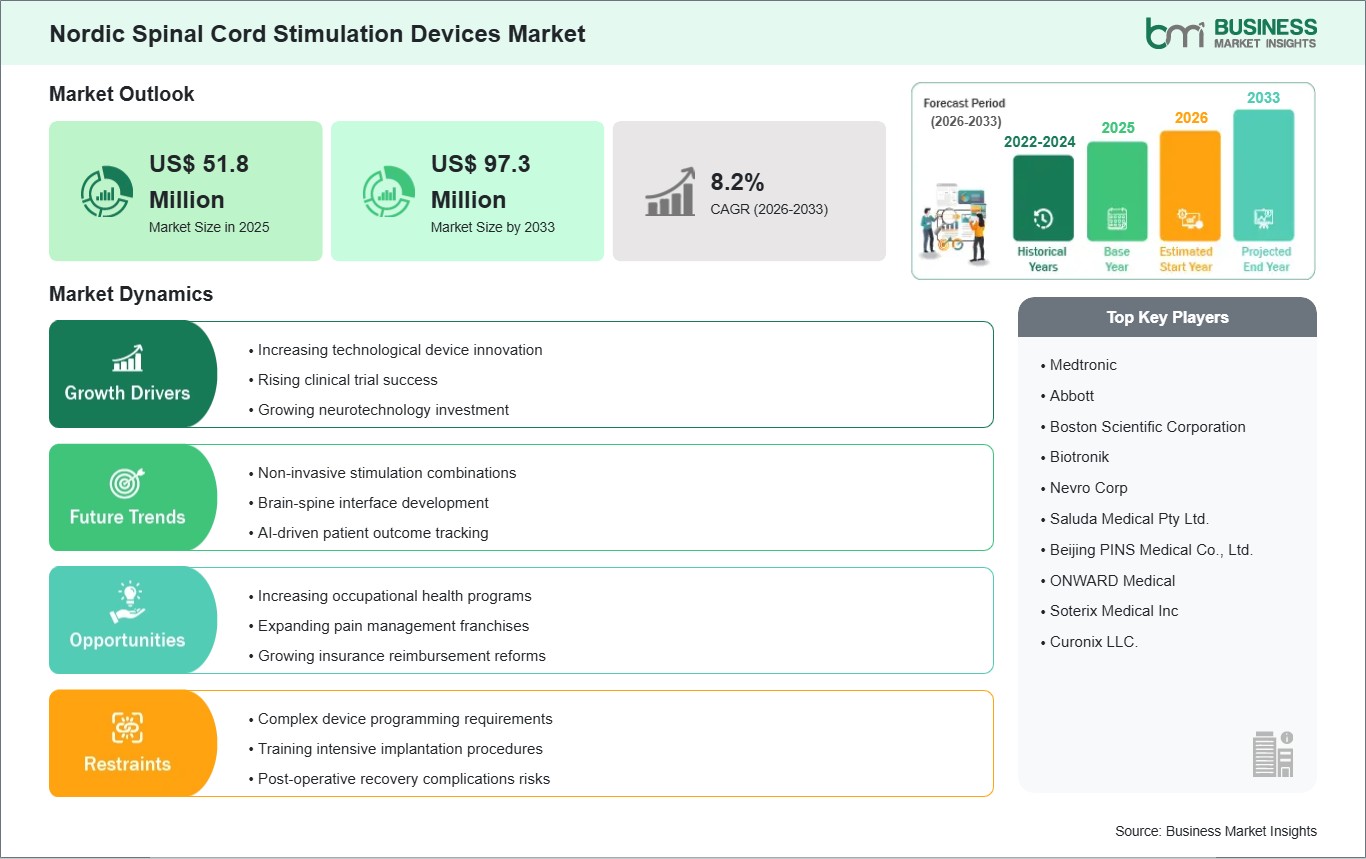
The Nordic Spinal cord stimulation devices market size is expected to reach US$ 97.3 million by 2033 from US$ 51.8 million in 2025. The market is estimated to record a CAGR of 8.2% from 2026 to 2033.
Nordic spinal cord stimulation devices market has a distinctive healthcare framework that includes highly organized healthcare settings, high focus on evidence-based treatment methods, and rapid adoption of advanced neuromodulation techniques used in chronic pain treatment. It has been observed that there is a comparatively high prevalence of chronic musculoskeletal disorders and neuropathic pains among the Nordic population that has aged with the degeneration of its spine. Providers in Nordic regions are giving increasing preference to spinal cord stimulators for chronic pain management purposes instead of pharmacological treatments in cases where traditional methods have failed due to frequent surgeries.
A significant factor contributing to the expansion of the Nordic spinal cord stimulation devices market is the high degree of integration between healthcare institutions' public system and neurological centers for structured neuromodulation referral pathways. There has been an increased use of innovative spinal cord stimulation solutions, including rechargeable implants and patients' programming systems. The presence of well-established physician training mechanisms and participation in scientific research contributes to the early adoption of cutting-edge stimulation technology.
Nevertheless, some limitations can be observed. Firstly, there are strict regulations and procedures for evaluating the efficacy of innovations in public healthcare institutions, thus preventing quick adaptation of new solutions. Secondly, a high cost of procedure and narrow patient inclusion criteria are some of the limiting factors. Nonetheless, the high demand for long-term pain relief solutions and a focus on improving patients' quality of life foster steady growth of the market in the Nordic countries.

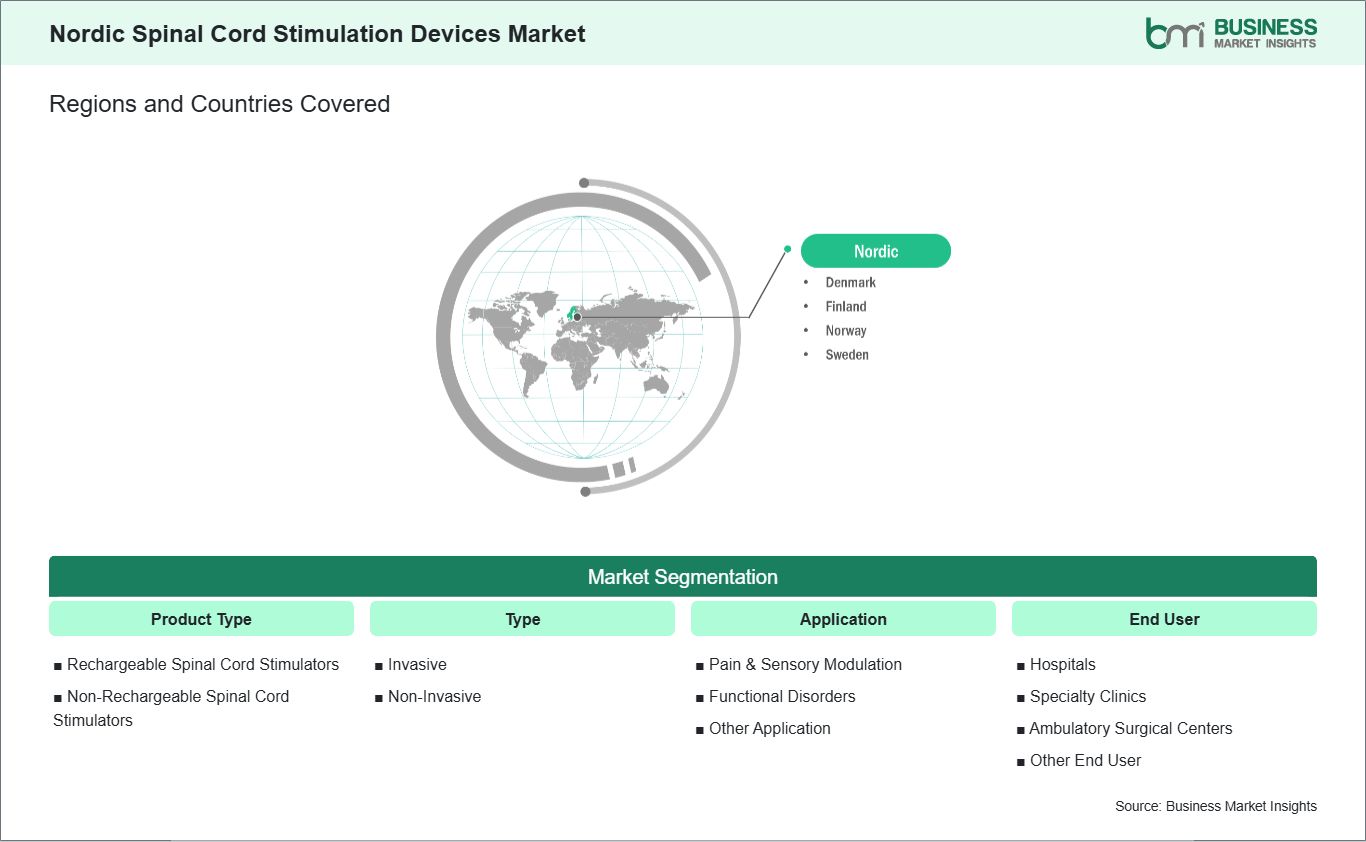
Key segments that contributed to the derivation of the Nordic spinal cord stimulation devices market analysis are product type, type, application, and end user.
In addition, the Nordic SCS devices market in Sweden, Norway, Denmark, Finland, and Iceland is significantly driven by technological development, where the high clinical efficiency and long-term cost-effectiveness of products have the highest priority. Hospitals in such cities as Stockholm, Oslo, Copenhagen, and Helsinki are quick in adopting innovative neuromodulation platforms, namely closed-loop and adaptive stimulators, which automatically adjust their performance according to patient's response. The latter aspect perfectly fits into the Nordic healthcare model as its focus on precision medicine implies taking into account patients' specific needs.
There is another trend, which can be identified when discussing this regional market - the growing use of MRI-compatible and rechargeable spinal cord stimulators. For patients in Nordic countries who are frequently examined through imaging due to musculoskeletal and neurological disorders, MRI-safety has become one of the most important considerations. In addition, clinicians tend to opt for devices that feature longer lifecycle performance so that they do not need to conduct several surgeries to replace worn out batteries of implants. It should be noted that Sweden has been an early adopter of innovative neuromodulation technologies in Europe; the country uses structured pain registries that facilitate the monitoring of long-term results.
Faster adoption rates of innovations become more likely thanks to digital integration. The Scandinavian healthcare system utilizes digitization significantly; it allows for the complete integration of SCS devices with the patients' EHRs. Physicians are increasingly resorting to telemedicine in order to conduct follow-ups involving adjustment of neuromodulation in northern Finland and Norway. This allows for lowering healthcare expenses while preserving the accuracy of therapy. Due to the continuous development of intelligent devices, the Nordics are expected to be one of the pioneers for future innovations.
There is also the aspect of robust occupational health setups in places such as construction, manufacturing, transportation, and the energy sector, where there is greater exposure to musculoskeletal problems and spinal injury. Nations such as Norway and Finland, which have larger workforces in industry and at sea, take considerable care to address issues regarding chronic spinal conditions. Employers are working more with occupational health providers to minimize the occurrence of long-term disability cases, leading to the creation of a structured process for referring patients to pain management treatment methods, such as neuromodulation.
Workplace safety guidelines in all the Nordics are extremely strict compared to many other regions around the world, prioritizing preventative rather than corrective care measures. Employer organizations are mandated to ensure that the staff members undergo comprehensive programs aimed at sustaining their well-being and include ergonomic assessments, physiotherapy, and treatment pathways for managing chronic pain. In situations when non-invasive methods fail, employees may be referred to pain specialists who offer spinal cord stimulation therapy as an alternative option to either prolonged use of opioids or frequent surgeries involving the spinal cord.
Moreover, the increasing concern for maintaining high workforce efficiency in aged employees plays an essential role in promoting spinal cord stimulation technologies in the Nordics. With retirement age slowly increasing across various countries in the Nordic region, there has been a heightened importance of sustaining mobility and functional abilities of the senior population at the workplace. Insurance companies specializing in occupational health as well as public healthcare organizations are actively supporting modern approaches in managing chronic pains to reduce absenteeism and economic loss associated with such problems. Programs combining rehabilitation with neuromodulation procedures are gaining popularity especially among cases of chronic lower back pain related to physical overstrain.

The Nordic spinal cord stimulation devices market is experiencing steady growth, with market size and share analysis reflecting evolving treatment preferences and competitive dynamics among key players. The report evaluates important subsegments categorized within product type, type, application, and end user, highlighting their respective contributions to overall market performance.
By product type, the rechargeable spinal cord Stimulators subsegment dominated the market in 2025, because long-term chronic pain treatment requires devices that can operate continuously for several years without frequent replacement. Patients increasingly preferred rechargeable systems as they reduce the likelihood of repeat surgeries and lower overall treatment interruption.
Based on type, the invasive subsegment dominated the market in 2025 because implanted spinal cord stimulators deliver more stable and accurate nerve stimulation compared to external therapies. These systems are widely used for severe chronic pain conditions where medication and physiotherapy provide limited relief.
On the basis of application, the pain and sensory modulation subsegment dominated the market in 2025, because spinal cord stimulation is primarily designed to manage chronic neuropathic and musculoskeletal pain. The growing number of patients suffering from lower back pain, diabetic nerve pain, and post-surgical pain significantly increased demand for neuromodulation therapies.
In terms of end user, the hospitals subsegment dominated the market in 2025 because most spinal cord stimulator procedures require specialized surgical facilities, imaging equipment, and multidisciplinary pain management teams. Patients generally prefer hospitals for implantation procedures due to better emergency support and post-operative monitoring capabilities.
| Report Attribute | Details |
|---|---|
| Market size in 2025 | US$ 51.8 Million |
| Market Size by 2033 | US$ 97.3 Million |
| CAGR (2026 - 2033) | 8.2% |
| Historical Data | 2022-2024 |
| Forecast period | 2026-2033 |
| Segments Covered | By Product Type
|
|
Regions and Countries Covered
| |
| Nordic | Sweden, Denmark, Norway, Finland |
| Market leaders and key company profiles |
|
The "Nordic Spinal Cord Stimulation Devices Market Size and Forecast (2022-2033)" report provides a detailed analysis of the market covering below areas:
The geographical scope of the Nordic Spinal cord stimulation devices market report is divided into: Sweden, Norway, Denmark, and Finland. Sweden held the largest share in 2025.
A key reason why Sweden leads in the adoption of neurostimulators in the Nordic region is attributed to the excellent health care system infrastructure in the country coupled with its high emphasis on neurological research and organized management of chronic pain syndromes. Sweden is known to have set up specialized clinics within leading universities where spinal cord stimulation has been adopted in the management of neuropathic pain, failed back surgeries syndrome, and spinal ailments. There is a high level of embracement of technological pain management in Sweden by health practitioners. Another key contributor to the success of Sweden as a global leader is the significant cooperation between research-oriented academic hospitals and clinical experts. The country provides an ideal ecosystem for implementing sophisticated systems of spinal cord stimulation, such as high-frequency stimulation and closed-loop feedback systems. Doctors in Sweden have a substantial participation in clinical studies and neuromodulation investigations, thus facilitating earlier introduction and adoption of new innovations into regular medical practices. Moreover, there are organized referral programs aimed at identifying candidates eligible for neuromodulation services. Sweden also has a highly digitized health care industry, which facilitates better patient monitoring and follow-up after the implantation procedures, especially through remote programming. In general, these developments contribute to improved outcomes and higher satisfaction rates among patients using spinal cord stimulators. Nevertheless, Sweden's adoption process is slowed down by strict assessments for medical reimbursement purposes and the cautious use of innovations in the public sector. Nonetheless, the country remains a leader within the Nordic countries due to clinical expertise, developed infrastructure of hospitals, and increased interest in non-opioid pain management solutions.

The Nordic spinal cord stimulation devices market is evaluated by gathering qualitative and quantitative data post primary and secondary research, which includes important corporate publications, association data, and databases. A few of the key developments in the Nordic spinal cord stimulation devices market are:
The Nordic Spinal Cord Stimulation Devices Market is valued at US$ 51.8 Million in 2025, it is projected to reach US$ 97.3 Million by 2033.
As per our report Nordic Spinal Cord Stimulation Devices Market, the market size is valued at US$ 51.8 Million in 2025, projecting it to reach US$ 97.3 Million by 2033. This translates to a CAGR of approximately 8.2% during the forecast period.
The Nordic Spinal Cord Stimulation Devices Market report typically cover these key segments-
The historic period, base year, and forecast period can vary slightly depending on the specific market research report. However, for the Nordic Spinal Cord Stimulation Devices Market report:
The Nordic Spinal Cord Stimulation Devices Market is populated by several key players, each contributing to its growth and innovation. Some of the major players include:
The Nordic Spinal Cord Stimulation Devices Market report is valuable for diverse stakeholders, including:
Essentially, anyone involved in or considering involvement in the Nordic Spinal Cord Stimulation Devices Market value chain can benefit from the information contained in a comprehensive market report.
Please tell us your area of interest
(Market Segments/ Regions and Countries/ Companies)