Market Summary
Executive Summary and Market Analysis
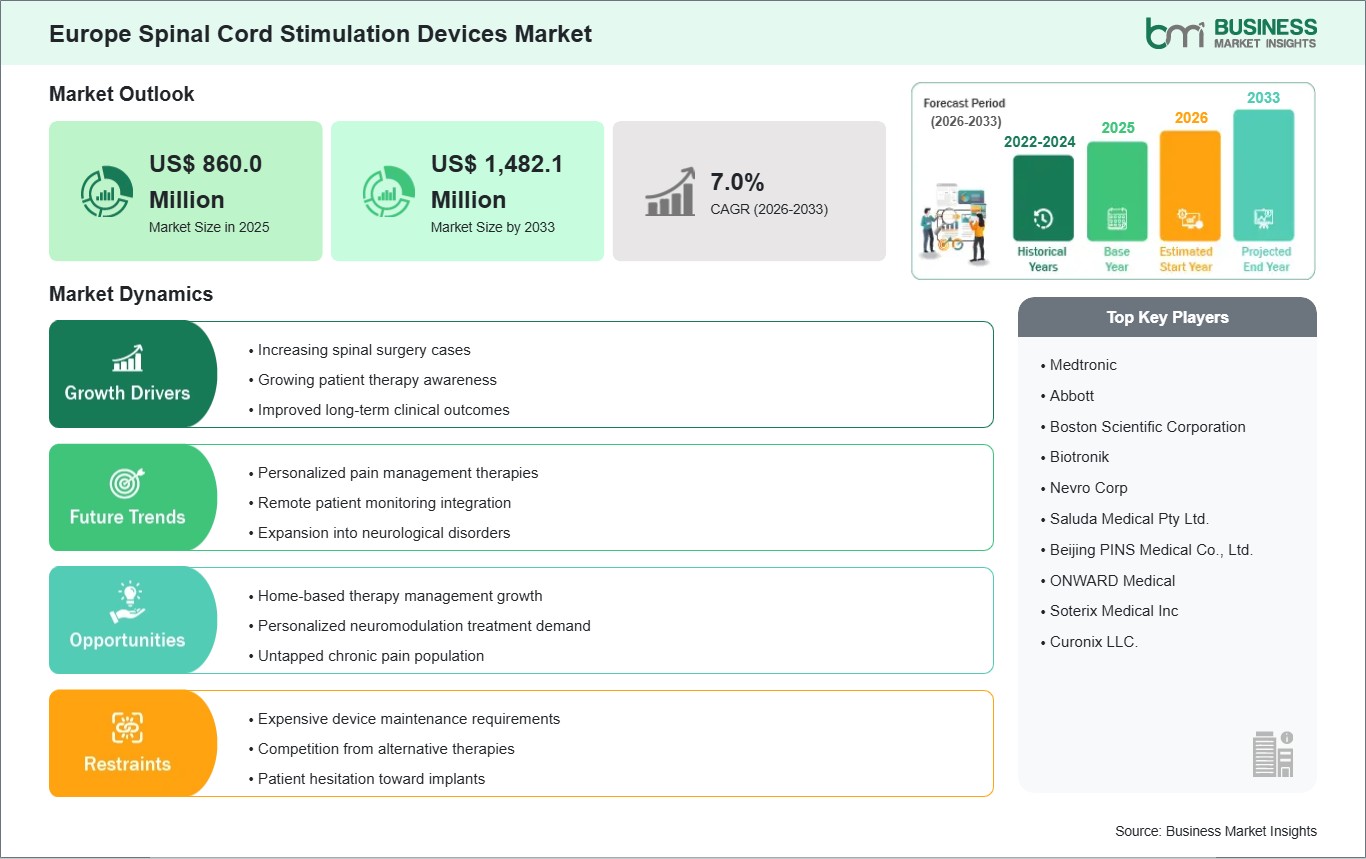
Europe's spinal cord stimulation (SCS) device market represents an established and clinically validated component of neuromodulation therapy with a strong healthcare system infrastructure, a well-developed pain management paradigm, and an expert medical community familiar with intervention techniques. Spinal cord stimulation becomes a popular component in the overall pain management strategy and a tool in treating such pathologies as failed back surgery syndrome, neuropathic pain conditions, and degenerative spine disease. Moreover, there is a tendency towards decreasing the use of pharmacotherapy in managing chronic pain in Europe due to its side effects, thus contributing to neuromodulation market development. One of the main growth factors in this market is the presence of publicly financed healthcare systems that facilitate access to innovative technologies for medical applications in case of medical indications. Spinal cord stimulation therefore becomes a component of specialized programs for treating pain syndromes. In addition, a strict regulatory environment and established clinical protocols make the use of neuromodulation devices standardized in hospitals and teaching institutions. Moreover, innovations in the industry improve spinal cord stimulation efficiency and clinical application perspectives. Nonetheless, the market remains limited by rigorous reimbursement considerations and cost-benefit analyses that might hinder the implementation of newer technologies. Moreover, adoption may be affected by conservative treatment approaches in certain medical systems, whereby invasive techniques are only adopted after exhausting previous lines of treatment. Nonetheless, the European region maintains its growth prospects due to an aging population, rising incidences of spinal disorders, and sustained integration of neuromodulation within pain management programs.
Segment Analysis
Europe Spinal Cord Stimulation Devices Market Segmentation
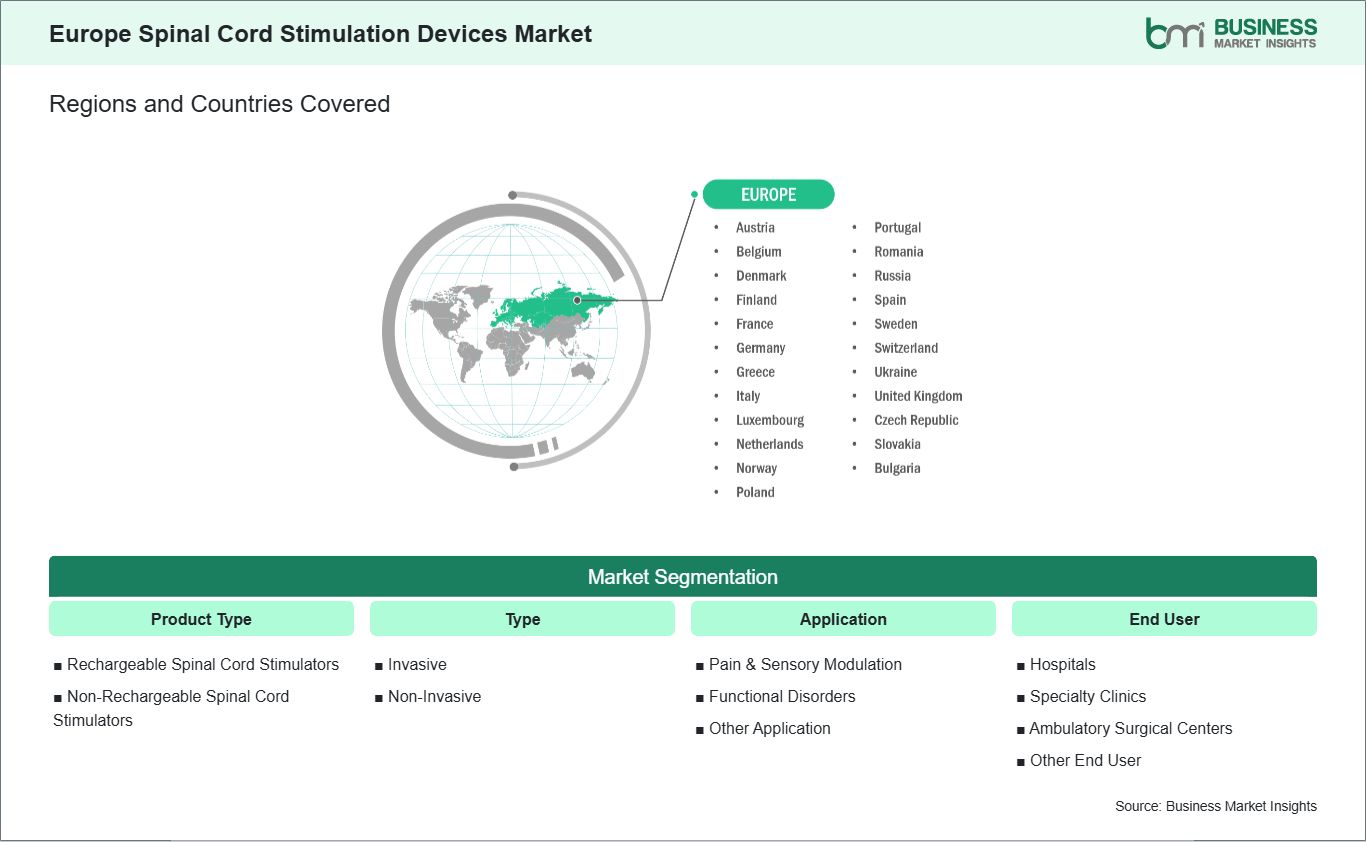
Key segments that contributed to the derivation of the Europe spinal cord stimulation devices market analysis are product type, type, application, and end user.
- By product type, the spinal cord stimulation devices market is segmented into rechargeable spinal cord stimulators and non-rechargeable spinal cord stimulators. The rechargeable spinal cord stimulators segment dominated the market in 2025.
- Based on type, the spinal cord stimulation devices market is segmented into invasive and non-invasive. The invasive segment dominated the market in 2025.
- On the basis of application, the spinal cord stimulation devices market is classified into pain and sensory modulation, functional disorders, and other application. The pain and sensory modulation segment dominated the market in 2025.
- In terms of end user, the spinal cord stimulation devices market is categorized into hospitals, specialty clinics, ambulatory surgical centers, and other end user. The hospitals segment dominated the market in 2025.
Market Forces
Europe Spinal Cord Stimulation Devices Market Drivers and Opportunities
Increasing Spinal Surgery Cases
There has been growth in the Europe SCS devices market owing to an increase in spinal surgery cases resulting in an increase in postoperative chronic pain cases. Patients who undergo spine operations including lumbar decompression, fusion, and disc replacement operations develop various cases of pain conditions, particularly failed back surgery syndrome, and this creates a market demand for the use of neuromodulation devices. Approximately one in three people living in Europe suffers from chronic pain; most of them suffer from pain due to spinal problems.
In most leading health systems in Europe, hospital surgeons are treating an increasing number of cases requiring spinal intervention. The majority of these patients have undergone spine surgery and are suffering from recurrent pain because of surgical procedures done. Therefore, spinal cord stimulation has become very common among surgeons where surgery has proved not to be successful in treating pain.
Moreover, advancements in the realm of surgery, as well as the availability of advanced orthopedic services, have helped increase the patient pool that is suitable for SCS therapy. As per European clinical guidelines, neuromodulation for treating chronic spinal pain is increasingly being advocated at an early stage. Minimally invasive procedures for SCS implantation are contributing further to the uptake of the technique in both public and private healthcare institutions.
Home-Based Therapy Management Growth
In addition, the Europe spinal cord stimulators market is expected to witness growth on account of the increasing trend towards managing therapies at home with digitized neuromodulation systems. Advanced SCS systems today have capabilities that enable doctors to make changes to the parameters of therapy remotely, thus eliminating the need for patients to visit hospitals repeatedly.
Many countries across Europe have been able to integrate technology in their health care sector. The use of smartphones and cloud-based software applications to monitor the status of the devices and report results remotely has helped increase compliance among patients.
Additionally, increased focus on outpatient services and efficiency in treatment procedures is driving the adoption of neuromodulation devices that can be managed at home. Given the current scenario where close to 20% of Europes population suffers from chronic pain that persists for more than three months, the healthcare industry is looking for scalable solutions that can be administered easily at home to address the demand effectively.
Size and Share Analysis
Europe Spinal Cord Stimulation Devices Market Size and Share Analysis
The Europe spinal cord stimulation devices market is experiencing steady growth, with market size and share analysis reflecting evolving treatment preferences and competitive dynamics among key players. The report evaluates important subsegments categorized within product type, type, application, and end user, highlighting their respective contributions to overall market performance.
By product type, the rechargeable spinal cord Stimulators subsegment dominated the market in 2025, because long-term chronic pain treatment requires devices that can operate continuously for several years without frequent replacement. Patients increasingly preferred rechargeable systems as they reduce the likelihood of repeat surgeries and lower overall treatment interruption.
Based on type, the invasive subsegment dominated the market in 2025 because implanted spinal cord stimulators deliver more stable and accurate nerve stimulation compared to external therapies. These systems are widely used for severe chronic pain conditions where medication and physiotherapy provide limited relief.
On the basis of application, the pain and sensory modulation subsegment dominated the market in 2025, because spinal cord stimulation is primarily designed to manage chronic neuropathic and musculoskeletal pain. The growing number of patients suffering from lower back pain, diabetic nerve pain, and post-surgical pain significantly increased demand for neuromodulation therapies.
In terms of end user, the hospitals subsegment dominated the market in 2025 because most spinal cord stimulator procedures require specialized surgical facilities, imaging equipment, and multidisciplinary pain management teams. Patients generally prefer hospitals for implantation procedures due to better emergency support and post-operative monitoring capabilities.
Report Coverage
Europe Spinal Cord Stimulation Devices Market Report Coverage and Deliverables
The "Europe Spinal Cord Stimulation Devices Market Size and Forecast (2022-2033)" report provides a detailed analysis of the market covering below areas:
- Market size and forecast at regional and country levels for all market segments covered under the scope
- Market trends, as well as drivers, restraints, and opportunities
- Market analysis covering key trends, regional framework, major players, regulations, and recent developments
- Market concentration, heat map analysis, prominent players, and recent developments for the Market
- Detailed company profiles, including SWOT analysis
Geographic Insights
Europe Spinal Cord Stimulation Devices Market Geographic Insights
The geographical scope of the Europe spinal cord stimulation devices marketreport is divided into: Germany, Italy, France, the UK, Spain, Belgium, the Netherlands, Luxembourg, Norway, Finland, Denmark, Sweden, Austria, Switzerland, Russia, Romania, Greece, the Czech Republic, Portugal, Ukraine, Poland, Slovakia, and Bulgaria. Germany held the largest share in 2025.
Germany is the leading country in the European market for spinal cord stimulators owing to the sophisticated structure of the health care industry, presence of advanced neurosurgical expertise, and readiness to adopt cutting-edge technologies in medicine. Germany has quite well-developed pain clinics and university hospitals where spinal cord stimulation is commonly prescribed for patients who suffer from chronic and untreatable forms of pain. In this context, German medical specialists tend to apply new evidence-based neuromodulation techniques to treatment of such painful conditions as failed back surgery syndrome and complex neuropathic pain, thus becoming leaders in Europe in terms of clinical practice. One of the advantages of the German market of spinal cord stimulators can be explained by the inclusion of spinal cord stimulation in standard procedures performed in the framework of public and private health care sectors. It should be emphasized that physicians tend to use diagnostic and therapeutic algorithms according to which spinal cord stimulation can be effectively applied to patients. In addition, reimbursement issues are quite clear in the German health care system since the cost reimbursement for neuromodulation procedures that are clinically indicated is well-organized when compared to other European nations. This leads to wider access among patients who have been clinically indicated. Nonetheless, adoption is subject to stringent clinical assessment criteria, which means new device versions cannot be adopted before sufficient evidence is provided. In spite of this approach, Germany acts as the epicenter of spinal cord stimulation adoption in Europe because of its superior clinical experience and commitment to finding advanced solutions for pain management problems.
Industry Activity
Recent Developments
The Europe Spinal cord stimulation devices marketis evaluated by gathering qualitative and quantitative data post primary and secondary research, which includes important corporate publications, association data, and databases. A few of the key developments in the Europe Spinal cord stimulation devices marketare:
- In February 2024, Boston Scientific announced the European launch of expanded spinal cord stimulation capabilities under its WaveWriter Alpha portfolio, strengthening its presence in Europe with MRI-conditional, multi-waveform SCS systems designed to improve pain coverage and patient-specific therapy programming for chronic pain management.
- In December 2023, Medtronic announced that it received CE Mark approval for its Percept RC rechargeable neurostimulator with BrainSense technology, expanding its neuromodulation portfolio in Europe and enabling patients with chronic pain and neurological disorders to benefit from sensing-enabled stimulation therapy.
Trust & Transparency
Research Methodology
The market analysis combines proprietary research with secondary data from government agencies, company disclosures, regulatory filings, industry databases and expert interviews. Market estimates are validated through data triangulation, cross-market benchmarking and analyst
review.
View Full Research Methodology
Key Sources Referred:
The World BankWorld Health Organization (WHO)Center for Disease Control and Prevention (CDC)Food and Drug Administration (FDA)Centers for Medicare and Medicaid Services (CMS)European CommissionMedicines and Healthcare products Regulatory Agency (MHRA)Company WebsitesCompany Annual ReportsCompany Investor Presentation