Market Summary
Executive Summary and Market Analysis
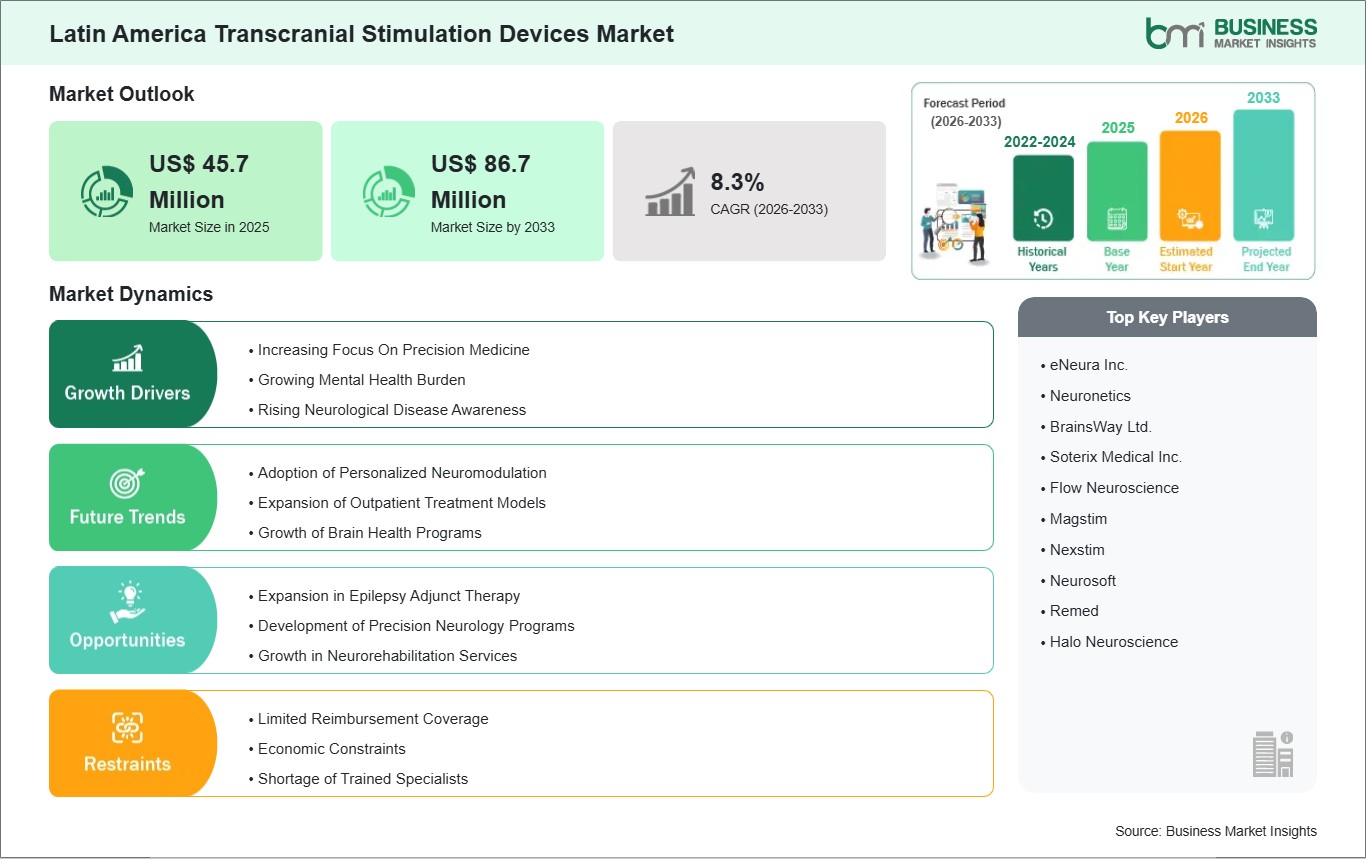
The landscape of devices used for transcranial stimulation throughout Latin America has been affected by the increasing popularity of non-invasive neuromodulation methods, such as transcranial magnetic stimulation and transcranial direct current stimulation, in medical practice. An increase in the number of patients suffering from diseases of the nervous system and, in particular, strokes and depression, as well as the need to address resistant forms of these conditions, stimulates clinicians to apply new technologies of device-based neurostimulation. In addition, there is an increased interest in non-drug therapy options for the post-stroke period. Nevertheless, divergent regulatory approval mechanisms in different countries and inconsistent insurance coverage, along with the lack of neurotechnology specialists, are still holding back its broader implementation. Another challenge is changing hospital purchasing practices with the rise of more and more neuropsychiatry clinics implementing pilot projects, fueled by the growing partnership between neurotechnological device companies and scientists working on optimizing protocols for stimulating individual patients. Geographical disparities in terms of health-care infrastructure have an effect on adoption, with urban centers being quicker at deploying neurotechnology outside the hospital and smaller hospitals being left with inadequate technology and clinical experience, highlighting the need for education programs and protocols for effective treatment.
Segment Analysis
Latin America Transcranial Stimulation Devices Market Segmentation
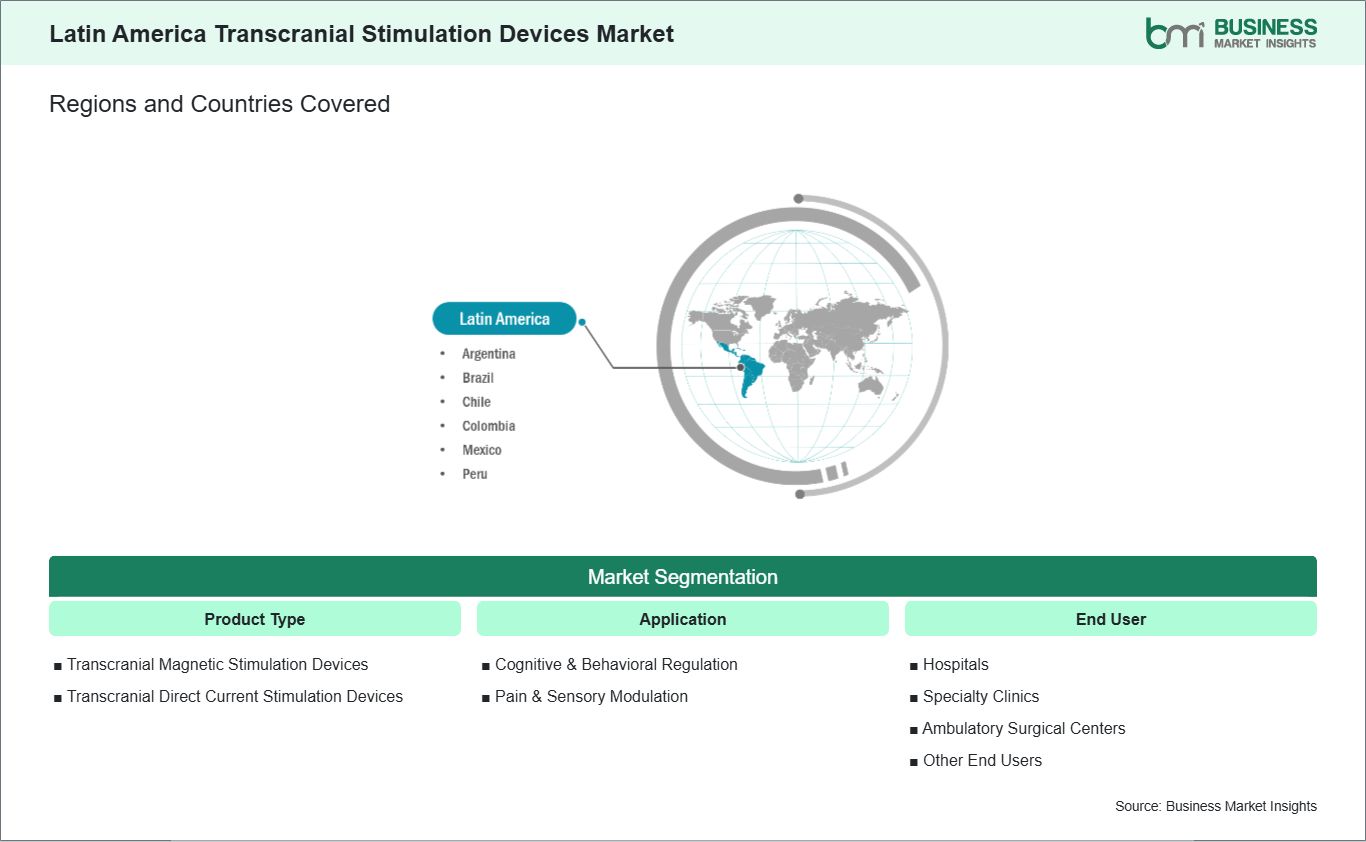
Key segments that contributed to the derivation of the Latin America transcranial stimulation devices market analysis are product type, application, and end user.
- By product type, the transcranial stimulation devices market is segmented into transcranial magnetic stimulation devices and transcranial direct current stimulation devices. The transcranial magnetic stimulation devices segment dominated the market in 2025.
- Based on application, the transcranial stimulation devices market is categorized into cognitive & behavioral regulation and pain & sensory modulation. The cognitive & behavioral regulation segment dominated the market in 2025.
- In terms of end user, the transcranial stimulation devices market is categorized into hospitals, specialty clinics, ambulatory surgical centers, and other end users. The hospitals segment dominated the market in 2025.
Market Forces
Latin America Transcranial Stimulation Devices Market Drivers and Opportunities
Increasing Focus on Precision Medicine
Latin American neurology clinics are now determining the choice of equipment for transcranial stimulation through personal cortical target protocols. The combination of neuroimaging results and stimulation planning is reducing the number of trial-and-error phases in the use of transcranial stimulation technology, especially among patients suffering from treatment-resistant neurological disorders. This trend is impacting the way manufacturers market their programmable devices.
Healthcare facilities are incorporating EEG-based calibration into their procedures to ensure that stimulation settings can be adjusted after the initial application. Teams working across neurology, biomedical engineering, and rehabilitation departments will collaborate to establish iterative processes of device calibration, which give an advantage to programmable devices over those that have rigid parameters.
The purchase decisions being made by healthcare institutions are now driven more by compatibility issues than individual characteristics of stimulation devices. Equipment vendors offering regular software upgrades and training opportunities are gaining a competitive advantage in tender evaluations, as the need for long-term integration grows. The process of sales negotiation also involves service continuity plans.
Expansion in Epilepsy Adjunct Therapy
Transcranial stimulation devices for the management of medication-resistant epilepsy in Latin America have emerged as a major application domain, whereby doctors seek to incorporate non-invasive treatments into their pharmacotherapy. This has an impact on referral patterns in specialized neurology clinics. Doctors usually make the decision to use non-invasive stimulation methods in case of incomplete seizure control following diagnosis.
Doctors working in the hospital environment start integrating the use of transcranial stimulation into the routine of epilepsy patients. In such a way, the results of the stimulation are used in relation to EEG evaluation. In terms of device use, portability becomes an important criterion that impacts commercial success.
As far as device design is concerned, manufacturers tailor their solutions based on the workflow needs of neurologists. In particular, flexible electrodes and stimulation parameters should be provided. Neurologists' training is incorporated into the marketing strategy of transcranial stimulation devices. The adoption pattern is defined by the focus on continuous therapeutic processes.
Size and Share Analysis
Latin America Transcranial Stimulation Devices Market Size and Share Analysis
The Latin America transcranial stimulation devices market demonstrates steady growth, with size and share analysis highlighting evolving trends and competitive dynamics among key players. The report examines subsegments categorized within product type, application, and end user, offering insights into their contribution to overall market performance.
By product type, the transcranial magnetic stimulation devices subsegment dominated the market in 2025, driven by its strong clinical efficacy in treating major depression and other neurological disorders, along with increasing regulatory approvals and growing adoption in hospital-based neuropsychiatric care.
Based on application, the cognitive & behavioral regulation subsegment dominated the market in 2025, driven by the rising prevalence of mental health disorders and increasing demand for non-invasive therapies that improve cognition, mood, and behavioral outcomes without pharmacological side effects.
In terms of end user, the hospitals subsegment dominated the market in 2025, driven by higher availability of advanced neurostimulation infrastructure, presence of trained specialists, and preference for supervised clinical environments for safe and effective patient treatment.
Report Coverage
Latin America Transcranial Stimulation Devices Market Report Coverage and Deliverables
The "Latin America Transcranial Stimulation Devices Market Size and Forecast (2022-2033)" report provides a detailed analysis of the market covering below areas:
- Market size and forecast at global, regional, and country levels for all the key market segments covered under the scope
- Market trends, as well as drivers, restraints, and opportunities
- Market analysis covering key trends, global and regional framework, major players, regulations, and recent developments
- Market concentration, heat map analysis, prominent players, and recent developments for the Market
- Detailed company profiles, including SWOT analysis
Geographic Insights
Latin America Transcranial Stimulation Devices Market Geographic Insights
The geographical scope of the Latin America Transcranial Stimulation Devices Market report is divided into Mexico, Brazil, Argentina, Peru, Chile, Colombia. Brazil held the largest share in 2025.
Brazil leads in terms of the Latin American transcranial stimulation devices market, thanks to an extensive neurorehabilitation network, integration of neurology research into public hospitals, and the use of clinical brain modulation therapies. Mexico demonstrates consistent growth, which is linked to the establishment of private neurology clinics, growing acceptance of psychiatric uses, and collaborations in the field of medical technology across borders to enhance the presence of brain stimulation devices. Argentina has been making progress in the implementation of trials conducted at academic hospitals as well as through affordable neurostimulation devices, especially under economically difficult conditions that necessitate the implementation of more cost-effective therapies. Peru has experienced consistent growth through urban neurological hospitals and efforts to make newer mental health treatments more accessible in cities. The growth of the Chilean market relies on technological innovation among hospitals and the early introduction of brain stimulation methods. Regional trends in general reveal differential adoption driven by the maturity of healthcare infrastructure, the level of regulation, and the priority of mental health. The adoption is rapid in urban centers but restricted in rural areas in a number of locations because of inequalities in financing and distribution of human capital, affecting availability in Latin America.
Industry Activity
Recent Developments
The Latin America Transcranial Stimulation Devices Market is evaluated by gathering qualitative and quantitative data post primary and secondary research, which includes important corporate publications, association data, and databases. A few of the key developments in the Latin America transcranial stimulation devices market are:
- In January 2023, Neuronetics, Inc. announced that it had expanded its long-term commercial partnership with Greenbrook TMS through a six-year exclusive agreement to supply NeuroStar transcranial magnetic stimulation systems, strengthening its installed base and utilization of TMS therapy systems across international provider networks.
- In January 2024, BrainsWay Ltd. announced that it had initiated clinical evaluation of its Rotational Field Deep TMS 360 technology, advancing next-generation neuromodulation innovation aimed at improving brain stimulation efficiency and treatment coverage.
Trust & Transparency
Research Methodology
The market analysis combines proprietary research with secondary data from government agencies, company disclosures, regulatory filings, industry databases and expert interviews. Market estimates are validated through data triangulation, cross-market benchmarking and analyst
review.
View Full Research Methodology
Key Sources Referred:
U.S. Food and Drug Administration (FDA)National Institute of Mental Health (NIMH)National Institute for Health and Care Excellence (NICE)European Medicines Agency (EMA)Medicines and Healthcare products Regulatory Agency (MHRA)American Psychiatric Association (APA)World Health Organization (WHO)International Neuromodulation Society (INS)International Society for Neuroregulation & Research (ISNR)European Society for Magnetic Resonance in Medicine and Biology (ESMRMB)Company WebsitesCompany Annual ReportsCompany Investor Presentations