Market Summary
Executive Summary and Market Analysis
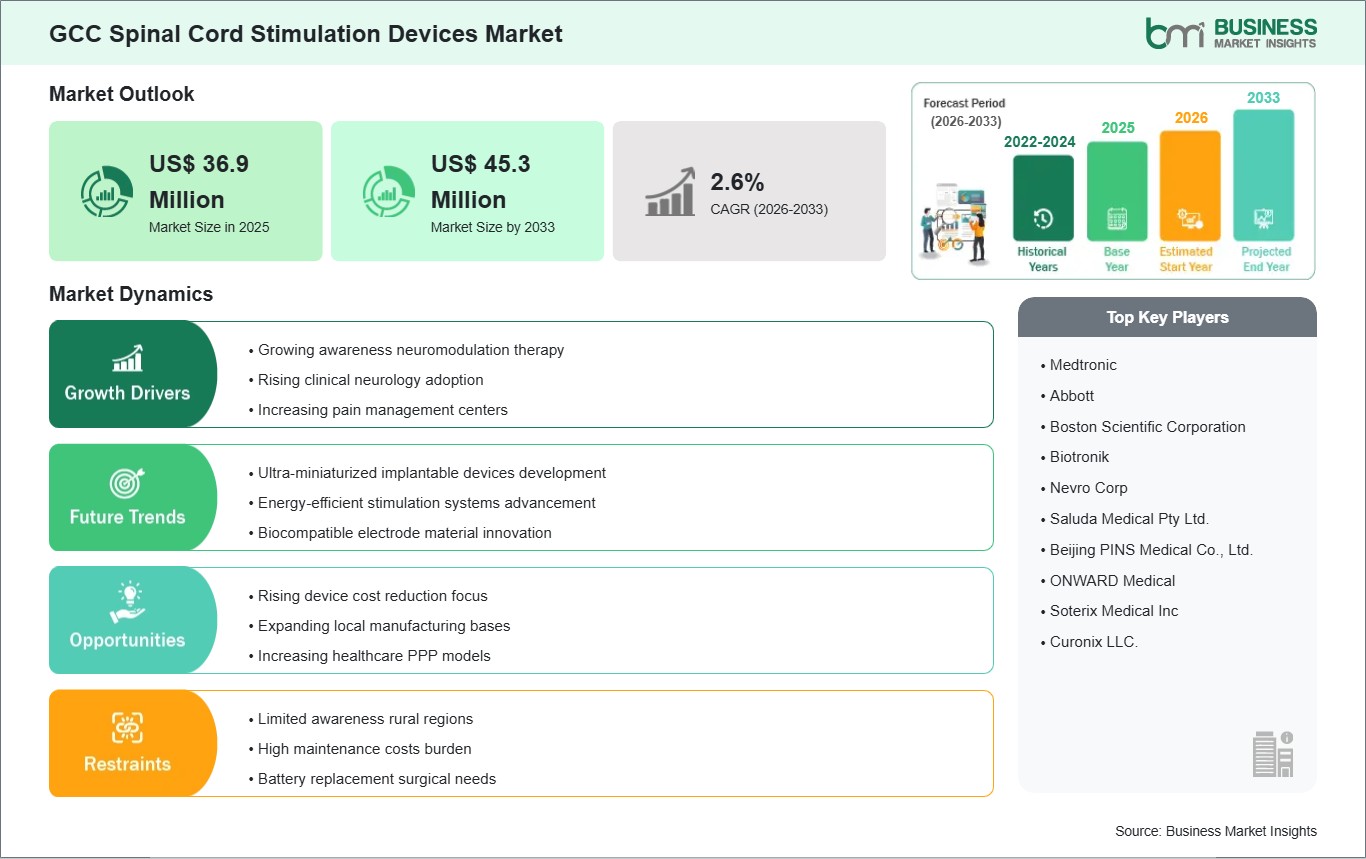
The GCC spinal cord stimulation (SCS) devices market is an upcoming and dynamic category in the field of neuromodulation, driven by favorable factors such as healthcare modernization and the development of sophisticated tertiary medical services. There is growing awareness regarding advanced treatment methods for chronic pain disorders as the healthcare system shifts focus from traditional pharmacological therapies to intervention-based treatment methodologies. Increasing incidence rates of spinal complications, post-operative pain, and musculoskeletal problems due to unhealthy lifestyles are driving the adoption of advanced pain management treatments that are not based on opioid medication. The use of SCS in pain management protocols is becoming prevalent across leading healthcare destinations. The growth in the market will be fueled by the emphasis put by the government towards the development of excellent healthcare facilities especially in specialty hospitals and medical cities that seek to make the GCC a destination for advanced medical care in the region. Neuromodulation will experience rapid growth owing to the existence of internationally qualified doctors and partnerships with medical equipment companies from other regions of the world. Nevertheless, the market is hindered by expensive procedures, lack of insurance coverage in some health insurance systems, and the selective eligibility criteria required for implants. Nonetheless, there exists potential for steady growth in the GCC market due to health diversification and need for advanced technological interventions for pain control measures.
Segment Analysis
GCC Spinal Cord Stimulation Devices Market Segmentation
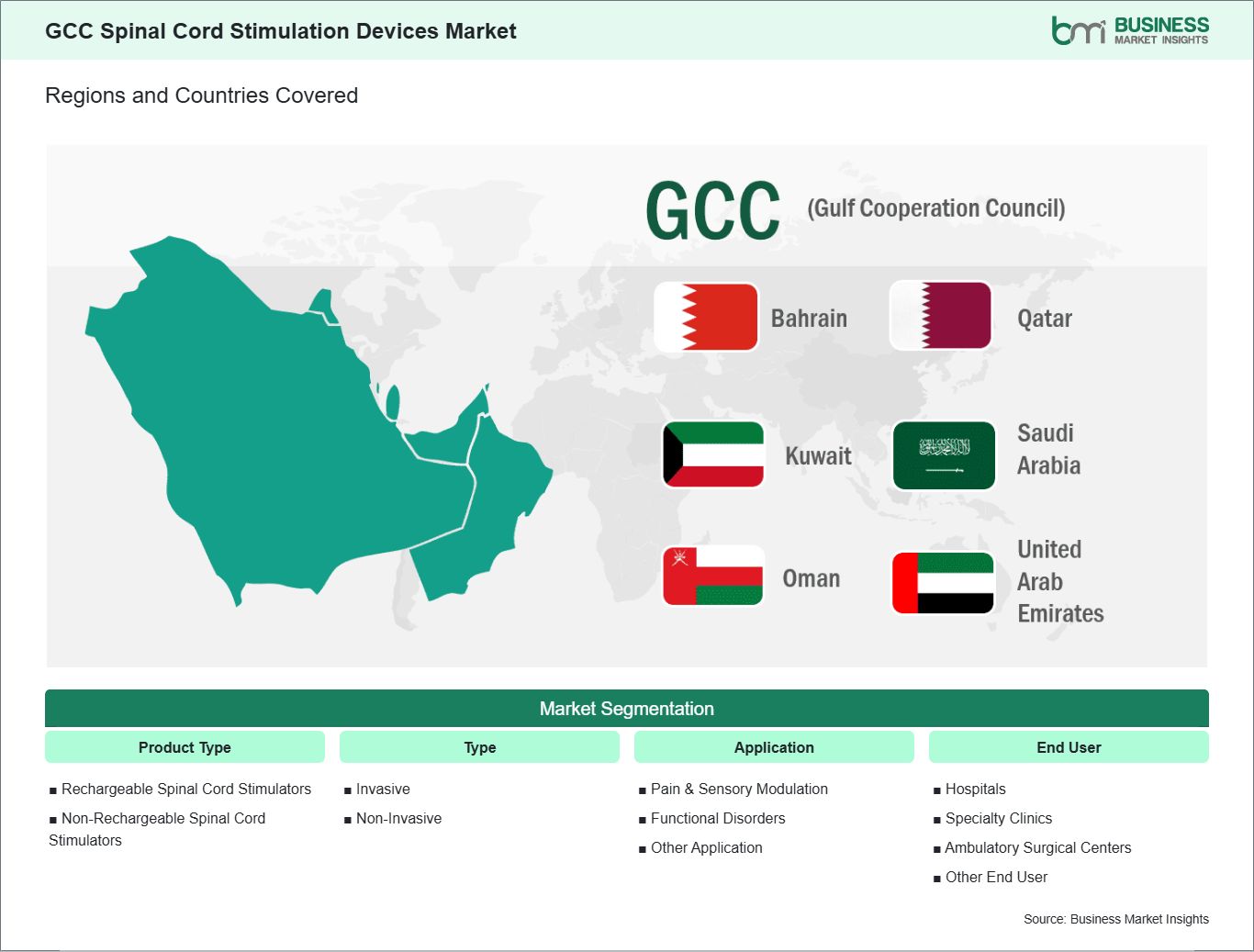
Key segments that contributed to the derivation of the GCC spinal cord stimulation devices market analysis are product type, type, application, and end user.
- By product type, the spinal cord stimulation devices market is segmented into rechargeable spinal cord stimulators and non-rechargeable spinal cord stimulators. The rechargeable spinal cord stimulators segment dominated the market in 2025.
- Based on type, the spinal cord stimulation devices market is segmented into invasive and non-invasive. The invasive segment dominated the market in 2025.
- On the basis of application, the spinal cord stimulation devices market is classified into pain and sensory modulation, functional disorders, and other application. The pain and sensory modulation segment dominated the market in 2025.
- In terms of end user, the spinal cord stimulation devices market is categorized into hospitals, specialty clinics, ambulatory surgical centers, and other end user. The hospitals segment dominated the market in 2025.
Market Forces
GCC Spinal Cord Stimulation Devices Market Drivers and Opportunities
Growing Awareness of Neuromodulation Therapy
A notable growth trend is observed in the GCC market for spinal cord stimulators (SCS), thanks to increased awareness among medical professionals regarding neuromodulation therapy as a means of managing chronic pain conditions. More cases of failed back surgery syndrome, neuropathic pain, and degenerative spine diseases are being reported, which have prompted physicians to look at spinal cord stimulation early in their treatment plans. Greater awareness about non-opioid pain management techniques has prompted patients to embrace implantable neuromodulation therapies.
There are growing numbers of awareness campaigns conducted at advanced healthcare facilities in the region to sensitize both physicians and patients on the benefits of spinal cord stimulation. With the rise in specialized pain clinics in tertiary care hospitals, there is a growing number of training sessions aimed at educating medical practitioners on the benefits of spinal cord stimulation devices in improving functional outcomes and minimizing reliance on medications.
Further, the knowledge and awareness of patients have increased owing to higher exposure to digital healthcare solutions and pain education programs. Patients with chronic spinal pain problems are turning to second-line treatment after primary treatments have failed to work on them. These increasing levels of awareness have helped to diagnose conditions early and increase acceptance of neuromodulation treatment.
Rising Device Cost Reduction Focus
The market for GCC spinal cord stimulation devices is also influenced by the increased emphasis on making the implantation process more cost-effective to facilitate better accessibility and increase its usage. While SCS is highly efficient, the problem of excessive device costs still discourages patients from undergoing this therapy. In response, healthcare organizations and companies involved in the manufacture of SCS devices pay close attention to cost minimization.
Several hospitals have already started using spinal cord stimulation devices with a longer service life and recharging capabilities to decrease the number of replacement procedures and lower the total costs associated with long-term treatment. Besides, minimally invasive surgery has enabled lowering hospitalization and costs of procedure itself. Furthermore, payment models oriented toward providing value-based care are slowly being implemented.
Moreover, there are investments in simpler device designs, wireless programming, and scalability in manufacturing for reducing manufacturing and maintenance costs. Increased cooperation between governmental and private parties for negotiating prices and extending reimbursement coverage is also aiding in addressing this challenge. With reduced cost constraints, spinal cord stimulation is likely to become increasingly available for a larger number of patients, thus ensuring continued growth in the market.
Size and Share Analysis
GCC Spinal Cord Stimulation Devices Market Size and Share Analysis
The GCC spinal cord stimulation devices market is experiencing steady growth, with market size and share analysis reflecting evolving treatment preferences and competitive dynamics among key players. The report evaluates important subsegments categorized within product type, type, application, and end user, highlighting their respective contributions to overall market performance.
By product type, the rechargeable spinal cord Stimulators subsegment dominated the market in 2025, because long-term chronic pain treatment requires devices that can operate continuously for several years without frequent replacement. Patients increasingly preferred rechargeable systems as they reduce the likelihood of repeat surgeries and lower overall treatment interruption.
Based on type, the invasive subsegment dominated the market in 2025 because implanted spinal cord stimulators deliver more stable and accurate nerve stimulation compared to external therapies. These systems are widely used for severe chronic pain conditions where medication and physiotherapy provide limited relief.
On the basis of application, the pain and sensory modulation subsegment dominated the market in 2025, because spinal cord stimulation is primarily designed to manage chronic neuropathic and musculoskeletal pain. The growing number of patients suffering from lower back pain, diabetic nerve pain, and post-surgical pain significantly increased demand for neuromodulation therapies.
In terms of end user, the hospitals subsegment dominated the market in 2025 because most spinal cord stimulator procedures require specialized surgical facilities, imaging equipment, and multidisciplinary pain management teams. Patients generally prefer hospitals for implantation procedures due to better emergency support and post-operative monitoring capabilities.
Report Coverage
GCC Spinal Cord Stimulation Devices Market Report Coverage and Deliverables
The "GCC Spinal Cord Stimulation Devices Market Size and Forecast (2022-2033)" report provides a detailed analysis of the market covering below areas:
- Market size and forecast at regional and country levels for all market segments covered under the scope
- Market trends, as well as drivers, restraints, and opportunities
- Market analysis covering key trends, regional framework, major players, regulations, and recent developments
- Market concentration, heat map analysis, prominent players, and recent developments for the Market
- Detailed company profiles, including SWOT analysis
Geographic Insights
GCC Spinal Cord Stimulation Devices Market Geographic Insights
The geographical scope of the GCC Spinal cord stimulation devices market report is divided into: Saudi Arabia, the UAE, Qatar, Kuwait, Bahrain, and Oman. Saudi Arabia held the largest share in 2025.
The presence of several healthcare transformation programs in Saudi Arabia makes it one of the leading markets for spinal cord stimulation therapy among other GCC countries. This is further reinforced by the significant investments made by the country's government towards developing specialty medical infrastructure and the rapid growth of tertiary level hospitals. The kingdom has developed numerous medical centers and neurological clinics specializing in spinal cord stimulation treatment for patients suffering from chronic pain. Vision-based reforms have contributed largely to making Saudi Arabia a dominant market for high-end spinal cord stimulators since they involve developing highly advanced medical technology. This has made it possible to integrate neuromodulation therapy into the hospital system as well as access internationally trained neurosurgeons and pain specialists. Moreover, financial investments made by the government towards providing specialty healthcare in cities like Riyadh and Jeddah have played a critical role in adopting innovative pain management devices. Nevertheless, there are certain drawbacks involved, which are procedural cost concerns, stringent clinical qualification for the procedure, and dependence on specialized centers for implantation and subsequent care of the patient. Public health insurance covers the application of advanced procedures in a few cases only, whereas awareness regarding the process is still emerging among general practitioners. In spite of these barriers, Saudi Arabia continues to be the major center for adopting SCS procedures in the GCC region, considering the healthcare development that exists in the country.
Industry Activity
Recent Developments
The GCC spinal cord stimulation devices market is evaluated by gathering qualitative and quantitative data post primary and secondary research, which includes important corporate publications, association data, and databases. A few of the key developments in the GCC spinal cord stimulation devices market are:
- In May 2025, Abbott announced that its Eterna spinal cord stimulation system received regulatory approval in Saudi Arabia (SFDA), expanding access to its BurstDR neuromodulation therapy for chronic pain patients across the GCC region, including the UAE, Saudi Arabia, and Kuwait through regional distributor networks.
- In August 2023, Medtronic announced that it received CE Mark approval for its Inceptiv closed-loop spinal cord stimulation system, enabling expanded commercial availability in international markets including GCC countries such as the UAE and Saudi Arabia, where CE-marked neuromodulation devices are widely adopted in tertiary pain management hospitals.
Trust & Transparency
Research Methodology
The market analysis combines proprietary research with secondary data from government agencies, company disclosures, regulatory filings, industry databases and expert interviews. Market estimates are validated through data triangulation, cross-market benchmarking and analyst
review.
View Full Research Methodology
Key Sources Referred:
The World BankWorld Health Organization (WHO)Center for Disease Control and Prevention (CDC)Food and Drug Administration (FDA)Centers for Medicare and Medicaid Services (CMS)European CommissionMedicines and Healthcare products Regulatory Agency (MHRA)Company WebsitesCompany Annual ReportsCompany Investor Presentation