Market Summary
Executive Summary and Market Analysis
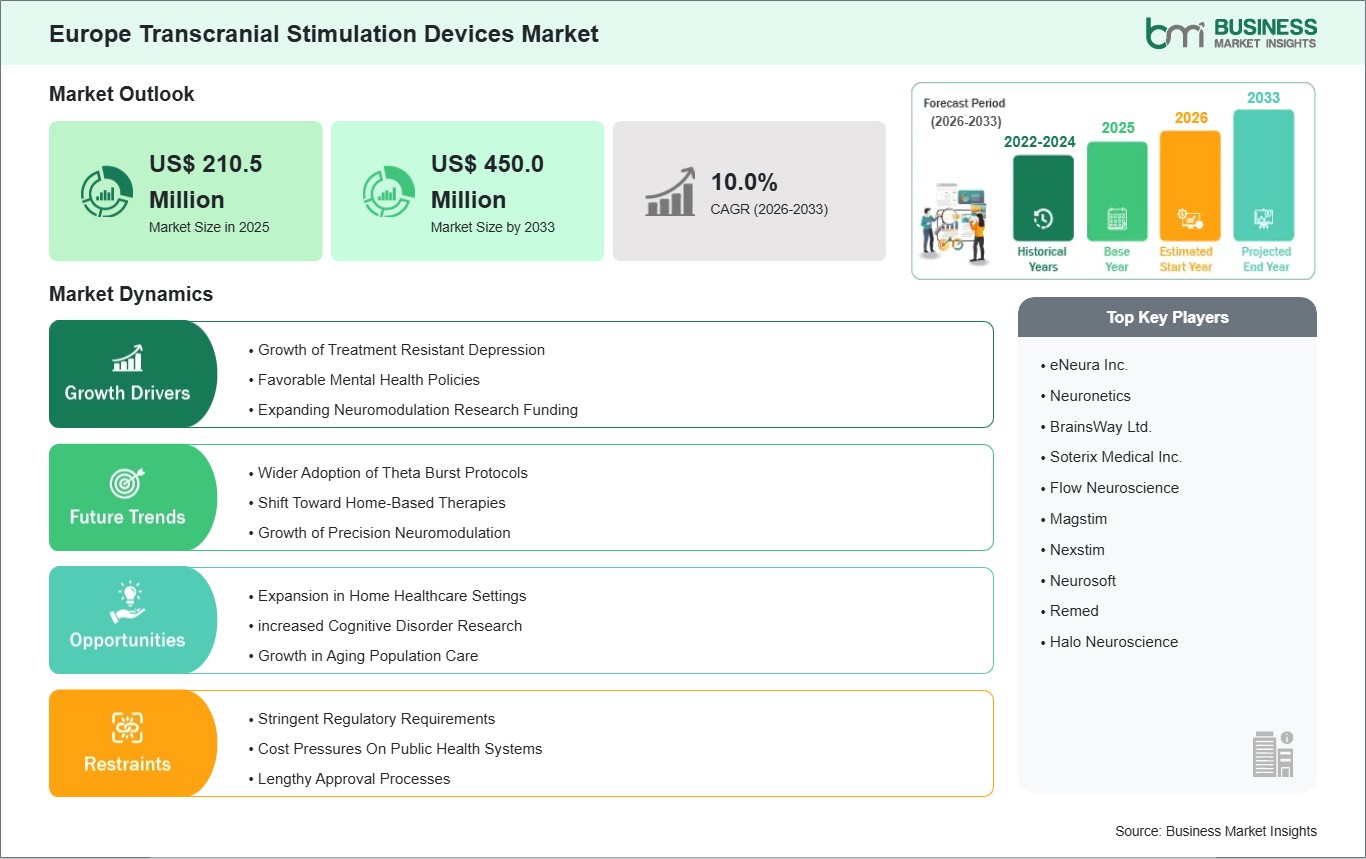
The market for Europe's transcranial stimulation devices has been characterized by a consistent trend towards non-invasive neuromodulation through the implementation of various techniques, such as transcranial magnetic stimulation and transcranial direct current stimulation, among others, within various clinical practices in neurology and psychiatry, where there has been an increase in the use of these treatments for resistant neurological and psychological disorders. There has been a noticeable increase in hospitals and specialized centers dealing with neurology cases due to increased demand for non-pharmacological treatments, especially for depression and patients recovering from strokes. This can be attributed to the increasing adoption of neuromodulation therapies based on available clinical evidence in the management of mental and cognitive disorders. The second reason is that devices have been made smaller and more portable, allowing their application in various environments. Adoption is nevertheless constrained by the rigorous requirements of regulations within the European medical devices frameworks, delaying time-to-market and demanding stringent validation from manufacturers, thereby delaying the process of commercialization of new players and product iterations. Inter-institutional collaboration between academic centers, medical device companies, and clinicians helps in achieving standardization of protocols and iterative improvement of stimulation paradigms across different neuroscientific applications through clinical evidence sharing platforms.
Segment Analysis
Europe Transcranial Stimulation Devices Market Segmentation
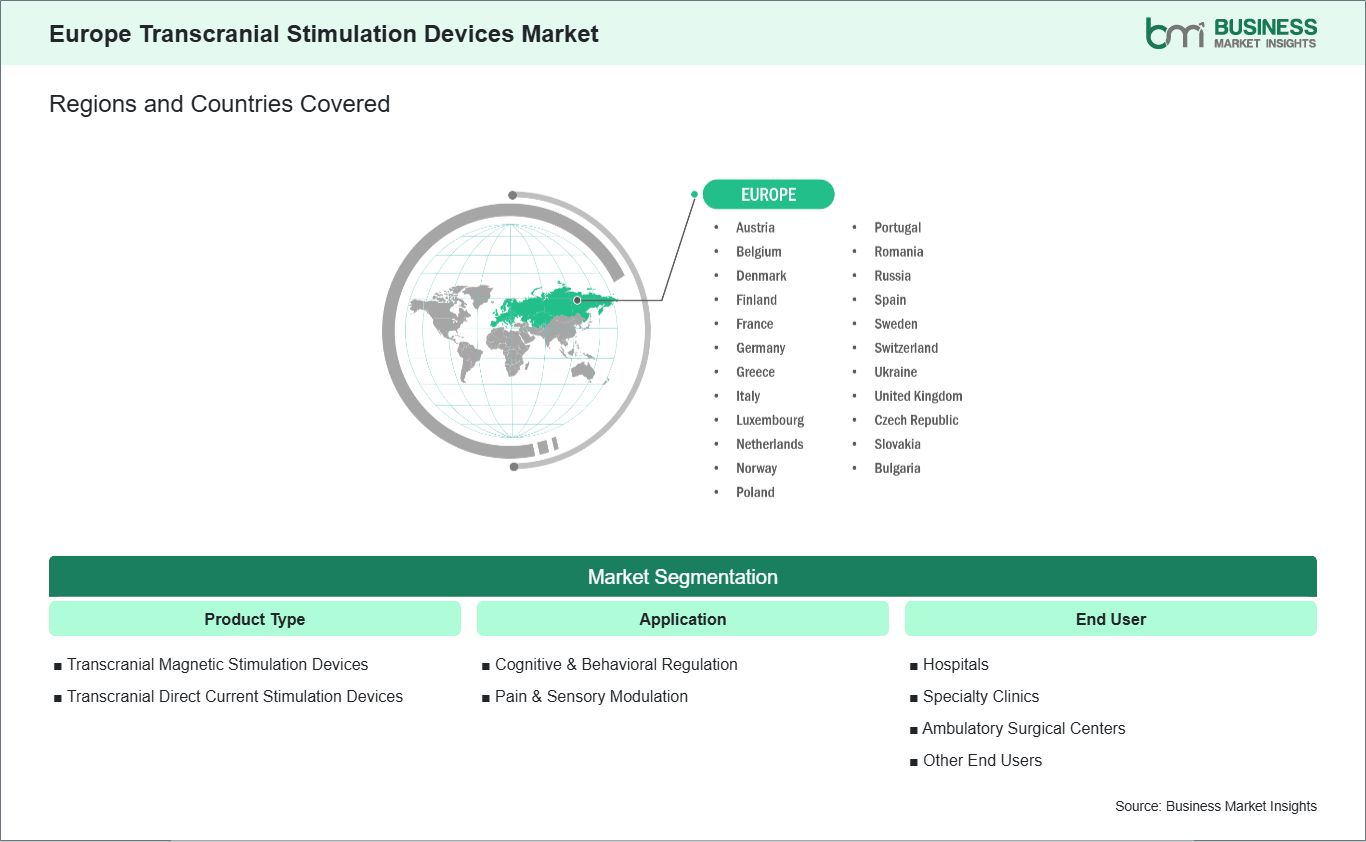
Key segments that contributed to the derivation of the Europe transcranial stimulation devices market analysis are product type, application, and end user.
- By product type, the transcranial stimulation devices market is segmented into transcranial magnetic stimulation devices and transcranial direct current stimulation devices. The transcranial magnetic stimulation devices segment dominated the market in 2025.
- Based on application, the transcranial stimulation devices market is categorized into cognitive & behavioral regulation and pain & sensory modulation. The cognitive & behavioral regulation segment dominated the market in 2025.
- In terms of end user, the transcranial stimulation devices market is categorized into hospitals, specialty clinics, ambulatory surgical centers, and other end users. The hospitals segment dominated the market in 2025.
Market Forces
Europe Transcranial Stimulation Devices Market Drivers and Opportunities
Increasing Incidence of Treatment Resistant Depression
In Europe's psychiatry landscape, the increasing resistance to the existing antidepressant drugs has forced psychiatrists to look towards neuromodulation methods. Rather than going for multiple drug trials, the condition is being defined as an issue within the circuits, thus paving the way for using neurostimulants.
These devices have been introduced into the process of treatment at specialist clinics much earlier. In situations where medication tolerance levels become an obstacle to further medical intervention, neurology and psychiatry experts collaborate to decide whether to adopt device-based treatment in conjunction with increased psychotherapy. The introduction of neuromodulation services has now been made possible by hospital systems, where usage of these devices has been integrated into the treatment process outside the premises as well.
Expansion in Home Healthcare Settings
The use of transcranial stimulation devices in supervised home care settings is gaining popularity among Europeans, especially for patients who have been clinically stabilized. This trend provides the opportunity for continued treatment in non-hospital settings while allowing for clinical assessment at regular intervals.
This trend is being supported by the introduction of features that make the use of these devices easier and more convenient to operate. Some features include a user-friendly interface, guidance on electrode positioning, and automatic tracking of sessions, among others. Furthermore, telemedicine has played a major role in making this system possible as clinicians adapt treatment protocols from information provided by remotely collected data on patient progress. Home care providers and specialty pharmacies are also getting involved in supporting this process.
Size and Share Analysis
Europe Transcranial Stimulation Devices Market Size and Share Analysis
The Europe transcranial stimulation devices market demonstrates steady growth, with size and share analysis highlighting evolving trends and competitive dynamics among key players. The report examines subsegments categorized within product type, application, and end user, offering insights into their contribution to overall market performance.
By product type, the transcranial magnetic stimulation devices subsegment dominated the market in 2025, driven by its strong clinical efficacy in treating major depression and other neurological disorders, along with increasing regulatory approvals and growing adoption in hospital-based neuropsychiatric care.
Based on application, the cognitive & behavioral regulation subsegment dominated the market in 2025, driven by the rising prevalence of mental health disorders and increasing demand for non-invasive therapies that improve cognition, mood, and behavioral outcomes without pharmacological side effects.
In terms of end user, the hospitals subsegment dominated the market in 2025, driven by higher availability of advanced neurostimulation infrastructure, presence of trained specialists, and preference for supervised clinical environments for safe and effective patient treatment.
Report Coverage
Europe Transcranial Stimulation Devices Market Report Coverage and Deliverables
The "Europe Transcranial Stimulation Devices Market Size and Forecast (2022-2033)" report provides a detailed analysis of the market covering below areas:
- Market size and forecast at global, regional, and country levels for all the key market segments covered under the scope
- Market trends, as well as drivers, restraints, and opportunities
- Market analysis covering key trends, global and regional framework, major players, regulations, and recent developments
- Market concentration, heat map analysis, prominent players, and recent developments for the Market
- Detailed company profiles, including SWOT analysis
Geographic Insights
Europe Transcranial Stimulation Devices Market Geographic Insights
The geographical scope of the Europe Transcranial Stimulation Devices Market report is divided into Germany, Italy, France, U.K., Spain, Belgium, Netherlands, Luxembourg, Norway, Finland, Denmark, Sweden, Switzerland, Austria, Greece, Portugal, Russia, Poland, Romania, Czech Republic, Ukraine, Slovakia, Bulgaria. Germany held the largest share in 2025.
In Europe, the transcranial stimulation devices market has diverse growth dynamics across the region. Germany dominates because of its advanced neurotechnology ecosystem, hospital usage, reimbursement mechanisms, and integration of neuroscience research. Italy depends on rehabilitation-oriented neuromodulation treatments and post-stroke treatment services. France has modernized its psychiatric treatment in public hospitals. The UK is driven by NHS clinical trials of neuropsychiatry services. Spain depends on private neurorehabilitation clinics and medical tourism. Belgium is taking advantage of medtech innovation hubs and the harmonization of regulations. The Netherlands relies on the integration of digital health and outpatient neuromodulation therapies. Luxembourg is characterized by wealthy people crossing borders for specialty treatments. Norway benefits from its aging population and need for neurological rehabilitation. Finland is relying on remote healthcare pilots and technology-driven therapy programs. Denmark benefits from neuroscience collaborations and research funds. In Sweden, there are psychiatry reform programs and home-based therapy. In Switzerland, there are innovations in medical devices and excellent hospitals. In Austria, there is support through rehabilitation facilities and regional medical centers. In Greece, there are programs aimed at increasing the number of private health care facilities and neuromodulation procedures. In Portugal, there is an increase in neurotherapy services offered to outpatients. In Russia, there is an emphasis on domestic manufacturing and a large neurology patient base. In Poland, there is a cost-sensitive adoption of technology and hospital capacity expansion. In Romania, there is healthcare modernization and an upgrade of neurology services. In the Czech Republic, there is growth in medtech manufacturing and clinical adoption.
Industry Activity
Recent Developments
The Europe Transcranial Stimulation Devices Market is evaluated by gathering qualitative and quantitative data post primary and secondary research, which includes important corporate publications, association data, and databases. A few of the key developments in the Europe transcranial stimulation devices market are:
- In December 2023, Medtronic announced that it received CE Mark approval for its Percept™ RC deep brain stimulation (DBS) neurostimulator with BrainSense™ technology, enabling launch in the European Union as a rechargeable sensing-enabled neuromodulation device for Parkinson's disease and other movement disorders.
- In October 2023, Sooma announced the launch of its Sooma Duo remote brain stimulation system, enabling clinician-monitored at-home transcranial direct current stimulation (tDCS) treatment for depression and expanding digital neuromodulation access across European markets through distributor networks.
Trust & Transparency
Research Methodology
The market analysis combines proprietary research with secondary data from government agencies, company disclosures, regulatory filings, industry databases and expert interviews. Market estimates are validated through data triangulation, cross-market benchmarking and analyst
review.
View Full Research Methodology
Key Sources Referred:
U.S. Food and Drug Administration (FDA)National Institute of Mental Health (NIMH)National Institute for Health and Care Excellence (NICE)European Medicines Agency (EMA)Medicines and Healthcare products Regulatory Agency (MHRA)American Psychiatric Association (APA)World Health Organization (WHO)International Neuromodulation Society (INS)International Society for Neuroregulation & Research (ISNR)European Society for Magnetic Resonance in Medicine and Biology (ESMRMB)Company WebsitesCompany Annual ReportsCompany Investor Presentations