Market Summary
Executive Summary and Market Analysis
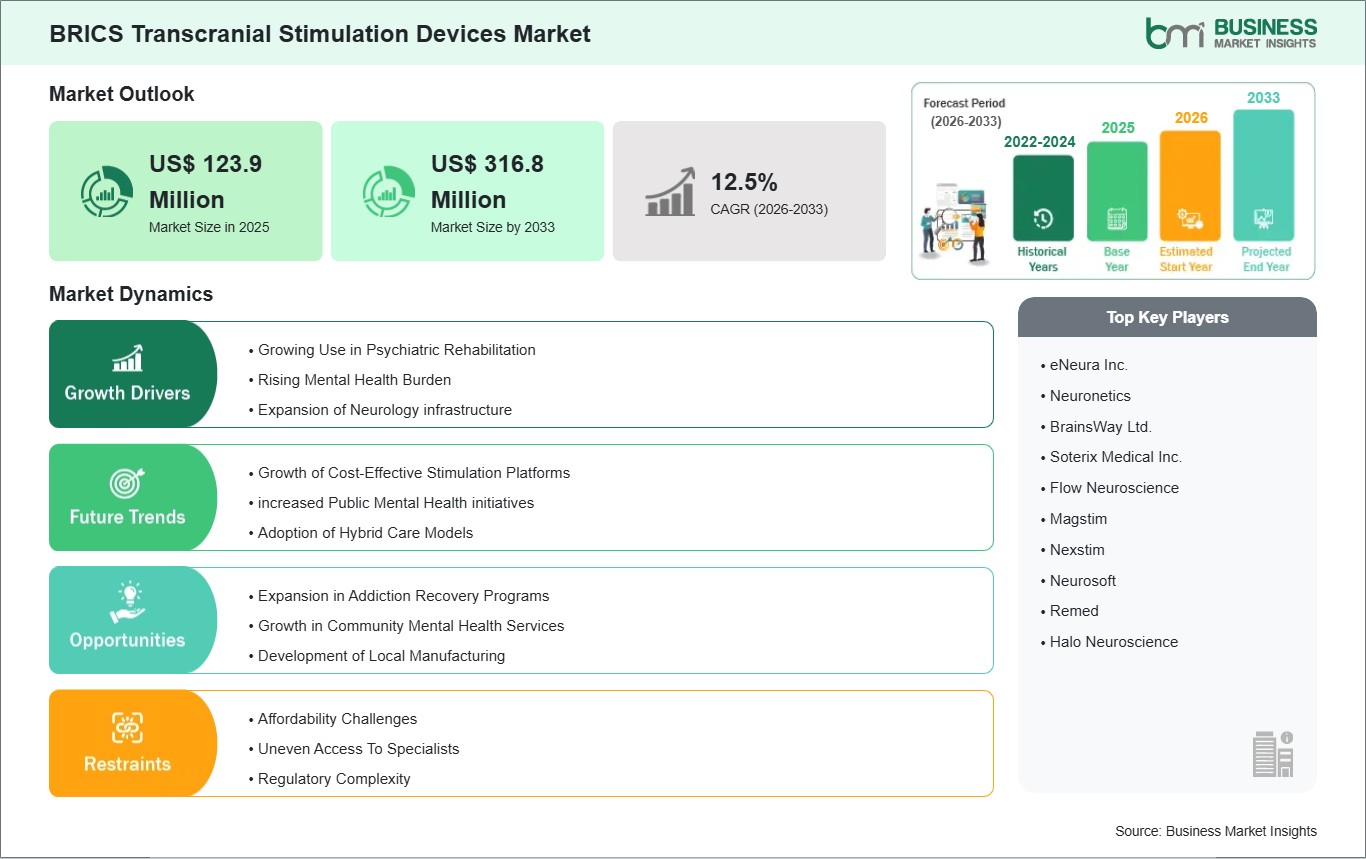
There has been an observed growth in the Transcranial Stimulation Devices market within the BRICS countries owing to the growing number of mental health illnesses and the increasing recognition of neuromodulation therapy as a non-invasive alternative to conventional therapy options. There has been an increasing emphasis on technological advancement within the field of mental illness treatments in emerging economies such as Brazil, Russia, India, China, and South Africa. This is leading to a conducive environment for the development and implementation of transcranial stimulation devices, including transcranial magnetic stimulation and other forms of neuromodulation therapy. Growing incidence rates of mental illnesses and lack of access to conventional psychiatric care in several regions are leading to an increase in the adoption of alternative treatment methods using these devices. In addition to this, there has been growing clinician recognition of the benefits of adopting neuroplasticity as a treatment method. Market expansion is facilitated by steady growth in healthcare infrastructure and the use of technology within cities of the BRICS nations. The increased investment in neurotechnologies, together with the opening of specialized neuromodulation clinics, is helping to advance market reach. Specifically, clinical trials conducted at the leading metropolitan healthcare centers are contributing to the validation of the products offered. There are several barriers facing the market in terms of its development; for instance, expensive medical devices as compared to the capacity for healthcare expenditure in some areas, poor access to neurological care within the rural and suburban markets, and limited reimbursement policies, as well as inconsistencies in the regulatory approach to this sector in BRICS nations. Generally, the BRICS transcranial stimulation devices market is characterized by a fast-growing industry due to the rising demand for neurological services, the advancement in healthcare systems, and the growing acceptance of medical solutions by clinicians.
Segment Analysis
BRICS Transcranial Stimulation Devices Market Segmentation
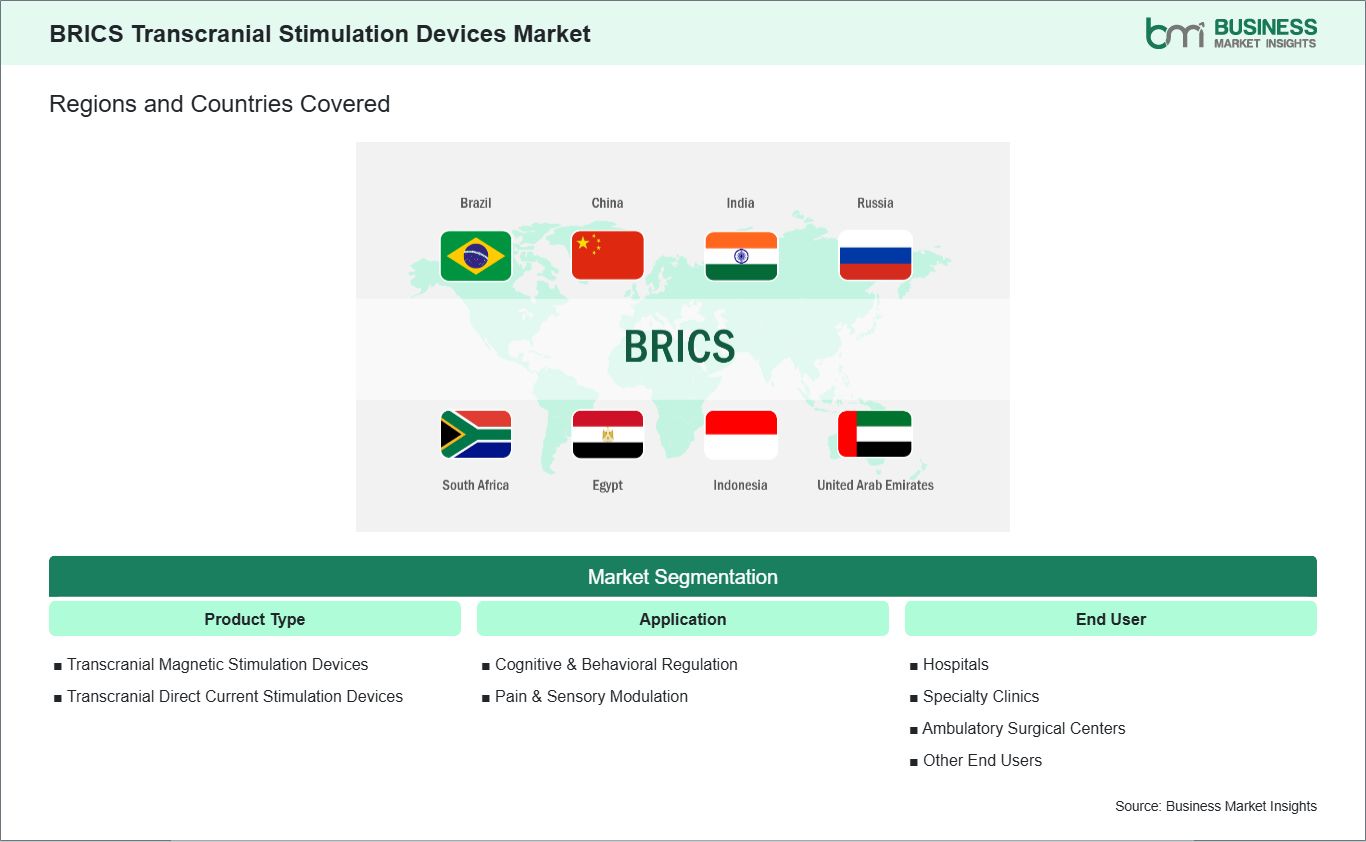
Key segments that contributed to the derivation of the BRICS transcranial stimulation devices market analysis are product type, application, and end user.
- By product type, the transcranial stimulation devices market is segmented into transcranial magnetic stimulation devices and transcranial direct current stimulation devices. The transcranial magnetic stimulation devices segment dominated the market in 2025.
- Based on application, the transcranial stimulation devices market is categorized into cognitive & behavioral regulation and pain & sensory modulation. The cognitive & behavioral regulation segment dominated the market in 2025.
- In terms of end user, the transcranial stimulation devices market is categorized into hospitals, specialty clinics, ambulatory surgical centers, and other end users. The hospitals segment dominated the market in 2025.
Market Forces
BRICS Transcranial Stimulation Devices Market Drivers and Opportunities
Growing Use in Psychiatric Rehabilitation
In the BRICS region, the use of transcranial stimulators is becoming a significant practice among psychiatric rehabilitation centers because healthcare practitioners in this region prefer noninvasive treatments for various mood and trauma-related disorders and cognitive recovery. In particular, hospitals located in urban areas of Brazil and China are integrating stimulation practices into comprehensive rehabilitation plans for their patients who need long-term behavioral support and relapse prevention.
Furthermore, in India, mental health facilities are creating more collaborations between neurologists, psychiatrists, and rehabilitation specialists in order to increase access to treatment using transcranial stimulation devices for people with depression and anxiety disorders that do not respond to common therapies. Stimulation devices are also being considered by Russian rehabilitation networks for the treatment of veterans and socially isolated individuals.
On the other hand, South African clinics and community wellness centers are collaborating with research universities in efforts to establish more rehabilitation programs involving the use of transcranial stimulators. In addition, healthcare facilities operating in the Gulf region, which operate within BRICS trade relations, have strengthened their procurement partnership with Chinese companies that produce stimulation devices.
Expansion in Addiction Recovery Programs
BRICS countries have shown increased interest in utilizing stimulation devices to assist in addiction recovery efforts, including behavioral rehabilitation, through substance dependence programs. Rehabilitation centers from China and Brazil include stimulation therapy in their programs as part of a larger process involving craving reduction and stabilization of the patient emotionally, as well as improving engagement with therapy.
Rehabilitation programs from India have been making more efforts to engage mental health practitioners in order to tackle problems like alcohol abuse, addiction to internet technology, and inappropriate consumption of prescription medications. Such partnerships are motivating the use of non-invasive neurological treatments in addition to regular treatment practices. The Russian rehabilitation community has considered the application of transcranial stimulation in the case of stress relapses in patients.
There is an increase in collaboration between rehabilitation centers and academic institutions in South Africa, researching the latest addiction treatments for high-risk groups. Meanwhile, Chinese suppliers are engaging with healthcare providers in new BRICS regions to supply them with transcranial stimulation technologies.
Size and Share Analysis
BRICS Transcranial Stimulation Devices Market Size and Share Analysis
The BRICS transcranial stimulation devices market demonstrates steady growth, with size and share analysis highlighting evolving trends and competitive dynamics among key players. The report examines subsegments categorized within product type, application, and end user, offering insights into their contribution to overall market performance.
By product type, the transcranial magnetic stimulation devices subsegment dominated the market in 2025, driven by its strong clinical efficacy in treating major depression and other neurological disorders, along with increasing regulatory approvals and growing adoption in hospital-based neuropsychiatric care.
Based on application, the cognitive & behavioral regulation subsegment dominated the market in 2025, driven by the rising prevalence of mental health disorders and increasing demand for non-invasive therapies that improve cognition, mood, and behavioral outcomes without pharmacological side effects.
In terms of end user, the hospitals subsegment dominated the market in 2025, driven by higher availability of advanced neurostimulation infrastructure, presence of trained specialists, and preference for supervised clinical environments for safe and effective patient treatment.
Report Coverage
BRICS Transcranial Stimulation Devices Market Report Coverage and Deliverables
The "BRICS Transcranial Stimulation Devices Market Size and Forecast (2022-2033)" report provides a detailed analysis of the market covering below areas:
- Market size and forecast at global, regional, and country levels for all the key market segments covered under the scope
- Market trends, as well as drivers, restraints, and opportunities
- Market analysis covering key trends, global and regional framework, major players, regulations, and recent developments
- Market concentration, heat map analysis, prominent players, and recent developments for the Market
- Detailed company profiles, including SWOT analysis
Geographic Insights
BRICS Transcranial Stimulation Devices Market Geographic Insights
The geographical scope of the BRICS Transcranial Stimulation Devices Market report is divided into Russia, Brazil, South Africa, India, China, Egypt, Indonesia, Saudi Arabia, and the UAE. China held the largest share in 2025.
The BRICS countries' market for transcranial stimulation devices showcases different levels of maturity and adoption, as China is considered the leading hub of this segment, owing to its robust manufacturing base of neurotechnology products and quick adoption in neurological rehabilitation and mental health care services, along with the use of the technology in research activities. Russia's restricted modernization of healthcare facilities and geopolitical factors play an important role in determining its selective approach towards technology adoption, where most of the sophisticated neuromodulation devices are found at urban tertiary care institutions. The growing inclination of Brazil to adopt the technology is attributed to heightened awareness of noninvasive brain stimulation techniques and increasing investment in private healthcare facilities. The growing interest of South Africa in adopting the technology can be attributed to various research activities and the increased focus on managing neurological disorders in specialized hospitals. India exhibits high-growth potential owing to the active presence of clinical research facilities and a large number of patients with mental illnesses, although availability and accessibility issues determine its slow adoption. Egypt's nascent adoption of the technology can be attributed to modernization programs in hospitals and an interest in neuropsychiatry applications. Saudi Arabia, on the other hand, is pushing for adoption via healthcare transformation initiatives focusing on digital and sophisticated medical technologies. In terms of innovation, the UAE leads as the gateway to innovation in the region due to its massive investment in highly advanced neuromodulation therapies and medical research partnerships. In both cases, China continues to be at the center of innovation, logistics, and deployment of advanced clinical practices. In general, technology transfer, increased clinical awareness, and the involvement of private companies have made the regional market environment more cohesive, even as China remains the trendsetter in all aspects of neuromodulation practices.
Industry Activity
Recent Developments
The BRICS Transcranial Stimulation Devices Market is evaluated by gathering qualitative and quantitative data post primary and secondary research, which includes important corporate publications, association data, and databases. A few of the key developments in the BRICS transcranial stimulation devices market are:
- In June 2023, Nexalin Technology announced a joint venture agreement with Wider Come Limited to commercialize its transcranial alternating current stimulation (tACS) devices in China and the broader Asia Pacific region. The partnership included plans for four clinical trials focused on insomnia, depression, and other neurological indications.
- In January 2024, BrainsWay announced the initiation of clinical feasibility studies for its new “Deep TMS 360” technology, which uses a rotational electric field approach to improve neuronal activation coverage in targeted brain regions. This development represents an R&D advancement aimed at enhancing efficacy in non-invasive neuromodulation therapies.
Trust & Transparency
Research Methodology
The market analysis combines proprietary research with secondary data from government agencies, company disclosures, regulatory filings, industry databases and expert interviews. Market estimates are validated through data triangulation, cross-market benchmarking and analyst
review.
View Full Research Methodology
Key Sources Referred:
U.S. Food and Drug Administration (FDA)National Institute of Mental Health (NIMH)National Institute for Health and Care Excellence (NICE)European Medicines Agency (EMA)Medicines and Healthcare products Regulatory Agency (MHRA)American Psychiatric Association (APA)World Health Organization (WHO)International Neuromodulation Society (INS)International Society for Neuroregulation & Research (ISNR)European Society for Magnetic Resonance in Medicine and Biology (ESMRMB)Company WebsitesCompany Annual ReportsCompany Investor Presentations