Market Summary
Executive Summary and Global Market Analysis
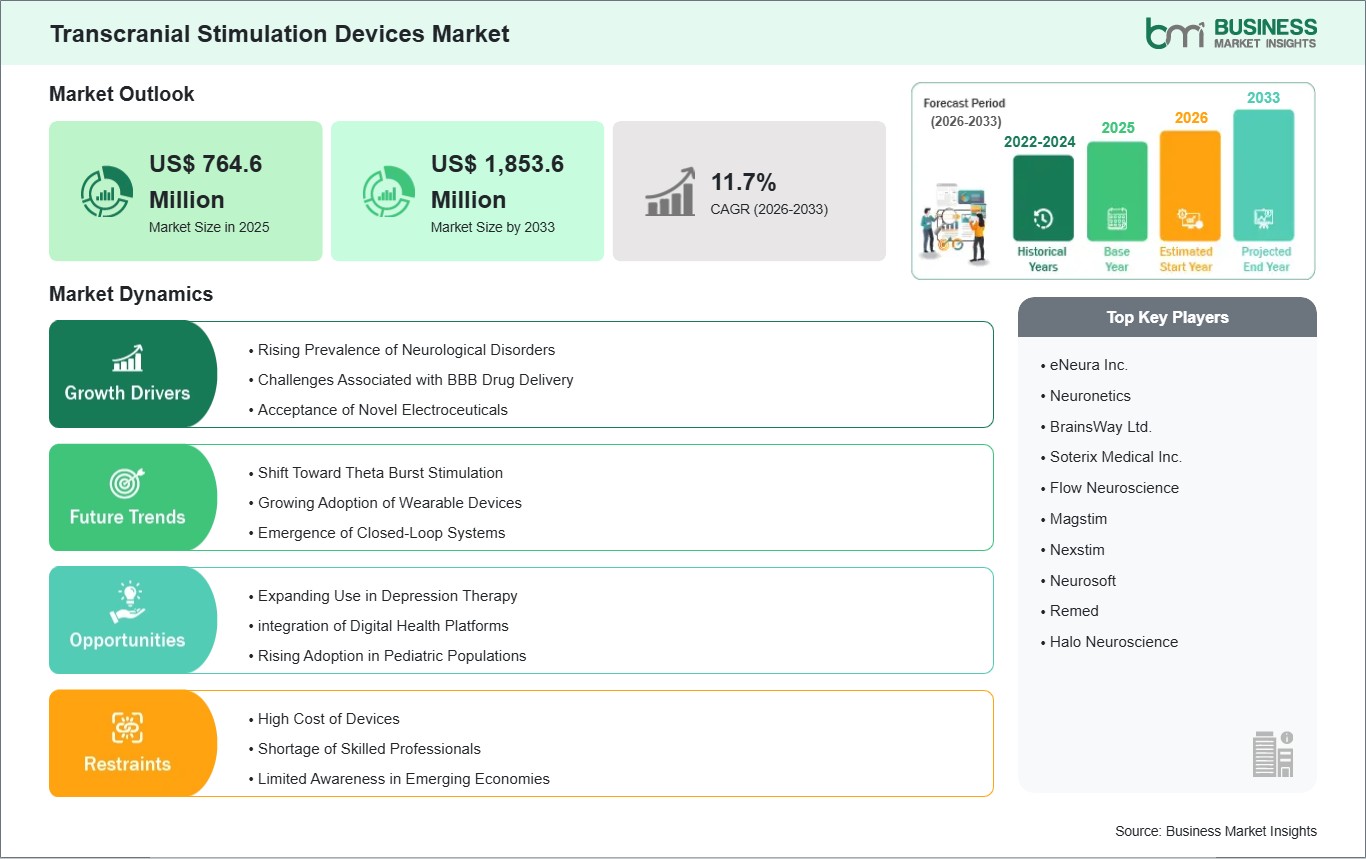
There is increasing clinical interest in neuromodulation techniques that are employed in the modulation of the excitability of the brain cortex. There are emerging advancements in neuroscience, miniaturization, and increased interest in treatments that are drug-free. The prevalence of neuropsychiatric and neurodegenerative diseases is increasing. Hence, health care specialists are looking for noninvasive treatment methods such as transcranial direct and magnetic stimulation. Other driving forces are the advent of miniaturization and portability of these stimulators and the clinical validation being conducted at hospitals' neuro-rehabilitation units. There are inconsistent regulations and unclear reimbursement models across various locations. Key trends include increasing cooperation between device manufacturers, neuroscience research centers, and digital health solutions providers to optimize stimulation protocols and doses, as well as adherence to treatment. Increased interest in applications such as depression treatment, migraine management, stroke recovery, and cognitive rehabilitation expands the scope of application for noninvasive stimulation outside of special clinical facilities. Focus on the development of standardized protocols, training for healthcare professionals, and risk management strategies becomes critical to maintain consistency in the results and address individual differences in patient response to treatment.
Segment Analysis
Transcranial Stimulation Devices Market Segmentation
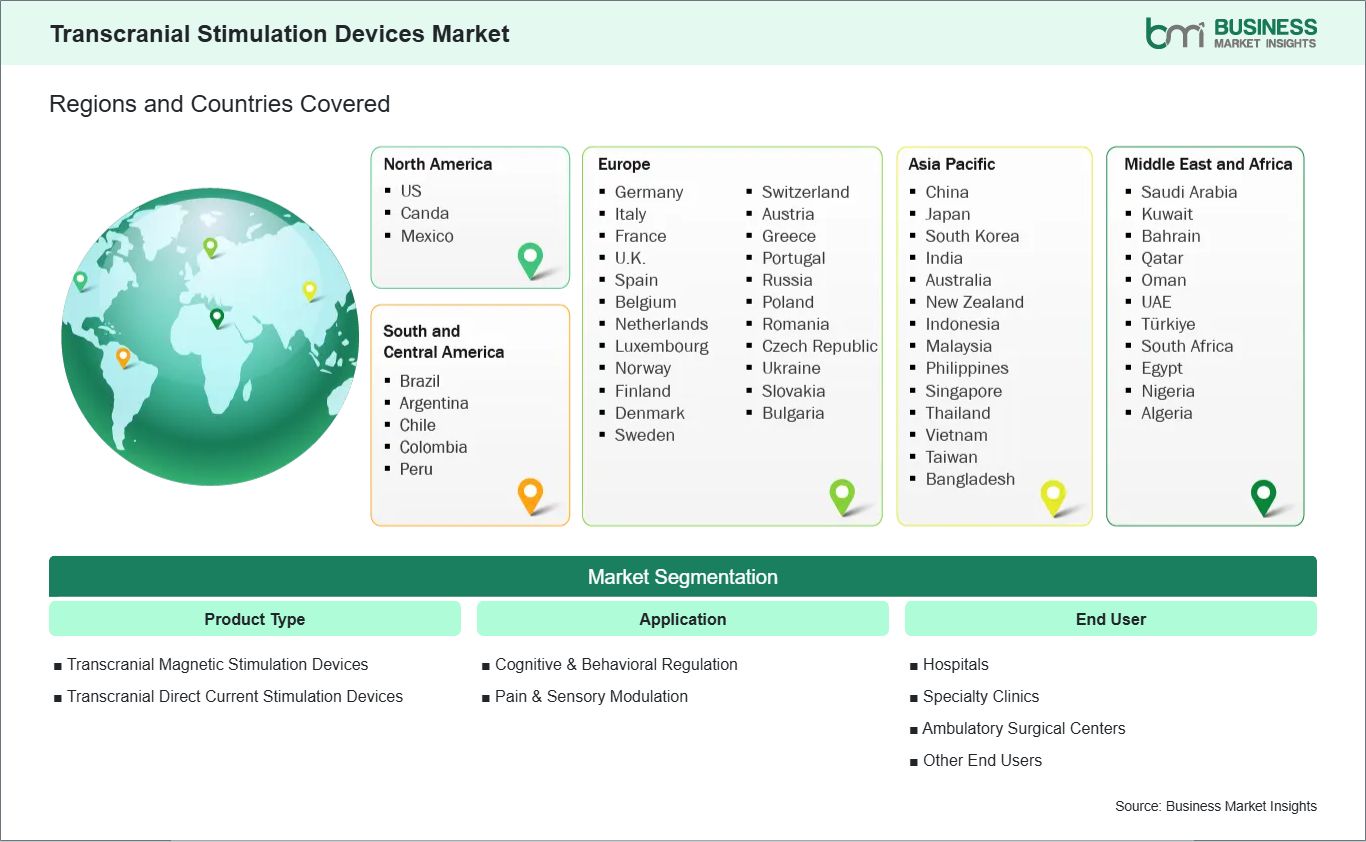
Key segments that contributed to the derivation of the transcranial stimulation devices market analysis are product type, application, and end user.
- By product type, the transcranial stimulation devices market is segmented into transcranial magnetic stimulation devices and transcranial direct current stimulation devices. The transcranial magnetic stimulation devices segment dominated the market in 2025.
- Based on application, the transcranial stimulation devices market is categorized into cognitive & behavioral regulation and pain & sensory modulation. The cognitive & behavioral regulation segment dominated the market in 2025.
- In terms of end user, the transcranial stimulation devices market is categorized into hospitals, specialty clinics, ambulatory surgical centers, and other end users. The hospitals segment dominated the market in 2025.
Market Forces
Transcranial Stimulation Devices Market Drivers and Opportunities
Rising Prevalence of Neurological Disorders
Neurology clinics have been adopting noninvasive brain stimulation devices in their clinical evaluation process in situations when patients present complex symptoms that cannot be managed using medication alone. As a result, there is an increasing need for manufacturers to develop products that fit well into outpatient processes with regards to time taken to install as well as electrode placement procedures by clinicians who experience frequent patient turnover.
Hospital acquisition staff members are rethinking the acquisition process for neurostimulation devices with regards to their use in departments other than neurology, such as psychiatry and rehabilitation. This change has made manufacturers rethink the way their software interface works to allow for easy presets along with clinician customization to avoid issues with respect to training. Remote calibration features are becoming popular in vendor support.
Clinicians' knowledge with respect to noninvasive brain stimulation will continue to increase through exposure from rehabilitation follow-up cases, in which patient response to certain stimuli determines the extent of involvement of device intervention in the treatment process.
Expanding Use in Depression Therapy
Psychiatric practice is incorporating transcranial stimulation devices into step-care models, in which clinicians proceed from psychotherapy to psychotherapy coupled with the use of devices, depending on the patterns of resistance to therapy established over several sessions. This trend has implications for room design in therapy offices. It focuses on patient comfort, continuity of the process, and the discrete operation of equipment in an outpatient setting, facilitating structured decision-making procedures.
Developers of stimulation devices are consulting mental health professionals on protocol settings corresponding to different symptom profiles of depression, with a focus on adjustable waveforms and flexible scheduling of sessions. The engineering team continues to simplify the user interface to decrease the cognitive load experienced by clinicians who have to conduct several interventions simultaneously. Emphasis on compatibility with electronic health records used in clinics and hospitals.
People who are experiencing symptoms of depression and undergo transcranial stimulation go through treatment protocols during which response monitoring occurs concurrently with psychological evaluations conducted regularly by the clinician.
Size and Share Analysis
Transcranial Stimulation Devices Market Size and Share Analysis
The transcranial stimulation devices market demonstrates steady growth, with size and share analysis highlighting evolving trends and competitive dynamics among key players. The report examines subsegments categorized within product type, application, and end user, offering insights into their contribution to overall market performance.
By product type, the transcranial magnetic stimulation devices subsegment dominated the market in 2025, driven by its strong clinical efficacy in treating major depression and other neurological disorders, along with increasing regulatory approvals and growing adoption in hospital-based neuropsychiatric care.
Based on application, the cognitive & behavioral regulation subsegment dominated the market in 2025, driven by the rising prevalence of mental health disorders and increasing demand for non-invasive therapies that improve cognition, mood, and behavioral outcomes without pharmacological side effects.
In terms of end user, the hospitals subsegment dominated the market in 2025, driven by higher availability of advanced neurostimulation infrastructure, presence of trained specialists, and preference for supervised clinical environments for safe and effective patient treatment.
Report Coverage
Transcranial Stimulation Devices Market Report Coverage and Deliverables
The "Transcranial Stimulation Devices Market Size and Forecast (2022-2033)" report provides a detailed analysis of the market covering below areas:
- Market size and forecast at global, regional, and country levels for all the key market segments covered under the scope
- Market trends, as well as drivers, restraints, and opportunities
- Market analysis covering key trends, global and regional framework, major players, regulations, and recent developments
- Market concentration, heat map analysis, prominent players, and recent developments for the Market
- Detailed company profiles, including SWOT analysis
Geographic Insights
Transcranial Stimulation Devices Market Geographic Insights
The geographical scope of the Transcranial Stimulation Devices Market report is divided into North America, Asia Pacific, Europe, the Middle East & Africa, and South & Central America. North America held the largest share in 2025.
North America is characterized by the early incorporation of neuromodulation techniques, developed clinical neurophysiology frameworks, and robust research facilities of hospitals and universities, which constantly incorporate noninvasive brain stimulation devices into the practice of neuropsychiatry and neurology. Market development in APAC is driven by improving healthcare infrastructures, affordable cost of brain stimulation techniques, a large number of undiagnosed patients, and the development of domestic production and training of specialists to make brain stimulation technologies available in rural and semi-urban areas. In Europe, market expansion is caused by active promotion of non-invasive brain treatments, a considerable proportion of the aged population suffering from neurodegenerative diseases, and favorable innovation ecosystems. Growth in the Middle East & Africa is driven by advances in healthcare modernization programs, increased establishment of neurology centers, increased knowledge about mental disease treatment alternatives, and alliances with medical device companies from other countries that contribute to better technology transfer. South & Central America is seeing steady market development driven by improved access to neurology, increased private neuro-psychiatric clinics, urban areas' healthcare spending, and adoption of non-invasive stimulations at specialized treatment centers in the face of an unstable economy. Regional trends vary depending on the different levels of maturity of healthcare infrastructure. Still, technology diffusion will improve via foreign cooperation, evolving reimbursement systems, and noninvasive neuromodulation as another treatment option for mental disorders and neurological conditions.
Industry Activity
Recent Developments
The Transcranial Stimulation Devices Market is evaluated by gathering qualitative and quantitative data post primary and secondary research, which includes important corporate publications, association data, and databases. A few of the key developments in the transcranial stimulation devices market are:
- In June 2023, Neuronetics received FDA 510(k) clearance for its OCD Motor Threshold (MT) Cap technology used with its NeuroStar Advanced Therapy system, enhancing treatment efficiency and expanding its clinical indications in transcranial magnetic stimulation.
- In May 2023, Nexstim announced that its Quality Management System and NBS 6 navigated transcranial magnetic stimulation (nTMS) system received MDR certification in the European Union, enabling CE-marked commercial distribution of its system for pre-surgical brain mapping and depression treatment applications in Europe.
Trust & Transparency
Research Methodology
The market analysis combines proprietary research with secondary data from government agencies, company disclosures, regulatory filings, industry databases and expert interviews. Market estimates are validated through data triangulation, cross-market benchmarking and analyst
review.
View Full Research Methodology
Key Sources Referred:
U.S. Food and Drug Administration (FDA) National Institute of Mental Health (NIMH) National Institute for Health and Care Excellence (NICE) European Medicines Agency (EMA) Medicines and Healthcare products Regulatory Agency (MHRA) American Psychiatric Association (APA) World Health Organization (WHO) International Neuromodulation Society (INS) International Society for Neuroregulation & Research (ISNR) European Society for Magnetic Resonance in Medicine and Biology (ESMRMB) Company Websites Company Annual Reports Company Investor Presentations