Market Summary
Executive Summary and Market Analysis
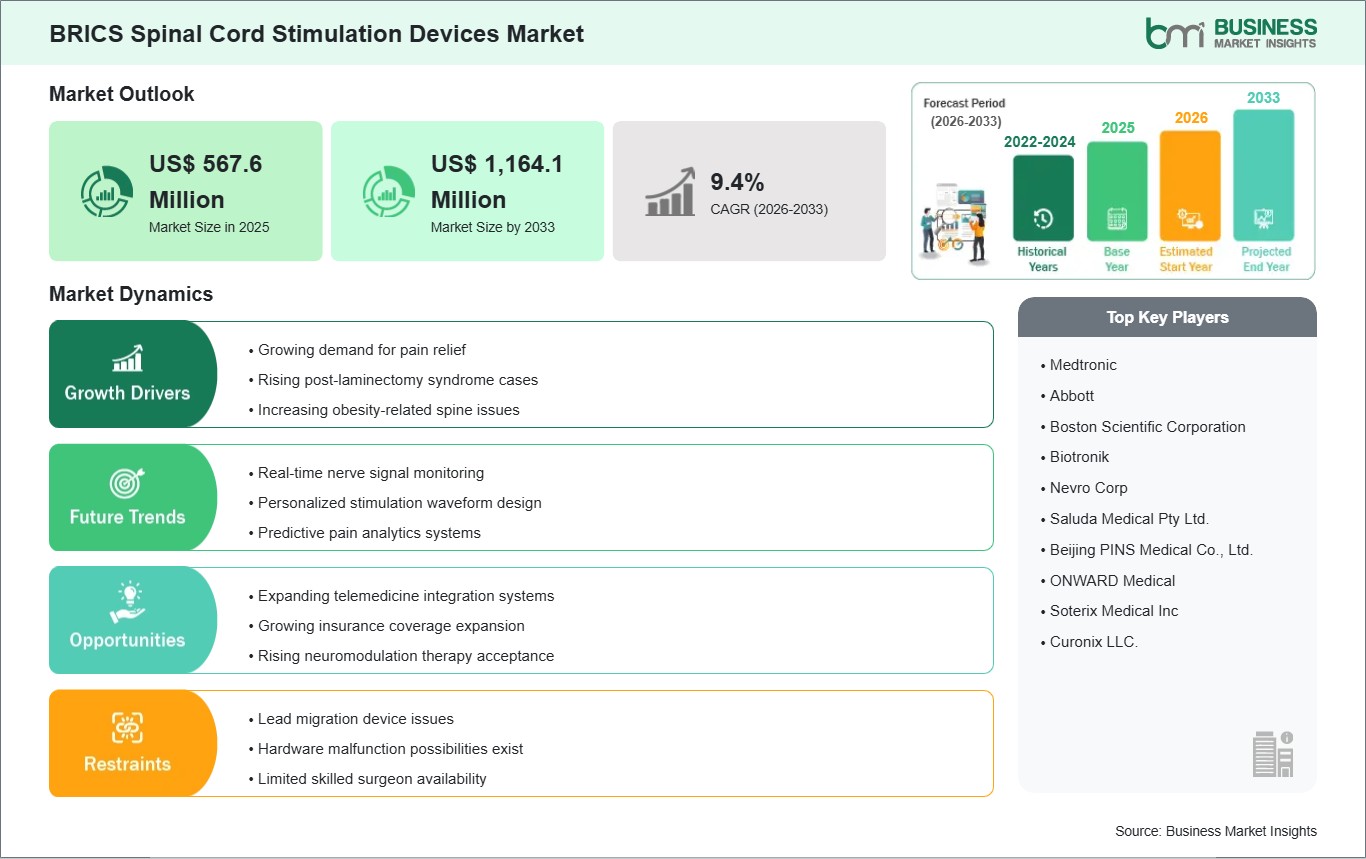
The BRICS Spinal Cord Stimulation Devices Market is a relatively new and imbalanced niche of the overall neuromodulation industry, heavily influenced by existing disparities regarding healthcare systems, availability of modern pain treatment technologies, and specialists within member countries. The major factors that fuel the development of the market include an increasing prevalence of chronic spinal diseases, neuropathic pain conditions, and postoperative pain syndrome cases, especially among residents of large cities due to increasingly sedentary lifestyle and aging population. Spinal cord stimulation procedures are progressively applied in more developed healthcare facilities among the BRICS countries as a treatment option for patients resistant to non-invasive therapy and surgery. An important factor driving growth in the sector is the increasing availability of tertiary care hospitals and private investment in healthcare, which have facilitated the availability of neuromodulation technology in certain metropolitan cities. Another important aspect driving growth is the growing exposure of doctors to global practices, which have spurred the use of implantable devices in chronic pain treatment on a gradual basis. The market, however, faces several limitations in terms of low coverage and affordability issues, along with the availability of knowledge about neuromodulation. While there are several limitations associated with the market, it is expected that the future will keep much promise as far as the adoption of such technology is concerned.
Segment Analysis
BRICS Spinal Cord Stimulation Devices Market Segmentation
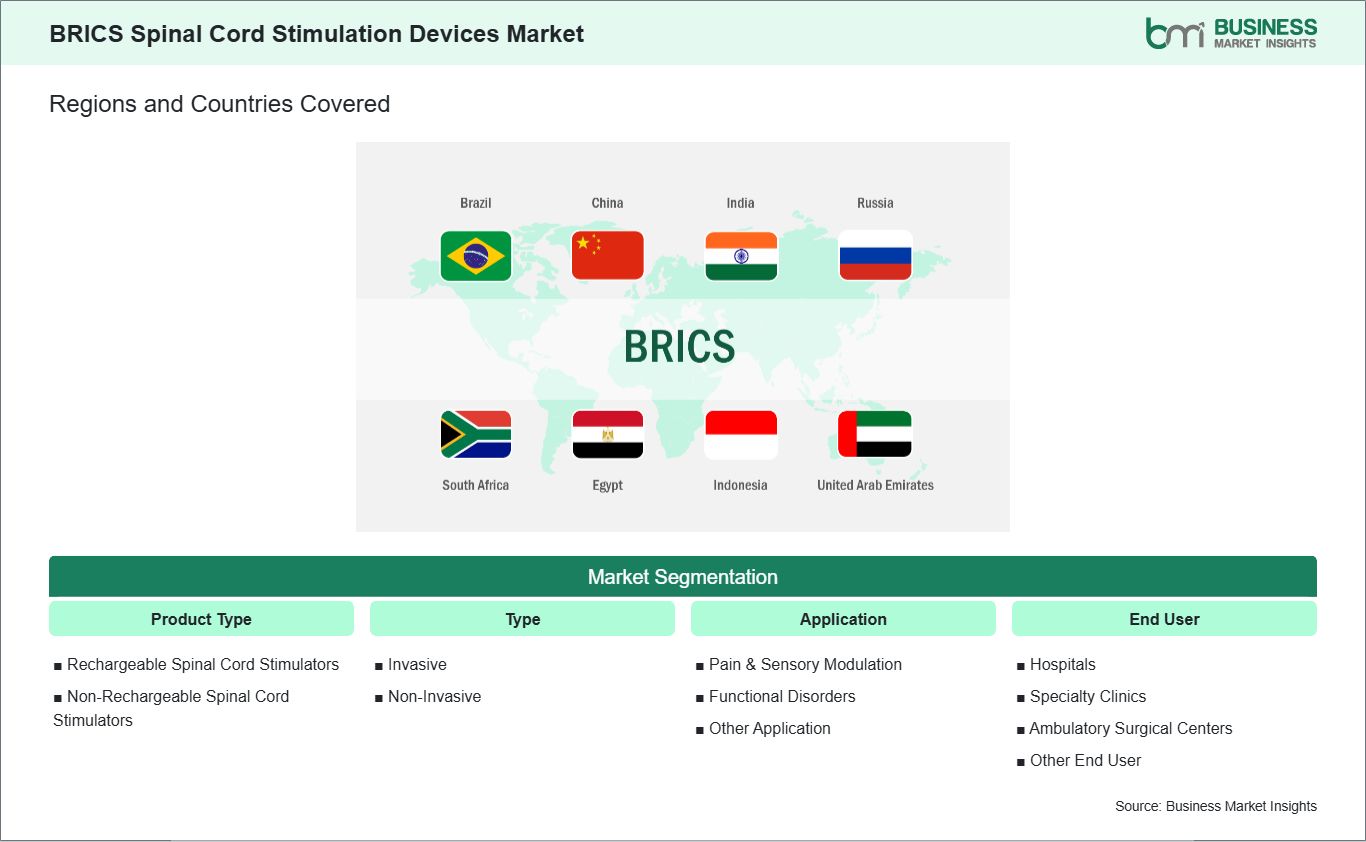
Key segments that contributed to the derivation of the BRICS spinal cord stimulation devices market analysis are product type, type, application, and end user.
- By product type, the spinal cord stimulation devices market is segmented into rechargeable spinal cord stimulators and non-rechargeable spinal cord stimulators. The rechargeable spinal cord stimulators segment dominated the market in 2025.
- Based on type, the spinal cord stimulation devices market is segmented into invasive and non-invasive. The invasive segment dominated the market in 2025.
- On the basis of application, the spinal cord stimulation devices market is classified into pain and sensory modulation, functional disorders, and other application. The pain and sensory modulation segment dominated the market in 2025.
- In terms of end user, the spinal cord stimulation devices market is categorized into hospitals, specialty clinics, ambulatory surgical centers, and other end user. The hospitals segment dominated the market in 2025.
Market Forces
BRICS Spinal Cord Stimulation Devices Market Drivers and Opportunities
Growing Demand for Pain Relief
The demand for BRICS SCS devices is expected to witness significant growth in coming years owing to the high prevalence of various chronic pain disorders like neuropathic pain, failed back syndrome, spinal degeneration-related pain etc. The population suffering from chronic pain disorders is rapidly increasing in these economies owing to the prevalence of aged demographics, manual working industries, and the occurrence of lifestyle-related health disorders. A considerable percentage of the adult population in BRICS countries is suffering from chronic pain that needs modern treatment techniques such as neuromodulation.
Hospitals in large urban centers have witnessed an increasing number of patients who respond inadequately to traditional treatments for their pain disorder, which includes conventional medications and physical therapy. Spinal cord stimulators are increasingly being adopted in these hospitals for treating spinal pain, which includes post-operative spinal pain and diabetic neuropathy-related disorders. An increasing number of spinal surgeries performed in BRICS economies has also resulted in chronic post-operative pain conditions among people.
Further, knowledge about pain management using advanced technology is slowly spreading in emerging health care systems. Spinal cord stimulation is becoming popular among physicians as a long-term remedy for patients suffering from chronic pain, where they do not have easy access to consistent medication. More than one point five billion people worldwide suffer from chronic pain problems, including many people from the emerging countries.
Expanding Telemedicine Integration Systems
The growth in demand for spinal cord stimulators within the BRICS nations is further augmented by the fast development of telemedicine and remote monitoring technologies that help to increase access to chronic pain management among the dispersed population. Digital healthcare solutions are increasingly used to provide follow-up treatment for patients that have received their implants in order to limit the need for in-patient visits and promote better therapy compliance.
In large urban areas, hospitals as well as specialized pain management centers integrate remote programming features into SCS devices in order to allow physicians to make changes in stimulation parameters without having to consult with patients personally. Moreover, initial deployment of AI-powered monitoring technologies has made it possible to develop more personalized strategies for pain management based on feedback and usage trends.
The development of telemedicine solutions also helps to increase access to neuromodulation in semi-urban and underserved areas, as it provides patients with preliminary consultations and follow-up treatment via digital tools, while implantation takes place at specialized facilities located in major metropolitan centers.
Size and Share Analysis
BRICS Spinal Cord Stimulation Devices Market Size and Share Analysis
The BRICS spinal cord stimulation devices market is experiencing steady growth, with market size and share analysis reflecting evolving treatment preferences and competitive dynamics among key players. The report evaluates important subsegments categorized within product type, type, application, and end user, highlighting their respective contributions to overall market performance.
By product type, the rechargeable spinal cord Stimulators subsegment dominated the market in 2025, because long-term chronic pain treatment requires devices that can operate continuously for several years without frequent replacement. Patients increasingly preferred rechargeable systems as they reduce the likelihood of repeat surgeries and lower overall treatment interruption.
Based on type, the invasive subsegment dominated the market in 2025 because implanted spinal cord stimulators deliver more stable and accurate nerve stimulation compared to external therapies. These systems are widely used for severe chronic pain conditions where medication and physiotherapy provide limited relief.
On the basis of application, the pain and sensory modulation subsegment dominated the market in 2025, because spinal cord stimulation is primarily designed to manage chronic neuropathic and musculoskeletal pain. The growing number of patients suffering from lower back pain, diabetic nerve pain, and post-surgical pain significantly increased demand for neuromodulation therapies.
In terms of end user, the hospitals subsegment dominated the market in 2025 because most spinal cord stimulator procedures require specialized surgical facilities, imaging equipment, and multidisciplinary pain management teams. Patients generally prefer hospitals for implantation procedures due to better emergency support and post-operative monitoring capabilities.
Report Coverage
BRICS Spinal Cord Stimulation Devices Market Report Coverage and Deliverables
The "BRICS Spinal Cord Stimulation Devices Market Size and Forecast (2022-2033)" report provides a detailed analysis of the market covering below areas:
- Market size and forecast at regional and country levels for all market segments covered under the scope
- Market trends, as well as drivers, restraints, and opportunities
- Market analysis covering key trends, regional framework, major players, regulations, and recent developments
- Market concentration, heat map analysis, prominent players, and recent developments for the Market
- Detailed company profiles, including SWOT analysis
Geographic Insights
BRICS Spinal Cord Stimulation Devices Market Geographic Insights
The geographical scope of the BRICS spinal cord stimulation devices market report is divided into: Russia, Brazil, South Africa, India, China, Egypt, Indonesia, Saudi Arabia, and the UAE. China held the largest share in 2025.
China leads in terms of the spinal cord stimulation device market in BRICS based on the huge patient base, development of the healthcare infrastructure, and investments made in high-end medical technology equipment. There have been notable developments in the tertiary hospitals and specialized neurosurgical hospitals in many urban areas where the introduction of the advanced chronic pain services has started. Patients suffering from complex neuropathic pain conditions, failed back surgery syndrome, and degenerative diseases of the spine are benefiting from this procedure when other treatment methods fail. One reason behind the dominance of the Chinese spinal cord stimulators market can be attributed to the advancements that are taking place in the country's health care industry, which allows better access to sophisticated procedures and stimulates the adoption of neuromodulation devices in the best hospitals. Specialists working in such hospitals get accustomed to the international treatment standards which is helping them incorporate this treatment into the standardized pain management pathway. Nonetheless, implementation is skewed towards urban areas, as well as high-income areas, because of the costs associated with the implantation of neuromodulation devices. The public health centers tend to offer only necessary health services, thereby hindering wider availability. Additionally, awareness concerning these pain therapies is relatively low among doctors and patients. There are further issues with other members of the BRICS group due to poor infrastructure and high prices. Hence, the Chinese nation has continued playing a central role in the growth of spinal cord stimulation in the BRICS nations due to improved health care systems and increased demand for pain therapy products.
Industry Activity
Recent Developments
The BRICS spinal cord stimulation devices market is evaluated by gathering qualitative and quantitative data post primary and secondary research, which includes important corporate publications, association data, and databases. A few of the key developments in the BRICS spinal cord stimulation devices market are:
- In May 2025, Abbott announced that its Eterna spinal cord stimulation system received approval from ANVISA, expanding access to its low-dose BurstDR neuromodulation therapy for chronic pain patients in Brazil, one of the largest SCS adoption markets in Latin America and a key BRICS healthcare market.
- In August 2023, Medtronic announced that it received CE Mark approval for its Inceptiv closed-loop spinal cord stimulation system, enabling expanded international commercialization pathways into BRICS-linked markets such as Brazil, India, and South Africa, where CE-marked neuromodulation devices are commonly adopted ahead of local regulatory clearance.
Trust & Transparency
Research Methodology
The market analysis combines proprietary research with secondary data from government agencies, company disclosures, regulatory filings, industry databases and expert interviews. Market estimates are validated through data triangulation, cross-market benchmarking and analyst
review.
View Full Research Methodology
Key Sources Referred:
The World BankWorld Health Organization (WHO)Center for Disease Control and Prevention (CDC)Food and Drug Administration (FDA)Centers for Medicare and Medicaid Services (CMS)European CommissionMedicines and Healthcare products Regulatory Agency (MHRA)Company WebsitesCompany Annual ReportsCompany Investor Presentation