Market Summary
Executive Summary and Market Analysis
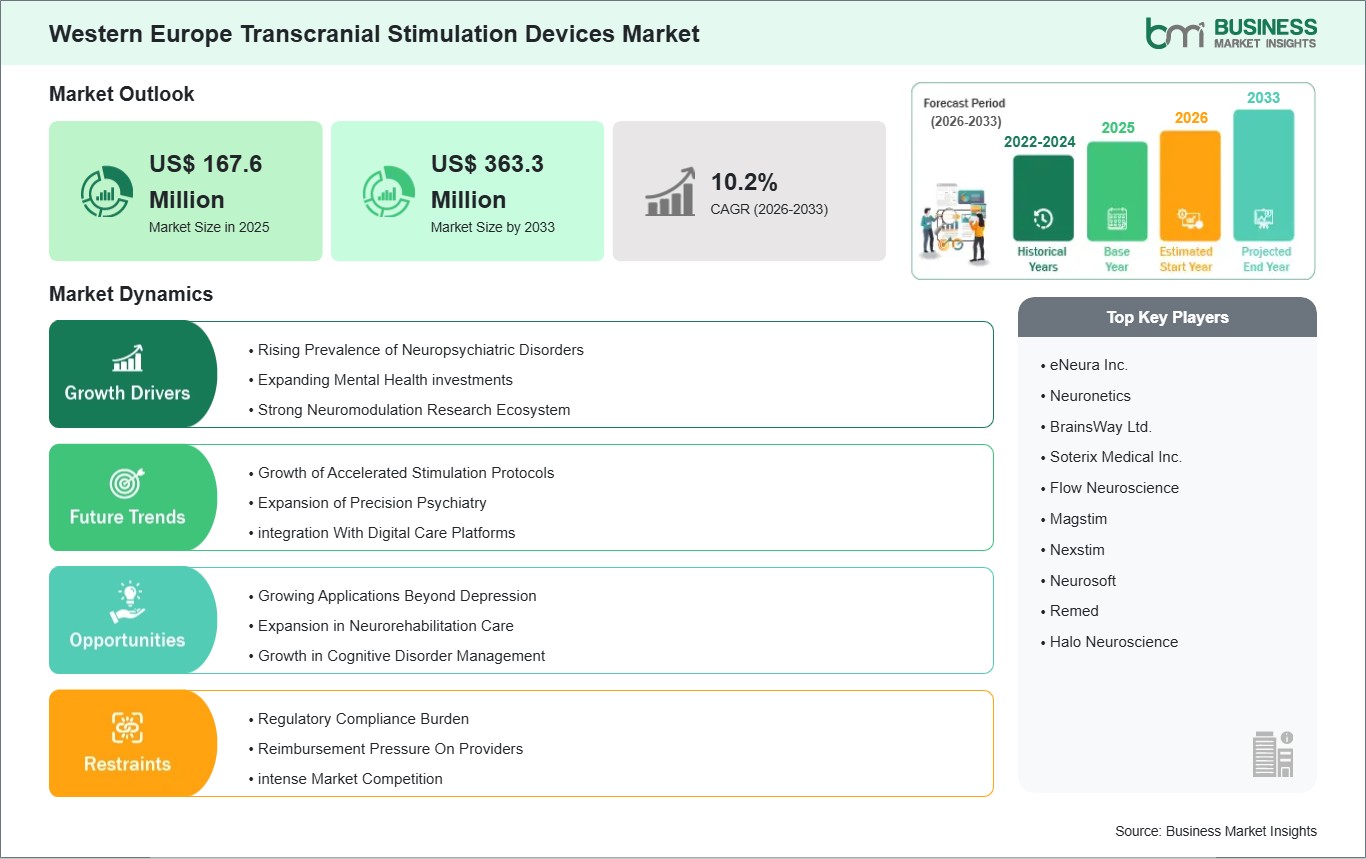
Western Europe is witnessing increasing incorporation of neuromodulation technologies into patient care management pathways for depression resistant to medication, chronic pain disorders, and cognitive restoration. Clinical support from neurologists and psychiatrists remains driven by the increasing endorsement of brain stimulation methods as supplementary options to drugs and psychological therapies in cases when treatment pathways prove to be non-responsive. Additional momentum comes from the growth in the availability of neurorehabilitation services in outpatient settings, along with increasing efforts to develop portable stimulation devices that will allow conducting therapy at home within the framework of integrated care programs. Key challenges faced by the industry include disparate interpretations of regulatory standards among healthcare systems, combined with the lack of reimbursement policies and standard clinical guidelines regarding emerging indications for brain stimulation. Manufacturers seek to increase stimulation accuracy, optimize the device usability, and adapt their products to the needs of hospital and private neurology departments focused on non-invasive treatment options. The competitive landscape is also driven by collaborative efforts in research across borders, as well as the process of developing standardized training methods for practitioners that together contribute to greater clinical consistency in different environments. Ongoing investments in neurotechnology ecosystems drive decision-making processes as cost-related issues meet demands for scientifically validated technologies of neuromodulation. Ethical concerns about brain enhancements and potential long-term effects of neuromodulation on patients are becoming key in discussions in regulatory frameworks and multidisciplinary healthcare teams.
Segment Analysis
Western Europe Transcranial Stimulation Devices Market Segmentation
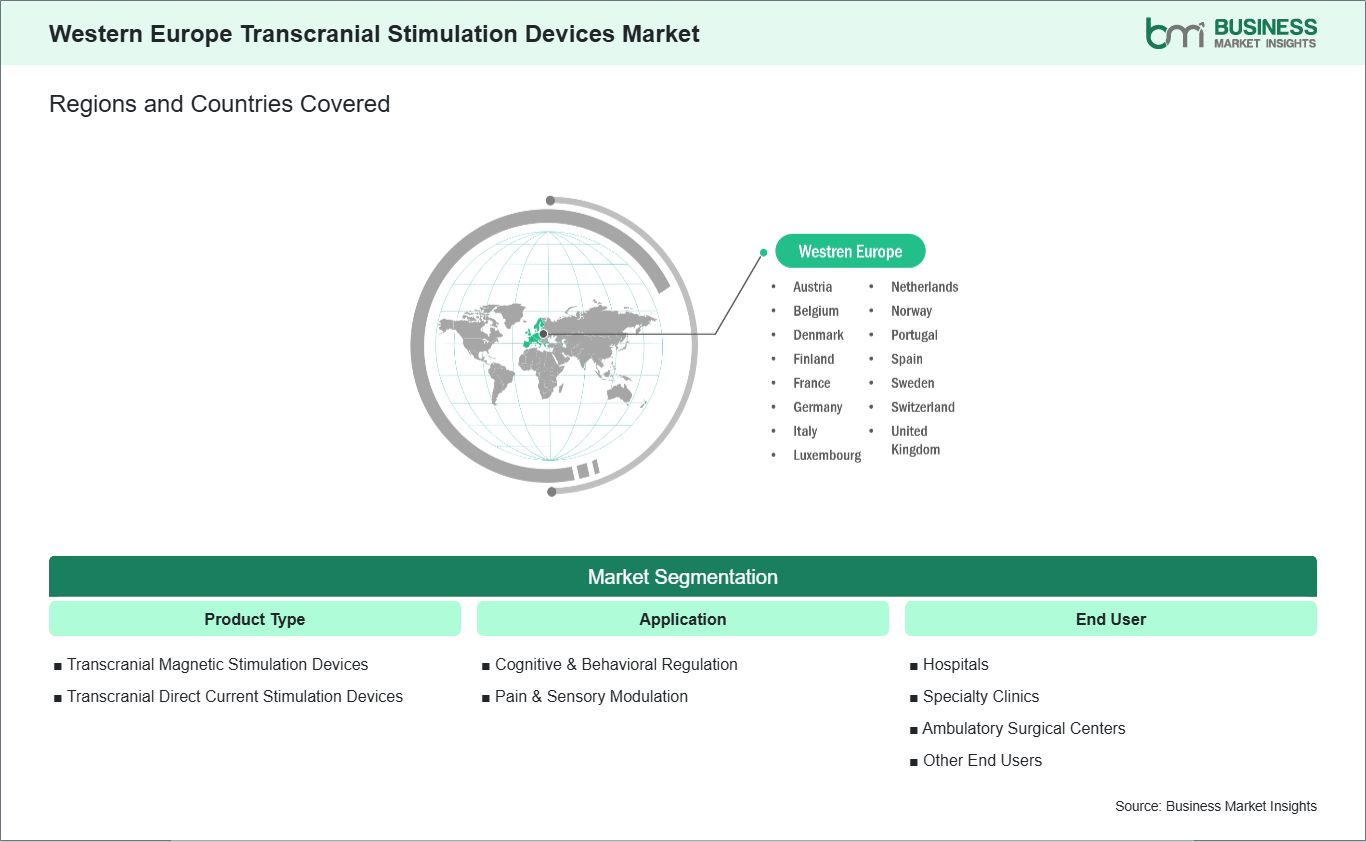
Key segments that contributed to the derivation of the Western Europe transcranial stimulation devices market analysis are product type, application, and end user.
- By product type, the transcranial stimulation devices market is segmented into transcranial magnetic stimulation devices and transcranial direct current stimulation devices. The transcranial magnetic stimulation devices segment dominated the market in 2025.
- Based on application, the transcranial stimulation devices market is categorized into cognitive & behavioral regulation and pain & sensory modulation. The cognitive & behavioral regulation segment dominated the market in 2025.
- In terms of end user, the transcranial stimulation devices market is categorized into hospitals, specialty clinics, ambulatory surgical centers, and other end users. The hospitals segment dominated the market in 2025.
Market Forces
Western Europe Transcranial Stimulation Devices Market Drivers and Opportunities
Rising Prevalence of Neuropsychiatric Disorders
Neurology and psychiatry departments in Western Europe are facing more difficult-to-treat cases and are considering neuromodulation techniques, including those based on transcranial stimulation devices, at an early stage. Care pathways are moving from being medication-driven to utilizing additional devices, especially in urban hospitals' networks, where multidisciplinary care teams analyze the impact of neuromodulation tools on patients' cognitive functioning and mood disorders over time.
The procurement of transcranial stimulation devices is characterized by a long evaluation process that is aimed at finding the best options to use alongside other neurological devices while meeting the regulatory requirements and providing opportunities for clinicians to be trained on their use. The decision-making is driven by workflow requirements, and budgets are allocated according to departmental specialization.
Outpatient clinics are adding new service lines, and the referral process is becoming organized in a way to allow identifying candidates for noninvasive brain stimulation devices. Devices are recommended to patients following the partial effectiveness of pharmacologic treatments, considering patients' tolerance to sessions, their scheduling, and functional stabilization.
Growing Applications Beyond Depression
Device manufacturers are focusing more on transcranial stimulation systems that have applications moving further into cognitive rehabilitation, pain control, and stroke rehabilitation processes outside the realm of mood disorder treatment experimentation. Research-oriented hospitals test such devices under programs of neuroplasticity, specifically at the neurology-led rehabilitation units in these hospitals.
Transcranial stimulation device application is being explored for use in perioperative neurorehabilitation and chronic pain management as a means of using nonpharmacological methods of neural circuit modulation to achieve rehabilitation goals without reliance on medications. The diffusion process is characterized by the adoption of the technology first in academic medical institutions and later spreading to specialized outpatient networks in regional health systems.
New therapeutic processes include the inclusion of neuromodulation procedures as part of rehabilitation for motor recovery, language recovery, and sensory processing issues. Clinicians are designing therapeutic plans that utilize device-based interventions together with other therapies rather than stand-alone therapies. The current experimentation trend is characteristic of European neurotherapy systems.
Size and Share Analysis
Western Europe Transcranial Stimulation Devices Market Size and Share Analysis
The Western Europe transcranial stimulation devices market demonstrates steady growth, with size and share analysis highlighting evolving trends and competitive dynamics among key players. The report examines subsegments categorized within product type, application, and end user, offering insights into their contribution to overall market performance.
By product type, the transcranial magnetic stimulation devices subsegment dominated the market in 2025, driven by its strong clinical efficacy in treating major depression and other neurological disorders, along with increasing regulatory approvals and growing adoption in hospital-based neuropsychiatric care.
Based on application, the cognitive & behavioral regulation subsegment dominated the market in 2025, driven by the rising prevalence of mental health disorders and increasing demand for non-invasive therapies that improve cognition, mood, and behavioral outcomes without pharmacological side effects.
In terms of end user, the hospitals subsegment dominated the market in 2025, driven by higher availability of advanced neurostimulation infrastructure, presence of trained specialists, and preference for supervised clinical environments for safe and effective patient treatment.
Report Coverage
Western Europe Transcranial Stimulation Devices Market Report Coverage and Deliverables
The "Western Europe Transcranial Stimulation Devices Market Size and Forecast (2022-2033)" report provides a detailed analysis of the market covering below areas:
- Market size and forecast at global, regional, and country levels for all the key market segments covered under the scope
- Market trends, as well as drivers, restraints, and opportunities
- Market analysis covering key trends, global and regional framework, major players, regulations, and recent developments
- Market concentration, heat map analysis, prominent players, and recent developments for the Market
- Detailed company profiles, including SWOT analysis
Geographic Insights
Western Europe Transcranial Stimulation Devices Market Geographic Insights
The geographical scope of the Western Europe Transcranial Stimulation Devices Market report is divided into Belgium, the Netherlands, Luxembourg, Germany, France, Italy, Spain, Switzerland, Sweden, Austria, the UK, Denmark, Portugal, Norway, and Finland. Germany held the largest share in 2025.
Germany is characterized by its advanced environment for neurotechnology, hospital capacity, reimbursement structure, and concentration of clinical trials and neurorehabilitation programs. Belgium is the gateway for cross-European policies on healthcare and research in the region, and multidisciplinary research studies and neurological centers that facilitate experiments with neuro-modulatory equipment. The integration of the digital healthcare system characterizes the Netherlands. Patients' inclination toward noninvasive treatment at home fosters the adoption of stimulation devices. Luxembourg is another growth driver in the region through cross-border patients' traffic and funding mechanisms within the medical technology industry. France's contribution comes from the development of neurological institutes and the modernization of its healthcare system. Post-stroke rehabilitative needs associated with the growing elderly population drive Italy's demand. Private investments in healthcare boost the demand in Spain and specialization in neuropsychiatry. Sweden utilizes excellence in neuroscience research and efficient health-tech integration. Austria's benefits come from the growth of rehab centers and coverage of insurance services for neuromodulation treatments. The UK retains its momentum due to the NHS's mental health campaigns and the emerging popularity of non-drug brain stimulation techniques. Telemedicine provides Denmark with better treatment approaches and decentralized treatments. Portugal is focusing on the progressive improvement of the healthcare system and the cost-effective adoption of treatments. Norway maintains a steady demand due to high healthcare expenditures and remote neurological treatment options. Finland improves through advanced digital healthcare and remote neurotherapy.
Industry Activity
Recent Developments
The Western Europe Transcranial Stimulation Devices Market is evaluated by gathering qualitative and quantitative data post primary and secondary research, which includes important corporate publications, association data, and databases. A few of the key developments in the Western Europe transcranial stimulation devices market are:
- In May 2023, Nexstim announced that its NBS 6 system received EU MDR certification, enabling commercial sale and clinical deployment across Western European markets for the treatment of major depressive disorder and chronic neuropathic pain.
- In May 2023, Neuronetics announced that its NeuroStar Advanced Therapy system received CE Mark approval under the EU Medical Device Regulation (MDR), enabling continued commercialization and regulatory compliance across Western European healthcare systems.
Trust & Transparency
Research Methodology
The market analysis combines proprietary research with secondary data from government agencies, company disclosures, regulatory filings, industry databases and expert interviews. Market estimates are validated through data triangulation, cross-market benchmarking and analyst
review.
View Full Research Methodology
Key Sources Referred:
U.S. Food and Drug Administration (FDA)National Institute of Mental Health (NIMH)National Institute for Health and Care Excellence (NICE)European Medicines Agency (EMA)Medicines and Healthcare products Regulatory Agency (MHRA)American Psychiatric Association (APA)World Health Organization (WHO)International Neuromodulation Society (INS)International Society for Neuroregulation & Research (ISNR)European Society for Magnetic Resonance in Medicine and Biology (ESMRMB)Company WebsitesCompany Annual ReportsCompany Investor Presentations