Market Summary
Executive Summary and Market Analysis
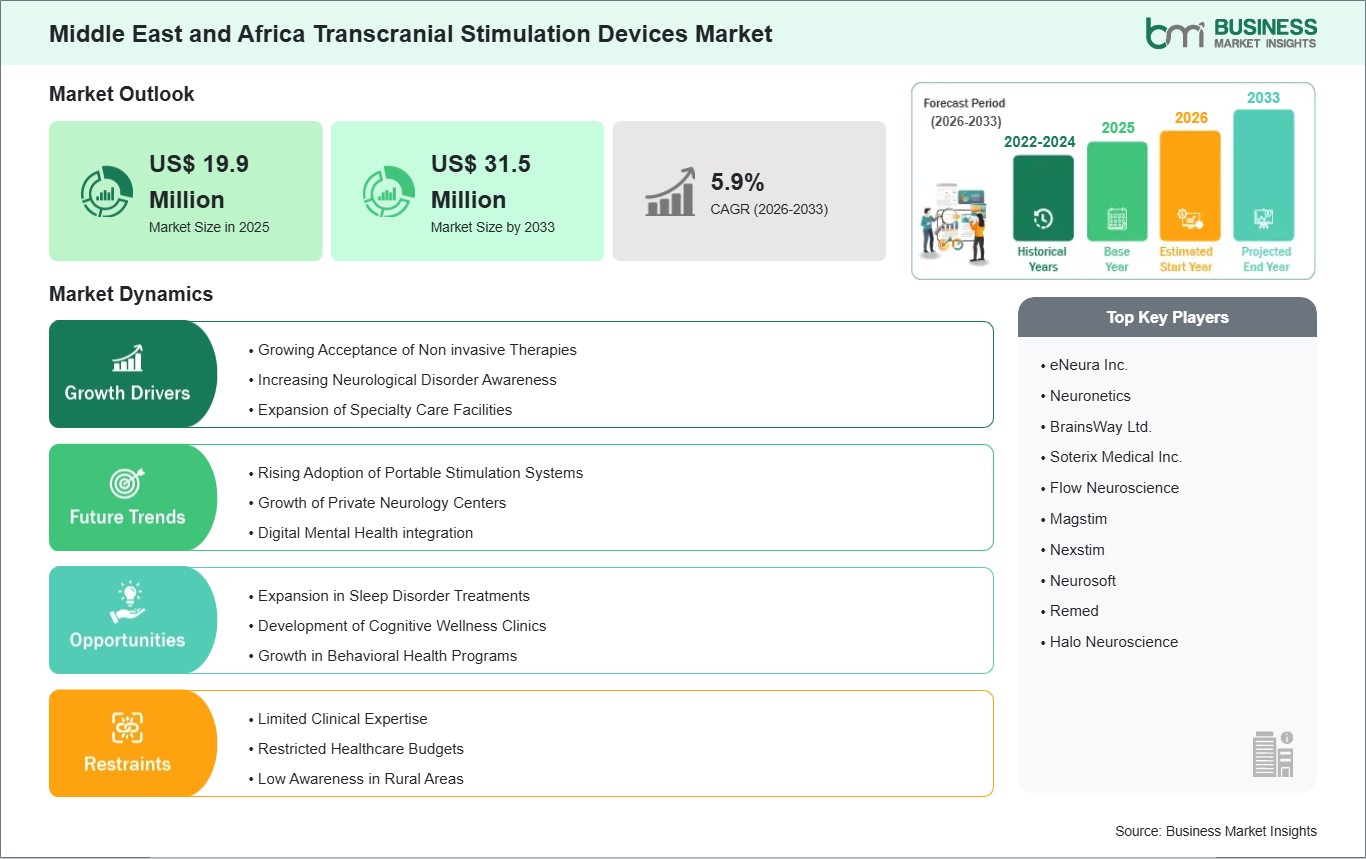
There is increasing innovation in the use of transcranial stimulation devices in the Middle East and Africa region due to the prioritization of non-invasive techniques in the management of complex brain disorders. The emergence of more interest in cases involving neurological and psychiatric illnesses like depression, epilepsy, Parkinson's disease, chronic pain, and recovery after stroke has seen increased attention given to technologies like transcranial magnetic stimulation and transcranial direct current stimulation. The application of these devices has been integrated into hospitals and neurological centers in an effort to minimize drug dependency while maximizing personalized approaches to care. An important factor that shapes the industry is the increase in mental health and neurological care programs, especially within the Gulf Cooperation Council states. The other notable factor is related to rising collaborations among research institutions, universities, and medical device manufacturers targeting the field of cognitive neuroscience and neuro-rehabilitation to promote greater clinical validation and professionalism for neuromodulation treatments. Another positive trend observed in the industry is the emergence of portable and easy-to-use stimulation devices used in outpatient facilities and rehabilitation centers. While all these are contributing positively towards the growth of the market, its adoption is hindered due to poor reimbursement practices and the scarcity of skilled neurologists and neurostimulation experts in various African and Middle Eastern countries. Furthermore, issues such as difficult regulatory approvals, disparities in access to health care services between rural and urban areas, and expensive procurement of state-of-the-art stimulation devices are hampering the market expansion, leaving the industry restricted within specialized facilities and private healthcare settings.
Segment Analysis
Middle East and Africa Transcranial Stimulation Devices Market Segmentation
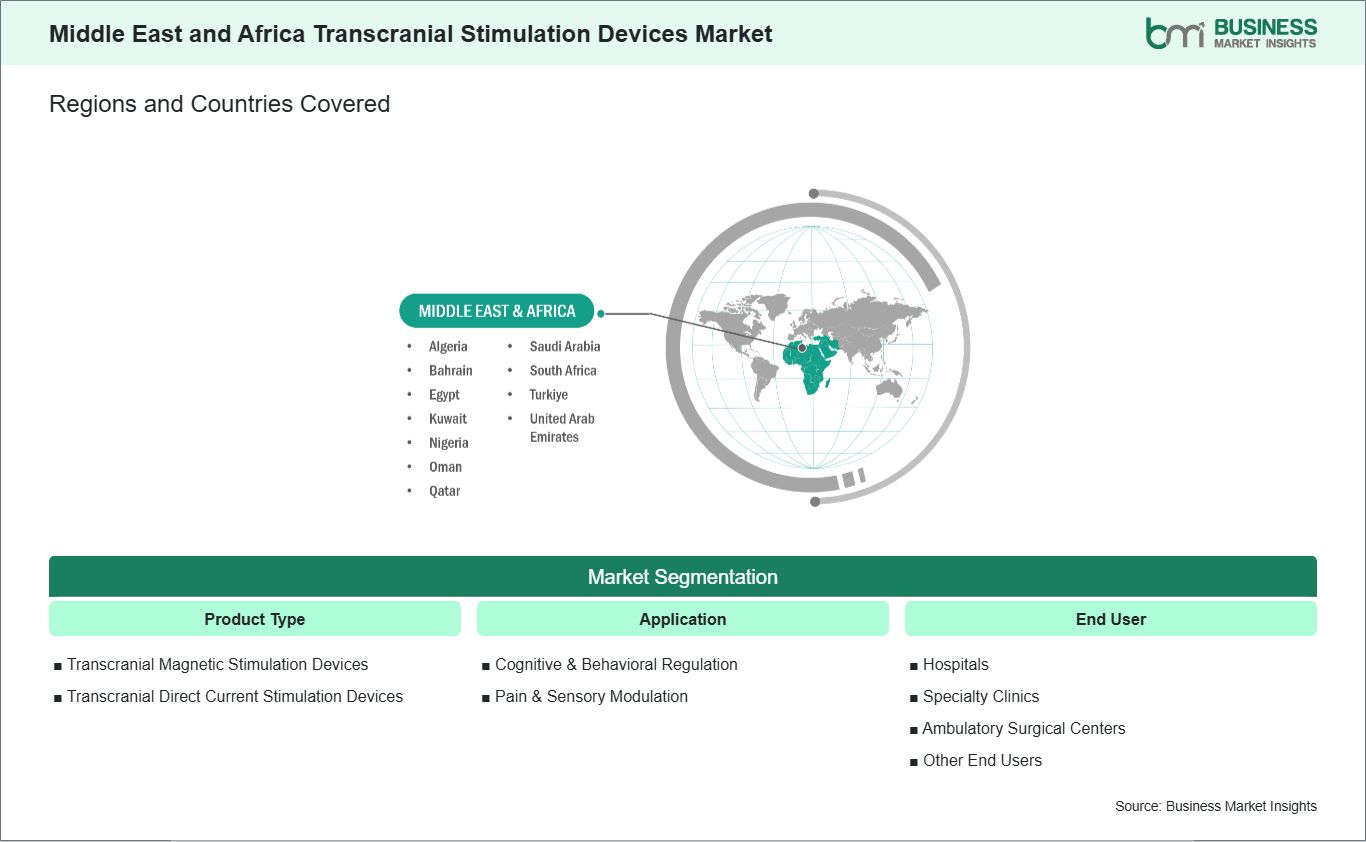
Key segments that contributed to the derivation of the Middle East and Africa transcranial stimulation devices market analysis are product type, application, and end user.
- By product type, the transcranial stimulation devices market is segmented into transcranial magnetic stimulation devices and transcranial direct current stimulation devices. The transcranial magnetic stimulation devices segment dominated the market in 2025.
- Based on application, the transcranial stimulation devices market is categorized into cognitive & behavioral regulation and pain & sensory modulation. The cognitive & behavioral regulation segment dominated the market in 2025.
- In terms of end user, the transcranial stimulation devices market is categorized into hospitals, specialty clinics, ambulatory surgical centers, and other end users. The hospitals segment dominated the market in 2025.
Market Forces
Middle East and Africa Transcranial Stimulation Devices Market Drivers and Opportunities
Growing Acceptance of Non Invasive Therapies
Transcranial stimulation devices have become common among health practitioners in the Middle East and Africa region in treating neurological and psychiatric ailments owing to their preference for non-invasive treatment protocols. Medical professionals are now using these techniques to treat patients with long-term medical needs without resorting to surgery.
Stimulation techniques are increasingly being adopted by hospitals and specialized treatment centers along with psychotherapy sessions and neuro-rehabilitation programs. These medical gadgets are progressively shifting from experimentation to clinical practices, especially when patients fail to respond to drug-based treatment methods.
In addition, there is growing acceptance among patients to adopt non-drug therapy using stimulators to treat mental illnesses such as depression and anxiety and stroke-related ailments. Health institutions are offering outpatient therapy options while device manufacturers concentrate on producing lightweight and user-friendly devices.
Expansion in Sleep Disorder Treatments
The application of transcranial stimulation equipment in sleep disorders is becoming popular as healthcare professionals seek out neurological methods for insomnia and irregular sleep cycles. Treatment facilities are increasingly opting for the employment of brain stimulation treatments among individuals who are suffering from cognitive and stress-based sleep disturbances.
Sleep problems are now increasingly being associated with the mental state and general neurological well-being of the affected individuals. This has prompted many medical professionals to recommend more stimulating treatments in an attempt to offer a treatment alternative other than sedatives.
The emergence of wellness centers and neurotherapy centers in the urban environment has boosted such treatment. Medical practitioners are offering customized sessions for people with stress-based sleep problems as manufactures have been developing stimulant equipment that allows short stimulation sessions.
Size and Share Analysis
Middle East and Africa Transcranial Stimulation Devices Market Size and Share Analysis
The Middle East and Africa transcranial stimulation devices market demonstrates steady growth, with size and share analysis highlighting evolving trends and competitive dynamics among key players. The report examines subsegments categorized within product type, application, and end user, offering insights into their contribution to overall market performance.
By product type, the transcranial magnetic stimulation devices subsegment dominated the market in 2025, driven by its strong clinical efficacy in treating major depression and other neurological disorders, along with increasing regulatory approvals and growing adoption in hospital-based neuropsychiatric care.
Based on application, the cognitive & behavioral regulation subsegment dominated the market in 2025, driven by the rising prevalence of mental health disorders and increasing demand for non-invasive therapies that improve cognition, mood, and behavioral outcomes without pharmacological side effects.
In terms of end user, the hospitals subsegment dominated the market in 2025, driven by higher availability of advanced neurostimulation infrastructure, presence of trained specialists, and preference for supervised clinical environments for safe and effective patient treatment.
Report Coverage
Middle East and Africa Transcranial Stimulation Devices Market Report Coverage and Deliverables
The "Middle East and Africa Transcranial Stimulation Devices Market Size and Forecast (2022-2033)" report provides a detailed analysis of the market covering below areas:
- Market size and forecast at global, regional, and country levels for all the key market segments covered under the scope
- Market trends, as well as drivers, restraints, and opportunities
- Market analysis covering key trends, global and regional framework, major players, regulations, and recent developments
- Market concentration, heat map analysis, prominent players, and recent developments for the Market
- Detailed company profiles, including SWOT analysis
Geographic Insights
Middle East and Africa Transcranial Stimulation Devices Market Geographic Insights
The geographical scope of the Middle East and Africa Transcranial Stimulation Devices Market report is divided into Turkiye, the UAE, Saudi Arabia, Bahrain, Oman, Egypt, South Africa and Africa, Algeria, Nigeria, Kuwait, and Qatar. Turkiye held the largest share in 2025.
The Transcranial Stimulation Devices Market in the Middle East and Africa exhibits a consistent growth trend as a result of enhanced awareness of the disorders affecting the central nervous system, improved healthcare facilities, and growing use of non-invasive therapies. In the MENA region, Turkiye is a leader in terms of the growth of the market as a result of advanced hospital facilities, active research in neuroscience, and the implementation of transcranial stimulation procedures for treating psychiatric illnesses and performing neurorehabilitation treatments. Strong manufacturing capabilities and high demand for clinical devices support its dominant position in the area. In the United Arab Emirates, market expansion is fostered by the fast digitalization of the sector, demand for more advanced neurological treatments, and the availability of specialized facilities for delivering wellness and cognitive therapy. Saudi Arabia is characterized by a rapidly growing market because of ongoing healthcare reform efforts, mental health awareness campaigns, and investments in state-of-the-art treatment equipment. Bahrain shows a gradual improvement of its market position owing to the growth of the healthcare sector in the private sector, physician awareness of innovative neurostimulation, and Oman's market success is driven by the use of minimally invasive methods of treatment for chronic diseases. The growth of markets in Egypt stems from increasing investments into education in the medical field, enhanced availability of neurodiagnostic services for patients, and improved cooperation between educational establishments and healthcare organizations. In South Africa, the market remains one of the largest on the African continent owing to the advanced medical infrastructure, presence of various rehabilitation activities, and development of medical technology distribution channels in other African nations. As for Algeria, Nigeria, Kuwait, and Qatar, there are also noticeable developments in the market as a result of enhanced accessibility to specialists, hospital modernization, and awareness concerning neuromodulation treatment methods.
Industry Activity
Recent Developments
The Middle East and Africa Transcranial Stimulation Devices Market is evaluated by gathering qualitative and quantitative data post primary and secondary research, which includes important corporate publications, association data, and databases. A few of the key developments in the Middle East and Africa transcranial stimulation devices market are:
- In May 2026, neurocare group AG announced that it had received Saudi Food & Drug Authority (SFDA) Medical Device Marketing Authorization (MDMA) approval for its transcranial magnetic stimulation (TMS) devices in Saudi Arabia, enabling the company to expand access to non-invasive mental health treatment solutions across the Middle East.
- In February 2026, Nexstim announced that it had received import clearance in the United Arab Emirates for its NBS 6 Diagnostics System, strengthening the company's expansion of navigated transcranial magnetic stimulation (nTMS) technologies in the Middle East healthcare market.
Trust & Transparency
Research Methodology
The market analysis combines proprietary research with secondary data from government agencies, company disclosures, regulatory filings, industry databases and expert interviews. Market estimates are validated through data triangulation, cross-market benchmarking and analyst
review.
View Full Research Methodology
Key Sources Referred:
U.S. Food and Drug Administration (FDA)National Institute of Mental Health (NIMH)National Institute for Health and Care Excellence (NICE)European Medicines Agency (EMA)Medicines and Healthcare products Regulatory Agency (MHRA)American Psychiatric Association (APA)World Health Organization (WHO)International Neuromodulation Society (INS)International Society for Neuroregulation & Research (ISNR)European Society for Magnetic Resonance in Medicine and Biology (ESMRMB)Company WebsitesCompany Annual ReportsCompany Investor Presentations