Market Summary
Executive Summary and Market Analysis
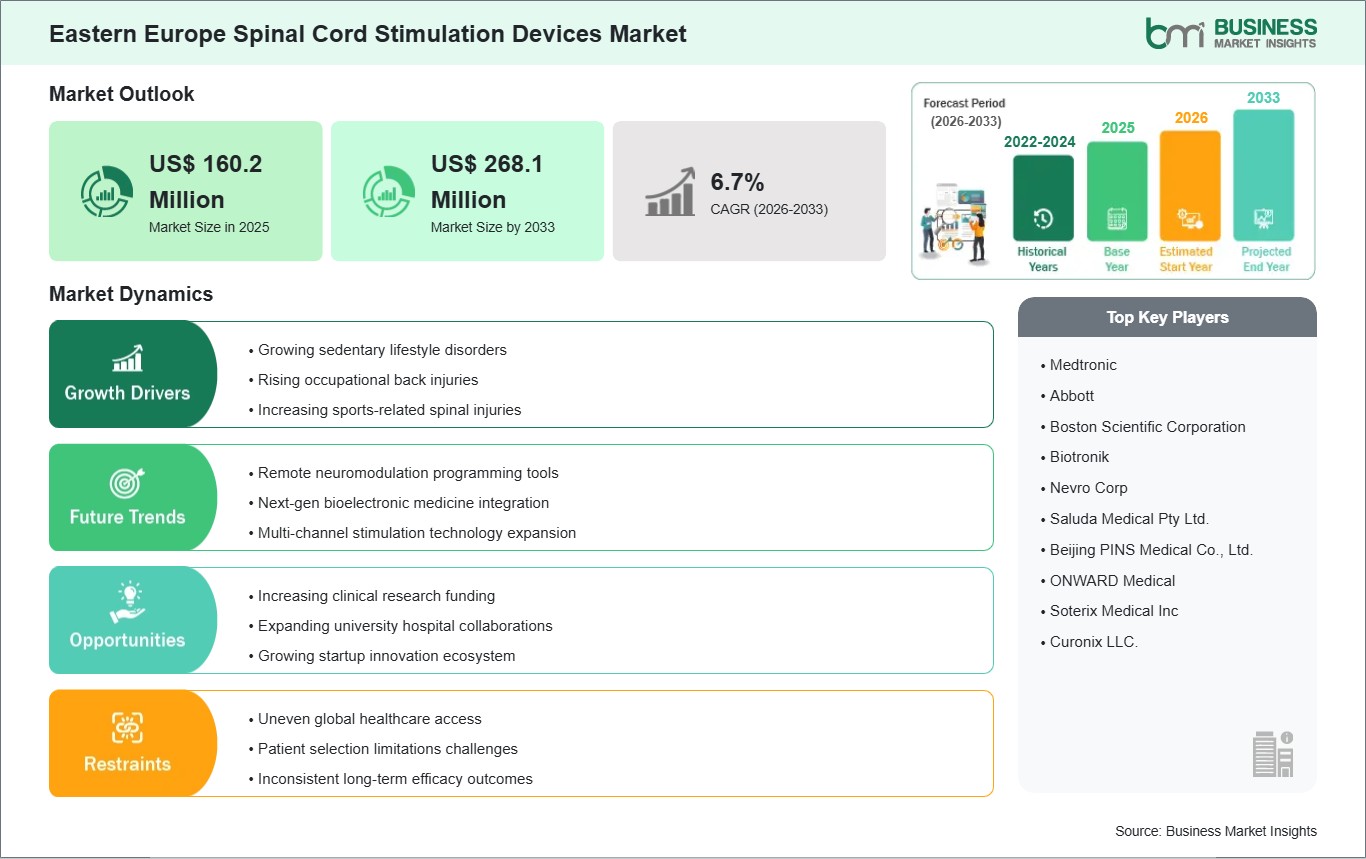
The market for SCS devices in the Eastern Europe is an emerging industry in the overall neuromodulation market and entails slow adoption of new pain management techniques amid healthcare system upgrading. This market is stimulated by the rising cases of chronic spinal diseases, degenerative disorders, and neuropathic pains that cannot be treated using pharmacotherapy methods. The use of spinal cord stimulation is becoming more relevant among medical specialists as a means to help patients suffering from pain in urban areas where advanced medical centers offer a wide range of services. The growth potential of the market is fostered by the steady increase of specialized private hospitals in the region, as well as growing knowledge on international practice in the field of neuromodulation techniques among local physicians. Advanced treatment programs involving spinal cord stimulation become part of the repertoire of neurosurgeons working in specialized centers located in large cities. Nevertheless, the market is constrained by the scarcity of reimbursement opportunities, unbalanced development of healthcare infrastructure, and financial restrictions limiting access to expensive implantable equipment in public healthcare organizations. Furthermore, the level of awareness about spinal cord stimulation is still quite limited, thus restricting the number of early referrals. However, despite the difficulties, the market has promising prospects due to the modernization of health care services and the rising demand for chronic pain management devices.
Segment Analysis
Eastern Europe Spinal Cord Stimulation Devices Market Segmentation
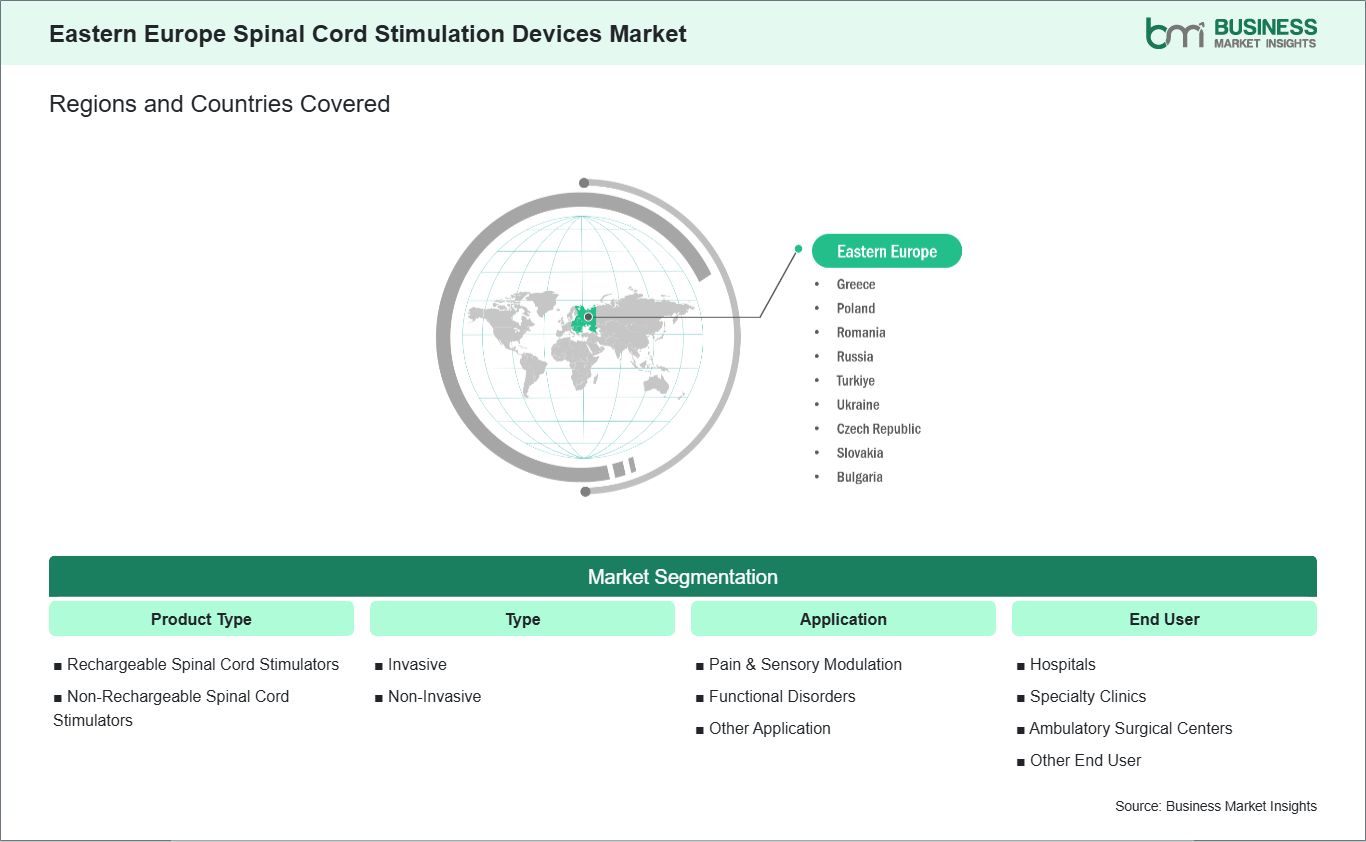
Key segments that contributed to the derivation of the Eastern Europe spinal cord stimulation devices market analysis are product type, type, application, and end user.
- By product type, the spinal cord stimulation devices market is segmented into rechargeable spinal cord stimulators and non-rechargeable spinal cord stimulators. The rechargeable spinal cord stimulators segment dominated the market in 2025.
- Based on type, the spinal cord stimulation devices market is segmented into invasive and non-invasive. The invasive segment dominated the market in 2025.
- On the basis of application, the spinal cord stimulation devices market is classified into pain and sensory modulation, functional disorders, and other application. The pain and sensory modulation segment dominated the market in 2025.
- In terms of end user, the spinal cord stimulation devices market is categorized into hospitals, specialty clinics, ambulatory surgical centers, and other end user. The hospitals segment dominated the market in 2025.
Market Forces
Eastern Europe Spinal Cord Stimulation Devices Market Drivers and Opportunities
Growing Sedentary Lifestyle Disorders
Eastern Europe SCS Devices Market Overview: The Eastern European market for spinal cord stimulation devices is influenced by the rising prevalence of sedentary lifestyle-induced illnesses such as spinal deterioration, neuropathy, and musculoskeletal ailments. There is an increasing trend towards office work that involves prolonged periods of sitting and minimal physical exercise among the working population. The rise in cases of lower back pain and cervical spine problems, which are some of the leading causes of disability in the region, can be attributed to this trend.
Healthcare settings in metropolitan areas are recording higher numbers of patients suffering from degenerative disc problems and chronic radicular pain associated with poor posture, obesity, and physical inactivity. Such illnesses tend to be refractory to traditional pain management interventions such as physical therapy and analgesics, hence the increased preference for advanced treatment options. In this regard, spinal cord stimulation is fast emerging as a safe and effective pain management procedure for patients with chronic neuropathic pain and limited success with conservative treatment strategies.
Moreover, changes in lifestyles following changes in economic and industrial trends have led to greater susceptibility to sedentary activities among the younger generation as well. The early occurrence of spine degenerative diseases has resulted in a prolongation of disease duration and need for neuromodulation treatment programs. With growing awareness about non-opioid treatment strategies for pain, spinal cord stimulation has gained importance within a multidisciplinary approach to pain treatment.
Increasing Clinical Research Funding
The Eastern Europe spinal cord stimulation devices market is further propelled by increased funding of clinical research activities related to neuromodulation devices and management of chronic pain. The governments as well as medical academicians are slowly but surely making greater investments in neurological studies, which are intended to improve treatment approaches towards spinal problems and neuropathic pains. This, in turn, helps to create more evidence for spinal cord stimulation devices in the region.
Clinical trials on advanced SCS devices, including high frequency stimulation and burst stimulation, are being carried out across several leading medical universities and hospitals. Patient selection methods as well as optimization of SCS treatments are gaining momentum, particularly in terms of tackling those hard-to-treat chronic pains. Collaborations between domestic and foreign medical device companies have also been aiding innovation in neuromodulation technology platform development.
In addition, the increased involvement of practitioners in multinational clinical trials is facilitating the dissemination of knowledge and training in modern techniques for pain management. The support provided for translational research is allowing for faster application of scientifically proven neuromodulation methods in clinical settings. With the further development of research facilities, spinal cord stimulation can become clinically validated and incorporated into standard pain treatment protocols in the region.
Size and Share Analysis
Eastern Europe Spinal Cord Stimulation Devices Market Size and Share Analysis
The Eastern Europe spinal cord stimulation devices market is experiencing steady growth, with market size and share analysis reflecting evolving treatment preferences and competitive dynamics among key players. The report evaluates important subsegments categorized within product type, type, application, and end user, highlighting their respective contributions to overall market performance.
By product type, the rechargeable spinal cord Stimulators subsegment dominated the market in 2025, because long-term chronic pain treatment requires devices that can operate continuously for several years without frequent replacement. Patients increasingly preferred rechargeable systems as they reduce the likelihood of repeat surgeries and lower overall treatment interruption.
Based on type, the invasive subsegment dominated the market in 2025 because implanted spinal cord stimulators deliver more stable and accurate nerve stimulation compared to external therapies. These systems are widely used for severe chronic pain conditions where medication and physiotherapy provide limited relief.
On the basis of application, the pain and sensory modulation subsegment dominated the market in 2025, because spinal cord stimulation is primarily designed to manage chronic neuropathic and musculoskeletal pain. The growing number of patients suffering from lower back pain, diabetic nerve pain, and post-surgical pain significantly increased demand for neuromodulation therapies.
In terms of end user, the hospitals subsegment dominated the market in 2025 because most spinal cord stimulator procedures require specialized surgical facilities, imaging equipment, and multidisciplinary pain management teams. Patients generally prefer hospitals for implantation procedures due to better emergency support and post-operative monitoring capabilities.
Report Coverage
Eastern Europe Spinal Cord Stimulation Devices Market Report Coverage and Deliverables
The "Eastern Europe Spinal Cord Stimulation Devices Market Size and Forecast (2022-2033)" report provides a detailed analysis of the market covering below areas:
- Market size and forecast at regional and country levels for all market segments covered under the scope
- Market trends, as well as drivers, restraints, and opportunities
- Market analysis covering key trends, regional framework, major players, regulations, and recent developments
- Market concentration, heat map analysis, prominent players, and recent developments for the Market
- Detailed company profiles, including SWOT analysis
Geographic Insights
Eastern Europe Spinal Cord Stimulation Devices Market Geographic Insights
The geographical scope of the Eastern Europe spinal cord stimulation devices market report is divided into: Russia, Poland, Romania, the Czech Republic, Ukraine, Romania, Greece, Slovakia, and Bulgaria. Russia held the largest share in 2025.
The Russian domination in the Eastern Europe market of spinal cord stimulation devices arises from the relatively developed healthcare infrastructure of the country, along with an increase in the availability of neurosurgery in various urban facilities and a tendency towards more progressive techniques in managing pain. Large cities like Moscow and St. Petersburg have developed specialized hospitals, neurology research institutes that utilize spinal cord stimulation for managing complicated forms of pain, neuropathic pain, failed back surgery syndrome, and spinal degeneration syndromes. The reason behind this domination lies in the existence of well-developed tertiary healthcare institutions that provide services of skilled neurosurgeons and doctors specializing in pain who become increasingly accustomed to worldwide clinical practices. As a result, there is a gradual introduction of implantable neuromodulation therapy as a technique for managing chronic pain, especially in cases when other therapeutic methods were ineffective. In addition, the development of private healthcare facilities has enhanced access to advanced medical technologies. But it should be noted that the development of technology is constrained by its cost, lack of reimbursement options, and availability in certain areas due to the limited availability of advanced medical equipment. Hospitals in the public sphere concentrate their efforts on providing basic care, which does not provide an opportunity to introduce other technologies, including implantation. In addition, peoples and doctors' awareness of this issue needs development for earlier detection. Nevertheless, despite this, Russia maintains its leading role in the implementation of this technology in Eastern Europe, driven by the introduction of new solutions and the expansion of the private healthcare sector.
Industry Activity
Recent Developments
The Eastern Europe spinal cord stimulation devices market is evaluated by gathering qualitative and quantitative data post primary and secondary research, which includes important corporate publications, association data, and databases. A few of the key developments in the Eastern Europe spinal cord stimulation devices market are:
- In November 2024, Nevro Corp. announced that it received CE Mark certification for its HFX iQ spinal cord stimulation system, allowing commercialization across Europe, including Eastern European markets where advanced high-frequency SCS therapy is being increasingly adopted in private and university hospital pain clinics.
- In December 2023, Medtronic announced that it received CE Mark approval for its Percept RC neurostimulator with BrainSense technology, strengthening its neuromodulation portfolio in Europe and supporting expanded use in Eastern European healthcare systems for chronic pain and movement disorder management.
Trust & Transparency
Research Methodology
The market analysis combines proprietary research with secondary data from government agencies, company disclosures, regulatory filings, industry databases and expert interviews. Market estimates are validated through data triangulation, cross-market benchmarking and analyst
review.
View Full Research Methodology
Key Sources Referred:
The World BankWorld Health Organization (WHO)Center for Disease Control and Prevention (CDC)Food and Drug Administration (FDA)Centers for Medicare and Medicaid Services (CMS)European CommissionMedicines and Healthcare products Regulatory Agency (MHRA)Company WebsitesCompany Annual ReportsCompany Investor Presentation