Market Summary
Executive Summary and Market Analysis
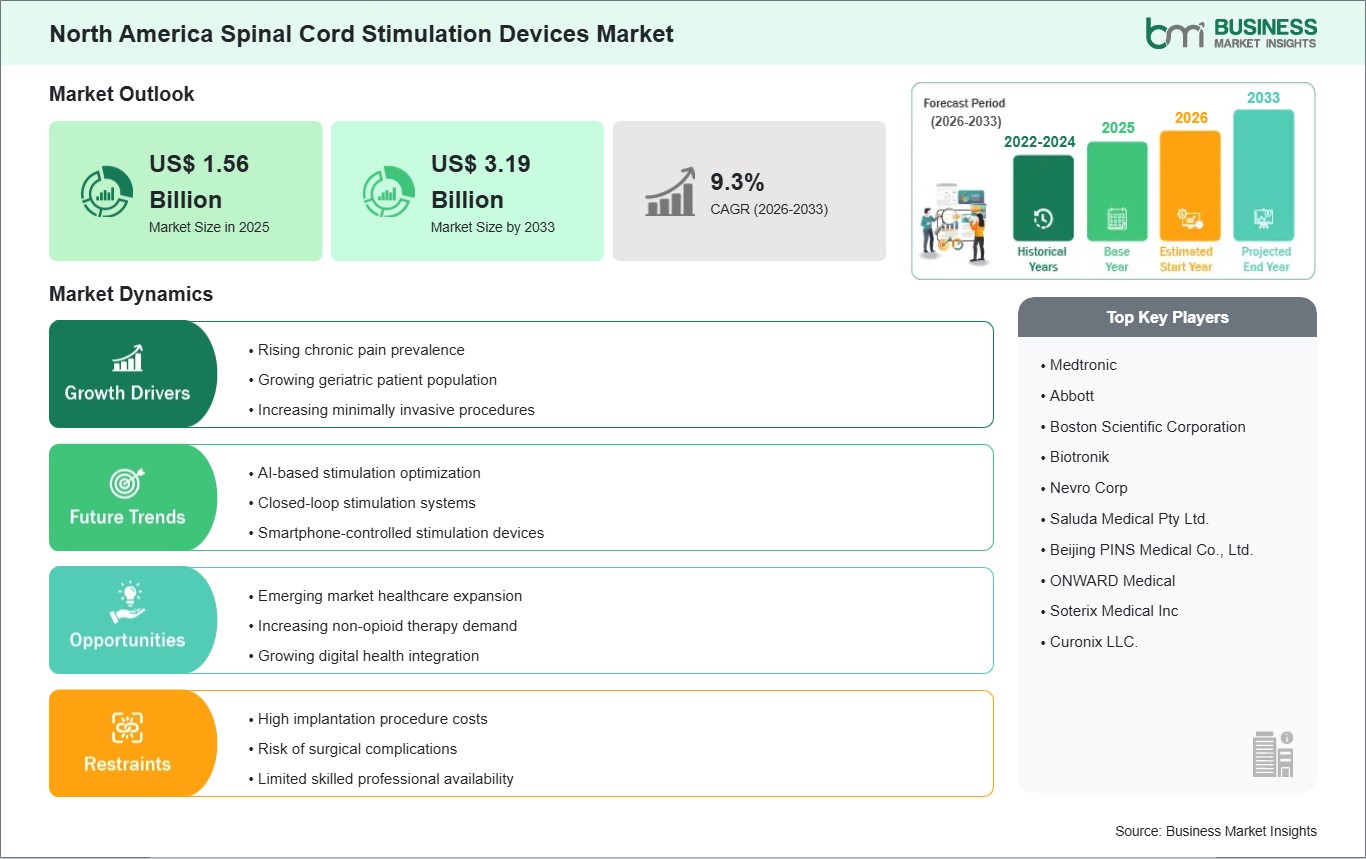
North America spinal cord stimulation devices market is a leading and highly developed neuromodulation segment, demonstrating intensive implementation in clinical practice, as well as early introduction of implantable technologies for pain management. Growth of this market is mostly due to a great number of chronic pain disorders (for example, failed back surgery syndrome, degenerative spine disease, and other neuropathic pain) that require innovative and modern treatment approach. In accordance with the growing preference for non-opioid solutions and long-term results, spinal cord stimulation has gained popularity as an intervention in pain therapy. Among the main drivers are experienced pain specialists and neurosurgeons familiar with neuromodulation procedures and able to apply implantable SCS technologies consistently. Patients in North America usually have good knowledge regarding treatment options, thus, it is easier for them to accept implantation as a treatment modality. Besides, development of SCS devices and systems, including advancements in pulse generators and increased programmability of stimulators, facilitates wider use and improves the efficiency of this treatment method. Nevertheless, the market faces several limitations such as relatively high procedural costs and the invasiveness of implants, which may affect patient adherence from some categories of patients. Insurance coverage and the process of obtaining prior authorizations have been identified as additional barriers to accessing treatment, especially when dealing with new technologies and stimulation systems. Moreover, variability in patient responses is an important factor that needs to be considered, especially in the case of ambiguous decisions of physicians. Nevertheless, the North American region retains a promising outlook on the market due to its advanced healthcare system, high level of treatment availability at specialized facilities, and continuous innovations within neuromodulation.
Segment Analysis
North America Spinal Cord Stimulation Devices Market Segmentation
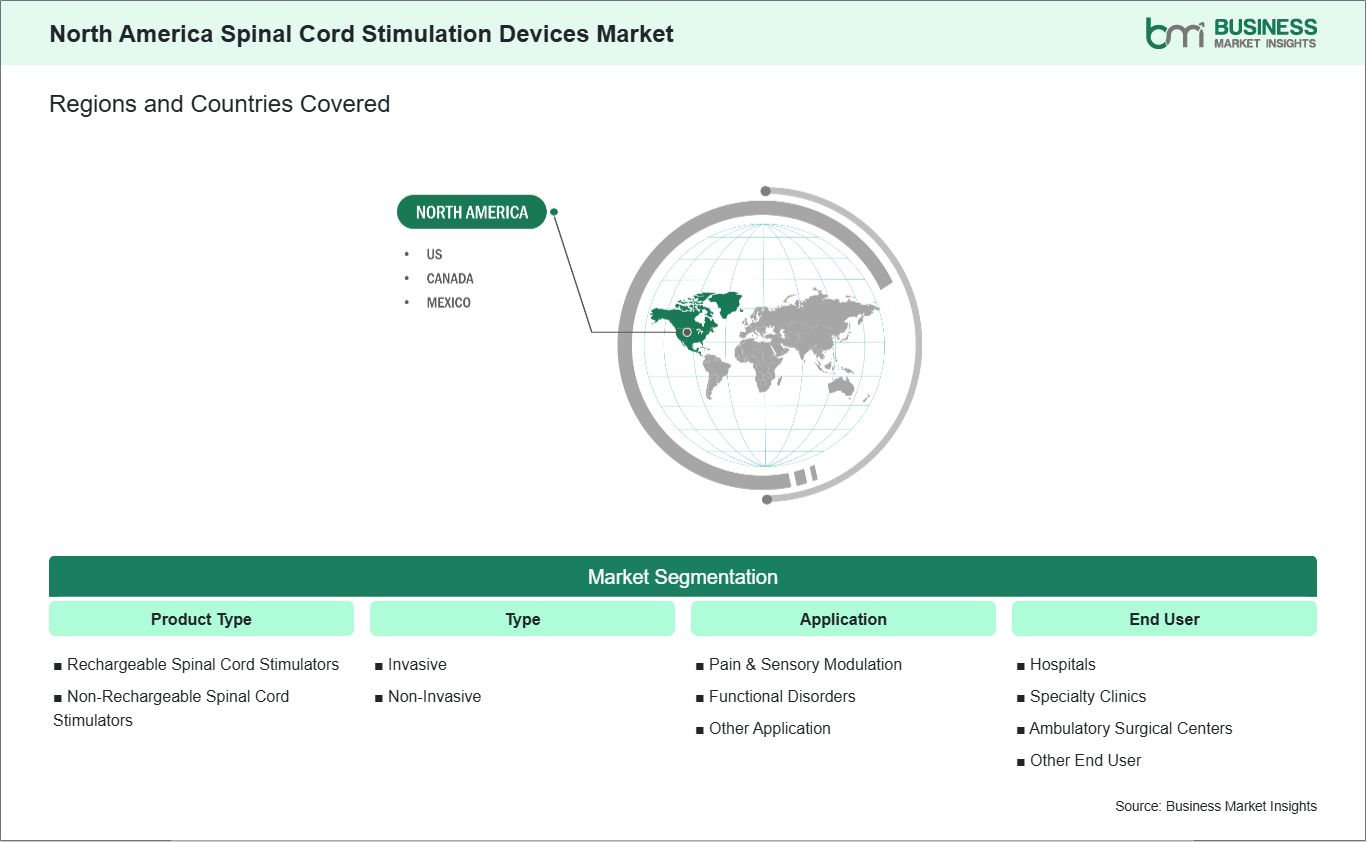
Key segments that contributed to the derivation of the North America spinal cord stimulation devices market analysis are product type, type, application, and end user.
- By product type, the spinal cord stimulation devices market is segmented into rechargeable spinal cord stimulators and non-rechargeable spinal cord stimulators. The rechargeable spinal cord stimulators segment dominated the market in 2025.
- Based on type, the spinal cord stimulation devices market is segmented into invasive and non-invasive. The invasive segment dominated the market in 2025.
- On the basis of application, the spinal cord stimulation devices market is classified into pain and sensory modulation, functional disorders, and other application. The pain and sensory modulation segment dominated the market in 2025.
- In terms of end user, the spinal cord stimulation devices market is categorized into hospitals, specialty clinics, ambulatory surgical centers, and other end user. The hospitals segment dominated the market in 2025.
Market Forces
North America Spinal Cord Stimulation Devices Market Drivers and Opportunities
Rising chronic pain prevalence
The growth of the market for Spinal Cord Stimulation devices in North America will be fueled by the growing prevalence of disorders characterized by chronic pain syndromes such as neuropathic pain, failed back syndrome, and complex regional pain syndrome. The number of people who suffer from pain-related disorders is very high among the population living within the continent with figures pointing at more than 100 million people experiencing such pain conditions.
In the context of well-developed healthcare infrastructure, hospitals and SCS pain management clinics have been noting a consistent increase in the number of SCS implantation surgeries, which is attributed to more spinal surgeries and age-related disorders. Major hospital chains in large cities have reported an increase in the number of admissions of patients suffering from chronic pain in their limbs or backs, which may be associated with spinal degeneration due to poor life practices and post-operation problems.
Moreover, there has been a transition from the widespread use of opioids for pain management; hence, SCS implantation is gaining popularity. The growing recommendation of using SCS for patients experiencing intractable pain by regulatory authorities and medical associations is among the reasons for this trend.
Emerging market healthcare expansion
North American SCS devices are also witnessing the positive impact of ongoing growth in the health care sector and increased access to modern neuromodulation treatments. North America has one of the most developed hospital networks and high health care expenditure that has helped it adopt innovative techniques quickly in pain management therapies. Over the past few years, substantial investment made in the establishment of ambulatory surgery centers and pain clinics has widened the reach of SCS devices across hospitals.
Coverage and payment mechanisms are key factors in driving market growth. A considerable share of the spinal cord stimulator procedure is covered by public and private health insurance providers. This trend has been a source of reduced cost burden for patients, making them avail such expensive treatment options more frequently than before.
The rapid progress in technology along with the presence of prominent medical devices companies has contributed to growth. Innovations in the area of recharging systems, minimally invasive surgeries, and remote programmable systems have increased operational efficiencies. As health care organizations look at effective ways of managing pain in the long term, SCS devices are becoming an integral part of treatment processes.
Size and Share Analysis
North America Spinal Cord Stimulation Devices Market Size and Share Analysis
The North America spinal cord stimulation devices market is experiencing steady growth, with market size and share analysis reflecting evolving treatment preferences and competitive dynamics among key players. The report evaluates important subsegments categorized within product type, type, application, and end user, highlighting their respective contributions to overall market performance.
By product type, the rechargeable spinal cord Stimulators subsegment dominated the market in 2025, because long-term chronic pain treatment requires devices that can operate continuously for several years without frequent replacement. Patients increasingly preferred rechargeable systems as they reduce the likelihood of repeat surgeries and lower overall treatment interruption.
Based on type, the invasive subsegment dominated the market in 2025 because implanted spinal cord stimulators deliver more stable and accurate nerve stimulation compared to external therapies. These systems are widely used for severe chronic pain conditions where medication and physiotherapy provide limited relief.
On the basis of application, the pain and sensory modulation subsegment dominated the market in 2025, because spinal cord stimulation is primarily designed to manage chronic neuropathic and musculoskeletal pain. The growing number of patients suffering from lower back pain, diabetic nerve pain, and post-surgical pain significantly increased demand for neuromodulation therapies.
In terms of end user, the hospitals subsegment dominated the market in 2025 because most spinal cord stimulator procedures require specialized surgical facilities, imaging equipment, and multidisciplinary pain management teams. Patients generally prefer hospitals for implantation procedures due to better emergency support and post-operative monitoring capabilities.
Report Coverage
North America Spinal Cord Stimulation Devices Market Report Coverage and Deliverables
The "North America Spinal Cord Stimulation Devices Market Size and Forecast (2022-2033)" report provides a detailed analysis of the market covering below areas:
- Market size and forecast at regional and country levels for all market segments covered under the scope
- Market trends, as well as drivers, restraints, and opportunities
- Market analysis covering key trends, regional framework, major players, regulations, and recent developments
- Market concentration, heat map analysis, prominent players, and recent developments for the Market
- Detailed company profiles, including SWOT analysis
Geographic Insights
North America Spinal Cord Stimulation Devices Market Geographic Insights
The geographical scope of the North America spinal cord stimulation devices market report is divided into: The US, Canada, and Mexico. The US held the largest share in 2025.
The North American region is considered to be the most developed and technologically advanced spinal cord stimulators market. This region is dominated by the United States, due to its strong clinical expertise in the application of neurostimulation implants and the existence of a well-developed infrastructure related to the use of device-based pain management. Moreover, North America has many specialized clinics and medical centers that focus on chronic pain treatment and pain management. Such features provide an excellent environment for the implementation of new techniques in chronic pain management. Clinicians in North America apply neuromodulation early in their algorithm of treatment, mainly in the cases when the conventional treatments, such as conservative therapies and repeated surgeries, prove to be ineffective for the treatment of pain. Furthermore, the US enjoys strong collaboration between doctors and developers of spinal cord stimulation devices, leading to a rapid introduction of novel techniques and innovations. One of the main drivers contributing to the demand is the increasing focus on minimizing the reliance on opioids for treating chronic pain. As a result, there has been an increase in referrals for the use of spinal cord stimulation devices. Additionally, patients in the United States have become more open to interventional approaches, especially if recommended by pain management experts as part of multidisciplinary teams. Although the region is at the forefront of adoption, several factors may hinder its growth. For example, higher initial costs and complicated reimbursement models may affect how accessible it is to certain patients. Furthermore, prior authorization requirements and differences among insurance companies may impact the rate at which new generations of devices are adopted. However, with the integration of technology and clinical expertise, North America, dominated by the United States, will continue to be at the forefront of using spinal cord stimulation devices.
Industry Activity
Recent Developments
The North America spinal cord stimulation devices market is evaluated by gathering qualitative and quantitative data post primary and secondary research, which includes important corporate publications, association data, and databases. A few of the key developments in the North America Spinal cord stimulation devices market are:
- In October 2025, Boston Scientific announced that it agreed to acquire the remaining equity in Nalu Medical to strengthen its neuromodulation and chronic pain portfolio, expanding its spinal cord stimulation and peripheral nerve stimulation offerings in the North American market.
- In May 2024, Medtronic announced that it received FDA approval for its Intellis™ Plus spinal cord stimulation system, featuring AI-based AdaptiveStim technology that automatically adjusts stimulation based on patient posture and activity to deliver more personalized chronic pain therapy across the U.S. market.
Trust & Transparency
Research Methodology
The market analysis combines proprietary research with secondary data from government agencies, company disclosures, regulatory filings, industry databases and expert interviews. Market estimates are validated through data triangulation, cross-market benchmarking and analyst
review.
View Full Research Methodology
Key Sources Referred:
The World BankWorld Health Organization (WHO)Center for Disease Control and Prevention (CDC)Food and Drug Administration (FDA)Centers for Medicare and Medicaid Services (CMS)European CommissionMedicines and Healthcare products Regulatory Agency (MHRA)Company WebsitesCompany Annual ReportsCompany Investor Presentation