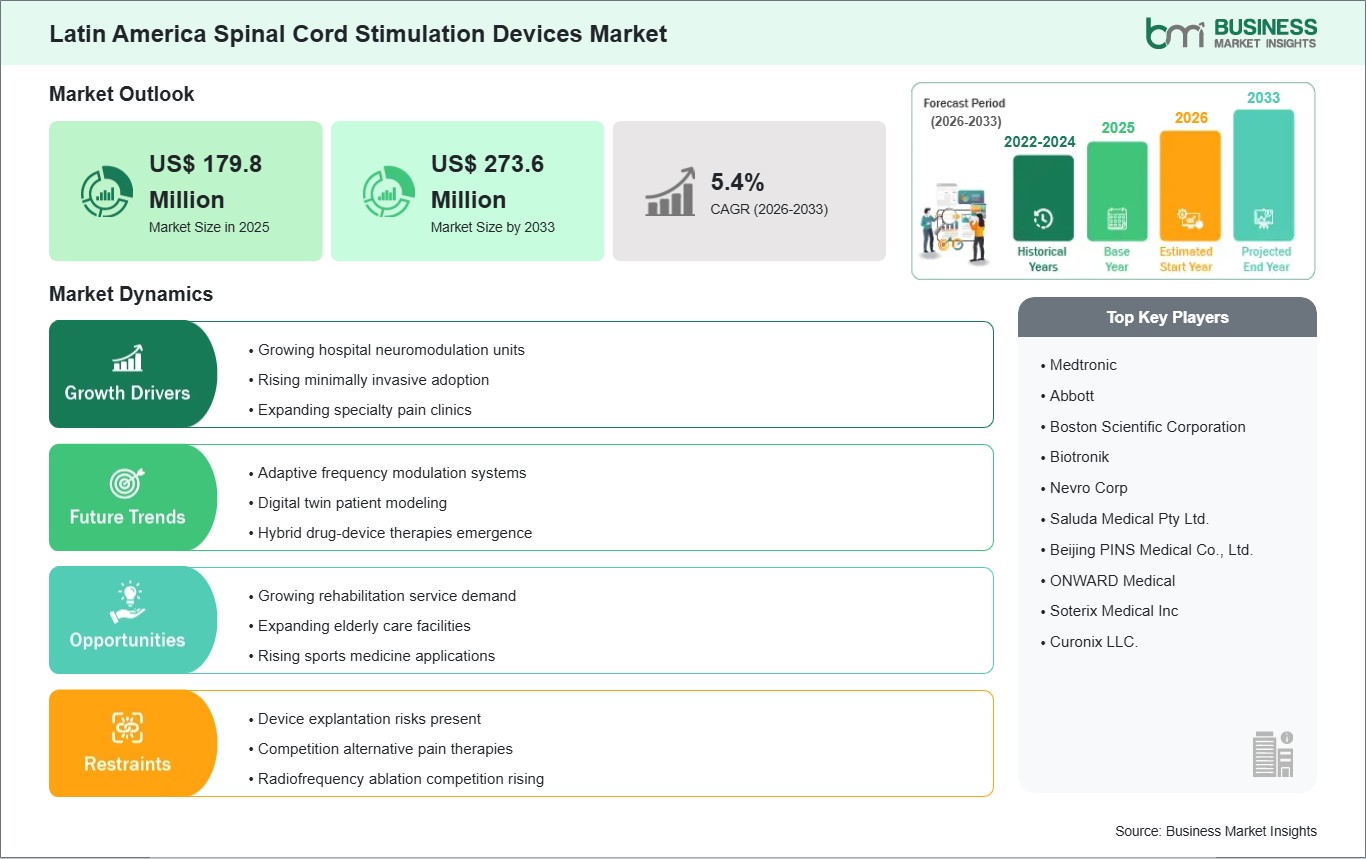
The Latin America spinal cord stimulation devices market size is expected to reach US$ 273.6 million by 2033 from US$ 179.8 million in 2025. The market is estimated to record a CAGR of 5.4% from 2026 to 2033.
The spinal cord stimulation devices market in Latin America is witnessing steady growth owing to the rise in prevalence of chronic pain diseases and the high need for innovative neuromodulation treatments. In Latin American countries, medical professionals are slowly adopting pain management methods that involve minimal invasiveness for conditions such as post-laminectomy pain syndrome, degenerative disc disease, and neuropathic pain. The rising numbers of elderly patients, coupled with sedentary lifestyles and cases of spinal injuries, have led to an increase in patients who require chronic pain management treatments. In this regard, Mexico continues to be an important contributor to the growth of regional demand due to the expansion of its private healthcare industry and the rising acceptance of implantable neurostimulators. There have been investments by urban healthcare institutions in the implementation of innovative technologies in surgery and education of physicians to increase the use of spinal cord stimulation procedures. The search for alternative therapies instead of long-term opioid therapy has created positive prospects for rechargeable and programmable stimulators. Even with positive trends, there have been certain structural constraints to growth in the regional market. Treatment and implantation cost barriers hinder access to patients with limited resources. Reimbursement practices vary widely in the publicly funded healthcare sectors within the region. Lack of trained neuromodulation specialists and surgical centers is an important constraint facing the market in rural areas of Latin America. Positive trends include growing awareness on pain management and increased investments in the modernization of private hospitals.

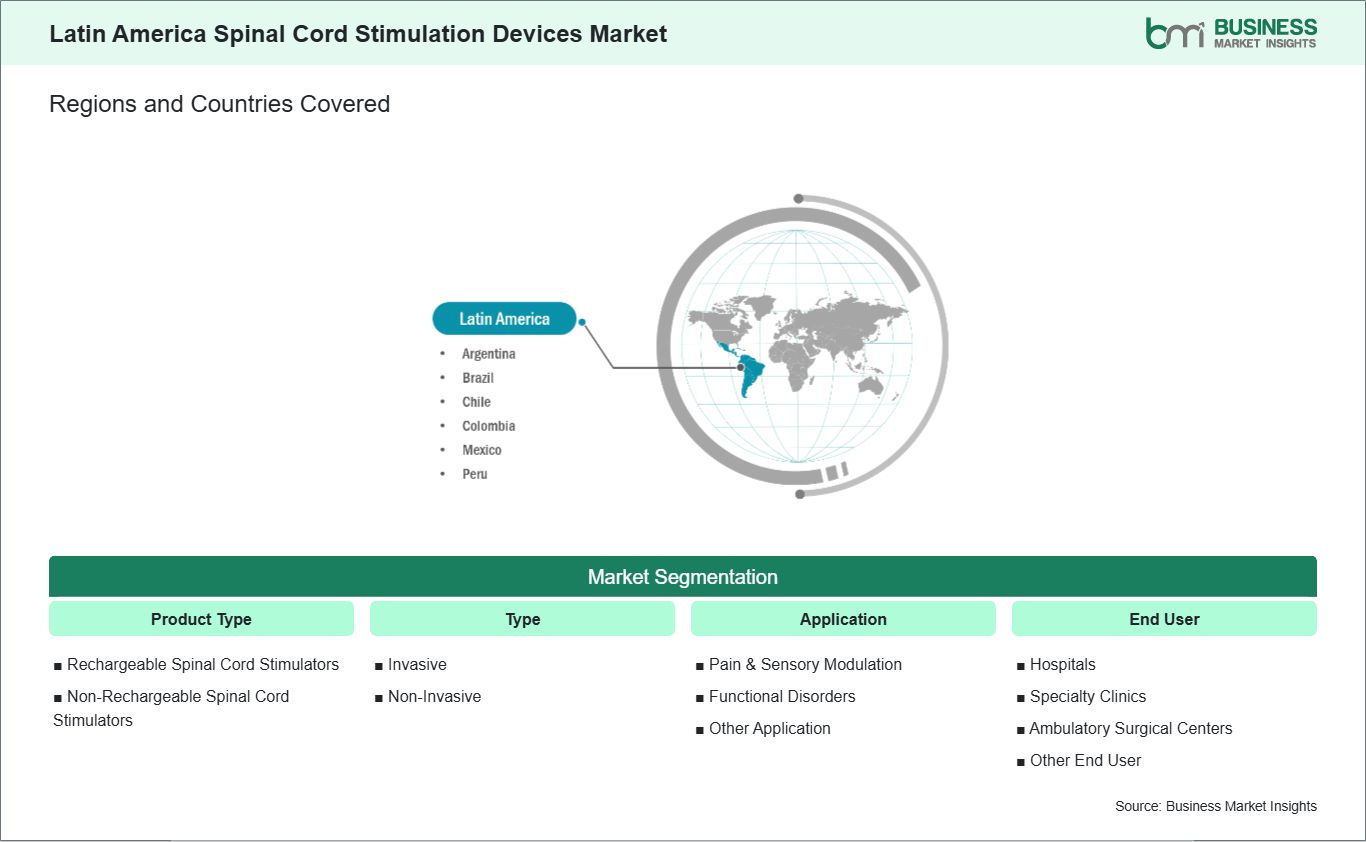
Key segments that contributed to the derivation of the Latin America spinal cord stimulation devices market analysis are product type, type, application, and end user.
Neuromodulation services in hospitals throughout Latin America are witnessing rapid advancement in the face of growing cases of chronic pain, spinal degradation, and postoperative neuropathy issues among an increasingly elderly urban population base. Key hospital chains in Brazil, Mexico, and Argentina are now investing in pain departments staffed by specialists able to conduct spinal cord stimulation procedures. In recent years, various major city hospitals have opted for neuromodulation techniques in place of traditional pain treatment options in an effort to avoid repeat admissions and minimize drug dependency. According to conservative projections, neuromodulation facilities now exist in well over 200 major to mid-sized Latin American hospitals, with Brazil leading the way due to private sector investments and greater expertise.
Hospital networks in the private sector have been driving technology adoption in the region. The hospitals located in São Paulo, Monterrey, Santiago, and Bogotá have been procuring technology like hybrid operating theaters, neuro-imaging tools, and digital programming devices to enhance procedures related to SCS. The preference among hospitals has shifted to rechargeable and MRI-compatible stimulators due to their contribution toward enhancing the long-term management of patients along with decreased need for repeated surgeries. Multidisciplinary approaches among healthcare professionals have been implemented by many hospitals in the region wherein neurologists, orthopedic surgeons, and physical therapists work in collaboration to decide on patients eligibility for SCS therapy.
Healthcare reform by government authorities will also contribute additional impetus to the growth in neuromodulation capacity within hospitals. Hospitals in nations like Chile and Colombia have begun adopting intervention programs for chronic pain within their neurological care services, mainly targeting failed back surgery syndrome and diabetic neuropathy patients. Cooperation between hospitals and foreign stimulator manufacturers is aiding in enhancing procedural expertise in the region. Simultaneously, telemedicine-based stimulator monitoring facilities are gaining ground within remote patient management programs. With the increasing focus on building up neurological treatment infrastructure and offering minimally invasive pain management solutions, it can be anticipated that the adoption of spinal cord stimulators will increase gradually in Latin American hospitals.
The need for rehabilitation services in Latin America has increased gradually owing to a higher incidence of spine injuries, musculoskeletal conditions, diabetic neuropathy, and mobility issues related to aging. The trend for adopting spinal cord stimulation therapy is increasingly becoming common within rehabilitation centers that offer comprehensive management solutions for chronic pain conditions, especially those individuals who cannot benefit from medications and surgical procedures. Brazil and Mexico are responsible for contributing a large percentage of regional rehabilitation service needs, mainly due to their high number of patients and increasing urbanization of healthcare facilities in the region.
Growth in cases of traumatic injuries has also been an additional factor that drives the development of the rehabilitation market. Latin American countries are still suffering from higher levels of road traffic accidents and workplace injuries, especially in areas with dense population concentration and heavy industrialization. Patients who recover from spinal injuries require extended treatment sessions alongside sophisticated pain management techniques. Consequently, rehabilitation centers have been forced to adopt multidisciplinary treatment programs which incorporate physical therapy, neuro-stimulation, psychotherapy, and mobility training.
Innovations in technology have been enhancing the utility of spinal cord stimulation in rehabilitation centers as well. The present-day stimulators are capable of providing personalized waveform programming, remote adjustments, and improved battery power, thus making them more feasible as tools for rehabilitation. Various medical universities in Argentina, Brazil, and Chile have also started conducting studies related to neurorehabilitation and stimulation techniques; this helps build physician awareness about the technologies. At the same time, some private insurance companies have begun to cover chronic pain rehabilitation services in certain urban areas. Due to continued technological improvement in the rehabilitation sector and growing awareness about non-opiate pain management, spinal cord stimulators in Latin America will experience steady growth.

The Latin America spinal cord stimulation devices market is experiencing steady growth, with market size and share analysis reflecting evolving treatment preferences and competitive dynamics among key players. The report evaluates important subsegments categorized within product type, type, application, and end user, highlighting their respective contributions to overall market performance.
By product type, the rechargeable spinal cord Stimulators subsegment dominated the market in 2025, because long-term chronic pain treatment requires devices that can operate continuously for several years without frequent replacement. Patients increasingly preferred rechargeable systems as they reduce the likelihood of repeat surgeries and lower overall treatment interruption.
Based on type, the invasive subsegment dominated the market in 2025 because implanted spinal cord stimulators deliver more stable and accurate nerve stimulation compared to external therapies. These systems are widely used for severe chronic pain conditions where medication and physiotherapy provide limited relief.
On the basis of application, the pain and sensory modulation subsegment dominated the market in 2025, because spinal cord stimulation is primarily designed to manage chronic neuropathic and musculoskeletal pain. The growing number of patients suffering from lower back pain, diabetic nerve pain, and post-surgical pain significantly increased demand for neuromodulation therapies.
In terms of end user, the hospitals subsegment dominated the market in 2025 because most spinal cord stimulator procedures require specialized surgical facilities, imaging equipment, and multidisciplinary pain management teams. Patients generally prefer hospitals for implantation procedures due to better emergency support and post-operative monitoring capabilities.
| Report Attribute | Details |
|---|---|
| Market size in 2025 | US$ 179.8 Million |
| Market Size by 2033 | US$ 273.6 Million |
| CAGR (2026 - 2033) | 5.4% |
| Historical Data | 2022-2024 |
| Forecast period | 2026-2033 |
| Segments Covered | By Product Type
|
|
Regions and Countries Covered
| |
| Latin America | Mexico, Brazil, Argentina, Peru, Chile, Colombia |
| Market leaders and key company profiles |
|
The "Latin America Spinal Cord Stimulation Devices Market Size and Forecast (2022-2033)" report provides a detailed analysis of the market covering below areas:
The geographical scope of the Latin America spinal cord stimulation devices market report is divided into: Brazil, Mexico, Argentina, Colombia, Chile, and Peru. Mexico held the largest share in 2025.
The Mexico spine cord stimulation devices market holds the largest share owing to its relatively well-developed medical infrastructure and establishment of numerous centers dedicated to pain management. Hospitals based in large cities like Mexico City, Monterrey, and Guadalajara are increasingly opting to perform spine cord stimulation surgery on patients with spinal cord pain disorders and chronic neuropathic pain. Compared to many other Latin American countries, Mexico boasts a relatively established neuromodulation market, thanks to rising knowledge and technological advancements related to minimally invasive surgical technologies. An important reason behind Mexicos strong position in the global spine cord stimulation devices market is the growing involvement of private health institutions in providing advanced neurological surgeries. Private hospitals are building advanced operating theaters, acquiring new imaging equipment, and offering comprehensive post-operative rehabilitation programs to enhance recovery prospects for spinal cord stimulation surgery patients. Physicians from Mexico are becoming active participants of various international training programs aimed at training physicians in performing complex neurological surgeries, thus ensuring a greater awareness and confidence in the use of spine cord stimulation procedures. Furthermore, medical tourism is increasing in the country as people from neighboring Latin American countries come to Mexico for treatment because of their need for treatment of chronic pain. However, its use has been largely restricted to urban private hospitals owing to the unavailability of such advanced technologies in public health care facilities. The dependency on imports and the uneven availability of healthcare have continued to pose difficulties. Despite all these problems, the country has managed to retain its edge by having better specialists, procedures, and awareness.

The Latin America spinal cord stimulation devices market is evaluated by gathering qualitative and quantitative data post primary and secondary research, which includes important corporate publications, association data, and databases. A few of the key developments in the Latin America spinal cord stimulation devices market are:
The Latin America Spinal Cord Stimulation Devices Market is valued at US$ 179.8 Million in 2025, it is projected to reach US$ 273.6 Million by 2033.
As per our report Latin America Spinal Cord Stimulation Devices Market, the market size is valued at US$ 179.8 Million in 2025, projecting it to reach US$ 273.6 Million by 2033. This translates to a CAGR of approximately 5.4% during the forecast period.
The Latin America Spinal Cord Stimulation Devices Market report typically cover these key segments-
The historic period, base year, and forecast period can vary slightly depending on the specific market research report. However, for the Latin America Spinal Cord Stimulation Devices Market report:
The Latin America Spinal Cord Stimulation Devices Market is populated by several key players, each contributing to its growth and innovation. Some of the major players include:
The Latin America Spinal Cord Stimulation Devices Market report is valuable for diverse stakeholders, including:
Essentially, anyone involved in or considering involvement in the Latin America Spinal Cord Stimulation Devices Market value chain can benefit from the information contained in a comprehensive market report.
Please tell us your area of interest
(Market Segments/ Regions and Countries/ Companies)