Market Summary
Executive Summary and Market Analysis
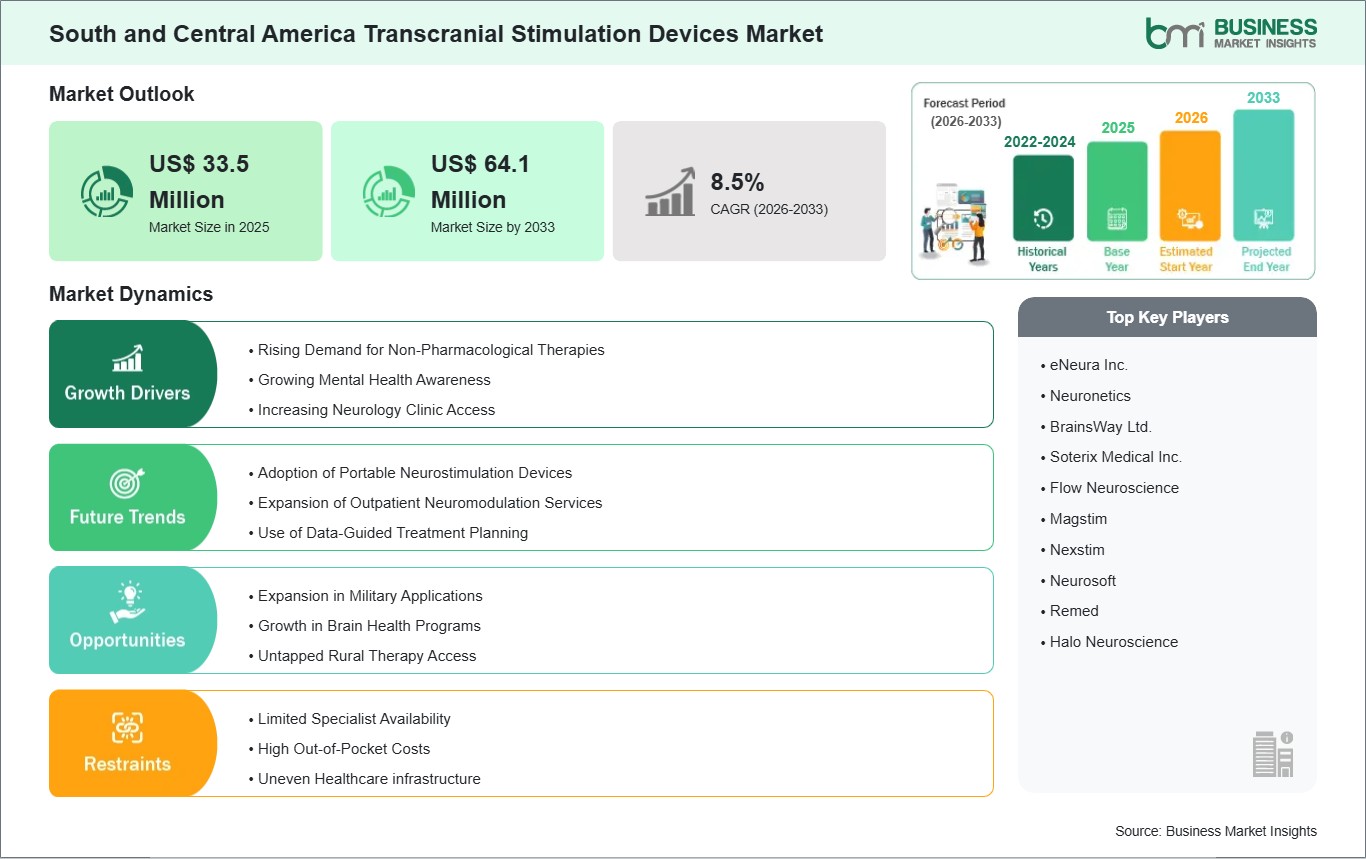
Market forces shaping the transcranial stimulation devices environment within South and Central America revolve around the gradual adoption of neuromodulation methods such as transcranial magnetic stimulation and transcranial direct current stimulation in the treatment pathways of psychiatric, neurological, and rehabilitation disciplines, with the adoption mainly taking place within private hospitals and academic medical centers in major urban healthcare markets. The growth of market interest in transcranial stimulation devices can be attributed to a growing number of patients diagnosed with depression, anxiety disorders, and the need for post-stroke rehabilitation, as well as patient education that drives greater acceptance of the treatment method as an additional option to medication therapies. Other market drivers include a growing partnership with medical institutions for conducting clinical trials and educating specialists in adopting protocols in treating mental illnesses and other neurological conditions using neuromodulation devices. However, one significant barrier facing the adoption of transcranial stimulation devices in South and Central America remains the complex reimbursement landscape and differing regulatory frameworks among countries in the region. Furthermore, the regional industry is marked by an increased reliance on importing neuromodulation devices owing to the lack of indigenous production capabilities in addition to the distribution process, which involves the involvement of specialized equipment suppliers that cater to urban hospitals and private clinics Service and maintenance agreements become significant since there is a need to calibrate the devices besides offering technical assistance as well as training clinicians for effective delivery of therapy despite the procurement process being influenced by cost considerations and differing regulatory requirements in various nations in the region There is a rising demand for outpatient mental health and rehabilitation services, although culture and health insurance plans have their impact.
Segment Analysis
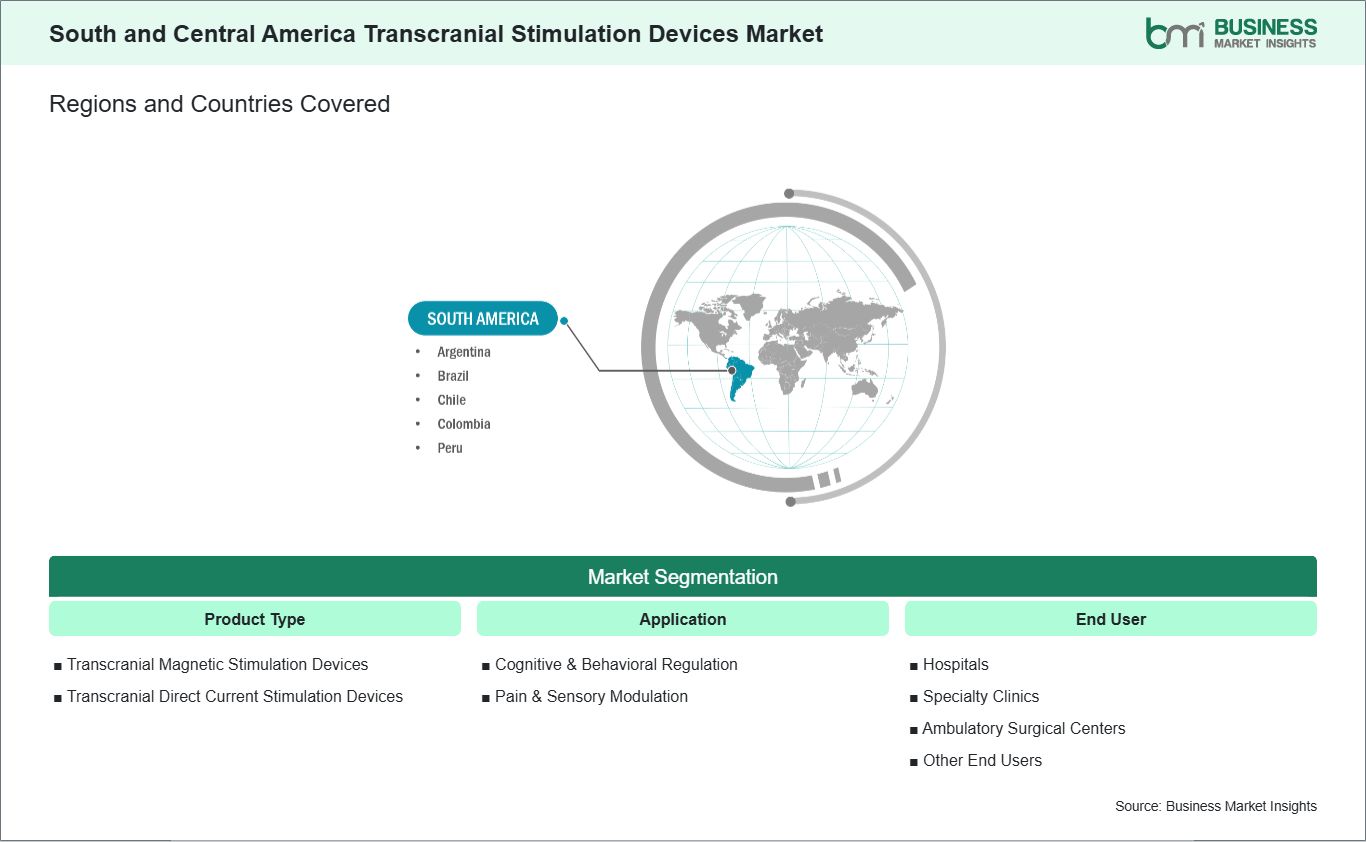
South and Central America Transcranial Stimulation Devices Market Segmentation
Key segments that contributed to the derivation of the South and Central America transcranial stimulation devices market analysis are product type, application, and end user.
- By product type, the transcranial stimulation devices market is segmented into transcranial magnetic stimulation devices and transcranial direct current stimulation devices. The transcranial magnetic stimulation devices segment dominated the market in 2025.
- Based on application, the transcranial stimulation devices market is categorized into cognitive & behavioral regulation and pain & sensory modulation. The cognitive & behavioral regulation segment dominated the market in 2025.
- In terms of end user, the transcranial stimulation devices market is categorized into hospitals, specialty clinics, ambulatory surgical centers, and other end users. The hospitals segment dominated the market in 2025.
Market Forces
South and Central America Transcranial Stimulation Devices Market Drivers and Opportunities
Rising Demand for Non Pharmacological Therapies
Within neurological and psychological care networks of South and Central America, transcranial stimulation devices have been adopted in pathways where clinicians emphasize adjunct treatments for resistant diseases. Neuromodulation units have increasingly been placed within the framework of hospital rehabilitation departments, and the usage of devices within structured therapy cycles and patient monitoring processes has emerged as a means to support functional recovery plans.
Given different and unequal reimbursement models between private and public healthcare organizations, transcranial stimulation devices are commonly used at outpatient neuropsychiatry centers. Placement allows repetition of therapy, tuning of parameters by the doctor, and treatment planning within cycles of depression, pain conditions, and stroke patients' motor recovery treatment.
Urban medical centers' adoption of devices depends on collaboration between neurologists, physiatrists, and psychologists when conducting assessments of stimulation therapy protocols combined with pharmacological intervention. Usage of devices has become a practice-oriented process involving a trial-and-error approach to determining the effectiveness of the treatment, based on individual patient reactions to therapy.
Expansion in Military and Defense Applications
Defense Health Units located in South and Central America have incorporated brain stimulation devices as part of their neurological recovery process for members who have suffered traumatic brain injury and stress-induced disorders. This technology can be used in military hospitals with a high priority to brain rehabilitation, along with other bodily functions, by taking into account the effects of such conditions on the attention span, moods, and motor coordination of patients.
Where military personnel experience cognitive and sleep problems due to exposure to highly stressful environments, brain stimulation devices are considered as supplementary technology to enhance the mental capacity of personnel. The intervention process is carried out in conjunction with psychological monitoring systems, which enable the military medical team to adjust treatment processes based on individual responses during the rehabilitation process.
When it comes to the acquisition of these technologies, there is always a focus on dual-use procurement processes in which rehabilitation and training simulation needs are considered simultaneously. In addition, the acquisition process is managed centrally by defense health units with consideration of device portability and flexibility in calibration.
Size and Share Analysis
South and Central America Transcranial Stimulation Devices Market Size and Share Analysis
The South and Central America transcranial stimulation devices market demonstrates steady growth, with size and share analysis highlighting evolving trends and competitive dynamics among key players. The report examines subsegments categorized within product type, application, and end user, offering insights into their contribution to overall market performance.
By product type, the transcranial magnetic stimulation devices subsegment dominated the market in 2025, driven by its strong clinical efficacy in treating major depression and other neurological disorders, along with increasing regulatory approvals and growing adoption in hospital-based neuropsychiatric care.
Based on application, the cognitive & behavioral regulation subsegment dominated the market in 2025, driven by the rising prevalence of mental health disorders and increasing demand for non-invasive therapies that improve cognition, mood, and behavioral outcomes without pharmacological side effects.
In terms of end user, the hospitals subsegment dominated the market in 2025, driven by higher availability of advanced neurostimulation infrastructure, presence of trained specialists, and preference for supervised clinical environments for safe and effective patient treatment.
Report Coverage
South and Central America Transcranial Stimulation Devices Market Report Coverage and Deliverables
The "South and Central America Transcranial Stimulation Devices Market Size and Forecast (2022-2033)" report provides a detailed analysis of the market covering below areas:
- Market size and forecast at global, regional, and country levels for all the key market segments covered under the scope
- Market trends, as well as drivers, restraints, and opportunities
- Market analysis covering key trends, global and regional framework, major players, regulations, and recent developments
- Market concentration, heat map analysis, prominent players, and recent developments for the Market
- Detailed company profiles, including SWOT analysis
Geographic Insights
South and Central America Transcranial Stimulation Devices Market Geographic Insights
The geographical scope of the South and Central America Transcranial Stimulation Devices Market report is divided into Brazil, Argentina, Chile, Colombia, Peru. Brazil held the largest share in 2025.
In the South and Central America transcranial stimulation devices market, Brazil continues to be the leader owing to the well-established private healthcare sector, developed neurotechnologies R&D environment, and intensive use of brain stimulation technologies in psychiatric and rehabilitation practices. This trend is facilitated by the prevalence of neurological centers where neuromodulation is integrated into the standard treatment process. In Argentina, growth potential is fueled by its active neuroscience research and testing community, with universities playing an instrumental role in adopting brain stimulation technology for the treatment of depression and cognitive rehabilitation. However, market growth can be constrained by macroeconomic instability and high reliance on imported stimulation devices. In Chile, the expansion of the transcranial stimulators market is attributed to the country's advanced organization of the public health care system, wherein neuromodulation is progressively used in neurorehabilitation treatment programs. Also, there is an emerging interest in using remote guided stimulation techniques in neurological practice. Finally, in Colombia, growth prospects are fueled by the increasing popularity of neurological diseases combined with the gradual adoption of private health insurance. The path of Peru's development can be summarized in improved access to healthcare and strategic investments in infrastructure for neurological care, where the usage of transcranial stimulation equipment is becoming popular among specialized urban hospitals while making an initial presence among the underprivileged through rehabilitation programs. Overall, the country displays differential growth dynamics, influenced by its structure of healthcare, intensity of biomedical research, and increasing yet uneven access to neurotherapeutic technology.
Industry Activity
Recent Developments
The South and Central America Transcranial Stimulation Devices Market is evaluated by gathering qualitative and quantitative data post primary and secondary research, which includes important corporate publications, association data, and databases. A few of the key developments in the South and Central America transcranial stimulation devices market are:
- In June 2024, Nexalin Technology announced that it had received approval from the Brazilian Health Regulatory Agency (ANVISA) to commercialize its Gen-2 neurostimulation device in Brazil, marking a key regulatory expansion into the South American mental health and neurostimulation device market.
- In November 2025, BrainsWay announced that the FDA expanded clearance of its Deep TMS system to include adolescent patients (ages 15-21) for major depressive disorder, significantly broadening the global addressable patient population for TMS therapy.
Trust & Transparency
Research Methodology
The market analysis combines proprietary research with secondary data from government agencies, company disclosures, regulatory filings, industry databases and expert interviews. Market estimates are validated through data triangulation, cross-market benchmarking and analyst
review.
View Full Research Methodology
Key Sources Referred:
U.S. Food and Drug Administration (FDA)National Institute of Mental Health (NIMH)National Institute for Health and Care Excellence (NICE)European Medicines Agency (EMA)Medicines and Healthcare products Regulatory Agency (MHRA)American Psychiatric Association (APA)World Health Organization (WHO)International Neuromodulation Society (INS)International Society for Neuroregulation & Research (ISNR)European Society for Magnetic Resonance in Medicine and Biology (ESMRMB)Company WebsitesCompany Annual ReportsCompany Investor Presentations