Market Summary
Executive Summary and Market Analysis
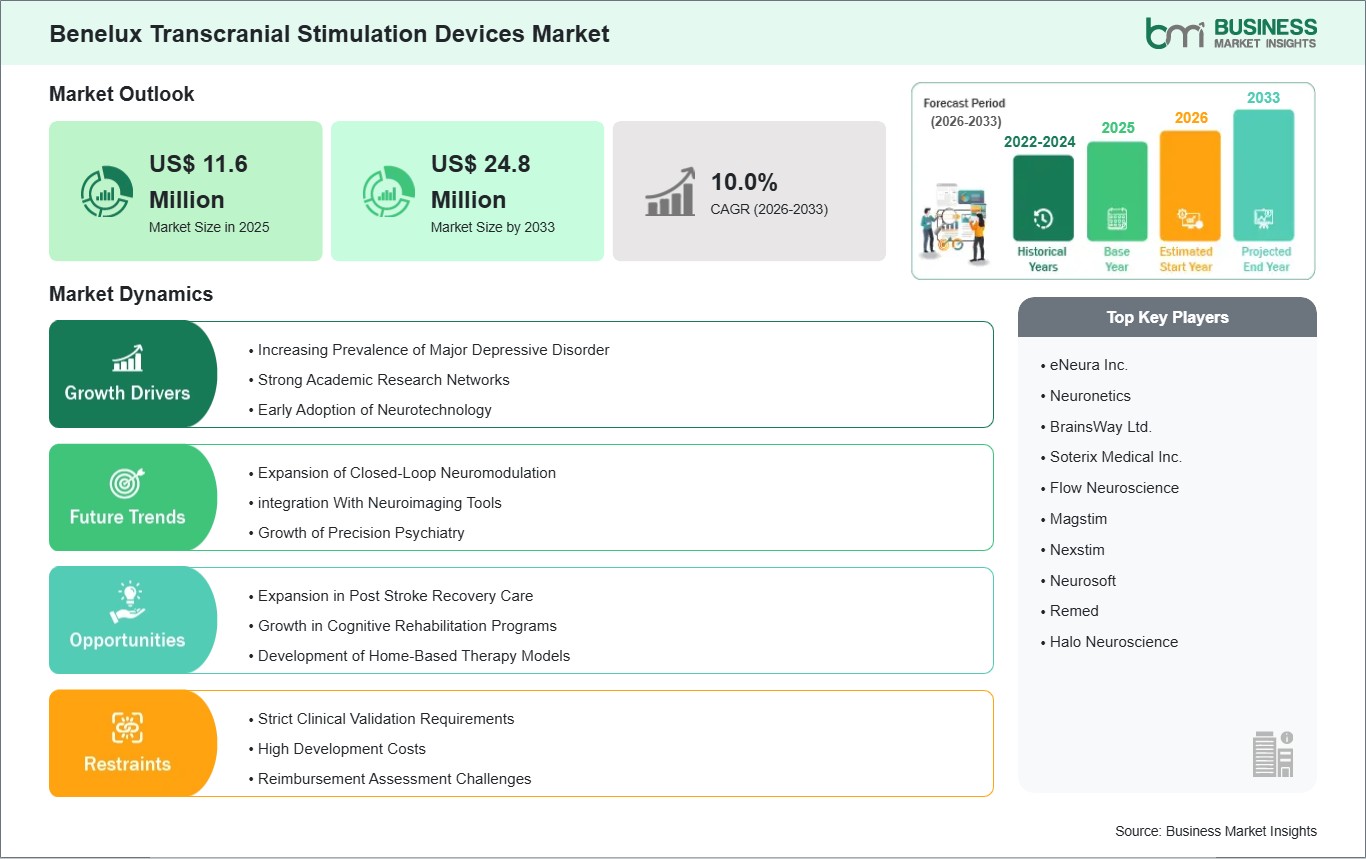
Transcranial Stimulation Devices in the Benelux Market represents a market that is constantly evolving with respect to the development of neuromodulation in the wider European landscape, characterized by growing attention towards the use of non-invasive techniques of brain stimulation for the treatment of neurological and psychological diseases. As a whole, Benelux (Belgium, the Netherlands, Luxembourg) represents one of the most technologically advanced environments in Europe when it comes to healthcare, characterized by strong attention towards the application of innovations from the research field, thus facilitating early adoption of transcranial stimulation devices. One of the main drivers of adoption in this context includes growing cases of neuropsychological disorders like depression, anxiety disorders, recovery after strokes, and chronic pain, which encourage the implementation of alternatives to pharmaceutical intervention. Furthermore, a well-developed research environment and clinical trials funded by the EU accelerate the process of awareness as well as procedural improvement concerning devices such as transcranial direct current stimulators and transcranial magnetic stimulators. One of the other factors behind adoption includes strong regulations in the region aligned with those of the EU. This drives technology advancement in developing more accurate, safe, and easy-to-use devices capable of stimulating nerve cells and being applied to both outpatient and at-home environments. Besides, the growing trend towards digital health and the integration of neurotechnologies into healthcare facilities further boost acceptance. There are several restraining factors for the growth of the Benelux market that have to be considered. Firstly, different approaches to reimbursement from healthcare institutions in the three countries can negatively affect the penetration rate and adoption pace of devices. Secondly, even though the level of acceptance is growing, there is still some clinical skepticism about the long-term effectiveness and implementation protocols of certain procedures. Thirdly, high prices on devices and the necessity for special training among clinicians slow down the process of implementation outside of academic and urban facilities. Thus, the Benelux market represents a mature market environment, where clinical acceptance and implementation are positively affected by scientific research conducted in the area and the well-developed healthcare system.
Segment Analysis
Benelux Transcranial Stimulation Devices Market Segmentation
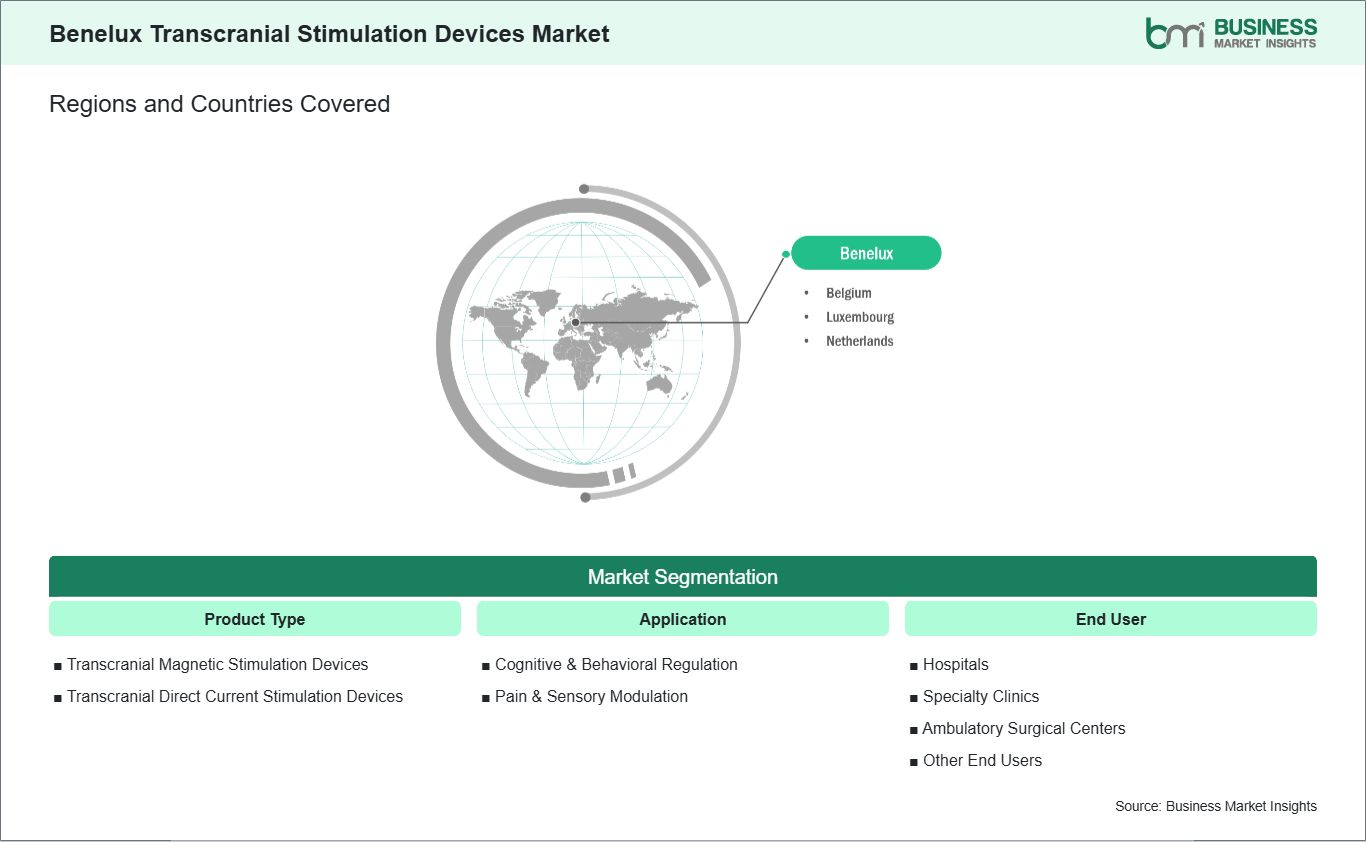
Key segments that contributed to the derivation of the Benelux transcranial stimulation devices market analysis are product type, application, and end user.
- By product type, the transcranial stimulation devices market is segmented into transcranial magnetic stimulation devices and transcranial direct current stimulation devices. The transcranial magnetic stimulation devices segment dominated the market in 2025.
- Based on application, the transcranial stimulation devices market is categorized into cognitive & behavioral regulation and pain & sensory modulation. The cognitive & behavioral regulation segment dominated the market in 2025.
- In terms of end user, the transcranial stimulation devices market is categorized into hospitals, specialty clinics, ambulatory surgical centers, and other end users. The hospitals segment dominated the market in 2025.
Market Forces
Benelux Transcranial Stimulation Devices Market Drivers and Opportunities
Increasing Prevalence of Major Depressive Disorder
Within the Benelux states, the increasing incidence of major depressive disorder can serve as an incentive for the introduction of transcranial stimulation devices within the region. The urban way of life in such Benelux cities as Amsterdam, Brussels, and Luxembourg City causes increased levels of stress, insomnia, and anxiety, thus raising interest in alternative methods of dealing with these problems.
Medical facilities within all three countries continue to develop and improve approaches to diagnosing and treating depressive disorders by strengthening their mental health strategies, ensuring early diagnosis and effective treatment of such disorders among patients in the form of using neuromodulation techniques, including transcranial stimulation therapies.
The growing popularity of the concept of brain stimulation serves as the motivation for many medical institutions, including hospitals and neurological clinics in Amsterdam, Brussels, and Luxembourg, to incorporate additional services into their treatment programs. In addition, many patients look for ways to avoid using medications for a long period of time, while doctors pay attention to personalized treatment.
Expansion in Post Stroke Recovery Care
In Benelux countries, rising demands for neurorehabilitation technology for stroke recovery have emerged due to a growing number of stroke patients and aging populations in the region. Rehabilitation hospitals and stroke units within Belgium and the Netherlands have integrated advanced technologies like transcranial stimulation as a solution to improving their motor functions and enhancing cognitive abilities.
Belgium and the Netherlands have seen a rising trend in using physical therapy with neuromodulation technologies in rehabilitation hospitals and stroke centers. The healthcare facilities in Luxembourg have taken advantage of patient movement across borders to include the use of transcranial stimulation tools in rehabilitation programs that focus on restoring mobility and speech.
Increasing outpatients' needs have also led to more rehabilitation clinics offering services outside the hospital. Outpatients are offered non-invasive stimulation to continue treatment at home. In addition, physiotherapists and caregivers focus on structured treatment plans during the stroke rehabilitation process.
Size and Share Analysis
Benelux Transcranial Stimulation Devices Market Size and Share Analysis
The Benelux transcranial stimulation devices market demonstrates steady growth, with size and share analysis highlighting evolving trends and competitive dynamics among key players. The report examines subsegments categorized within product type, application, and end user, offering insights into their contribution to overall market performance.
By product type, the transcranial magnetic stimulation devices subsegment dominated the market in 2025, driven by its strong clinical efficacy in treating major depression and other neurological disorders, along with increasing regulatory approvals and growing adoption in hospital-based neuropsychiatric care.
Based on application, the cognitive & behavioral regulation subsegment dominated the market in 2025, driven by the rising prevalence of mental health disorders and increasing demand for non-invasive therapies that improve cognition, mood, and behavioral outcomes without pharmacological side effects.
In terms of end user, the hospitals subsegment dominated the market in 2025, driven by higher availability of advanced neurostimulation infrastructure, presence of trained specialists, and preference for supervised clinical environments for safe and effective patient treatment.
Report Coverage
Benelux Transcranial Stimulation Devices Market Report Coverage and Deliverables
The "Benelux Transcranial Stimulation Devices Market Size and Forecast (2022-2033)" report provides a detailed analysis of the market covering below areas:
- Market size and forecast at global, regional, and country levels for all the key market segments covered under the scope
- Market trends, as well as drivers, restraints, and opportunities
- Market analysis covering key trends, global and regional framework, major players, regulations, and recent developments
- Market concentration, heat map analysis, prominent players, and recent developments for the Market
- Detailed company profiles, including SWOT analysis
Geographic Insights
Benelux Transcranial Stimulation Devices Market Geographic Insights
The geographical scope of the Benelux Transcranial Stimulation Devices Market report is divided into Belgium, Netherlands, Luxembourg. Netherlands held the largest share in 2025.
Benelux transcranial stimulation devices market dynamics are defined by the high popularity of non-invasive neuromodulation methods used to treat neurological disorders and mental illnesses, with demand affected by innovations in clinical application of technologies, demographic trends and increased mental health awareness in Benelux nations. Among the three countries, the largest market in the region is represented by the Netherlands, backed by an extensively developed healthcare industry, neurotechnology research capabilities and early clinical adoption of brain stimulation treatments. The Netherlands is characterized by active cooperation between institutions and medical device manufacturers that helps to introduce new developments faster and promote their use by medical professionals. Following the Netherlands, Belgium ranks second, driven by the country's sophisticated hospital sector and increased attention towards resistant forms of depression and chronic pain treatment, but is less prone to adopting innovative solutions and aligning reimbursements for new procedures. In turn, the smallest segment is held by Luxembourg, with demand for transcranial stimulation devices mainly emerging in specialized hospitals and among patients seeking treatment outside the country because of proximity to hospitals and clinics in Belgium and the Netherlands. But obstacles like high device cost, lack of awareness on the part of general practitioners, and variation in reimbursement pathways will continue to hinder adoption rates beyond the elite centers of academia. Nonetheless, continued advances in technology that lead to more portability and ease of use, coupled with the growing evidence for the effectiveness of such devices in neuropsychiatric conditions, may help drive adoption further ahead. The Netherlands will continue to dominate in this market, thanks to the innovative environment and supportive clinical community in the region, while Belgium and Luxembourg will be contributing modestly.
Industry Activity
Recent Developments
The Benelux Transcranial Stimulation Devices Market is evaluated by gathering qualitative and quantitative data post primary and secondary research, which includes important corporate publications, association data, and databases. A few of the key developments in the Benelux transcranial stimulation devices market are:
- In May 2023, Nexstim announced that its quality management system and NBS 6 navigated TMS platform received MDR certification under EU Regulation (EU) 2017/745, allowing the company to commercially market and expand sales of its transcranial stimulation devices across EU markets, including Benelux healthcare systems.
- In January 2024, BrainsWay announced the initiation of clinical feasibility studies for its new “Deep TMS 360 technology, which uses a rotational electric field approach to improve neuronal activation coverage in targeted brain regions. This development represents an R&D advancement aimed at enhancing efficacy in non-invasive neuromodulation therapies.
Trust & Transparency
Research Methodology
The market analysis combines proprietary research with secondary data from government agencies, company disclosures, regulatory filings, industry databases and expert interviews. Market estimates are validated through data triangulation, cross-market benchmarking and analyst
review.
View Full Research Methodology
Key Sources Referred:
U.S. Food and Drug Administration (FDA)National Institute of Mental Health (NIMH)National Institute for Health and Care Excellence (NICE)European Medicines Agency (EMA)Medicines and Healthcare products Regulatory Agency (MHRA)American Psychiatric Association (APA)World Health Organization (WHO)International Neuromodulation Society (INS)International Society for Neuroregulation & Research (ISNR)European Society for Magnetic Resonance in Medicine and Biology (ESMRMB)Company WebsitesCompany Annual ReportsCompany Investor Presentations