Market Summary
Executive Summary and Market Analysis
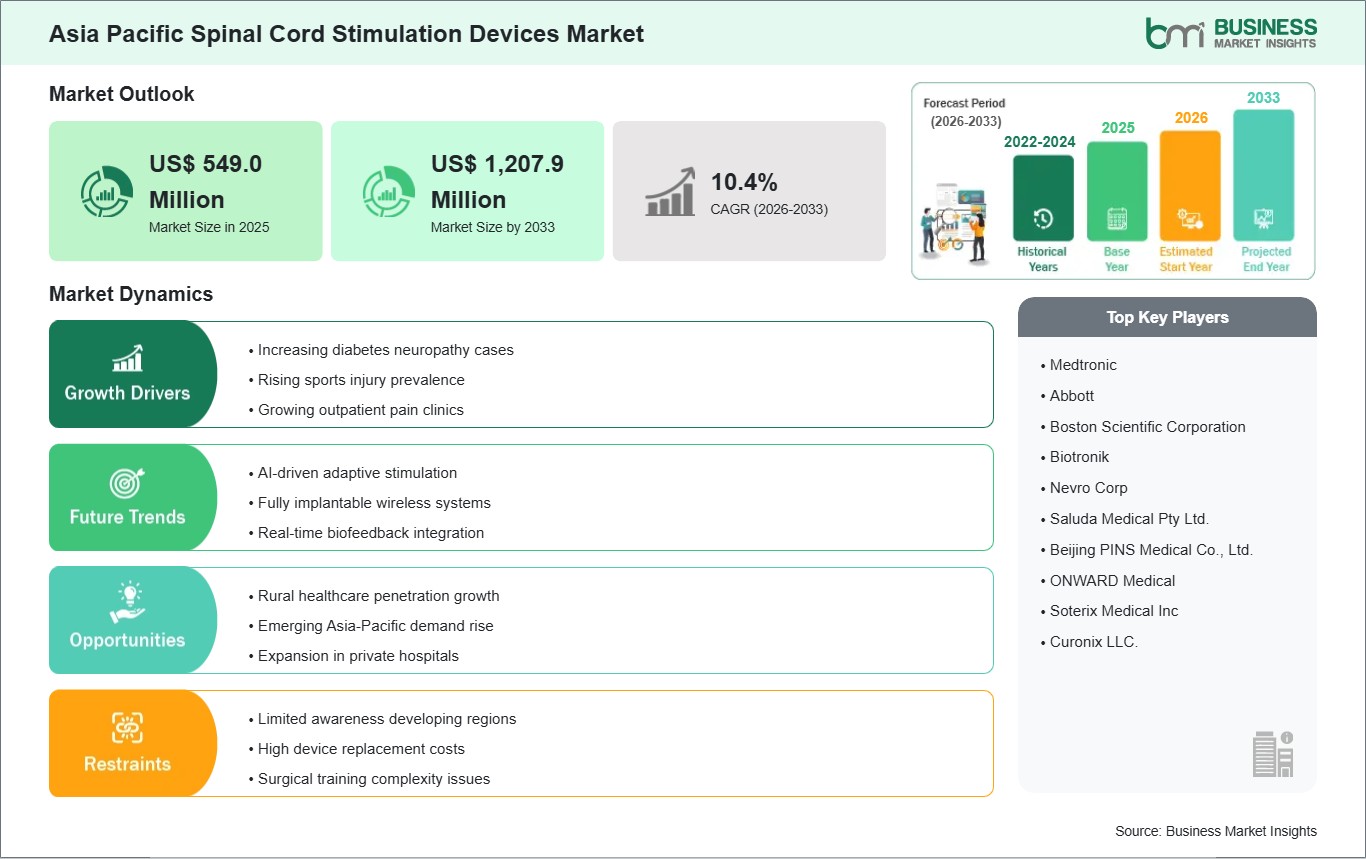
The Asia Pacific market for spinal cord stimulation devices constitutes a developing segment in the overall neuromodulation domain, owing to growing awareness regarding the usage of sophisticated interventional modalities for the management of chronic pain syndromes. There is a gradual trend observed towards moving away from pharmacological methods of pain management to more device-based techniques in urban and tertiary care centers. Spinal conditions, workplace injuries, and degeneration due to aging have resulted in a rise in the number of patients suffering from pain and requiring effective means of managing it. Spinal cord stimulation technology is increasingly being offered in more developed markets in the region as a treatment for failed back surgery and neuropathic pain syndromes. The development of the market will be driven by the construction of private healthcare infrastructure, capital investments in modern medical equipment for surgeries, and increased exposure of doctors to foreign experience with neuromodulation techniques. Medical tourism centers and prestigious urban hospitals will facilitate the introduction of new treatment technologies for spinal cord stimulation in a greater number of people. Nevertheless, regional disparities in market development remain relevant due to price sensitivity, a shortage of insurance coverage schemes, and a lack of adequate knowledge of the technology among the population and doctors. Nevertheless, progressive improvements in access to medical services, the implementation of more clinical programs, and the need for non-opioid analgesic treatments drive a stable development of the market. Overall, the Asia Pacific region can be characterized by the period of transition from low levels of awareness of new technologies to their selective adoption.
Segment Analysis
Asia Pacific Spinal Cord Stimulation Devices Market Segmentation
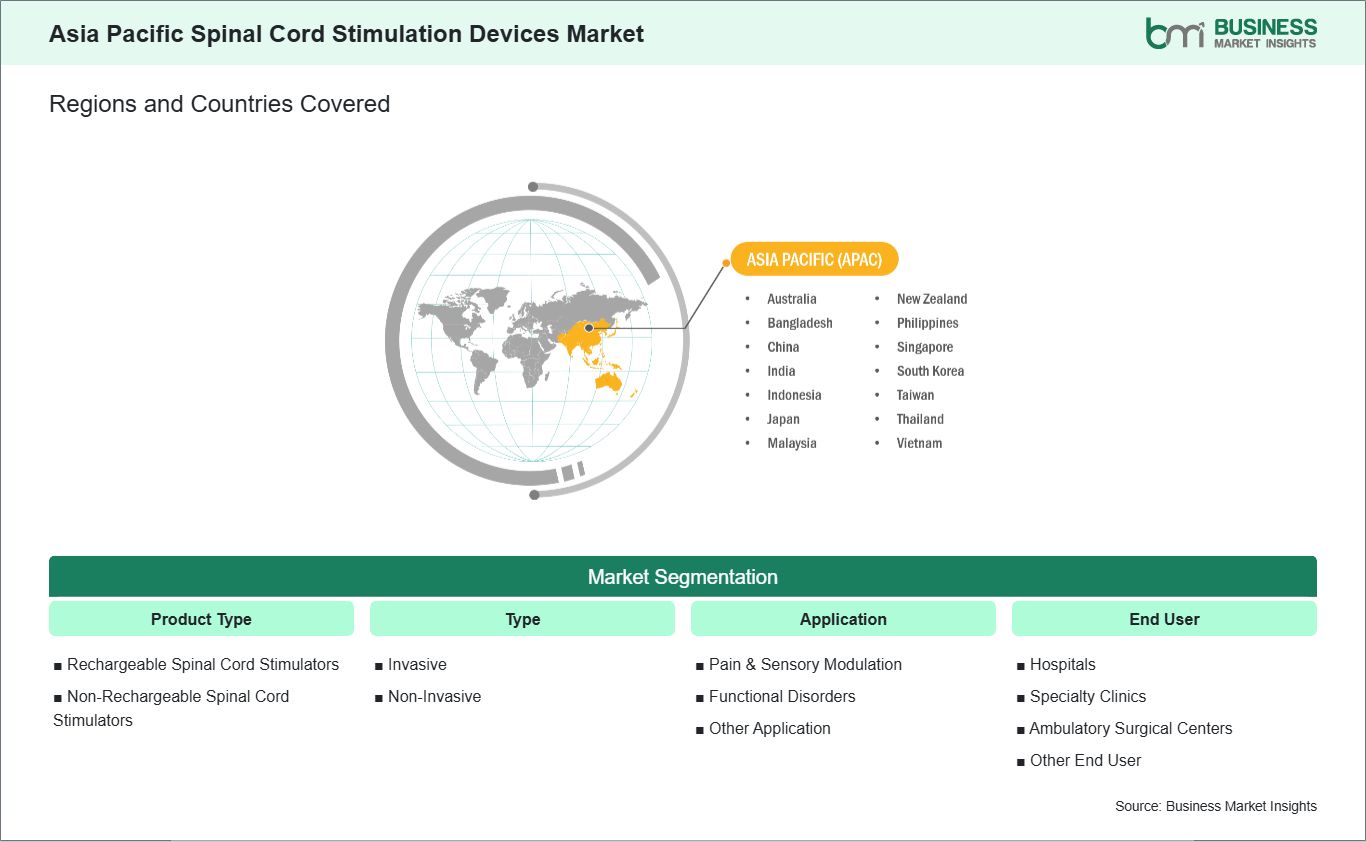
Key segments that contributed to the derivation of the Asia Pacific spinal cord stimulation devices market analysis are product type, type, application, and end user.
- By product type, the spinal cord stimulation devices market is segmented into rechargeable spinal cord stimulators and non-rechargeable spinal cord stimulators. The rechargeable spinal cord stimulators segment dominated the market in 2025.
- Based on type, the spinal cord stimulation devices market is segmented into invasive and non-invasive. The invasive segment dominated the market in 2025.
- On the basis of application, the spinal cord stimulation devices market is classified into pain and sensory modulation, functional disorders, and other application. The pain and sensory modulation segment dominated the market in 2025.
- In terms of end user, the spinal cord stimulation devices market is categorized into hospitals, specialty clinics, ambulatory surgical centers, and other end user. The hospitals segment dominated the market in 2025.
Market Forces
Asia Pacific Spinal Cord Stimulation Devices Market Drivers and Opportunities
Increasing Diabetes Neuropathy Cases
Diabetes neuropathy has become one of the key reasons behind the growing demand in the Asia Pacific market for spinal cord stimulation (SCS) devices, where it is expected to play a crucial role in contributing to chronic pain problems in the upcoming years. Since there is a rapidly growing diabetic population, a high number of people suffering from diabetics face issues related to their nervous system resulting in lower spine and limbs' pain conditions. The number of diabetic patients in the Asia Pacific region is expected to cross 250 million people with more than 30-40% suffering from neuropathic complications.
There is evidence of increased presentations of diabetic patients with refractory neuropathic pain at hospitals within the urban setting that fail to yield desirable outcomes from medical management strategies such as the use of anticonvulsant drugs and antidepressants. The situation is common within the tertiary health facility since the presentation arises among longstanding diabetic individuals suffering from more complicated pain syndromes needing neuromodulation procedures. This means that spinal cord stimulation is gaining popularity among diabetic individuals who fail to benefit from medical approaches to neuropathic pain management.
Besides, changes in lifestyles characterized by high sugar diets, low physical activities, and increasing obesity rates contribute to increased risks of diabetic neuropathies in the urban setting. There is a prevalence of early onset of diabetic neuropathic pain symptoms among middle-aged patients at several urban hospitals. In summary, spinal cord stimulation continues to gain popularity among diabetic neuropathic patients as an option beyond conventional approaches.
Rural Healthcare Penetration Growth
The Asia Pacific market for SCS devices would be affected gradually by improved rural access to health care as efforts have increased recently by both public and private parties to bridge long-existing inequalities in accessing innovative health care products and solutions. Many people in this region still live in rural and semi-urban locations, which have always lacked adequate healthcare infrastructure in most cases. This is mainly because the rural hospitals have not had adequate specialists, diagnostics tools, and treatment modalities for chronic pain disorders.
The health care infrastructure in this region is working towards creating better primary care facilities as well as efficient referral mechanisms for the tertiary hospitals, an effort that is contributing to greater application of neuromodulation treatments. Patients living in the rural communities and experiencing chronic back pain, diabetic neuropathy, and post-surgical issues can now be referred to tertiary hospitals, which have the capacity to provide spinal cord stimulation treatment.
Furthermore, steady improvements in insurance plans and government-sponsored health care systems will make expensive pain treatments easier to obtain in the rural areas. Even though rural hospitals do not offer direct implantation procedures of the SCS device yet, connectivity between rural clinics and specialty centers located in cities allows many patients to get treatment for their diseases. Eventually, this developing health care system will enable doctors to diagnose, refer, and treat patients with pain more effectively.
Size and Share Analysis
Asia Pacific Spinal Cord Stimulation Devices Market Size and Share Analysis
The Asia Pacific spinal cord stimulation devices market is experiencing steady growth, with market size and share analysis reflecting evolving treatment preferences and competitive dynamics among key players. The report evaluates important subsegments categorized within product type, type, application, and end user, highlighting their respective contributions to overall market performance.
By product type, the rechargeable spinal cord Stimulators subsegment dominated the market in 2025, because long-term chronic pain treatment requires devices that can operate continuously for several years without frequent replacement. Patients increasingly preferred rechargeable systems as they reduce the likelihood of repeat surgeries and lower overall treatment interruption.
Based on type, the invasive subsegment dominated the market in 2025 because implanted spinal cord stimulators deliver more stable and accurate nerve stimulation compared to external therapies. These systems are widely used for severe chronic pain conditions where medication and physiotherapy provide limited relief.
On the basis of application, the pain and sensory modulation subsegment dominated the market in 2025, because spinal cord stimulation is primarily designed to manage chronic neuropathic and musculoskeletal pain. The growing number of patients suffering from lower back pain, diabetic nerve pain, and post-surgical pain significantly increased demand for neuromodulation therapies.
In terms of end user, the hospitals subsegment dominated the market in 2025 because most spinal cord stimulator procedures require specialized surgical facilities, imaging equipment, and multidisciplinary pain management teams. Patients generally prefer hospitals for implantation procedures due to better emergency support and post-operative monitoring capabilities.
Report Coverage
Asia Pacific Spinal Cord Stimulation Devices Market Report Coverage and Deliverables
The "Asia Pacific Spinal Cord Stimulation Devices Market Size and Forecast (2022-2033)" report provides a detailed analysis of the market covering below areas:
- Market size and forecast at regional and country levels for all market segments covered under the scope
- Market trends, as well as drivers, restraints, and opportunities
- Market analysis covering key trends, regional framework, major players, regulations, and recent developments
- Market concentration, heat map analysis, prominent players, and recent developments for the Market
- Detailed company profiles, including SWOT analysis
Geographic Insights
Asia Pacific Spinal Cord Stimulation Devices Market Geographic Insights
The geographical scope of the Asia Pacific spinal cord stimulation devices market report is divided into: China, Japan, South Korea, India, Australia, New Zealand, Indonesia, Malaysia, the Philippines, Singapore, Thailand, Vietnam, Taiwan, Bangladesh, and the Rest of Asia. China held the largest share in 2025.
China dominates the Asia Pacific spinal cord stimulators market on account of its rapid advancement in its healthcare sector, high investment in new technologies, and emphasis on chronic condition treatments. The large number of patients suffering from spinal conditions, neuropathic pain, and post-operative complications in China makes it necessary to deploy advanced technologies to address this clinical demand. At present, spinal cord stimulators have been increasingly employed by hospitals in Beijing, Shanghai, and Guangzhou to deal with complex cases of spine-related disorders that are not responsive to traditional forms of therapy. In China, another major factor that has enabled the introduction of spinal cord stimulators has been the fast modernization of tertiary hospitals, which enables greater use of advanced neuromodulation techniques owing to advancements in surgical techniques and increased interaction of surgeons with international standards of treatment. Private hospitals and premium medical centers are increasingly adopting this technology to manage difficult cases like failed back surgery syndrome. Nonetheless, uptake throughout the rest of the healthcare environment is far from uniform. The insufficient insurance coverage for the implantable neuromodulation devices coupled with exorbitant prices confine the technology to rich patients and healthcare institutions of superior caliber. In addition, knowledge of the existence of the spinal cord stimulation therapy amongst general practitioners and patients is still evolving, hampering its implementation. Outside China, uptake in other Asia Pacific nations is still nascent owing to differences in healthcare infrastructure and cost considerations. Nevertheless, China remains the key driver of growth within the region, with steady expansion anticipated over time with rising expertise in managing pain conditions.
Industry Activity
Recent Developments
The Asia Pacific spinal cord stimulation devices market is evaluated by gathering qualitative and quantitative data post primary and secondary research, which includes important corporate publications, association data, and databases. A few of the key developments in the Asia Pacific spinal cord stimulation devices market are:
- In February 2024, Medtronic announced that its Sequentia LT spinal cord stimulation system received Therapeutic Goods Administration (TGA) listing approval in Australia, enabling broader clinical availability of its implantable neurostimulation therapy for chronic pain management in the Asia-Pacific region.
- In February 2024, Abbott announced that its Eterna implantable spinal cord stimulation system was listed in Australias ARTG (Australian Register of Therapeutic Goods), expanding access to its next-generation SCS platform designed to reduce charging burden and improve chronic pain therapy outcomes.
Trust & Transparency
Research Methodology
The market analysis combines proprietary research with secondary data from government agencies, company disclosures, regulatory filings, industry databases and expert interviews. Market estimates are validated through data triangulation, cross-market benchmarking and analyst
review.
View Full Research Methodology
Key Sources Referred:
The World BankWorld Health Organization (WHO)Center for Disease Control and Prevention (CDC)Food and Drug Administration (FDA)Centers for Medicare and Medicaid Services (CMS)European CommissionMedicines and Healthcare products Regulatory Agency (MHRA)Company WebsitesCompany Annual ReportsCompany Investor Presentation