Market Summary
Executive Summary and Market Analysis
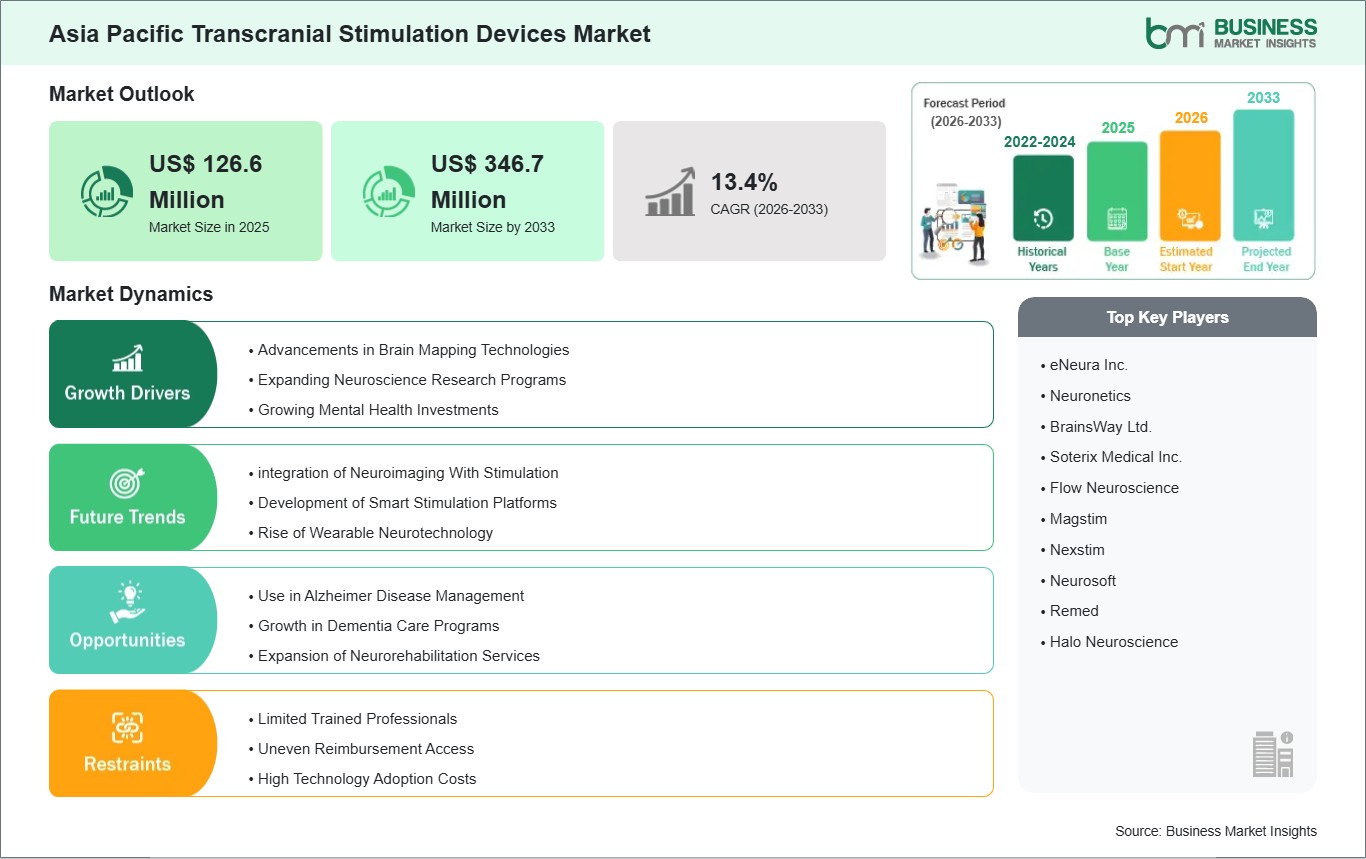
The Asia Pacific market of transcranial stimulation devices displays continuous dynamism due to the ongoing development of the region in terms of the implementation of advanced methods of neurotherapeutics and the increase in the disease burden in the form of neurological and psychiatric disorders. Growing awareness about non-invasive brain stimulation approaches, including transcranial direct current stimulation and transcranial magnetic stimulation, contributes to greater application of the equipment used for treating patients with depression, stroke, chronic pain, and neurodegenerative disorders within the context of a general trend toward pharmacological-free and minimally invasive treatments. One of the main factors that promotes market expansion in the Asia Pacific is the rapid advancement of the healthcare infrastructure, especially in terms of medical facilities located in cities. Moreover, increased attention to the development of the mental health sector in conjunction with growing access to neurodiagnostics and neuromodulation technology promotes market development. Clinical research and cooperation between academic organizations and manufacturers of medical equipment facilitate increased awareness of transcranial stimulation technologies. But there exist certain limitations in this market which might hinder its progress in certain parts of the world. For instance, high expenses on devices and a lack of reimbursement schemes in a number of Asia Pacific nations can hamper the usage of these medical products in many clinics. In addition to that, there exist regulatory disparities and insufficient availability of skilled personnel for the operation of devices of this type. Nonetheless, growing acceptance and advancing technology still make the future look promising for this market.
Segment Analysis
Asia Pacific Transcranial Stimulation Devices Market Segmentation
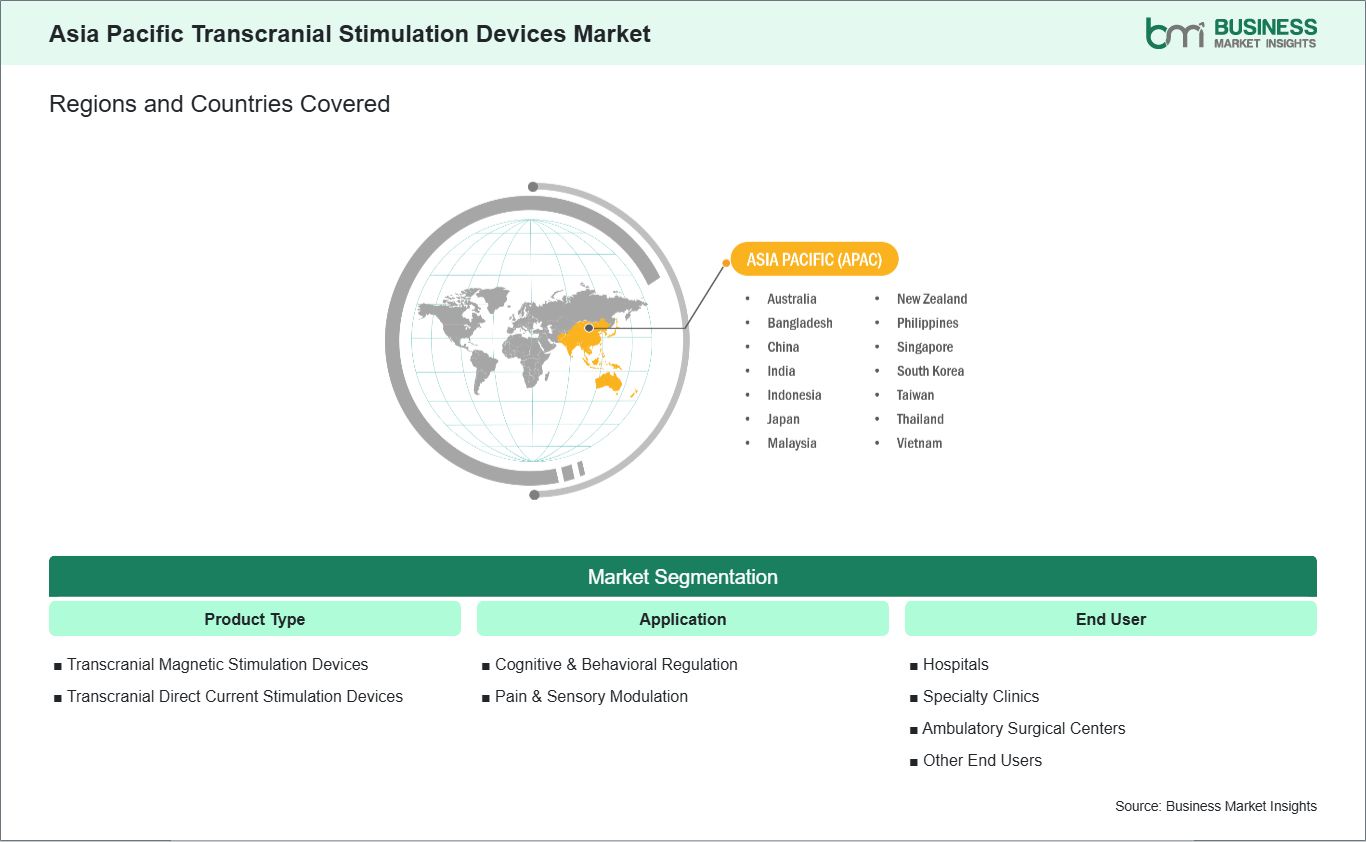
Key segments that contributed to the derivation of the Asia Pacific transcranial stimulation devices market analysis are product type, application, and end user.
- By product type, the transcranial stimulation devices market is segmented into transcranial magnetic stimulation devices and transcranial direct current stimulation devices. The transcranial magnetic stimulation devices segment dominated the market in 2025.
- Based on application, the transcranial stimulation devices market is categorized into cognitive & behavioral regulation and pain & sensory modulation. The cognitive & behavioral regulation segment dominated the market in 2025.
- In terms of end user, the transcranial stimulation devices market is categorized into hospitals, specialty clinics, ambulatory surgical centers, and other end users. The hospitals segment dominated the market in 2025.
Market Forces
Asia Pacific Transcranial Stimulation Devices Market Drivers and Opportunities
Advancements in Brain Mapping Technologies
Brain mapping technologies that have advanced in recent years have transformed the Asia Pacific transcranial stimulation devices market due to improved precision during targeting of neural circuits. Medical institutions in Japan, South Korea, and Australia have started using high-resolution brain imaging alongside the stimulators in order to ensure better efficacy of treatments.
Non-invasive brain mapping technology is being developed further within research centers located in India and China through collaboration between university researchers and medtech companies in order to facilitate higher signal accuracy within transcranial stimulation devices. Real-time brain cortex analysis is facilitated in part by the use of portable brain imaging solutions that can be accessed by hospitals and outpatients in urban areas.
Pediatric and geriatric neurology applications are also increasing the demand for brain-mapping technologies for transcranial stimulators in Southeast Asian markets. In particular, clinics in Singapore and Thailand have begun using software to adjust their approach and deliver optimal treatment. Patients will benefit from greater investments in digital health infrastructure that will lead to better diagnostics and rehabilitation prospects.
Use in Alzheimer Disease Management
Neurostimulation technology in treating Alzheimer's disease is being considered by healthcare practitioners in the region due to increased cases of the condition in the face of aging populations. Transcranial stimulation devices are now being incorporated in treatment programs by healthcare facilities in countries like Japan and South Korea in order to facilitate cognitive function. This combination of treatment entails the use of pharmacotherapy and cognitive therapy.
Clinical studies and research programs involving countries like India, China and Australia have been undertaken to test the effectiveness of brain stimulation on reducing cognitive impairment related to Alzheimer's disease. Academic hospitals and biotechnology companies have been working to optimize procedures in the process of developing better ways of patient monitoring using digital technology.
New developments in neuromodulation therapies delivered via wearable technologies have become the focus of several studies in Southeast Asian countries. The objective is to enhance the memory retention and cognitive abilities of Alzheimer's patients while also making provisions to provide long-term treatment via telemedicine.
Size and Share Analysis
Asia Pacific Transcranial Stimulation Devices Market Size and Share Analysis
The Asia Pacific transcranial stimulation devices market demonstrates steady growth, with size and share analysis highlighting evolving trends and competitive dynamics among key players. The report examines subsegments categorized within product type, application, and end user, offering insights into their contribution to overall market performance.
By product type, the transcranial magnetic stimulation devices subsegment dominated the market in 2025, driven by its strong clinical efficacy in treating major depression and other neurological disorders, along with increasing regulatory approvals and growing adoption in hospital-based neuropsychiatric care.
Based on application, the cognitive & behavioral regulation subsegment dominated the market in 2025, driven by the rising prevalence of mental health disorders and increasing demand for non-invasive therapies that improve cognition, mood, and behavioral outcomes without pharmacological side effects.
In terms of end user, the hospitals subsegment dominated the market in 2025, driven by higher availability of advanced neurostimulation infrastructure, presence of trained specialists, and preference for supervised clinical environments for safe and effective patient treatment.
Report Coverage
Asia Pacific Transcranial Stimulation Devices Market Report Coverage and Deliverables
The "Asia Pacific Transcranial Stimulation Devices Market Size and Forecast (2022-2033)" report provides a detailed analysis of the market covering below areas:
- Market size and forecast at global, regional, and country levels for all the key market segments covered under the scope
- Market trends, as well as drivers, restraints, and opportunities
- Market analysis covering key trends, global and regional framework, major players, regulations, and recent developments
- Market concentration, heat map analysis, prominent players, and recent developments for the Market
- Detailed company profiles, including SWOT analysis
Geographic Insights
Asia Pacific Transcranial Stimulation Devices Market Geographic Insights
The geographical scope of the Asia Pacific Transcranial Stimulation Devices Market report is divided into China, Japan, South Korea, India, Australia, New Zealand, Indonesia, Malaysia, Philippines, Singapore, Thailand, Vietnam, Taiwan, Bangladesh. China held the largest share in 2025.
The Asia Pacific transcranial stimulation devices market showcases varied maturity across the region, with China becoming the leading regional epicenter due to the presence of a vast healthcare landscape, robust neuroscience research community, high adoption rates of non-invasive brain stimulation technologies, and substantial investments by domestic and foreign players in medical devices. Japan takes the second place on account of highly sophisticated clinical implementations facilitated by its aging population, high disease burden of neurological ailments, and widespread acceptance of neuromodulation treatments in hospitals. South Korea makes an important contribution via an innovation-driven healthcare system and increased emphasis on digital therapeutics and hospital neurology practices. In India, steady growth of the market is attributed to the growing prevalence of mental disorders and improving access to specialized treatments, coupled with increasing use in urban clinics. Australia and New Zealand form a mature but relatively small market with significant clinical research, a strong regulatory framework, and early adoption of neuromodulation procedures. Some of the nations in the Southeast Asia region include Indonesia, Malaysia, the Philippines, Thailand, Vietnam, and Bangladesh, which have reached lower levels due to improvements in healthcare facilities, increasing patient knowledge, and investment in tertiary care hospitals, although costs still pose a challenge for these regions. Singapore is considered an innovation center for the region, while Taiwan excels because of its expertise in electronic products.
Industry Activity
Recent Developments
The Asia Pacific Transcranial Stimulation Devices Market is evaluated by gathering qualitative and quantitative data post primary and secondary research, which includes important corporate publications, association data, and databases. A few of the key developments in the Asia Pacific transcranial stimulation devices market are:
- In June 2023, Nexalin Technology announced that it entered a joint venture with Wider Come Limited to advance commercialization, marketing, and distribution of its transcranial alternating current stimulation (tACS) devices across the Asia Pacific region, including key ASEAN markets such as China and surrounding territories.
- In August 2023, BrainsWay announced the expansion of access to its Deep TMS systems in the Asia-Pacific region through multisystem purchases in Taiwan, strengthening its regional neurostimulation footprint relevant to Asia Pacific healthcare expansion activities.
Trust & Transparency
Research Methodology
The market analysis combines proprietary research with secondary data from government agencies, company disclosures, regulatory filings, industry databases and expert interviews. Market estimates are validated through data triangulation, cross-market benchmarking and analyst
review.
View Full Research Methodology
Key Sources Referred:
U.S. Food and Drug Administration (FDA)National Institute of Mental Health (NIMH)National Institute for Health and Care Excellence (NICE)European Medicines Agency (EMA)Medicines and Healthcare products Regulatory Agency (MHRA)American Psychiatric Association (APA)World Health Organization (WHO)International Neuromodulation Society (INS)International Society for Neuroregulation & Research (ISNR)European Society for Magnetic Resonance in Medicine and Biology (ESMRMB)Company WebsitesCompany Annual ReportsCompany Investor Presentations