Market Summary
Executive Summary and Market Analysis
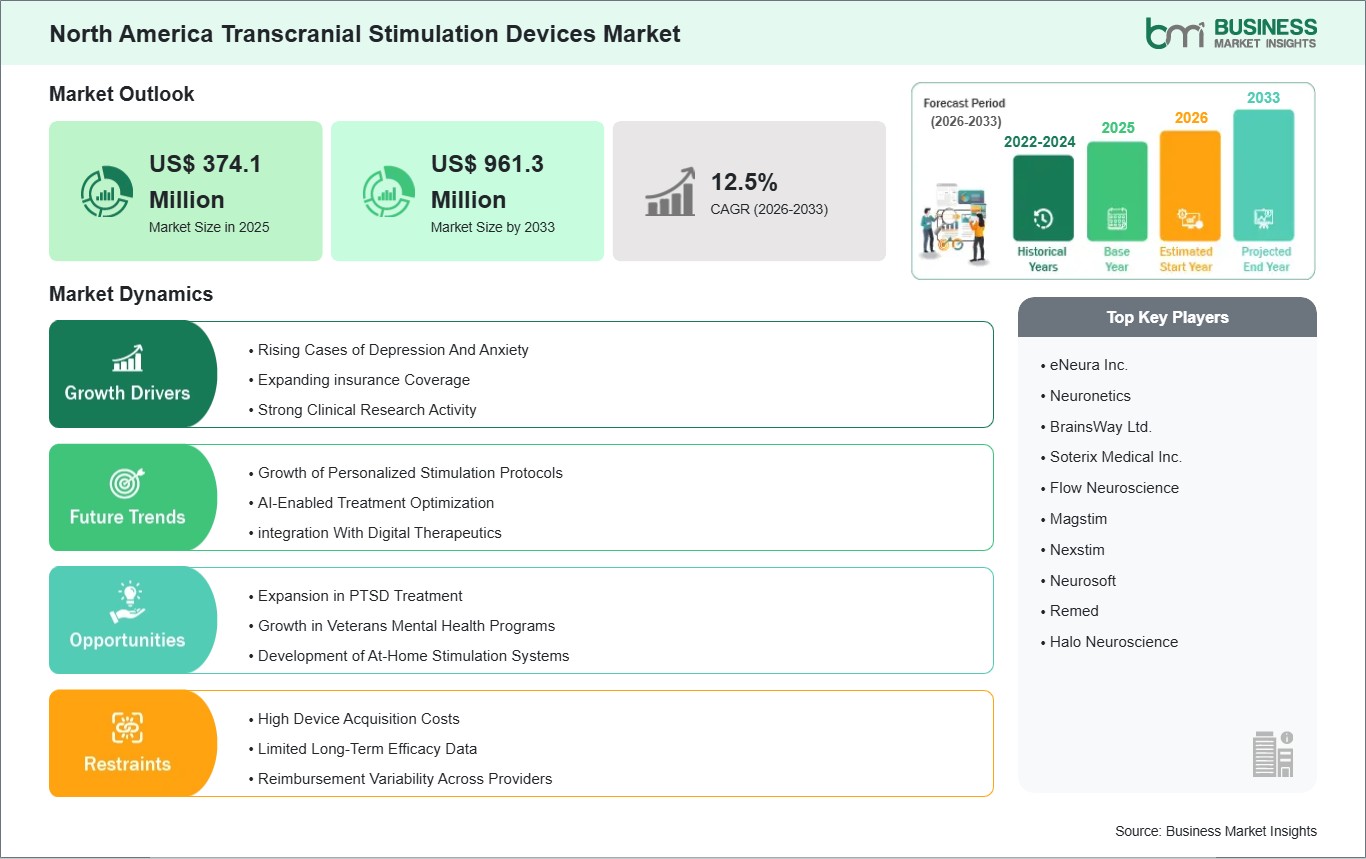
In the face of more advanced neurotechnology ecosystems that have emerged throughout North America, there are significant changes in how clinicians incorporate transcranial stimulation devices into their therapeutic practices when dealing with neurological and neuropsychiatric conditions. Firstly, one of the important drivers in the process comes from the increasing awareness among healthcare providers about neuropsychiatric and neurodegenerative disorders and the growing demand for alternatives to medication treatment, which leads to the incorporation of such technologies by hospitals and specialty clinics for neuromodulation purposes. Secondly, the improvement in the accuracy of neurotechnologies and ease of use, both in portable and targeting terms, serves as another factor in favor of increased utilization. However, an important limitation is that many institutions face certain difficulties in adopting new technologies because of regulatory requirements and the need for adequate evidence, which leads to a slower procurement process. Collaboration between departments of neurology, psychiatry, and rehabilitation units becomes another important factor affecting the adoption process, as organizations tend to look for ways to incorporate these solutions to support care pathways for various conditions. On the other hand, changing clinical training standards and interdisciplinary skills acquisition have affected the speed of adoption, while technological improvements by manufacturers are targeting interoperability, safety, and ease-of-use to match the needs of outpatient and home settings; however, concerns about payment remain as payers evaluate cautiously despite increased awareness of neuromodulation techniques at top hospital and clinic chains within the region's leading urban health networks.
Segment Analysis
North America Transcranial Stimulation Devices Market Segmentation
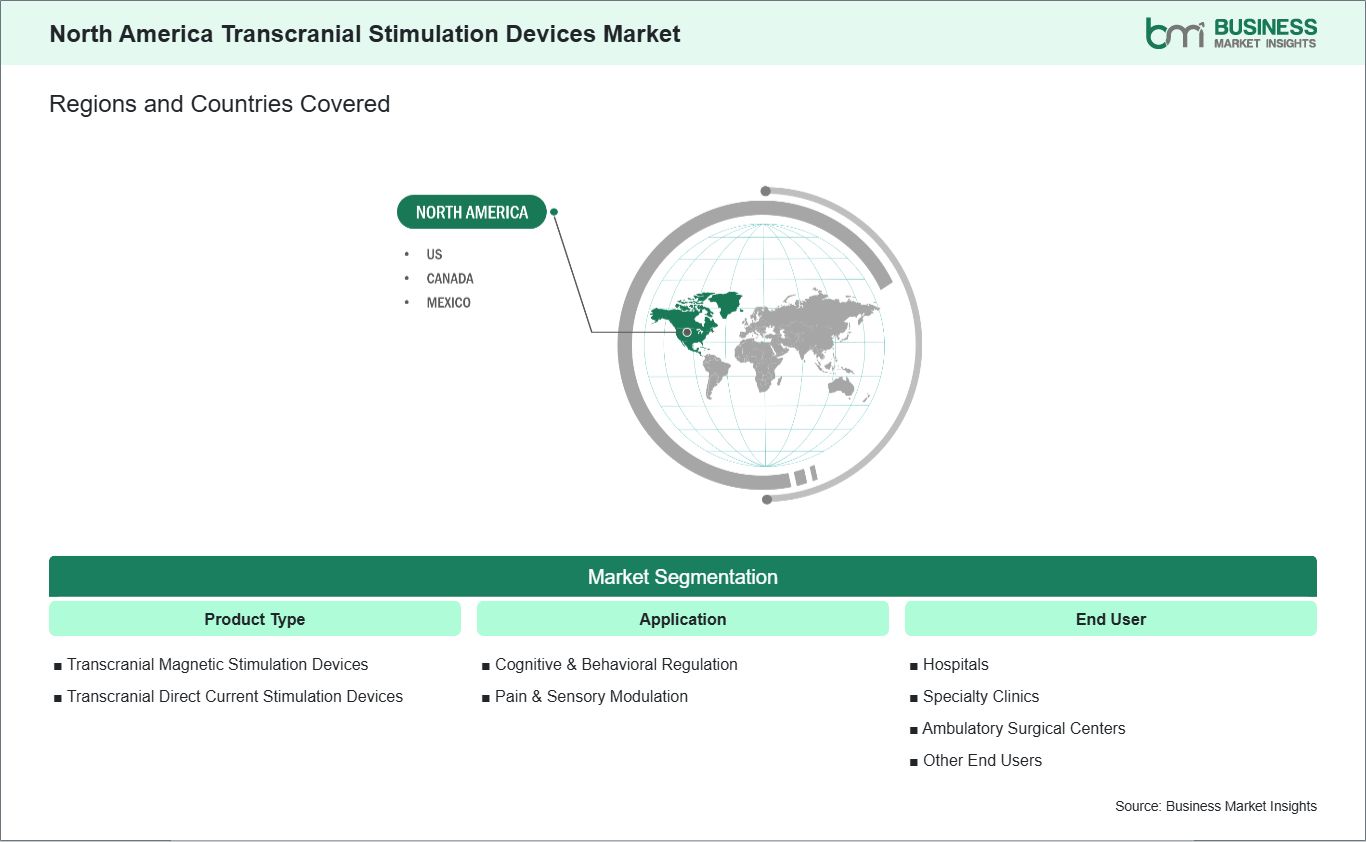
Key segments that contributed to the derivation of the North America transcranial stimulation devices market analysis are product type, application, and end user.
- By product type, the transcranial stimulation devices market is segmented into transcranial magnetic stimulation devices and transcranial direct current stimulation devices. The transcranial magnetic stimulation devices segment dominated the market in 2025.
- Based on application, the transcranial stimulation devices market is categorized into cognitive & behavioral regulation and pain & sensory modulation. The cognitive & behavioral regulation segment dominated the market in 2025.
- In terms of end user, the transcranial stimulation devices market is categorized into hospitals, specialty clinics, ambulatory surgical centers, and other end users. The hospitals segment dominated the market in 2025.
Market Forces
North America Transcranial Stimulation Devices Market Drivers and Opportunities
Rising Cases of Depression and Anxiety
North American healthcare facilities have seen an increase in cases involving patients who do not exhibit sustainable recovery through traditional drug therapy and/or psychotherapy. The emergence of such cases has motivated neuromodulation clinics and hospital networks to include the use of transcranial stimulation devices as early as possible in their treatment plans, especially when symptoms remain and interfere with patients' rehabilitation and return to work.
The proceduralization of transcranial stimulation procedures within outpatient mental healthcare facilities means that the process involves the allocation of chair time, tracking of response curves, and monitoring of progress within a more structured environment, enabling providers to easily compare responses between multiple treatment episodes without depending on patients' accounts. It also facilitates the systematic mapping of targeted brain areas and consistent dose administration throughout different episodes of treatment.
Clinic administrators must also consider the new priorities of patients who wish to receive treatment outside systemic intervention, owing to the negative side effects caused by medications. In turn, healthcare providers must also take note of the efficiency in the process of using transcranial stimulation equipment, technician training needs, and billing issues.
Expansion in PTSD Treatment
Transcranial stimulators, in this case, have become more common among clinical approaches to PTSD and other anxiety disorders. Devices are recommended for use alongside exposure treatments in cases when emotional regulation processes remain uncontrolled despite structured psychological treatment programs.
The positioning of devices in such settings usually corresponds to an attempt to measure patient engagement through the metrics of adherence and physiological responses to stimulator sessions. Stimulus session protocols in this setting include the introduction of stimulation sessions before or after the patient's psychotherapy appointment in order to impact their neuroplastic readiness to undergo psychotherapy sessions.
Sharing patient data allows clinicians to develop a sequence of stimulator sessions based on the timing of their symptoms in psychotherapy sessions. At the same time, specialty clinics and trauma-focused care programs in integrated health care facilities adjust referral design based on identifying patients suffering from chronic anxiety to engage in neurostimulation. Consequently, referral design and device placement can affect how quickly neurostimulation techniques will be used for PTSD treatment.
Size and Share Analysis
North America Transcranial Stimulation Devices Market Size and Share Analysis
The North America transcranial stimulation devices market demonstrates steady growth, with size and share analysis highlighting evolving trends and competitive dynamics among key players. The report examines subsegments categorized within product type, application, and end user, offering insights into their contribution to overall market performance.
By product type, the transcranial magnetic stimulation devices subsegment dominated the market in 2025, driven by its strong clinical efficacy in treating major depression and other neurological disorders, along with increasing regulatory approvals and growing adoption in hospital-based neuropsychiatric care.
Based on application, the cognitive & behavioral regulation subsegment dominated the market in 2025, driven by the rising prevalence of mental health disorders and increasing demand for non-invasive therapies that improve cognition, mood, and behavioral outcomes without pharmacological side effects.
In terms of end user, the hospitals subsegment dominated the market in 2025, driven by higher availability of advanced neurostimulation infrastructure, presence of trained specialists, and preference for supervised clinical environments for safe and effective patient treatment.
Report Coverage
North America Transcranial Stimulation Devices Market Report Coverage and Deliverables
The "North America Transcranial Stimulation Devices Market Size and Forecast (2022-2033)" report provides a detailed analysis of the market covering below areas:
- Market size and forecast at global, regional, and country levels for all the key market segments covered under the scope
- Market trends, as well as drivers, restraints, and opportunities
- Market analysis covering key trends, global and regional framework, major players, regulations, and recent developments
- Market concentration, heat map analysis, prominent players, and recent developments for the Market
- Detailed company profiles, including SWOT analysis
Geographic Insights
North America Transcranial Stimulation Devices Market Geographic Insights
The geographical scope of the North America Transcranial Stimulation Devices Market report is divided into US, Canada, and Mexico. US held the largest share in 2025.
The region of North America is known as a prime regional market for transcranial stimulation systems because the United States remains a leader in terms of the development of its neurotechnology industry, as well as clinical implementation of non-invasive brain stimulation techniques. Continuous market demands in the USA are underpinned by close cooperation between research facilities and healthcare organizations, fast adoption in the fields of psychiatry and neurology, and reimbursement practices that make non-invasive brain stimulation treatments financially feasible for hospitals and outpatient facilities alike. Canada is characterized by market expansion owing to growing focus on making mental healthcare more accessible, integration of neuromodulation techniques into the public healthcare system, and active involvement of universities and teaching hospitals in clinical trials aimed at optimizing therapy outcomes. In Mexico, the dynamics of the market will be dictated by increasing interest in private sector healthcare services, development of neurological care facilities, and growing awareness of non-invasive brain stimulation techniques among medical practitioners and patients. In addition, the high number of manufacturers, start-up ventures, and regulatory processes for stimulating technology make the market in the United States more mature than its neighboring markets due to the ease with which innovations can be brought to commercial use in the region. Knowledge exchange is also evident between North American nations, whereby knowledge related to clinical protocols and usage of the technology in question spreads through North American nations, from research centers in the United States to Canada and Mexico, thus making it possible for innovation to become more relevant in terms of health needs and costs in each country.
Industry Activity
Recent Developments
The North America Transcranial Stimulation Devices Market is evaluated by gathering qualitative and quantitative data post primary and secondary research, which includes important corporate publications, association data, and databases. A few of the key developments in the North America transcranial stimulation devices market are:
- In March 2026, Soterix Medical announced that it had received FDA clearance for its SPRY Transcranial Magnetic Stimulation (TMS) Therapy system, a next-generation transcranial stimulation platform designed for treating major depressive disorder in North American clinical settings.
- In December 2024, Neuronetics announced the completion of its acquisition of Greenbrook TMS, combining NeuroStar Advanced Therapy technology with Greenbrook's network of 95 U.S. treatment clinics to significantly expand access to transcranial magnetic stimulation services across North America.
Trust & Transparency
Research Methodology
The market analysis combines proprietary research with secondary data from government agencies, company disclosures, regulatory filings, industry databases and expert interviews. Market estimates are validated through data triangulation, cross-market benchmarking and analyst
review.
View Full Research Methodology
Key Sources Referred:
U.S. Food and Drug Administration (FDA)National Institute of Mental Health (NIMH)National Institute for Health and Care Excellence (NICE)European Medicines Agency (EMA)Medicines and Healthcare products Regulatory Agency (MHRA)American Psychiatric Association (APA)World Health Organization (WHO)International Neuromodulation Society (INS)International Society for Neuroregulation & Research (ISNR)European Society for Magnetic Resonance in Medicine and Biology (ESMRMB)Company WebsitesCompany Annual ReportsCompany Investor Presentations