Market Summary
Executive Summary and Market Analysis
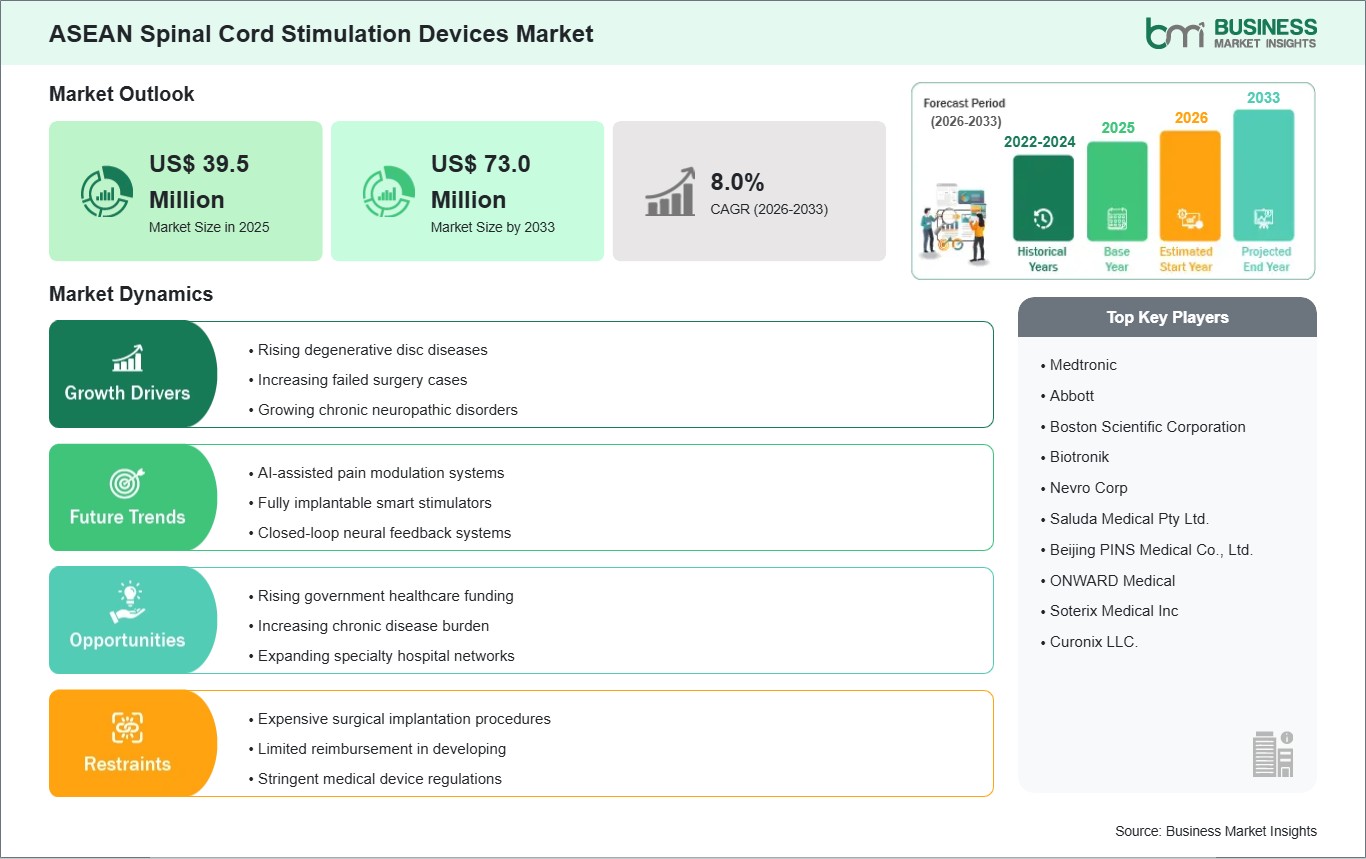
The ASEAN spinal cord stimulation devices market is slowly developing because of the expansion of healthcare systems in Southeast Asia in the area of advanced pain management treatments and neurostimulation therapies. The major market drivers include the rise in the number of patients suffering from chronic disorders of the spine, occupational musculoskeletal diseases, and neuropathic pains caused by aging and changes in lifestyle. In many ASEAN countries, doctors are starting to consider spinal cord stimulation as an effective treatment approach that can be used to help patients with chronic pain for whom traditional medication approaches or spinal procedures are ineffective. Increased interest in medical tourism and higher investments in private healthcare institutions are boosting the availability of advanced pain management treatments in the region. The international experience acquired by neurosurgeons and pain specialists contributes to greater adoption of neuromodulation technology and its application in spinal cord stimulation treatment programs. At present, the market is restricted by expensive procedures and insufficient reimbursement programs, along with the issue of unequal distribution of healthcare services between urban and rural regions. There is still a lack of awareness about spinal cord stimulation in patients and physicians practicing in ASEAN countries. In spite of these obstacles, however, ASEAN is projected to experience steady growth as a result of the increasing need for alternative therapies to chronic pain. This will probably be slow, selective, and mainly take place in tertiary care settings.
Segment Analysis
ASEAN Spinal Cord Stimulation Devices Market Segmentation
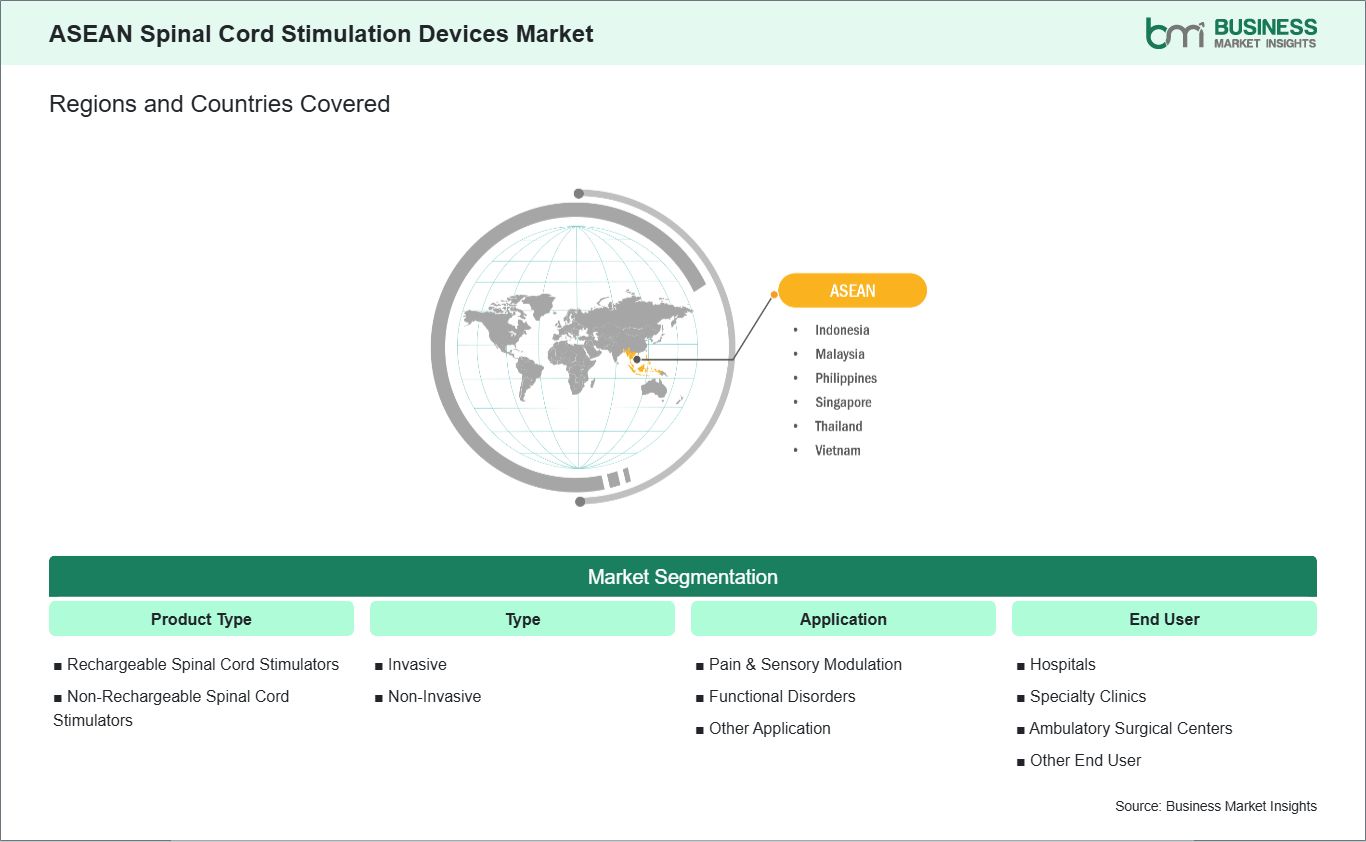
Key segments that contributed to the derivation of the ASEAN spinal cord stimulation devices market analysis are product type, type, application, and end user.
- By product type, the spinal cord stimulation devices market is segmented into rechargeable spinal cord stimulators and non-rechargeable spinal cord stimulators. The rechargeable spinal cord stimulators segment dominated the market in 2025.
- Based on type, the spinal cord stimulation devices market is segmented into invasive and non-invasive. The invasive segment dominated the market in 2025.
- On the basis of application, the spinal cord stimulation devices market is classified into pain and sensory modulation, functional disorders, and other application. The pain and sensory modulation segment dominated the market in 2025.
- In terms of end user, the spinal cord stimulation devices market is categorized into hospitals, specialty clinics, ambulatory surgical centers, and other end user. The hospitals segment dominated the market in 2025.
Market Forces
ASEAN Spinal Cord Stimulation Devices Market Drivers and Opportunities
Rising Degenerative Disc Diseases
There is significant growth being observed in the spinal cord stimulation (SCS) devices market in ASEAN because of increasing cases of degenerative diseases of the discs and chronic low back pains. Urbanization, older population demographics, and a sedentary lifestyle have led to an increase in cases of degenerative spine disease and neuropathy-related conditions. One of the major causes of disability throughout the world is lower back pain, which is increasing significantly in Southeast Asia due to factors such as prolonged sitting, obesity, and physically intensive jobs.
In metropolitan healthcare facilities, increased work hours and ergonomic issues are causing musculoskeletal problems amongst the working age population. Increased cases of chronic spinal pain related to disc degeneration and spinal stenosis are being reported by clinicians in the ASEAN region.
Furthermore, there is a steady rise in spinal surgery procedures in the area, which leads to the incidence of chronic postoperative pain that requires treatment. It is shown that Southeast Asia is one of the biggest regions in terms of the number of patients with degenerative spine disease worldwide because of the vast population and increasing number of seniors. With a better understanding of alternative pain management methods, spinal cord stimulation is increasingly regarded as a viable treatment modality for chronic spine pain management.
Rising Government Healthcare Funding
Spinal Cord Stimulation Devices Market in ASEAN Countries is seeing benefits due to increase in healthcare funding by governments which have been allocated for providing better access to advanced neurological and pain management treatments. Some healthcare organizations within the region have been allocating significant public funds towards the modernization of hospitals and development of new infrastructure to support advanced medical technologies.
Expansion in public healthcare services is helping establish better capacity for tertiary hospitals and specialized treatment facilities to provide patients with more effective care and advanced neuromodulation treatments. In recent years, an increased focus on non-communicable diseases, especially chronic musculoskeletal and neurological disorders, has seen many governments focusing on implementing treatment methods and technology solutions to ease their impacts.
Furthermore, growing healthcare spending is facilitating investments in doctor training, physiotherapy, and computerization in pain management units. Some urban hospitals have been making expenditures in sophisticated imaging technology, telemonitoring systems, and minimal-invasive surgery that enhance the efficacy of the SCS implantation process. In line with the expansion of healthcare facilities in ASEAN economies and improvements in health insurance coverage, the market for spinal cord stimulators will continue gaining momentum in the next few years.
Size and Share Analysis
ASEAN Spinal Cord Stimulation Devices Market Size and Share Analysis
The ASEAN spinal cord stimulation devices market is experiencing steady growth, with market size and share analysis reflecting evolving treatment preferences and competitive dynamics among key players. The report evaluates important subsegments categorized within product type, type, application, and end user, highlighting their respective contributions to overall market performance.
By product type, the rechargeable spinal cord Stimulators subsegment dominated the market in 2025, because long-term chronic pain treatment requires devices that can operate continuously for several years without frequent replacement. Patients increasingly preferred rechargeable systems as they reduce the likelihood of repeat surgeries and lower overall treatment interruption.
Based on type, the invasive subsegment dominated the market in 2025 because implanted spinal cord stimulators deliver more stable and accurate nerve stimulation compared to external therapies. These systems are widely used for severe chronic pain conditions where medication and physiotherapy provide limited relief.
On the basis of application, the pain and sensory modulation subsegment dominated the market in 2025, because spinal cord stimulation is primarily designed to manage chronic neuropathic and musculoskeletal pain. The growing number of patients suffering from lower back pain, diabetic nerve pain, and post-surgical pain significantly increased demand for neuromodulation therapies.
In terms of end user, the hospitals subsegment dominated the market in 2025 because most spinal cord stimulator procedures require specialized surgical facilities, imaging equipment, and multidisciplinary pain management teams. Patients generally prefer hospitals for implantation procedures due to better emergency support and post-operative monitoring capabilities.
Report Coverage
ASEAN Spinal Cord Stimulation Devices Market Report Coverage and Deliverables
The "ASEAN Spinal Cord Stimulation Devices Market Size and Forecast (2022-2033)" report provides a detailed analysis of the market covering below areas:
- Market size and forecast at regional and country levels for all market segments covered under the scope
- Market trends, as well as drivers, restraints, and opportunities
- Market analysis covering key trends, regional framework, major players, regulations, and recent developments
- Market concentration, heat map analysis, prominent players, and recent developments for the Market
- Detailed company profiles, including SWOT analysis
Geographic Insights
ASEAN Spinal Cord Stimulation Devices Market Geographic Insights
The geographical scope of the ASEAN Spinal cord stimulation devices market report is divided into: Indonesia, Malaysia, the Philippines, Singapore, Thailand, and Vietnam. Indonesia held the largest share in 2025.
The Indonesia region leads in the Spinal Cord Stimulation Devices market in the ASEAN region owing to its large patient population, development of the private healthcare industry, and increased investment in neurological and spinal treatments. In major cities like Jakarta and Surabaya, there is a rise in the construction of tertiary healthcare facilities and private clinics with the capability to conduct advanced interventions like spinal cord stimulation, which is recommended for treating neuropathic and post-surgical pain. The awareness about the use of such minimally invasive treatments is on the rise, leading to their adoption by doctors of top healthcare providers for complex patients who have shown poor response to conventional treatments. An important factor in Indonesia is the quick establishment of healthcare infrastructure that is providing better access to cutting-edge technology for patients in better economic condition. Neurosurgeons and pain physicians who are internationally trained are contributing towards bringing modern neuromodulation technologies and developing expertise within the country. Rising urbanization rates and increased incidences of spinal disorders associated with the change in lifestyles have resulted in the need for advanced treatment methods. On the contrary, adoption of the technology is highly localized to private urban healthcare centers owing to financial constraints and lack of insurance coverage for implantable neuromodulation devices. Public healthcare centers have an emphasis on basic health care services, thus making adoption difficult. In other countries in the ASEAN region, adoption rates are low owing to lower numbers of specialized doctors and limited infrastructure available for procedures. As such, Indonesia is continuing to be the major market for spinal cord stimulators within ASEAN.
Industry Activity
Recent Developments
The ASEAN spinal cord stimulation devices market is evaluated by gathering qualitative and quantitative data post primary and secondary research, which includes important corporate publications, association data, and databases. A few of the key developments in the ASEAN spinal cord stimulation devices market are:
- In November 2023, Singapores National Neuroscience Institute (NNI) and Tan Tock Seng Hospital (TTSH) announced the launch of Asias first spinal cord neurostimulation therapy trial in Singapore, using implanted spinal cord stimulation technology to help restore walking ability in patients with spinal cord injuries, marking a major advancement for neuromodulation adoption in the ASEAN region.
- In July 2023, NeuroSigma announced the establishment of its Singapore subsidiary, NeuroSigma Pte. Ltd., to strengthen research collaborations and support commercialization of neurostimulation technologies across Southeast Asia, including ASEAN markets such as Singapore, Malaysia, and Indonesia.
Trust & Transparency
Research Methodology
The market analysis combines proprietary research with secondary data from government agencies, company disclosures, regulatory filings, industry databases and expert interviews. Market estimates are validated through data triangulation, cross-market benchmarking and analyst
review.
View Full Research Methodology
Key Sources Referred:
The World BankWorld Health Organization (WHO)Center for Disease Control and Prevention (CDC)Food and Drug Administration (FDA)Centers for Medicare and Medicaid Services (CMS)European CommissionMedicines and Healthcare products Regulatory Agency (MHRA)Company WebsitesCompany Annual ReportsCompany Investor Presentation