Market Summary
Executive Summary and Market Analysis
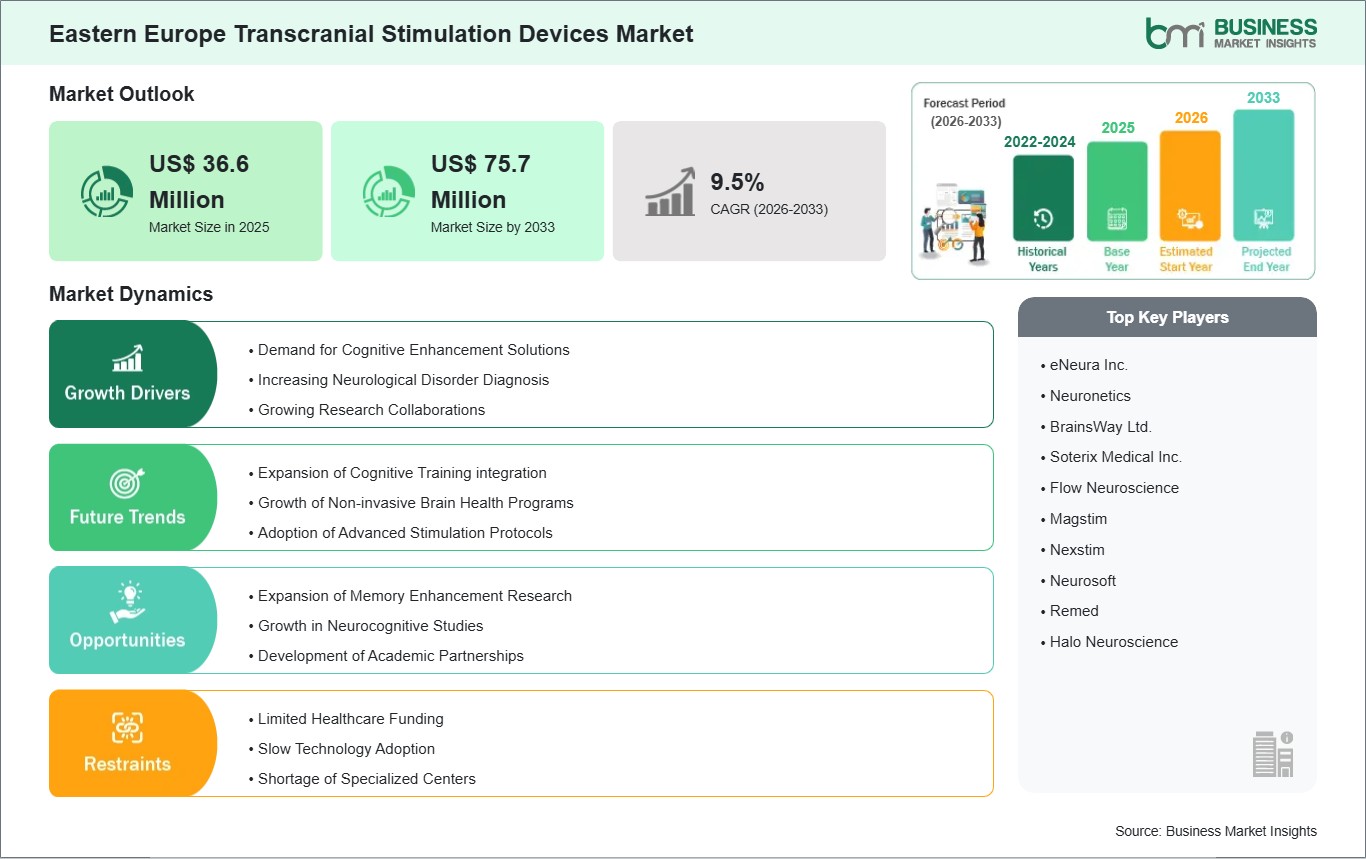
The Eastern European market for transcranial stimulation devices will be affected by the increasing interest shown by the region in using non-invasive treatment methods in the field of neurology and psychiatry, in hospitals as well as specialized rehabilitation clinics. As more focus is placed on depression, chronic pain disorders, stroke treatment, and neurodegeneration, there is an emerging trend among health care facilities to incorporate stimulation devices as part of their treatment regimen due to unsatisfactory results achieved with medications alone. One other important reason driving the market forward is increased cooperation between regional research institutions, universities, and medical device companies, which results in clinical studies, leading to the development of physicians' knowledge regarding the use of stimulation techniques. Moreover, demand can be attributed to improved medical infrastructures in several Eastern European countries and the adoption of neurotherapy devices in private clinics. Nevertheless, there is another restraint faced by the market associated with the lack of standardization and regulation in reimbursement and regulatory matters, leading to delays in purchasing. There are other factors that should be considered by companies as well, such as the training of clinicians and skepticism on the part of patients toward new technologies in neuromodulation. The main areas of focus in competition include portability, precise targeting, and integration of software into treatment.
Segment Analysis
Eastern Europe Transcranial Stimulation Devices Market Segmentation
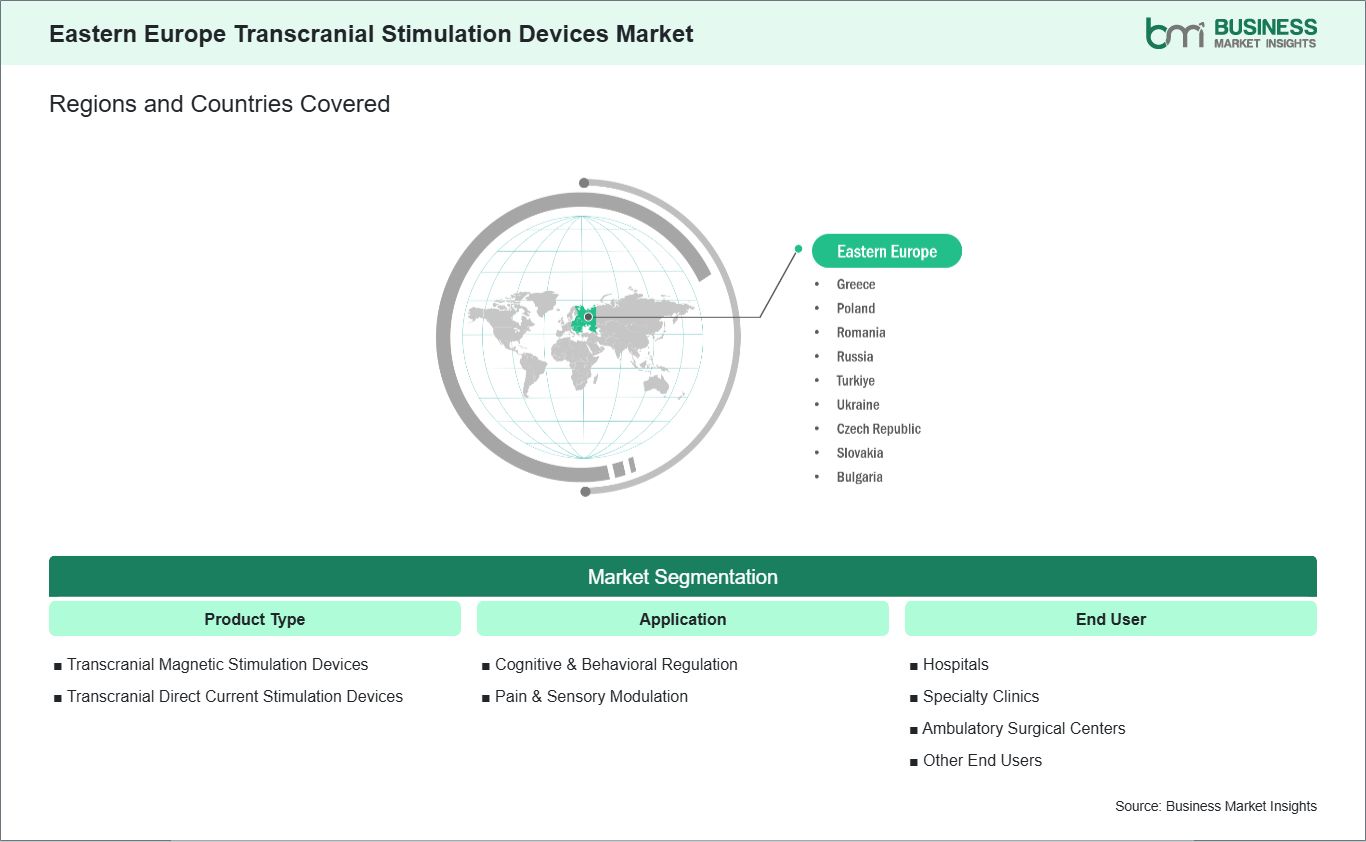
Key segments that contributed to the derivation of the Eastern Europe transcranial stimulation devices market analysis are product type, application, and end user.
- By product type, the transcranial stimulation devices market is segmented into transcranial magnetic stimulation devices and transcranial direct current stimulation devices. The transcranial magnetic stimulation devices segment dominated the market in 2025.
- Based on application, the transcranial stimulation devices market is categorized into cognitive & behavioral regulation and pain & sensory modulation. The cognitive & behavioral regulation segment dominated the market in 2025.
- In terms of end user, the transcranial stimulation devices market is categorized into hospitals, specialty clinics, ambulatory surgical centers, and other end users. The hospitals segment dominated the market in 2025.
Market Forces
Eastern Europe Transcranial Stimulation Devices Market Drivers and Opportunities
Demand for Cognitive Enhancement Solutions
More urban clinical networks in Eastern Europe witness the rising demand for transcranial stimulation technologies that are used not for medical but for performance-based purposes. Professionals engaged in analysis and working in technical jobs include neurostimulators in their training schedules in order to improve mental focus and decrease exhaustion. The described situation contributes to the tendency for clinics to offer patients a package of services related to cognitive optimization instead of neurotherapy. Thereby, ease of use and repeatability of neurostimulation sessions become crucial factors when selecting the appropriate system.
Clinics connected to medical educational institutions also play an important role in the process of adoption. Training sessions in the course of which medical students receive information about neuromodulation contribute to the greater comfort with using neurostimulators in their future private practices. In terms of preferred types of devices, this market segment prioritizes products that make it possible to adjust parameters of neurostimulation procedures and use them while implementing cognitive training.
Wellness centers specializing in productivity enhancement programs also foster the demand for neurostimulators. Due to this fact, portable technologies that can be used in the outpatient setting are highly demanded now.
Expansion of Memory Enhancement Research
There has been a notable increase in the number of applied experiments investigating the influence of transcranial stimulation on learning efficiency and memory consolidation conducted in Eastern European research institutions. Specifically, university labs have been concentrating on the development of exact stimulation protocols, examining the impact of parameter variations on attention control under challenging cognitive conditions. As a result, there is an increased need for reliable equipment that allows for fine-tuning and stable operation throughout the process.
Transcranial stimulation is being incorporated by medical specialists in cognitive rehabilitation programs aimed at improving memory and language functions. This particular application is most commonly used together with cognitive exercises; therefore, the required equipment must be easy to set up but should produce consistent results.
In addition, the collaboration of engineering and neuroscience departments leads to more innovative research aimed at exploring the process of neuroplasticity. Such research frequently involves stimulation combined with online learning systems.
Size and Share Analysis
Eastern Europe Transcranial Stimulation Devices Market Size and Share Analysis
The Eastern Europe transcranial stimulation devices market demonstrates steady growth, with size and share analysis highlighting evolving trends and competitive dynamics among key players. The report examines subsegments categorized within product type, application, and end user, offering insights into their contribution to overall market performance.
By product type, the transcranial magnetic stimulation devices subsegment dominated the market in 2025, driven by its strong clinical efficacy in treating major depression and other neurological disorders, along with increasing regulatory approvals and growing adoption in hospital-based neuropsychiatric care.
Based on application, the cognitive & behavioral regulation subsegment dominated the market in 2025, driven by the rising prevalence of mental health disorders and increasing demand for non-invasive therapies that improve cognition, mood, and behavioral outcomes without pharmacological side effects.
In terms of end user, the hospitals subsegment dominated the market in 2025, driven by higher availability of advanced neurostimulation infrastructure, presence of trained specialists, and preference for supervised clinical environments for safe and effective patient treatment.
Report Coverage
Eastern Europe Transcranial Stimulation Devices Market Report Coverage and Deliverables
The "Eastern Europe Transcranial Stimulation Devices Market Size and Forecast (2022-2033)" report provides a detailed analysis of the market covering below areas:
- Market size and forecast at global, regional, and country levels for all the key market segments covered under the scope
- Market trends, as well as drivers, restraints, and opportunities
- Market analysis covering key trends, global and regional framework, major players, regulations, and recent developments
- Market concentration, heat map analysis, prominent players, and recent developments for the Market
- Detailed company profiles, including SWOT analysis
Geographic Insights
Eastern Europe Transcranial Stimulation Devices Market Geographic Insights
The geographical scope of the Eastern Europe Transcranial Stimulation Devices Market report is divided into Russia, Poland, Romania, Czech Republic, Greece, Ukraine, Slovakia, Bulgaria. Russia held the largest share in 2025.
The Eastern European Transcranial Stimulation Devices Market reveals diverse development trends in the most significant economies of the region, with Russia retaining the leading position as a result of abundant neurological research activities, widespread use in psychiatric practice, and numerous local medical equipment vendors. The Polish market shows significant progress, fueled by the growing number of rehabilitation centers and the incorporation of non-invasive neurostimulation techniques in the rehabilitation programs after strokes. Romania shows increasing activity in the industry due to healthcare sector innovation campaigns aimed at the introduction of modern therapeutic products for the treatment of cognitive and neurological issues. The Czech Republic's market is fueled by the country's vibrant research activities in the field of neuroscience, thus promoting experimental use of brain stimulation devices. Greece shows promising dynamics as private health facilities increasingly resort to novel neurotherapeutic approaches as a means of providing patients with an option of treatment for their mental and physical discomfort. The Ukrainian market shows potential owing to the growing focus on neurological treatment and psycho-rehabilitation practices. There are some benefits Slovakia is enjoying through the gradual digital transformation that is happening in its healthcare institutions, making it easier for technologically innovative therapy tools to be accessed. Bulgaria, on the other hand, seems to have great potential because of the participation of special neurotherapy clinics.
Industry Activity
Recent Developments
The Eastern Europe Transcranial Stimulation Devices Market is evaluated by gathering qualitative and quantitative data post primary and secondary research, which includes important corporate publications, association data, and databases. A few of the key developments in the Eastern Europe transcranial stimulation devices market are:
- In September 2023, Sooma announced that it had become the first transcranial direct current stimulation (tDCS) device manufacturer to receive European MDR certification, strengthening regulatory compliance and commercialization opportunities for non-invasive brain stimulation devices across Eastern Europe.
- In October 2023, Sooma announced the launch of its Sooma Duo remote brain stimulation system, enabling clinician-monitored at-home transcranial direct current stimulation (tDCS) treatment for depression and expanding digital neuromodulation access across European markets, including Central and Eastern Europe through distributor networks.
Trust & Transparency
Research Methodology
The market analysis combines proprietary research with secondary data from government agencies, company disclosures, regulatory filings, industry databases and expert interviews. Market estimates are validated through data triangulation, cross-market benchmarking and analyst
review.
View Full Research Methodology
Key Sources Referred:
U.S. Food and Drug Administration (FDA)National Institute of Mental Health (NIMH)National Institute for Health and Care Excellence (NICE)European Medicines Agency (EMA)Medicines and Healthcare products Regulatory Agency (MHRA)American Psychiatric Association (APA)World Health Organization (WHO)International Neuromodulation Society (INS)International Society for Neuroregulation & Research (ISNR)European Society for Magnetic Resonance in Medicine and Biology (ESMRMB)Company WebsitesCompany Annual ReportsCompany Investor Presentations