Market Summary
Executive Summary and Market Analysis
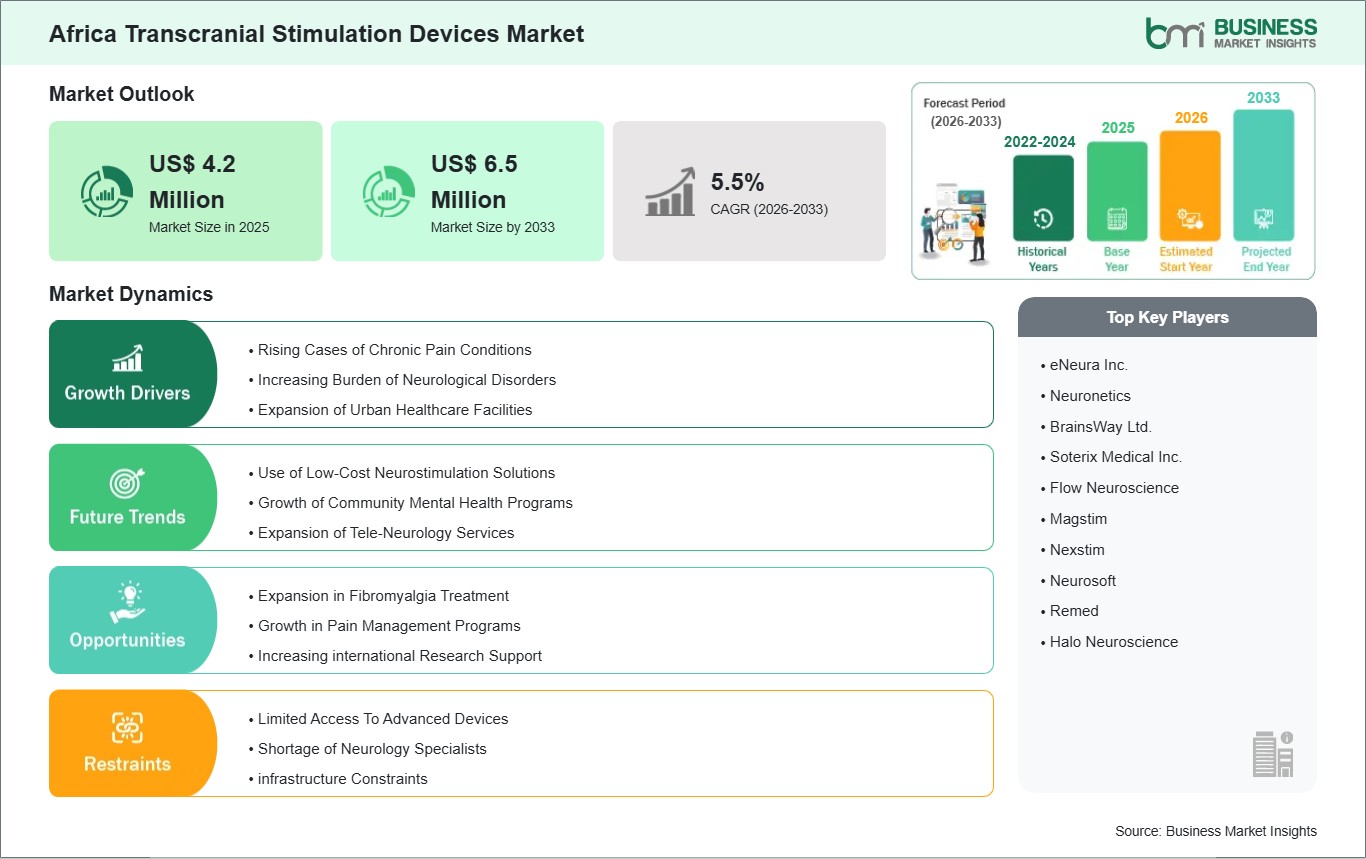
There is a growing number of mental illnesses and neurological conditions, as well as a growing need for rehabilitation among stroke and TBI patients. There is an increasing interest in using transcranial brain stimulation devices on the part of healthcare organizations in leading economies of the continent. These technologies are effective in treating patients who have shown a negative response to standard drug therapy. There has been an increase in the number of private hospitals, specialist centers, and academic facilities using this type of technology in South Africa, Egypt, and North and East Africa. The market is fueled by growing public recognition of the importance of mental illness treatment and investments in healthcare infrastructure, as well as cooperation between medical device manufacturers and local healthcare facilities. Healthcare facilities in urban areas are adopting technologically advanced neuromodulation systems for treating psychological disorders and pain. The high cost of acquisition and maintenance of transcranial stimulation equipment constitutes a considerable problem for a number of health care establishments. The insufficient number of qualified doctors working in neurology, psychiatry, and neurostimulation prevents people from having access to this procedure. An underdeveloped healthcare infrastructure, high dependence on the import of sophisticated medical equipment, and poor reimbursements hinder market growth.
Segment Analysis
Africa Transcranial Stimulation Devices Market Segmentation
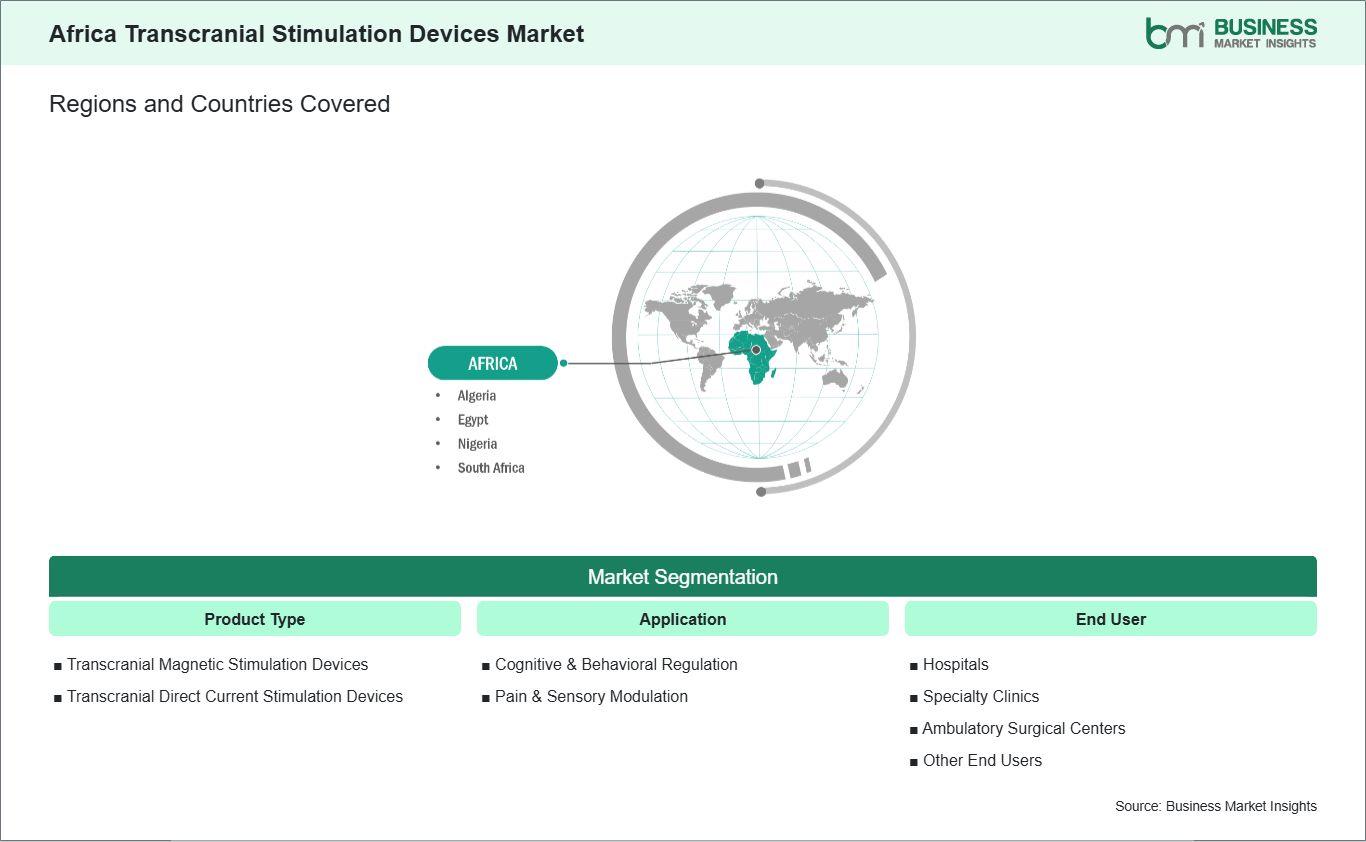
Key segments that contributed to the derivation of the Africa transcranial stimulation devices market analysis are product type, application, and end user.
- By product type, the transcranial stimulation devices market is segmented into transcranial magnetic stimulation devices and transcranial direct current stimulation devices. The transcranial magnetic stimulation devices segment dominated the market in 2025.
- Based on application, the transcranial stimulation devices market is categorized into cognitive & behavioral regulation and pain & sensory modulation. The cognitive & behavioral regulation segment dominated the market in 2025.
- In terms of end user, the transcranial stimulation devices market is categorized into hospitals, specialty clinics, ambulatory surgical centers, and other end users. The hospitals segment dominated the market in 2025.
Market Forces
Africa Transcranial Stimulation Devices Market Drivers and Opportunities
Rising Cases of Chronic Pain Conditions
The increasing trend toward chronic pain conditions is driving the use of brain stimulation technology in neurological practices and rehabilitative settings. Practitioners in South Africa, Egypt, and Nigeria are seeing more requests from their patients to use noninvasive methods of pain management that can ensure long-term relief without heavy reliance on drugs. The rising levels of urbanization, work-related pressure, and associated illnesses are increasing the number of people with chronic pain, neuropathy, and post-traumatic pain issues. Increasing emphasis on the importance of neurological well-being is prompting health facilities to invest in sophisticated pain therapy tools to ensure patient well-being.
Regional healthcare centers are adding neuromodulation techniques to their multi-modal pain management and functional restoration procedures. Clinics and academic medical centers are improving the expertise of their physicians through training in neurostimulation treatment techniques to encourage greater physician involvement with brain stimulation technology. Expansion of rehabilitative and neurological services is boosting the adoption rates of transcranial stimulators in emerging healthcare facilities.
Expansion in Fibromyalgia Treatment
Fibromyalgia treatment in Africa continues to expand, contributing to heightened interest in using transcranial stimulation devices among health care providers in search of more efficient methods of addressing symptoms associated with chronic neurological conditions. Patients suffering from fibromyalgia have problems with their overall energy levels, cognitive functions, sleep cycle, and physical discomfort. As a result, medical practitioners turn to therapeutic options other than medications. Countries such as Kenya, Morocco, and South Africa experience greater awareness of chronic pain disorders, which contributes to enhanced understanding of fibromyalgia and its effects in the context of neurology and rehabilitation.
Another factor contributing to increased demand for stimulatory treatments is the development of a holistic approach to therapy that includes physiotherapy, behavioral therapy, and neuromodulation treatments. Medical specialists undergo extensive neurological training and education programs, which help them develop skills related to diagnosis and treatment plans for chronic pain syndromes. Private healthcare development, as well as greater demand for neurological services, provide lucrative prospects for companies offering transcranial stimulation devices in Africa.
Size and Share Analysis
Africa Transcranial Stimulation Devices Market Size and Share Analysis
The Africa transcranial stimulation devices market demonstrates steady growth, with size and share analysis highlighting evolving trends and competitive dynamics among key players. The report examines subsegments categorized within product type, application, and end user, offering insights into their contribution to overall market performance.
By product type, the transcranial magnetic stimulation devices subsegment dominated the market in 2025, driven by its strong clinical efficacy in treating major depression and other neurological disorders, along with increasing regulatory approvals and growing adoption in hospital-based neuropsychiatric care.
Based on application, the cognitive & behavioral regulation subsegment dominated the market in 2025, driven by the rising prevalence of mental health disorders and increasing demand for non-invasive therapies that improve cognition, mood, and behavioral outcomes without pharmacological side effects.
In terms of end user, the hospitals subsegment dominated the market in 2025, driven by higher availability of advanced neurostimulation infrastructure, presence of trained specialists, and preference for supervised clinical environments for safe and effective patient treatment.
Report Coverage
Africa Transcranial Stimulation Devices Market Report Coverage and Deliverables
The "Africa Transcranial Stimulation Devices Market Size and Forecast (2022-2033)" report provides a detailed analysis of the market covering below areas:
- Market size and forecast at global, regional, and country levels for all the key market segments covered under the scope
- Market trends, as well as drivers, restraints, and opportunities
- Market analysis covering key trends, global and regional framework, major players, regulations, and recent developments
- Market concentration, heat map analysis, prominent players, and recent developments for the Market
- Detailed company profiles, including SWOT analysis
Geographic Insights
Africa Transcranial Stimulation Devices Market Geographic Insights
The geographical scope of the Africa Transcranial Stimulation Devices Market report is divided into Nigeria, Egypt, South Africa, and Algeria. South Africa held the largest share in 2025.
South Africa is characterized by its advanced healthcare sector, growing availability of neurological healthcare facilities, and high adoption of new noninvasive techniques for treating various ailments. The country enjoys easy access to professional healthcare workers, higher use of neurostimulation treatments for psychological disorders, and high awareness concerning the treatment of mental illnesses. The market in Egypt is witnessing considerable growth driven by increasing modernization of healthcare facilities, growing demand for neurological and psychiatric treatments, and innovations in therapeutic techniques in large city hospitals. There are opportunities for growth in Nigeria due to the country's huge population, increased occurrence of neurological diseases, and the growing number of private investment initiatives geared towards providing better access to treatment. Yet, poor infrastructure and varying levels of availability of healthcare facilities affect market penetration. In Algeria, there is an ongoing development of neurological rehabilitation treatment procedures and various new technologies associated with the treatment of chronic neurological and mental diseases. The government continues to develop healthcare and adopt new medical technologies, which positively influences market development.
Industry Activity
Recent Developments
The Africa Transcranial Stimulation Devices Market is evaluated by gathering qualitative and quantitative data post primary and secondary research, which includes important corporate publications, association data, and databases. A few of the key developments in the Africa transcranial stimulation devices market are:
- In June 2024, BrainsWay announced the launch of a prospective, randomized, multicenter clinical trial evaluating an accelerated Deep Transcranial Magnetic Stimulation (Deep TMS) protocol for major depressive disorder, aimed at expanding adoption of transcranial stimulation therapies globally, including emerging healthcare markets.
- In February 2023, electroCore announced an exclusive distribution agreement with Byond Healthcare Pty Ltd. for the distribution of gammaCore Sapphire non-invasive vagus nerve stimulation devices in South Africa and Namibia, strengthening the company's presence in Africa's neurostimulation market.
Trust & Transparency
Research Methodology
The market analysis combines proprietary research with secondary data from government agencies, company disclosures, regulatory filings, industry databases and expert interviews. Market estimates are validated through data triangulation, cross-market benchmarking and analyst
review.
View Full Research Methodology
Key Sources Referred:
U.S. Food and Drug Administration (FDA)National Institute of Mental Health (NIMH)National Institute for Health and Care Excellence (NICE)European Medicines Agency (EMA)Medicines and Healthcare products Regulatory Agency (MHRA)American Psychiatric Association (APA)World Health Organization (WHO)International Neuromodulation Society (INS)International Society for Neuroregulation & Research (ISNR)European Society for Magnetic Resonance in Medicine and Biology (ESMRMB)Company WebsitesCompany Annual ReportsCompany Investor Presentations