Market Summary
Executive Summary and Market Analysis
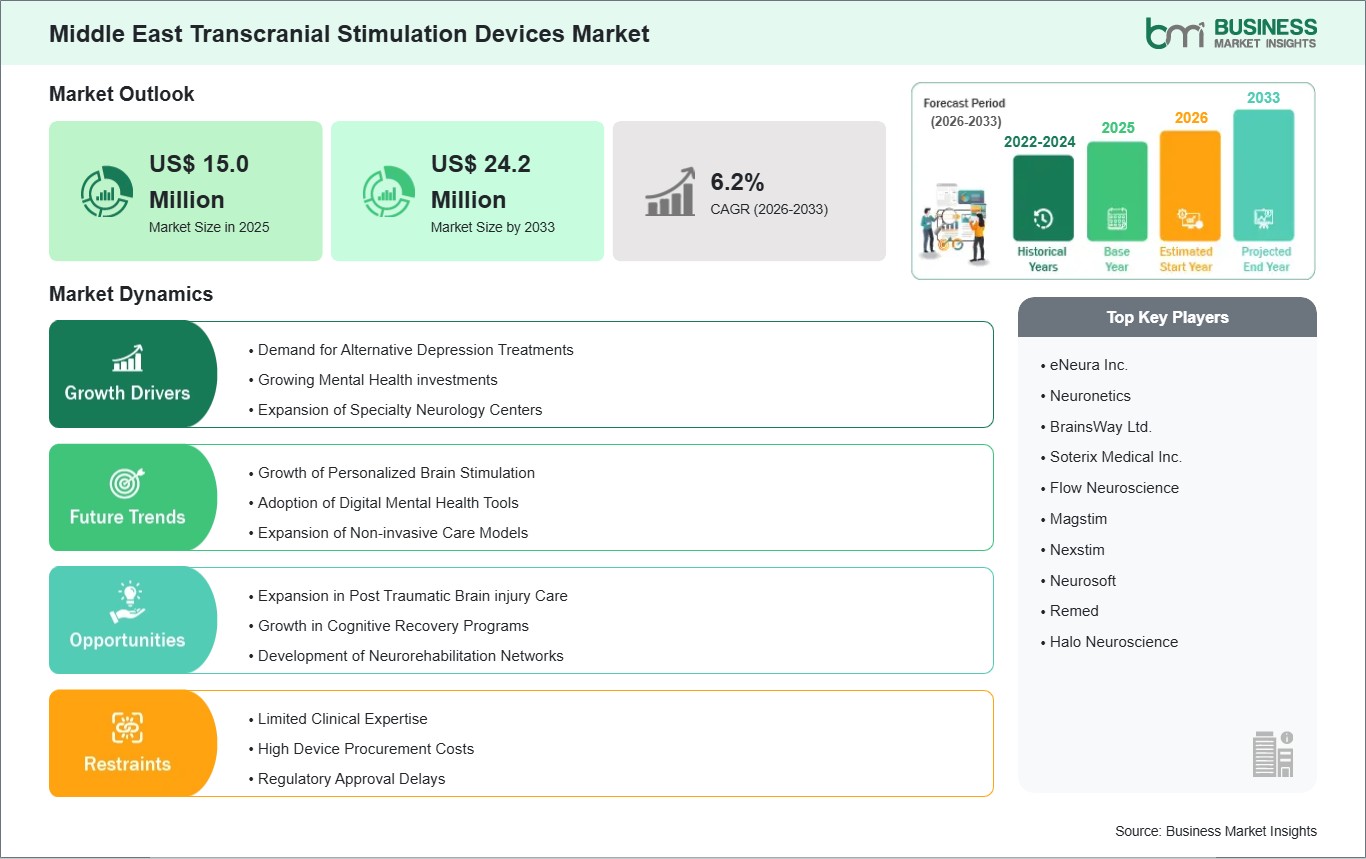
Market growth for transcranial stimulation devices in the Middle East will be closely related to the development of neurological and psychiatric treatment in the region. Health facilities have been focusing more on the integration of transcranial brain stimulation technologies in treatment programs for depression, chronic pain, epilepsy, stroke recovery, and other neurodegenerative disorders. The trend can also be explained by the increase in the demand for patient-specific neuromodulation procedures as health facilities provide their patients with access to the most innovative neurodiagnostics and neurorehabilitation treatments. In addition, the growing number of cases involving mental health disorders and decreased levels of stigma regarding mental illnesses have encouraged people and physicians to find new treatment options instead of turning to drug-based therapies. There is also a trend in regional medical institutions working with device manufacturers and educational organizations to introduce more advanced forms of stimulators characterized by highly targeted effects and digital monitoring capabilities. Nevertheless, uptake will remain inconsistent considering the expensive nature of procuring and maintaining the new generation transcranial stimulators, which may be unaffordable in healthcare settings with poor financial coverage programs and scarce professionals. The different regulatory frameworks governing medical device approval processes among the various Middle Eastern nations also contribute significantly towards determining business approaches and affecting the pace at which devices penetrate the market. Nonetheless, the competition within the market still remains attractive for medtech firms that want to capitalize on neurology and cognitive health innovations.
Segment Analysis
Middle East Transcranial Stimulation Devices Market Segmentation
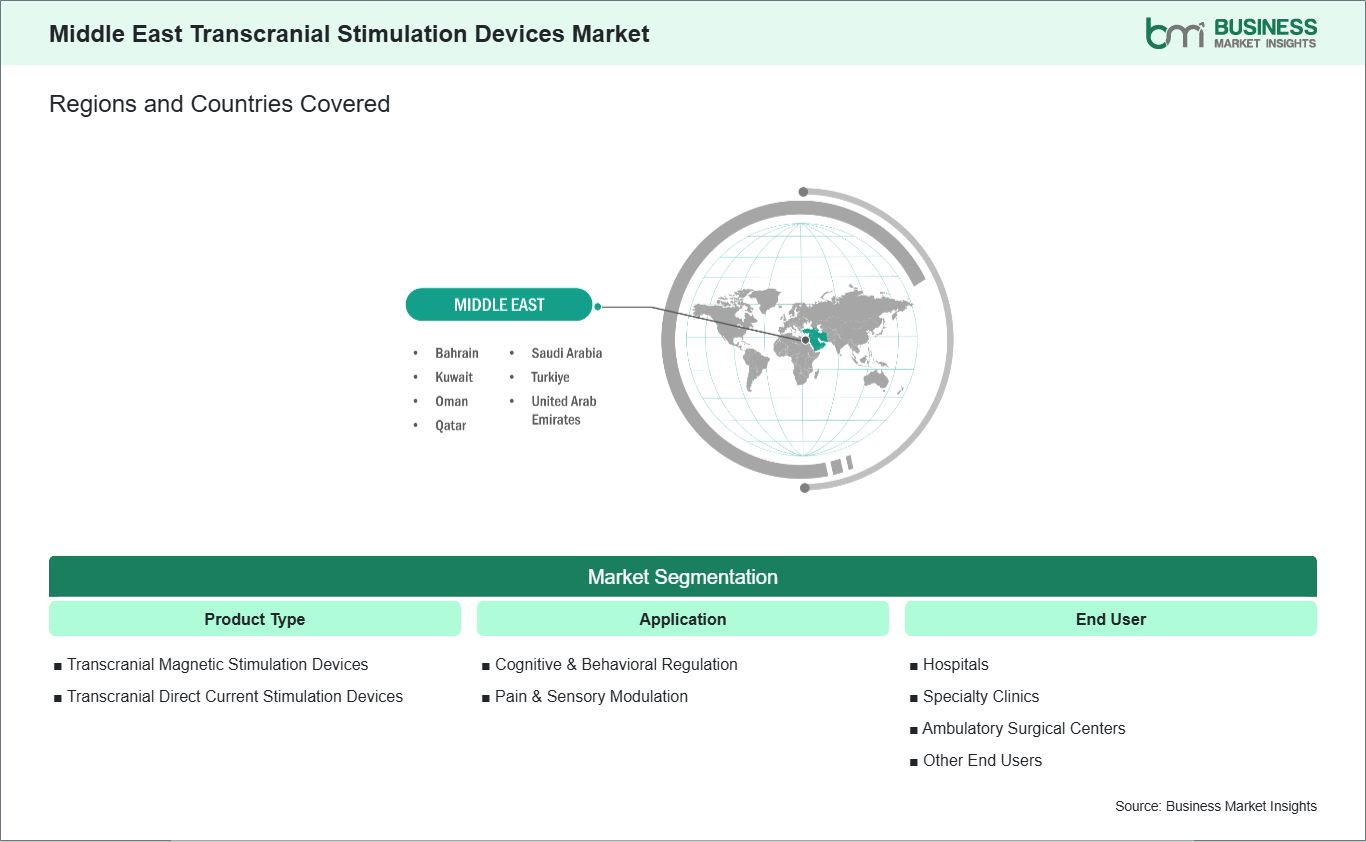
Key segments that contributed to the derivation of the Middle East transcranial stimulation devices market analysis are product type, application, and end user.
- By product type, the transcranial stimulation devices market is segmented into transcranial magnetic stimulation devices and transcranial direct current stimulation devices. The transcranial magnetic stimulation devices segment dominated the market in 2025.
- Based on application, the transcranial stimulation devices market is categorized into cognitive & behavioral regulation and pain & sensory modulation. The cognitive & behavioral regulation segment dominated the market in 2025.
- In terms of end user, the transcranial stimulation devices market is categorized into hospitals, specialty clinics, ambulatory surgical centers, and other end users. The hospitals segment dominated the market in 2025.
Market Forces
Middle East Transcranial Stimulation Devices Market Drivers and Opportunities
Growing Demand for Alternative Depression Treatments
In major Middle Eastern urban hubs, clinical pathways for psychiatric cases are slowly integrating non-pharmacologic neuromodulation alternatives into the process. Transcranial stimulation devices have been considered for use as an add-on modality where standard antidepressants prove ineffective or have a slow onset and/or intolerable side effects. This development will impact procurement decisions by hospital administrators who value diversity in their mental health offerings.
For private healthcare providers, there seems to be reluctance on the part of patients when it comes to continuous use of psychotropic medicines. Such a situation often leads physicians to investigate neuromodulation via device use as an alternative pathway. In this regard, as consultations become more patient-centric, neurostimulation becomes part of the early discussions regarding possible treatments.
Administrators who are looking into expanding mental health services within a hospital will have to consider how feasible it would be to integrate portable brain stimulation devices where both psychotherapy and neuromodulation take place. The development gives rise to a trend in terms of redesigning treatment rooms to accommodate multiple visits to the device by patients under clinician supervision.
Expansion in Post Traumatic Brain Injury Care
There is an evident development in the integration of neuromodulation procedures in addition to other conventional forms of therapy, such as physiotherapy and cognitive rehabilitation, in the management of traumatic brain injuries among people seeking rehabilitation services in Middle Eastern care facilities. The transcranial stimulation equipment is now perceived to assist the healing process of patients suffering from cognitive and mood disorders associated with trauma.
The use of neuromodulation in the treatment and recovery plan of individuals sustaining post-TBI symptoms has contributed immensely to the integration of the equipment in the process. The stimulation procedures are integrated with traditional rehabilitation practices as the clinicians aim at stimulating the neurons to enhance the process of synaptic reorganization. In specialized neurology hospitals, the use of the device will depend on the progress of the client.
Most of the clinics providing neuromodulation therapy usually incorporate the process into several phases, depending on the progress made by the clients. This enables the health practitioners to determine the appropriate intensity during stimulation procedures, which depends on the progress of the patient in cognitive training.
Size and Share Analysis
Middle East Transcranial Stimulation Devices Market Size and Share Analysis
The Middle East transcranial stimulation devices market demonstrates steady growth, with size and share analysis highlighting evolving trends and competitive dynamics among key players. The report examines subsegments categorized within product type, application, and end user, offering insights into their contribution to overall market performance.
By product type, the transcranial magnetic stimulation devices subsegment dominated the market in 2025, driven by its strong clinical efficacy in treating major depression and other neurological disorders, along with increasing regulatory approvals and growing adoption in hospital-based neuropsychiatric care.
Based on application, the cognitive & behavioral regulation subsegment dominated the market in 2025, driven by the rising prevalence of mental health disorders and increasing demand for non-invasive therapies that improve cognition, mood, and behavioral outcomes without pharmacological side effects.
In terms of end user, the hospitals subsegment dominated the market in 2025, driven by higher availability of advanced neurostimulation infrastructure, presence of trained specialists, and preference for supervised clinical environments for safe and effective patient treatment.
Report Coverage
Middle East Transcranial Stimulation Devices Market Report Coverage and Deliverables
The "Middle East Transcranial Stimulation Devices Market Size and Forecast (2022-2033)" report provides a detailed analysis of the market covering below areas:
- Market size and forecast at global, regional, and country levels for all the key market segments covered under the scope
- Market trends, as well as drivers, restraints, and opportunities
- Market analysis covering key trends, global and regional framework, major players, regulations, and recent developments
- Market concentration, heat map analysis, prominent players, and recent developments for the Market
- Detailed company profiles, including SWOT analysis
Geographic Insights
Middle East Transcranial Stimulation Devices Market Geographic Insights
The geographical scope of the Middle East Transcranial Stimulation Devices Market report is divided into UAE, Saudi Arabia, Bahrain, Oman, Kuwait, Qatar, Turkiye. Turkiye held the largest share in 2025.
In the Middle East, there are diverse trends observed in the Transcranial Stimulation Devices Market influenced by advancements in healthcare systems, research interests of neurologists, and changing paradigms for mental disorder treatments. At present, Turkey holds dominance in the regional markets because of its developed infrastructure for neurological treatments, increased capacity for developing advanced medical devices, and adoption of neurostimulation techniques in hospital and clinic settings of local universities. The expansion of the Transcranial Stimulation Devices market in the UAE has been aided by investments in premium healthcare systems and the use of non-invasive therapeutic methods in comprehensive care facilities. Healthcare transformations in Saudi Arabia have resulted in growth for the market owing to the prioritization of neuroscience services and rehabilitation technologies for better mental disorder treatments. Interest in such products is on the rise in Kuwait due to the push toward offering more specialty medical facilities for treating neurological and mental diseases in a contemporary hospital infrastructure. Oman is expected to witness steady growth driven by progressive healthcare availability as well as heightened awareness of alternative treatments for cognitive and behavioral issues that do not involve drugs. In Bahrain, increased activity among private healthcare entities alongside the development of neurotherapeutic clinics will facilitate widespread adoption of transcranial stimulation technologies.
Industry Activity
Recent Developments
The Middle East Transcranial Stimulation Devices Market is evaluated by gathering qualitative and quantitative data post primary and secondary research, which includes important corporate publications, association data, and databases. A few of the key developments in the Middle East transcranial stimulation devices market are:
- In February 2024, Nexalin Technology announced that its Gen-2 15mA neurostimulation device received regulatory approval from Oman's Ministry of Health, marking the company's first approval in the Middle East and supporting its regional expansion strategy.
- In May 2024, MagVenture announced a collaboration with Magnus Medical to commercialize the SAINT neuromodulation system using MagPro magnetic stimulation technology, strengthening advanced TMS treatment availability across international markets including the Middle East.
Trust & Transparency
Research Methodology
The market analysis combines proprietary research with secondary data from government agencies, company disclosures, regulatory filings, industry databases and expert interviews. Market estimates are validated through data triangulation, cross-market benchmarking and analyst
review.
View Full Research Methodology
Key Sources Referred:
U.S. Food and Drug Administration (FDA)National Institute of Mental Health (NIMH)National Institute for Health and Care Excellence (NICE)European Medicines Agency (EMA)Medicines and Healthcare products Regulatory Agency (MHRA)American Psychiatric Association (APA)World Health Organization (WHO)International Neuromodulation Society (INS)International Society for Neuroregulation & Research (ISNR)European Society for Magnetic Resonance in Medicine and Biology (ESMRMB)Company WebsitesCompany Annual ReportsCompany Investor Presentations