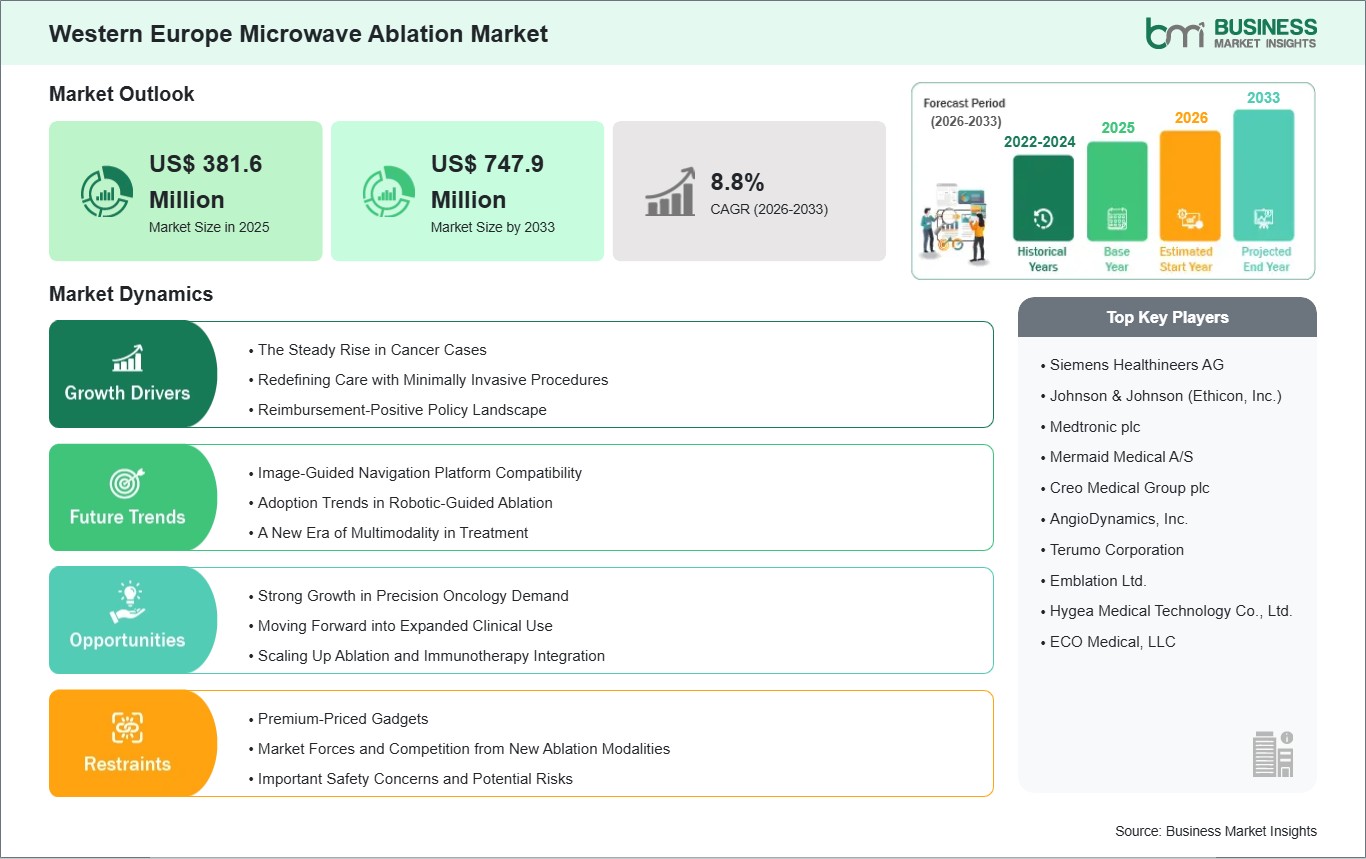
The Western Europe microwave ablation market size is expected to reach US$ 747.9 million by 2033 from US$ 381.6 million in 2025. The market is estimated to record a CAGR of 8.8% from 2026 to 2033.
The Western Europe microwave ablation market is marked by steady integration of advanced ablation technologies in clinical practices as healthcare systems increasingly seek minimally invasive alternatives for tumor management. Across Western Europe, hospitals and specialized oncology centers have embraced microwave ablation as a valuable treatment option for liver, lung, kidney, and other soft‑tissue tumors due to its ability to preserve healthy tissue while targeting lesions with precision. A combination of strong clinical awareness, established interventional radiology networks, and supportive treatment guidelines contributes to sustained interest in microwave ablation within the region. Physicians value the procedure's adaptability, its compatibility with modern imaging modalities, and the potential for reducing patient discomfort and recovery time compared to more invasive surgical procedures.
Despite a favorable clinical reception, some restraints influence broader adoption. Reimbursement frameworks and funding priorities vary between countries, resulting in differing levels of uptake across Western Europe. In some healthcare systems, cost constraints and approval timelines can delay the introduction of new ablation platforms. Additionally, competition from alternative thermal ablation technologies such as radiofrequency and cryoablation remains a challenge in clinical settings where established procedures are deeply integrated. Interventional specialists also emphasize the need for ongoing education and hands‑on training to ensure optimal use of microwave ablation systems, particularly when dealing with complex tumor cases.

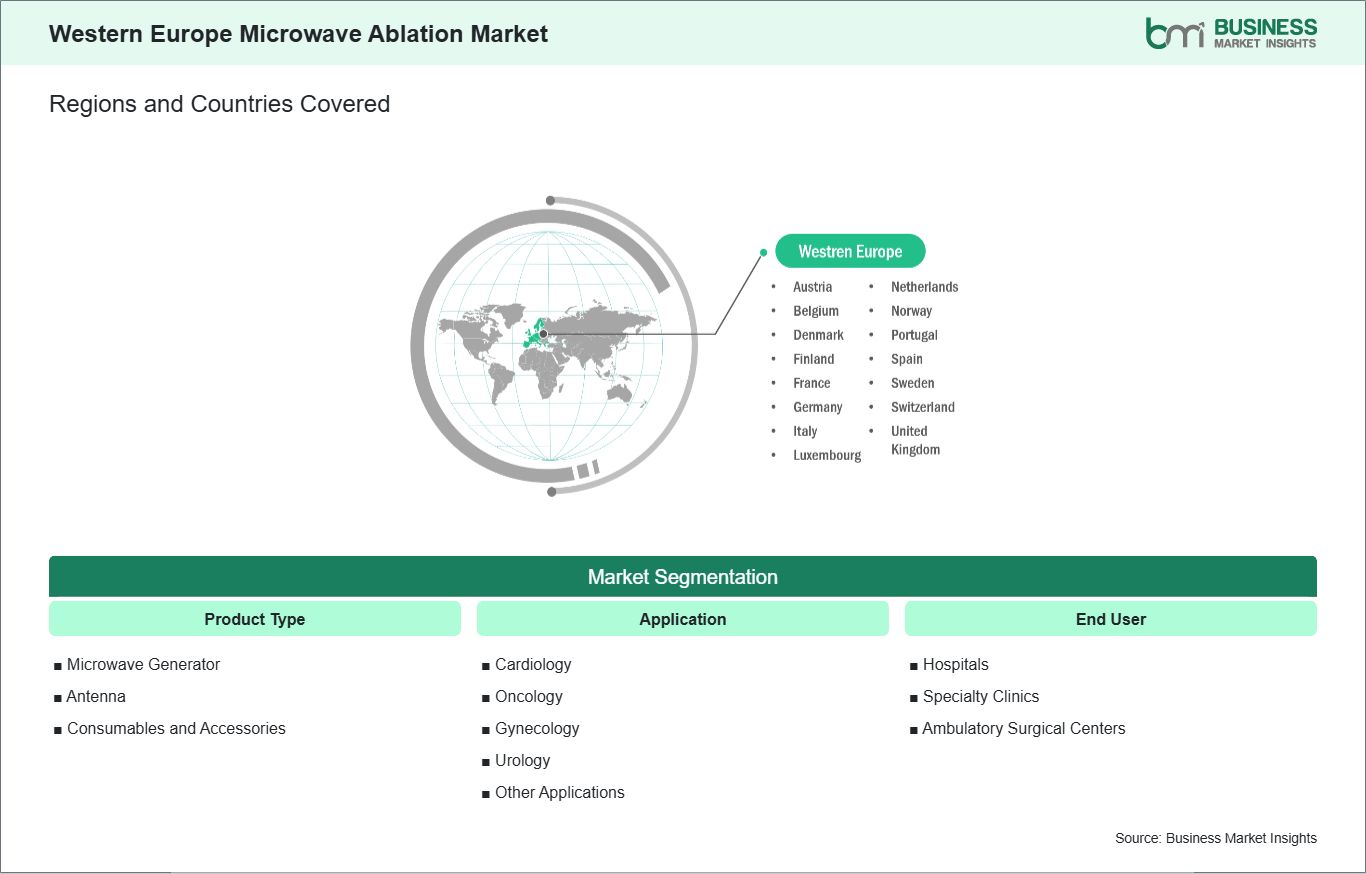
Key segments that contributed to the derivation of the Western Europe microwave ablation market analysis are product type, application, and end user.
The Western Europe microwave ablation market is being shaped by a consistent rise in cancer cases across the region. As populations age and screening programs become more sophisticated, clinicians are diagnosing increasing numbers of solid tumors, including those of the liver, lung, and breast. This trend has intensified demand for treatment options that can address a broader spectrum of tumor types while aligning with evolving standards of care and patient expectations.
Healthcare systems in Western Europe are expanding clinical pathways to integrate minimally invasive therapies alongside traditional surgery and systemic treatments. Hospitals and cancer centers are equipping interventional radiology and oncology units with advanced ablation platforms to manage tumors in patients who may not be ideal candidates for extensive surgical procedures. Microwave ablation is gaining attention as a method that can deliver precise thermal therapy with reduced procedural burden and shorter recovery time, which is particularly relevant in regions prioritizing efficiency and patient throughput.
In addition, policymakers and healthcare administrators are focusing on optimizing resource allocation within oncology services, given the rising caseload and associated treatment demands. There is increasing alignment between clinical goals and investment in technologies that support effective tumor management while minimizing hospital stays. As cancer incidence continues its steady upward trajectory, the market for microwave ablation systems and related procedural services in Western Europe is expected to grow as part of broader efforts to enhance cancer care delivery.
Western Europe is experiencing robust growth in demand for precision oncology, with treatment strategies increasingly tailored to individual patient and tumor characteristics. Multidisciplinary care teams including oncologists, radiologists, and surgeons work collaboratively to devise highly individualized treatment plans. In this context, microwave ablation is being recognized as a technology that can be adjusted to meet specific clinical needs, offering focused thermal destruction of tumors while preserving healthy surrounding tissue.
Clinicians across Western European cancer centers are leveraging advanced imaging and diagnostics to guide treatment decisions and procedural planning. This has encouraged the adoption of technologies that allow for precise targeting and controlled energy delivery. Microwave ablation's integration with real‑time imaging and its flexibility in treating tumors of varying size and location make it well-suited for inclusion in personalized care pathways, particularly for patients seeking alternatives to invasive surgery.
Patient preferences are also driving the shift toward personalized cancer care. There is growing interest among patients for therapies that balance efficacy with a focus on quality of life, including shorter recovery periods, fewer complications, and less disruption to daily activities. Microwave ablation aligns well with these expectations, reinforcing its appeal as a targeted, patient‑centric treatment option. As precision oncology continues to gain momentum in Western Europe, demand for microwave ablation technologies is expected to rise in tandem with evolving clinical practices and patient‑driven treatment trends.

The Western Europe microwave ablation market demonstrates consistent growth, with market size and share analysis reflecting evolving treatment preferences and competitive dynamics among leading players. The report evaluates important subsegments categorized within product type, application, and end user, highlighting their respective contributions to overall market performance.
By product type, the antenna subsegment dominated the market in 2025. There is a recurring need for high-performance, precise antennas during MWA procedures, which are essential for effective thermal ablation of tumors, making them a key revenue driver for manufacturers.
In terms of application, the oncology subsegment dominated the market in 2025. Oncology applications lead because of a rising prevalence of cancer cases, increasing preference for minimally invasive tumor ablation techniques, and growing awareness among healthcare providers about the effectiveness of MWA in treating liver, lung, and other solid tumors.
Based on end user, the hospitals subsegment dominated the market in 2025. Hospitals maintain a stronghold due to their well-established oncology and surgical departments, access to advanced MWA equipment, trained interventional radiologists and staff, and the capability to manage complex ablation procedures with comprehensive patient care.
| Report Attribute | Details |
|---|---|
| Market size in 2025 | US$ 381.6 Million |
| Market Size by 2033 | US$ 747.9 Million |
| CAGR (2026 - 2033) | 8.8% |
| Historical Data | 2022-2024 |
| Forecast period | 2026-2033 |
| Segments Covered | By Product Type
|
|
Regions and Countries Covered
| |
| Western Europe | Belgium, Netherlands, Luxembourg, Germany, France, Italy, Spain, Switzerland, Sweden, Austria, United Kingdom, Denmark, Portugal, Norway, Finland |
| Market leaders and key company profiles |
|
The "Western Europe Microwave Ablation Market Size and Forecast (2022-2033)" report provides a detailed analysis of the market covering below areas:
The geographical scope of the Western Europe microwave ablation market report is divided into Belgium, the Netherlands, Luxembourg, Germany, France, Italy, Spain, Switzerland, Sweden, Austria, the UK, Denmark, Portugal, Norway, and Finland. Germany held the largest share in 2025.
Germany is the dominant country within the Western Europe microwave ablation market, driven by its highly developed healthcare infrastructure and concerted focus on minimally invasive therapeutic approaches. Leading hospitals and comprehensive cancer centers in major German cities have been at the forefront of adopting microwave ablation into multidisciplinary oncology treatment pathways, particularly for liver and lung tumors. The strong presence of interventional radiologists and a culture of early technology adoption position Germany as a key regional hub for ablation therapy innovation. Within the German healthcare landscape, both public and private hospital systems actively invest in advanced imaging equipment and ablation devices that enhance procedural accuracy and patient outcomes. Clinical decision‑makers in Germany often prioritize therapies that can reduce hospital stays, improve quality of life, and streamline treatment workflows. Professional societies and continuing medical education programs also play an influential role, facilitating training and knowledge exchange among specialists.

The Western Europe Microwave Ablation market is evaluated by gathering qualitative and quantitative data post primary and secondary research, which includes important corporate publications, association data, and databases. A few of the key developments in the Western Europe Microwave Ablation market are:
The Western Europe Microwave Ablation Market is valued at US$ 381.6 Million in 2025, it is projected to reach US$ 747.9 Million by 2033.
As per our report Western Europe Microwave Ablation Market, the market size is valued at US$ 381.6 Million in 2025, projecting it to reach US$ 747.9 Million by 2033. This translates to a CAGR of approximately 8.8% during the forecast period.
The Western Europe Microwave Ablation Market report typically cover these key segments-
The historic period, base year, and forecast period can vary slightly depending on the specific market research report. However, for the Western Europe Microwave Ablation Market report:
The Western Europe Microwave Ablation Market is populated by several key players, each contributing to its growth and innovation. Some of the major players include:
The Western Europe Microwave Ablation Market report is valuable for diverse stakeholders, including:
Essentially, anyone involved in or considering involvement in the Western Europe Microwave Ablation Market value chain can benefit from the information contained in a comprehensive market report.
Please tell us your area of interest
(Market Segments/ Regions and Countries/ Companies)