
Microwave Ablation Market Outlook: Size, Share, Trends, Growth Analysis, Competitive Landscape & Forecast, 2026-2033

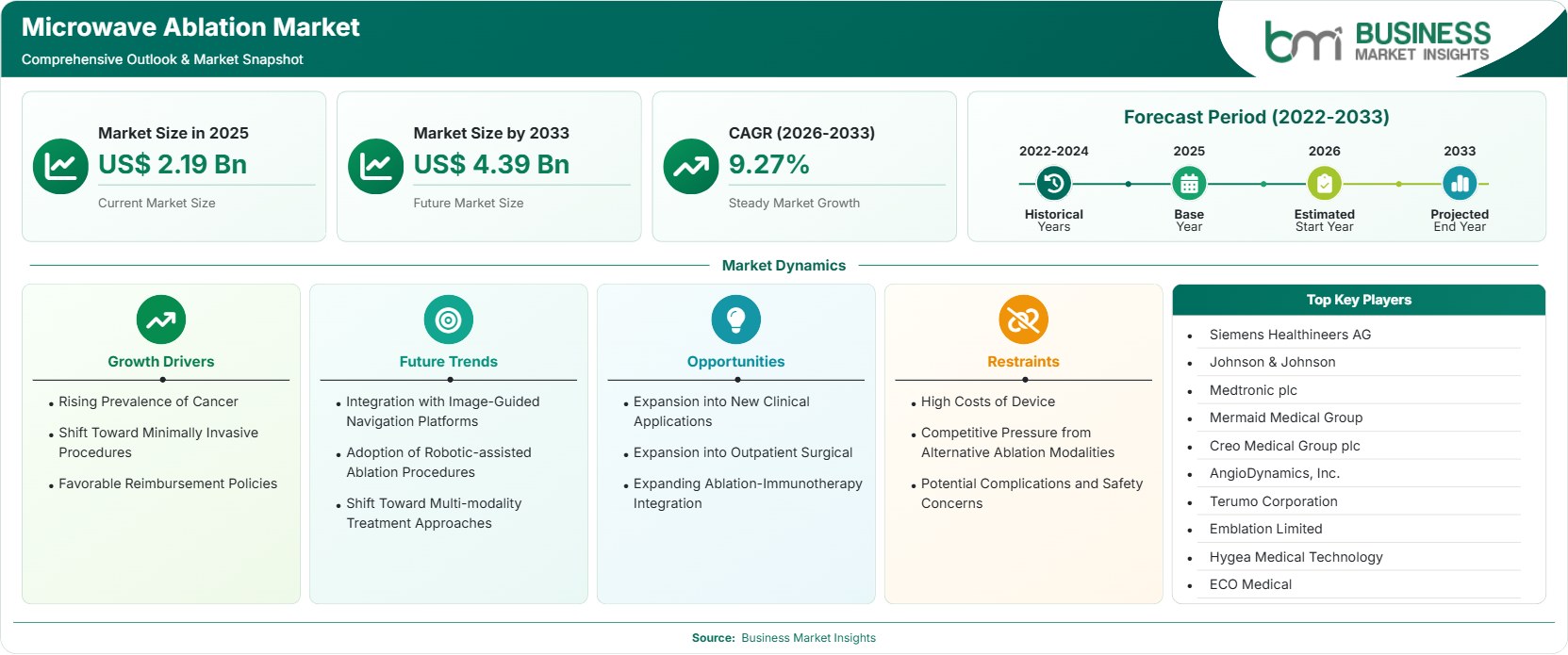
The Microwave Ablation Market size was valued at US$ 2.19 Billion in 2025 and is projected to reach US$ 4.39 Billion by 2033, growing at a CAGR of 9.27% during 2026–2033, driven by rising cancer incidence, minimally invasive treatment preference, image-guided procedures, and expanding outpatient oncology opportunities.

Report Coverage
  • Product Type: Microwave Generator, Antenna, Consumables and Accessories
  • Application: Cardiology, Oncology, Gynecology, Urology
  • End User: Hospitals, Specialty Clinics, Ambulatory Surgical Centers
US$ 2.19 Bn Market size in 2025
US$ 4.39 Bn Market Size by 2033
9.27% CAGR, 2026 - 2033
2026-2033 Forecast Period

AI Overview

Microwave Ablation Market Summary

  • North America Region: North America holds a market share of 45.7% in 2025, growing with a CAGR of 8.7%, influenced by established interventional oncology infrastructure, high procedure volumes, technology adoption, reimbursement support, and integrated imaging capabilities. The US remains the principal regional market, supported by specialist centers, clinical evidence generation, and established microwave platforms, with growth of 8.9% through 2033.
  • Fastest Growing Region: Asia Pacific accounts for a 25.9% share in 2025, expanding at a CAGR of 11.5%, supported by increasing cancer burden, improving hospital infrastructure, wider image-guided intervention access, domestic medical-device manufacturing, and expanding oncology investment across China, India, Japan, and South Korea.
  • Leading Segment: Oncology represents a 65.8% share in 2025, advancing at a CAGR of 7.7%, supported by increasing liver and other solid-tumor treatment requirements, minimally invasive intervention, image-guided targeting, repeatable ablation zones, and expanding multidisciplinary cancer-care pathways.
  • High Growth Segment: Consumables and Accessories is estimated to represent a 10.3% share in 2025, with a CAGR of 11.6%, driven by generator miniaturization, improved power control, real-time monitoring, dual-probe capabilities, workflow integration, and demand for reliable energy delivery across increasingly complex procedures.
  • Key Market Opportunity: Integration of microwave systems with advanced imaging, navigation, treatment planning, robotics, and real-time assessment can create differentiated platforms that improve procedural consistency while supporting broader clinical adoption.
  • Major Market Players: Siemens Healthineers AG, Johnson & Johnson, Medtronic plc, Mermaid Medical A/S, Creo Medical Group plc, AngioDynamics, Inc., Terumo Corporation, Emblation Microwave Limited, Hygea Medical Technology Co., Ltd., and ECO Medical, LLC.
Strategic Insights

Microwave Ablation Market: Strategic Insights

Microwave Ablation Market Strategic Framework
FREE PDF
Request your free sample
Request free sample
Stakeholder View

Key Takeaways

  • The microwave ablation market value chain is integrating generators, antennas, imaging, planning software, navigation, and disposable accessories into unified procedural ecosystems.
  • Oncology remains the leading application, supported by recurring demand for image-guided treatment of liver and other solid tumors.
  • Innovation focuses on predictable ablation geometry, thermal control, real-time monitoring, dual-probe capability, and software-assisted treatment planning.
  • Asia Pacific offers strong expansion potential as cancer-care infrastructure, interventional radiology capacity, and medical-device investment accelerate across major markets.
  • Investment increasingly targets complementary imaging, robotics, navigation, and treatment-planning technologies, with MicroBlate Fine illustrating broader minimally invasive energy applications.
Geographic Outlook

Microwave Ablation Market Regional Highlights

North America Microwave Ablation Market

North America represents 45.7% of global share in 2025 and is projected to grow at 8.7% CAGR through 2033. The region benefits from sophisticated interventional oncology centers, established reimbursement pathways, advanced imaging availability, and strong manufacturer presence. The US accounts for 94.1% of North American share, while Canada contributes through specialist cancer-care infrastructure. The regional Microwave Ablation Market share remains supported by high clinician familiarity with image-guided thermal therapies and investment in minimally invasive procedures.

  • Major cancer centers provide established interventional radiology teams, supporting adoption where complex liver and soft-tissue procedures require multidisciplinary treatment planning and advanced imaging.
  • Siemens Healthineers' IntelliBlate ecosystem connects microwave treatment with planning and image-guided workflows, illustrating the region's movement toward integrated procedural platforms.
  • The US benefits from strong manufacturer distribution, specialist training, clinical research activity, and availability of established systems from Medtronic and Johnson & Johnson.
  • Hospitals increasingly assess ablation systems according to procedural efficiency, consumable requirements, imaging compatibility, service support, and evidence of consistent treatment delivery.

US Microwave Ablation Market

The US represents 94.1% of North American share in 2025 and is expected to expand at 8.9% CAGR through 2033. Adoption is supported by advanced interventional oncology programs, specialist physician availability, established imaging infrastructure, and commercial access to microwave systems. Medtronic describes microwave ablation as a minimally invasive option for unresectable liver tumors, while its Emprint platform supports percutaneous, laparoscopic, and intraoperative applications.

  • Liver tumor treatment remains an important use case because microwave energy can be delivered through image-guided antennas while limiting surgical disruption.
  • Selected ablation procedures can be performed without prolonged hospitalization, supporting utilization where clinicians can achieve appropriate patient selection and procedural control.
  • Robotics, navigation, imaging, and ablation companies increasingly collaborate around precision treatment, creating opportunities for differentiated platforms and software-enabled workflows.

Europe Microwave Ablation Market

Europe accounts for 22.2% of Microwave Ablation Market share in 2025 and is projected to expand at 8.9% CAGR through 2033. Germany, the UK, France, and Italy represent important established markets, while Spain and selected Nordic markets provide additional adoption opportunities. Germany estimated to grow at 8.9% supported by specialist oncology centers and image-guided intervention. European adoption increasingly emphasizes treatment precision, workflow integration, clinician training, and evidence-based procurement.

  • Germany: High hospital technology capabilities and specialist interventional services support adoption of advanced image-guided ablation and associated planning technologies.
  • United Kingdom: Specialist interventional radiology networks and professional education programs provide an environment for technology evaluation and procedural adoption.
  • France and Italy: Established oncology infrastructure supports microwave applications, particularly where multidisciplinary treatment pathways combine surgery, systemic therapy, radiation, and local tumor control.
  • High-growth markets: Spain and selected Nordic countries offer incremental opportunities as hospitals expand minimally invasive oncology capabilities and modernize interventional suites.

Asia Pacific Microwave Ablation Market

Asia Pacific represents 25.9% share in 2025 and records the fastest regional expansion at 11.5% CAGR through 2033. Japan, China, India, and South Korea are the principal markets, while India is projected at 13.0% CAGR within the regional opportunity. Increasing cancer incidence, expanding tertiary hospitals, improving imaging access, and medical-device localization support adoption. India represented 3.6% of global microwave ablation revenue in one external regional assessment and was identified as its fastest-growing Asia Pacific Microwave Ablation Market.

  • China: Large oncology demand and expanding tertiary-care capacity create opportunities for domestic and international microwave ablation suppliers.
  • Japan: Advanced hospital infrastructure, established cancer treatment networks, and high technology acceptance make Japan a leading regional revenue market.
  • India: Rising interventional oncology capacity, increasing private hospital investment, and broader access to advanced imaging support rapid adoption.
  • South Korea: Strong medical-device capabilities and sophisticated hospital infrastructure support clinical adoption and technology development.

Rest of World Microwave Ablation Market

Rest of World represents 6.2% share in 2025, growing at 4.1% CAGR through 2033. South America recorded 4.1% global share in 2025 and is forecast at 5.0% CAGR through 2033, while Middle East and Africa recorded 2.2% share and 3.2% CAGR, respectively. Saudi Arabia is positioned for 3.7% CAGR, while Brazil provides broader regional scale through major hospital networks and cancer centers.

  • Brazil: Large healthcare networks and cancer-treatment demand provide a foundation for wider adoption of minimally invasive ablation technologies.
  • Mexico: Private hospital investment and proximity to US medical-device ecosystems support technology transfer and specialist training.
  • Saudi Arabia: Healthcare modernization and expansion of specialist cancer services create opportunities for image-guided intervention technologies.
  • United Arab Emirates: Advanced private hospitals and international clinical partnerships support adoption of sophisticated interventional procedures.
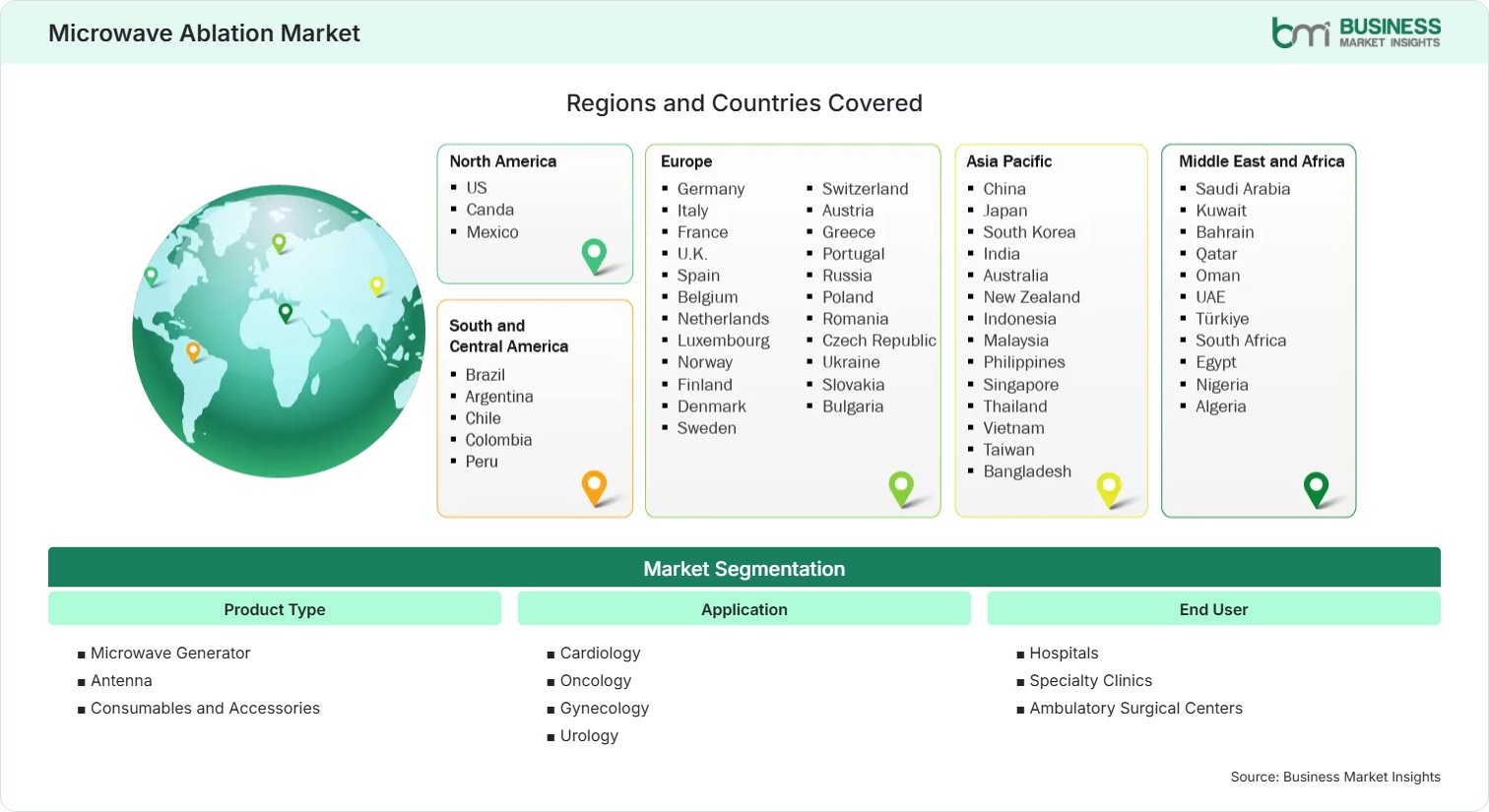
Global Market Geography
FREE PDF
Request your free sample
Request free sample
Segment Analysis

Microwave Ablation Market Segmentation

Product Type

Product configuration strongly influences capital purchasing and recurring revenue. Antenna represents approximately 66.2% share in 2025 and grows at 9.7% CAGR through 2033, while antennas, consumables, and accessories create recurring procedural demand. The Microwave Ablation Market scope increasingly centers on generator precision, probe performance, thermal monitoring, compatibility, and workflow integration. Procurement decisions therefore consider total procedure economics rather than generator acquisition cost alone.

  • Microwave Generator: Advanced generators provide controlled energy delivery, programmable treatment parameters, monitoring capabilities, and compatibility with specialized antennas, supporting more predictable ablation procedures and broader clinical utilization.
  • Antenna: Antennas determine energy transmission, insertion characteristics, and treatment geometry. Improvements in probe design support precise targeting, minimally invasive access, and adaptation to varied lesion locations.
  • Consumables and Accessories: Disposable applicators, cooling components, cables, and procedural accessories generate recurring revenue while influencing workflow efficiency, infection-control requirements, compatibility, and overall cost per procedure.

Application

Application mix is dominated by oncology, which represents approximately 65.8% share in 2025 and expands at 7.7% CAGR through 2033. The Microwave Ablation Market share reflects the strong clinical role of local tumor treatment, particularly for selected liver lesions. Cardiology, gynecology, and urology provide additional opportunities where localized thermal energy can complement established treatment pathways and specialist procedural capabilities.

  • Cardiology: Ablation-related cardiac procedures require stringent energy control and anatomical precision. Microwave applications remain specialized, with adoption dependent on clinical evidence, safety validation, and procedure-specific device development.
  • Oncology: Oncology provides the largest application opportunity because image-guided microwave energy can thermally destroy targeted soft tissue. Liver tumors remain a central use case across percutaneous, laparoscopic, and intraoperative approaches.
  • Gynecology: Localized treatment applications can benefit from minimally invasive approaches where clinicians seek controlled tissue destruction while limiting procedural disruption and recovery requirements.
  • Urology: Urological applications provide opportunities for image-guided local treatment of selected lesions, particularly as specialists evaluate alternatives to more invasive surgical interventions.

End User

Hospitals remain the dominant end-user environment because complex ablation procedures require imaging, anesthesia, specialist teams, and multidisciplinary oncology support. Specialty Clinics provide targeted growth where procedure volumes justify dedicated equipment, while Ambulatory Surgical Centers can benefit from shorter procedural pathways. The Microwave Ablation Market trends increasingly favor settings capable of integrating imaging, navigation, sterile consumables, and post-procedure assessment into streamlined workflows.

  • Hospitals: Hospitals provide the broadest infrastructure for microwave ablation, including interventional radiology, oncology, surgery, diagnostic imaging, intensive care, and multidisciplinary treatment planning.
  • Specialty Clinics: Specialty clinics can expand access to focused ablation services where trained specialists and appropriate imaging are available, particularly in high-volume oncology networks.
  • Ambulatory Surgical Centers: Ambulatory facilities can capture selected lower-complexity procedures by emphasizing shorter stays, standardized workflows, and efficient utilization of capital equipment.
Market Forces

Microwave Ablation Market Dynamics

Key Market Drivers

Rising Prevalence of Cancer

The growing burden of solid tumors supports demand for localized treatment technologies. Microwave ablation provides a method for selective destruction of tissue using image-guided procedures, and a minimally invasive approach when surgery is not feasible. Microwave Ablation Market growth is driven by increasing requirements for localized tumor control, especially in cases of liver cancer and other solid tumors. Market trends show an increasing focus on predictability of ablation area, accuracy in energy delivery, and safety for the surrounding tissue. With advancements in multidisciplinary cancer treatment approaches, microwave ablation could be used alongside surgery, radiation, and systemic treatments.

Rising Prevalence of Cancer

The increasing incidence and diagnosis of solid tumors is expanding demand for localized disease-control strategies, particularly for patients with unresectable, recurrent, or anatomically challenging tumors. Microwave ablation is one of the less invasive methods of treatment that can be carried out using CT, ultrasound, or MRI imaging. The Microwave Ablation Market trends are increasingly inclined towards the need for better energy application, higher quality ablation borders, and treatment monitoring. The compatibility of the method with chemotherapy, radiation therapy, and surgery treatment enables further implementation of microwave ablation into the process. As there is an increasing need for alternative treatment to invasive procedures, microwave ablation strengthens its role while supporting treatment flexibility.

Favorable Reimbursement Policies

Increasing recognition of minimally invasive image-guided procedures can improve the economic feasibility of microwave ablation when reimbursement mechanisms support physician services, facility resources, imaging, and disposable components. Improved visibility of reimbursement will make hospitals and specialized care facilities more willing to purchase microwave generators and procedural facilities. The use of microwave generators and consumables will be more compelling where short hospital stays, rapid recovery, and limited procedural disruptions will help cover costs. Nevertheless, the level of reimbursement is contingent on indications, geography, reimbursement rules, and the medical institution in which the procedure is performed.

Key Market Opportunities

Expansion into New Clinical Applications

Advancements in antenna geometry, energy control, navigation, and imaging integration can enable microwave platforms to address a broader range of tissue locations and lesion characteristics. Expanding beyond the current liver indications can lead to higher utilization in lung, kidney, bone, and other solid tumor indications. Companies can distinguish themselves by application specific probes, planning software, and monitoring systems apart from focusing on just the generator specifications. Research is still required as each new indication would require proof of safety, efficacy, accessibility, and reproducibility. The accessory products could create a continuous income source, and hospital ties could help the companies expand into other indications.

Expansion into Outpatient Surgical

Selected ablation procedures can be performed through minimally invasive approaches with limited incisions, creating opportunities for treatment settings focused on shorter stays and efficient patient throughput. Ambulatory and specialty centers could emerge as potential clients when there is complexity in procedures, need for anesthetics, availability of imaging technology, and appropriate patient selection for the right pathway. The Microwave Ablation Market Forecast captures the potential for increased use of these technologies due to compact generators, quick setup, single-use kits, standard protocols, and training of healthcare practitioners. There would be recurrent purchase of antenna tips and other accessory products because of the increase in outpatient use.

Expanding Ablation-Immunotherapy Integration

Growing interest in combining local tumor destruction with systemic therapies creates opportunities for microwave ablation within multidisciplinary oncology strategies. The ablation systems may be incorporated into larger treatment pathways rather than being used as procedural systems alone. The thermal destruction technology may help to deliver local disease control, while other treatment systems take care of the rest of the disease, but the use of combination therapy should be clinically validated for specific indications. Successful integration may help increase the demand from cancer centers focusing on precision medicine in oncology.

Market Restraints and Challenges

High Costs of Device

Factor: Microwave ablation requires capital equipment, specialized antennas, imaging infrastructure, service support, and recurring sterile consumables. Impact: High procedure cost could delay its adoption within institutions with restricted budget for capital equipment, especially those operating in emerging economies. The procurement department will compare the costs of the generators with the number of procedures that are likely to be performed per year, and determine the payback period. Consumable pricing can further influence utilization because every procedure may require dedicated disposable components.

Competitive Pressure from Alternative Ablation Modalities

Factor: Microwave ablation competes with radiofrequency ablation, cryoablation, irreversible electroporation, focused ultrasound, surgery, and radiation-based local treatments. Impact: Hospitals may be reluctant to buy an additional energy source where current energy sources fulfill the particular clinical needs. There are certain pros and cons for each modality related to the tissue effect, visualization, procedure control, equipment needed, and clinical evidence. Thus, microwave technologies require differentiation by performance rather than indication extension. The manufacturers could use their positioning with the help of predictable shape of the ablation zone, faster delivery, two probe procedure, thermal control, and imaging integration.

Company Analysis

Competitive Landscape

The competitive environment combines diversified medical-technology companies with specialist developers, making Microwave Ablation Market analysis increasingly focused on product integration, clinical evidence, distribution, and procedural workflow. Siemens Healthineers has strengthened its position through the Varian IntelliBlate ecosystem, while Medtronic maintains the Emprint platform and Johnson & Johnson has established microwave capabilities through Ethicon and NeuWave.

Company Name

Overview

Products and Services relevant to this market

Siemens Healthineers AG

Global healthcare technology company combining imaging, oncology, and interventional capabilities to support integrated treatment pathways.

IntelliBlate microwave ablation, myAblation Guide, image-guided intervention, treatment planning, and complementary imaging technologies.

Johnson & Johnson

Diversified healthcare company with microwave ablation capabilities positioned within Ethicon's advanced energy and interventional portfolio.

NEUWAVE Microwave Ablation System, ablation confirmation technologies, clinical evidence programs, and minimally invasive oncology solutions.

Medtronic plc

Global medical-device manufacturer with established surgical energy and tumor-ablation technologies.

Emprint HP Ablation Generator, Thermosphere technology, microwave antennas, pumps, and liver tumor ablation solutions.

Mermaid Medical A/S

European medical-device developer and manufacturer supplying specialized interventional and procedural technologies.

Microwave ablation-related components, interventional devices, procedural accessories, and specialized medical-device manufacturing capabilities.

Creo Medical Group plc

UK medical-technology company focused on advanced energy solutions for therapeutic endoscopy and minimally invasive procedures.

MicroBlate microwave ablation platforms, including MicroBlate Fine, with applications in endoscopic lesion treatment.

AngioDynamics, Inc.

US-based medical-device company focused on minimally invasive oncology and vascular interventions.

Solero Microwave Tissue Ablation System, microwave generators, applicators, and soft-tissue ablation solutions.

Terumo Corporation

Japanese global healthcare company with broad interventional and cardiovascular device capabilities.

Interventional oncology technologies, ablation-related products, procedural devices, and hospital support capabilities.

Emblation Microwave Limited

Specialist UK developer focused on microwave technology for medical treatment applications.

Emblation microwave generators, antennas, treatment accessories, and microwave energy delivery platforms.

Hygea Medical Technology Co., Ltd.

Medical-device developer serving interventional treatment applications with specialized ablation technologies.

Microwave ablation generators, antennas, accessories, and supporting procedural equipment for tissue ablation.

ECO Medical, LLC

Medical-device supplier and technology company participating in microwave and thermal ablation applications.

Microwave ablation systems, generators, probes, accessories, and procedural technologies for targeted tissue treatment.

Trust & Transparency

Research Methodology

The market analysis combines proprietary research with secondary data from government agencies, company disclosures, regulatory filings, industry databases and expert interviews. Market estimates are validated through data triangulation, cross-market benchmarking and analyst review.

View Full Research Methodology

Questions Answered

Frequently Asked Questions

What does the Microwave Ablation Market Report indicate about outpatient adoption?

Outpatient pathways can improve resource utilization and support shorter stays for appropriately selected procedures. Adoption depends on patient suitability, imaging, anesthesia, monitoring, and procedural complexity.

What role can microwave ablation play in multidisciplinary oncology?

Microwave ablation can complement surgery, radiation, and systemic therapies when localized tumor control is required and resection is unsuitable or burdensome.

Why is imaging integration important for ablation systems?

Imaging supports treatment planning, probe placement, monitoring, and post-procedure assessment. Integrated platforms can improve procedural precision and workflow efficiency.

How does antenna design influence procedure performance?

Antenna geometry affects energy distribution, treatment coverage, insertion, and ablation-zone control. Advanced designs emphasize predictable energy delivery, thermal control, and precise probe placement.

What clinical factors determine whether microwave ablation is appropriate?

Patient selection depends on tumor type, size, location, accessibility, proximity to critical structures, overall health, and imaging availability. Multidisciplinary evaluation helps determine the most appropriate treatment approach.

Access the Full Microwave Ablation Market Report

Get segment-level forecasts, regional estimates, competitive benchmarking, company profiles and downloadable Excel datasets.

Access the full Microwave Ablation Market Report
400 pages PDF & Excel | 2026-10-06
Similar Research

Related Market Reports