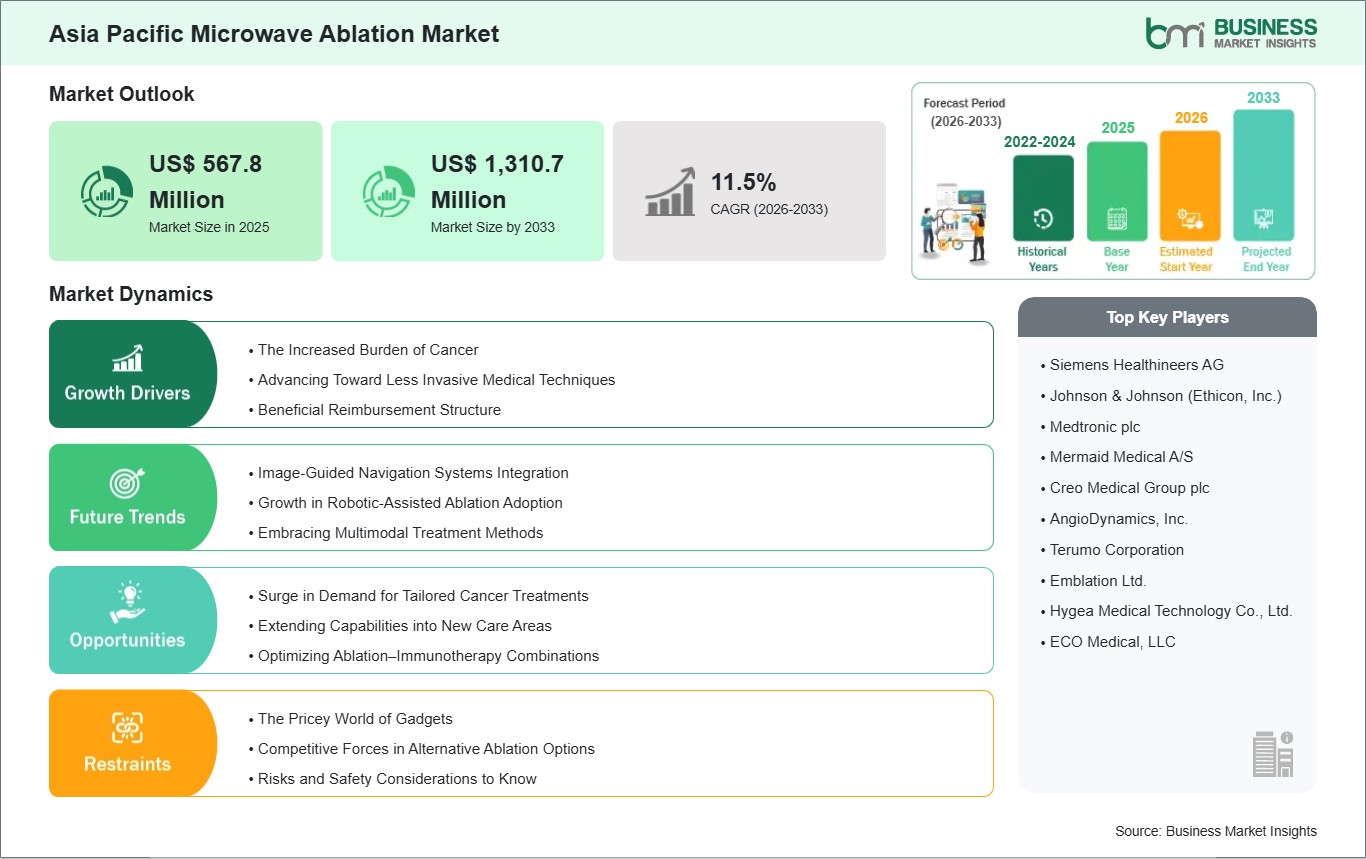
The Asia Pacific microwave ablation market size is expected to reach US$ 1,310.7 million by 2033 from US$ 567.8 million in 2025. The market is estimated to record a CAGR of 11.5% from 2026 to 2033.
The Asia Pacific microwave ablation market is experiencing steady growth driven by the increasing adoption of minimally invasive medical procedures across the region. Healthcare providers are turning to microwave ablation because it offers precise tumor targeting, reduces trauma to surrounding tissue, and shortens patient recovery time compared to traditional surgical interventions. Rising awareness among clinicians about its clinical advantages, combined with expanding advanced diagnostic imaging capabilities, is encouraging hospitals and specialty centers to integrate these procedures into routine care. Training programs and workshops for interventional radiologists and oncologists are also helping to build expertise, which further supports adoption in urban healthcare hubs.
Despite these positive trends, the market faces challenges. Access to microwave ablation is often concentrated in major cities, leaving rural areas and smaller hospitals with limited availability of the technology. Differences in healthcare infrastructure and regulatory practices across countries can slow the uniform implementation of these procedures. Additionally, there is a learning curve for clinicians to master image-guided techniques, which may temporarily limit the adoption rate. Across Asia Pacific, microwave ablation is gaining recognition as a valuable minimally invasive treatment, with expansion opportunities rising alongside improvements in training, infrastructure, and awareness.

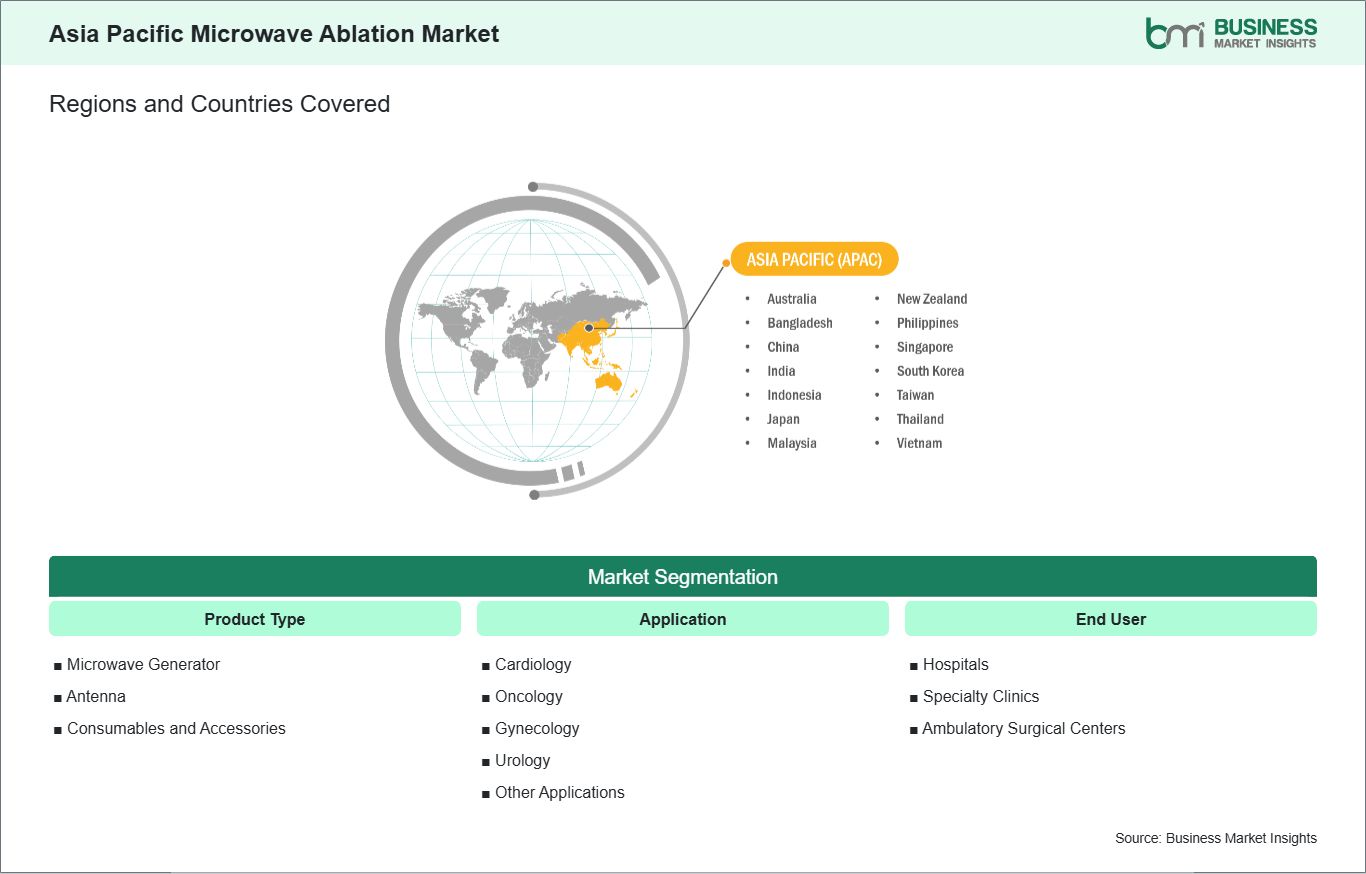
Key segments that contributed to the derivation of the Asia Pacific microwave Ablation market analysis are product type, application, and end user.
The Asia Pacific microwave ablation market is being shaped by a significant increase in the overall burden of cancer across the region. Rapid demographic shifts, longer life expectancy, and lifestyle transitions have contributed to a higher incidence of solid tumors that require advanced therapeutic options. As the number of patients entering oncology care pathways continues to rise, clinicians and healthcare systems are under pressure to adopt treatment modalities that can effectively complement conventional therapies while managing increasingly complex caseloads.
Healthcare facilities throughout Asia Pacific are experiencing heightened demand for interventions that reduce procedural risk and improve patient throughput. In busy oncology departments, there is a clear trend toward minimally invasive techniques that can alleviate pressure on surgical suites and improve operational efficiency. Microwave ablation with its ability to precisely target and destroy tumor tissue using thermal energy has become a viable choice for practitioners seeking to balance treatment effectiveness with resource constraints.
In addition, healthcare planners and administrators in the region are prioritizing investments in technologies that address the evolving cancer landscape. Expansion of interventional oncology capacity, including the adoption of image‑guided ablation systems, reflects a strategic response to the growing caseload and the need for flexible treatment options. With the cancer burden expected to continue rising, demand for microwave ablation systems and related procedural services is anticipated to remain strong as part of broader efforts to enhance cancer care delivery.
There is a noticeable shift in the Asia Pacific toward more individualized approaches to cancer treatment, driven by greater emphasis on patient outcomes and quality of life. Clinicians are increasingly seeking technologies that allow them to customize therapeutic strategies based on tumor characteristics, patient health status, and expected treatment responses. Microwave ablation is well‑aligned with this trend due to its precision and adaptability, enabling targeted destruction of tumor tissue while minimizing impact on healthy structures.
Multidisciplinary care models are gaining traction in the region, with teams of oncologists, interventional specialists, and radiologists collaborating to develop patient‑centric treatment plans. These models have encouraged the selection of therapies that can be tailored to meet specific clinical needs, particularly in cases where traditional surgery may pose an elevated risk or prolonged recovery. Microwave ablation's flexibility, including adjustable energy delivery and compatibility with advanced imaging, supports these personalized care strategies and enhances its appeal among healthcare professionals.
Patients themselves are increasingly informed and involved in decisions about their cancer care, seeking treatment options that offer effectiveness, reduced recovery time, and fewer side effects. As awareness of minimally invasive and tailored treatments grows, demand for procedures like microwave ablation is rising accordingly. This shift in patient expectations, combined with clinical preference for individualized therapy pathways, is expected to drive sustained expansion of the microwave ablation market across Asia Pacific.

The Asia Pacific microwave ablation market demonstrates steady growth, with size and share analysis highlighting evolving trends and competitive dynamics among key players. The report evaluates important subsegments categorized within product type, application, and end user, highlighting their respective contributions to overall market performance.
By product type, the antenna subsegment dominated the market in 2025. There is a recurring need for high-performance, precise antennas during MWA procedures, which are essential for effective thermal ablation of tumors, making them a key revenue driver for manufacturers.
In terms of application, the oncology subsegment dominated the market in 2025. Oncology applications lead because of a rising prevalence of cancer cases, increasing preference for minimally invasive tumor ablation techniques, and growing awareness among healthcare providers about the effectiveness of MWA in treating liver, lung, and other solid tumors.
Based on end user, the hospitals subsegment dominated the market in 2025. Hospitals maintain a stronghold due to their well-established oncology and surgical departments, access to advanced MWA equipment, trained interventional radiologists and staff, and the capability to manage complex ablation procedures with comprehensive patient care.
| Report Attribute | Details |
|---|---|
| Market size in 2025 | US$ 567.8 Million |
| Market Size by 2033 | US$ 1,310.7 Million |
| CAGR (2026 - 2033) | 11.5% |
| Historical Data | 2022-2024 |
| Forecast period | 2026-2033 |
| Segments Covered | By Product Type
|
|
Regions and Countries Covered
| |
| Asia Pacific | China, Japan, South Korea, India, Australia, New Zealand, Indonesia, Malaysia, Philippines, Singapore, Thailand, Vietnam, Taiwan, Bangladesh |
| Market leaders and key company profiles |
|
The "Asia Pacific Microwave Ablation Market Size and Forecast (2022-2033)" report provides a detailed analysis of the market covering below areas:
The geographical scope of the Asia Pacific microwave ablation market report is divided into China, Japan, South Korea, India, Australia, New Zealand, Indonesia, Malaysia, the Philippines, Singapore, Thailand, Vietnam, Taiwan, Bangladesh, and Rest of Asia. China held the largest share in 2025.
China is the leading country for microwave ablation adoption in the Asia Pacific region, driven by its advanced healthcare infrastructure and focus on modern treatment techniques. Major cities such as Beijing, Shanghai, and Guangzhou host specialized oncology and interventional radiology centers that actively use microwave ablation to treat liver, lung, and other tumors. These urban hospitals serve as centers of clinical excellence, allowing specialists to develop expertise and share best practices with peers across the country. Clinicians in China are increasingly recognizing microwave ablation as a less invasive alternative to surgery, offering patients quicker recovery and fewer complications. Collaboration between hospitals and medical device providers has helped expand training and knowledge-sharing, which is vital for safe and effective adoption. However, access to these procedures remains uneven, with smaller provincial hospitals often lacking the equipment or trained personnel to implement microwave ablation. Efforts to strengthen clinical capabilities, expand specialist training, and improve the availability of equipment are key to broadening adoption across the country, positioning China as a regional leader in minimally invasive tumor management.

The Asia Pacific microwave ablation market is evaluated by gathering qualitative and quantitative data post primary and secondary research, which includes important corporate publications, association data, and databases. A few of the key developments in the Asia Pacific microwave ablation market are:
The Asia Pacific Microwave Ablation Market is valued at US$ 567.8 Million in 2025, it is projected to reach US$ 1,310.7 Million by 2033.
As per our report Asia Pacific Microwave Ablation Market, the market size is valued at US$ 567.8 Million in 2025, projecting it to reach US$ 1,310.7 Million by 2033. This translates to a CAGR of approximately 11.5% during the forecast period.
The Asia Pacific Microwave Ablation Market report typically cover these key segments-
The historic period, base year, and forecast period can vary slightly depending on the specific market research report. However, for the Asia Pacific Microwave Ablation Market report:
The Asia Pacific Microwave Ablation Market is populated by several key players, each contributing to its growth and innovation. Some of the major players include:
The Asia Pacific Microwave Ablation Market report is valuable for diverse stakeholders, including:
Essentially, anyone involved in or considering involvement in the Asia Pacific Microwave Ablation Market value chain can benefit from the information contained in a comprehensive market report.
Please tell us your area of interest
(Market Segments/ Regions and Countries/ Companies)