Market Summary
Executive Summary and Market Analysis
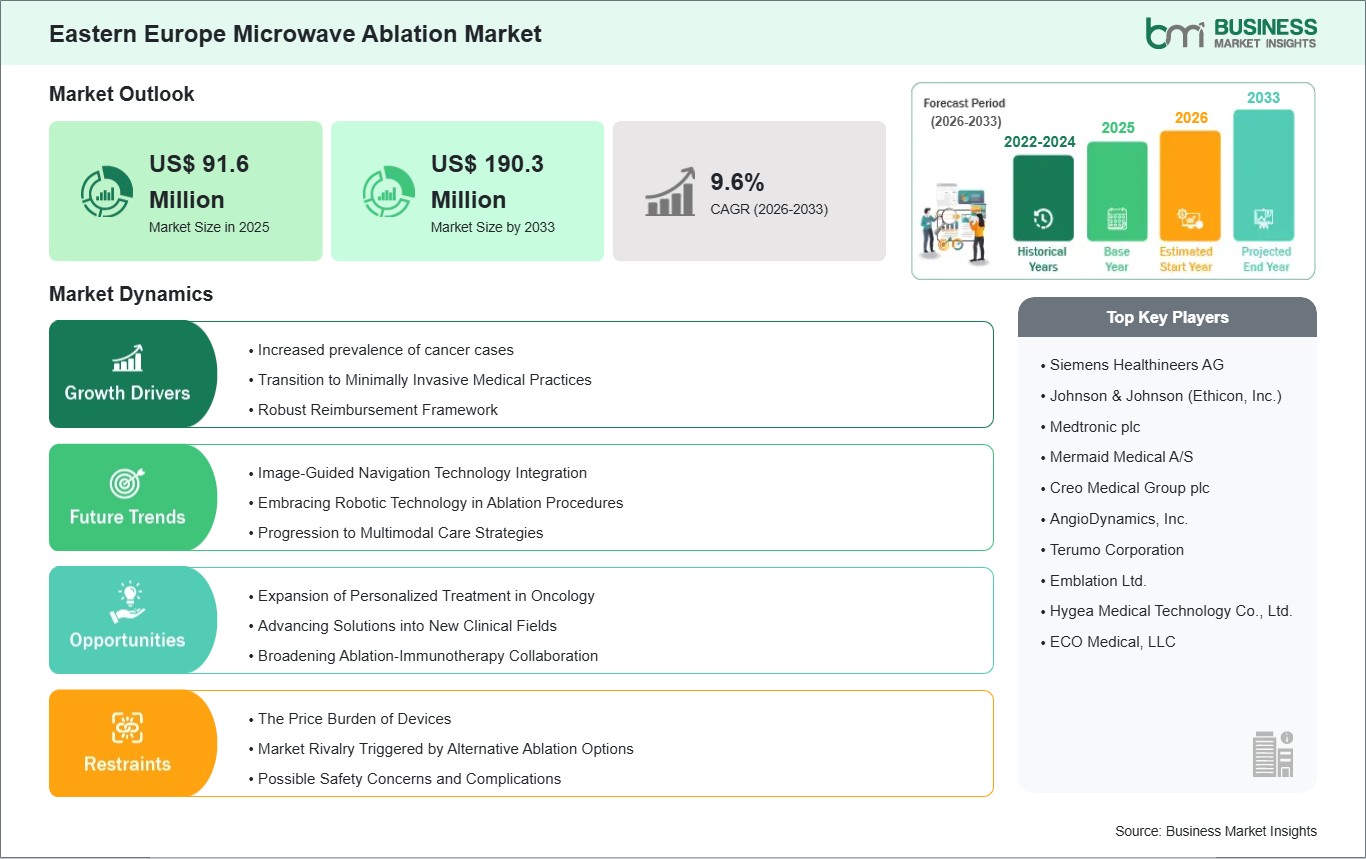
The Eastern Europe microwave ablation market is evolving as healthcare systems increasingly emphasize minimally invasive treatments for tumor management. Microwave ablation is recognized for its precision in destroying targeted tissue while minimizing damage to surrounding healthy tissue, making it a preferred option for patients seeking less invasive alternatives to traditional surgery. The region benefits from a growing network of specialized hospitals and clinics that are adopting advanced interventional radiology procedures. Clinician awareness and professional training programs are fostering expertise in these techniques, helping to expand clinical adoption.
However, the market faces several challenges. Healthcare infrastructure is uneven across Eastern Europe, with rural and regional hospitals often lacking the equipment or trained specialists to perform microwave ablation procedures. Regulatory processes for new medical technologies can be complex, creating delays in the introduction of new devices. Additionally, the cost and maintenance of advanced medical equipment may restrict adoption in less-funded facilities. Despite these obstacles, the region shows a strong inclination toward modern, minimally invasive oncology solutions, particularly in urban centers and major healthcare hubs, which serve as catalysts for wider market acceptance and professional expertise.
Segment Analysis
Eastern Europe Microwave Ablation Market Segmentation
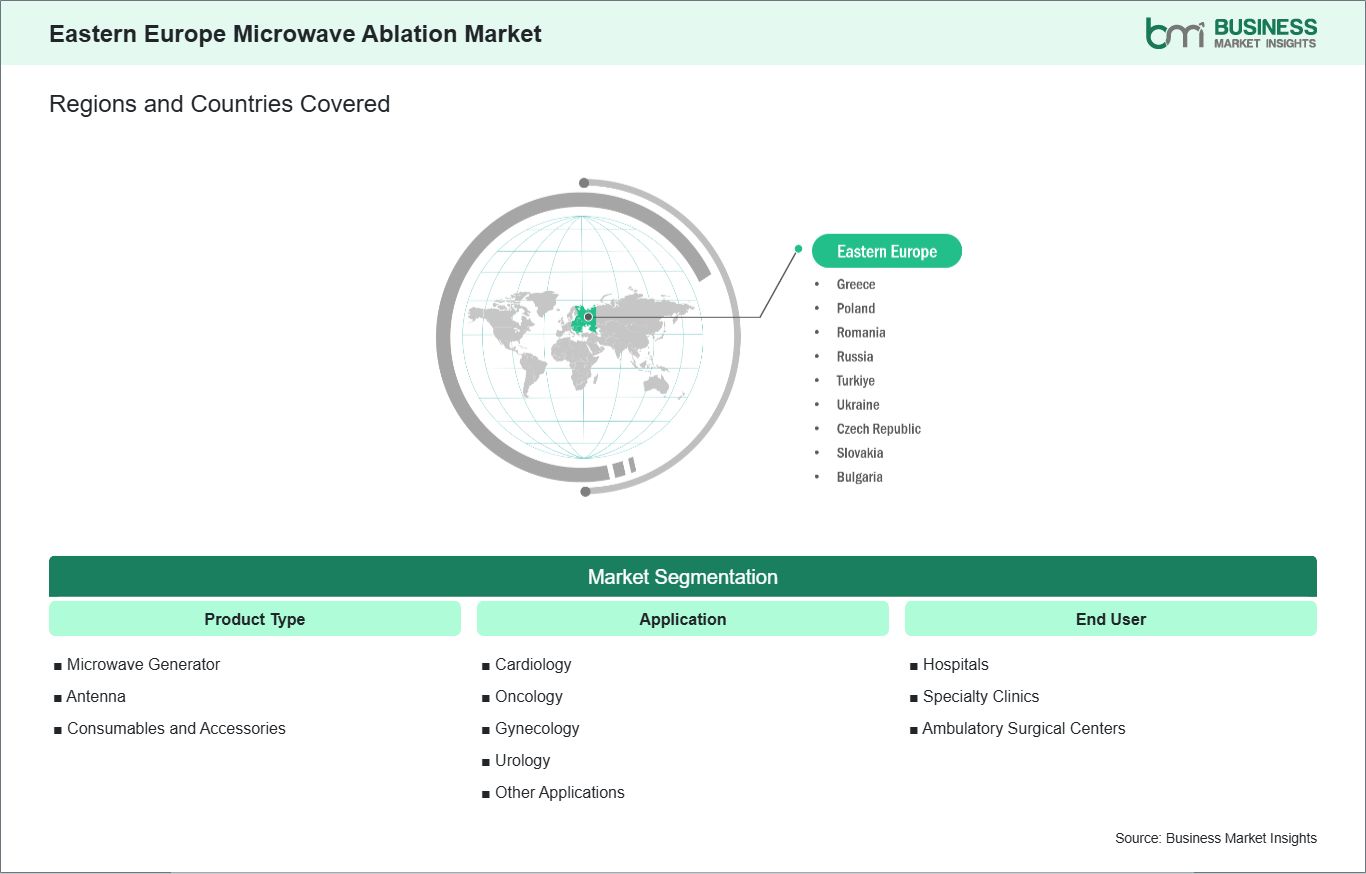
Key segments that contributed to the derivation of the Eastern Europe microwave ablation market analysis are product type, application, and end user.
- By product type, the microwave ablation market is segmented into microwave generator, antenna, and consumables & accessories. The antenna segment dominated the market in 2025.
- Based on application, the microwave ablation market is classified into cardiology, oncology, gynecology, urology, and others. The oncology segment dominated the market in 2025.
- In terms of end user, the microwave ablation market is categorized into hospitals, specialty clinics, and ambulatory surgical centers. The hospitals segment dominated the market in 2025.
Market Forces
Eastern Europe Microwave Ablation Market Drivers and Opportunities
Increased Prevalence of Cancer Cases
Eastern Europe has been witnessing a noticeable increase in cancer incidence over recent years, which is shaping demand for advanced treatment options. As populations age and lifestyle factors such as urbanization, diet changes, and rising tobacco use persist, solid tumors especially liver, colorectal, and lung cancers are becoming more frequently diagnosed in clinical settings. This growing caseload is encouraging health systems to broaden therapeutic strategies beyond conventional surgery and systemic therapies.
Hospitals and oncology centers in the region are under pressure to improve treatment throughput and clinical outcomes. In many tertiary care facilities, there is a shift toward minimally invasive interventional oncology procedures that can be delivered efficiently within limited operating room capacity. Microwave ablation has attracted attention as an alternative or adjunct to open surgery for eligible patients, allowing clinicians to manage tumors with less procedural trauma and shorter hospital stays.
There is an increased awareness among physicians and patients about the benefits of image‑guided ablation techniques. Where early detection programs identify tumors at stages amenable to percutaneous intervention, microwave ablation is increasingly considered in multidisciplinary treatment planning. This trend is contributing to steady growth in adoption, particularly in oncology clinics looking to balance demand for effective cancer control with the operational realities of regional healthcare infrastructure.
Expansion of Personalized Treatment in Oncology
Personalized oncology treatments are gaining popularity across Eastern Europe as clinicians place greater emphasis on tailoring therapies to individual patient profiles. Traditional "one‑size‑fits‑all" treatment patterns are giving way to approaches that consider tumor characteristics, patient health status, and quality‑of‑life expectations when selecting interventions. Microwave ablation fits well into this evolving paradigm due to its ability to deliver focused thermal therapy adapted to specific tumor size and location.
Multidisciplinary teams including oncologists, interventional radiologists, and diagnostic specialists are collaborating more frequently to design customized treatment plans. In many clinical centers, the integration of advanced imaging modalities such as ultrasound and CT during planning and monitoring is enabling more precise ablation procedures. This has enhanced clinician confidence in choosing minimally invasive options such as microwave ablation for suitable cases, especially when surgical resection carries a higher risk or may compromise organ function.
Patient expectations are also influencing treatment dynamics in Eastern Europe. As patients and referring physicians become increasingly informed about the spectrum of cancer therapies, they are showing interest in options that reduce recovery time and procedural discomfort while maintaining strong efficacy. Microwave ablation's minimally invasive profile resonates with these expectations, particularly among patients seeking alternatives to prolonged hospitalization or major surgery. As personalized oncology continues to expand across the region, the market for microwave ablation technologies is positioned for sustained interest and incremental growth.
Size and Share Analysis
Eastern Europe Microwave Ablation Market Size and Share Analysis
The Eastern Europe microwave ablation market demonstrates steady growth, with size and share analysis highlighting evolving trends and competitive dynamics among key players. The report evaluates important subsegments categorized within product type, application, and end user, highlighting their respective contributions to overall market performance.
By product type, the antenna subsegment dominated the market in 2025. There is a recurring need for high-performance, precise antennas during MWA procedures, which are essential for effective thermal ablation of tumors, making them a key revenue driver for manufacturers.
In terms of application, the oncology subsegment dominated the market in 2025. Oncology applications lead because of a rising prevalence of cancer cases, increasing preference for minimally invasive tumor ablation techniques, and growing awareness among healthcare providers about the effectiveness of MWA in treating liver, lung, and other solid tumors.
Based on end user, the hospitals subsegment dominated the market in 2025. Hospitals maintain a stronghold due to their well-established oncology and surgical departments, access to advanced MWA equipment, trained interventional radiologists and staff, and the capability to manage complex ablation procedures with comprehensive patient care.
Report Coverage
Eastern Europe Microwave Ablation Market Report Coverage and Deliverables
The "Eastern Europe Microwave Ablation Market Size and Forecast (2022-2033)" report provides a detailed analysis of the market covering below areas:
- Eastern Europe Microwave Ablation market size and forecast at regional and country levels for all market segments covered under the scope
- Eastern Europe Microwave Ablation market trends, as well as drivers, restraints, and opportunities
- Eastern Europe Microwave Ablation market analysis covering key trends, regional framework, major players, regulations, and recent developments
- Industry landscape and competition analysis covering market concentration, heat map analysis, prominent players, and recent developments for the Eastern Europe Microwave Ablation market
- Detailed company profiles, including SWOT analysis
Geographic Insights
Eastern Europe Microwave Ablation Market Geographic Insights
The geographical scope of the Eastern Europe microwave ablation market report is divided into Russia, Poland, Romania, the Czech Republic, Ukraine, Romania, Greece, Slovakia, and Bulgaria. Russia held the largest share in 2025.
Russia is the dominant country for microwave ablation in Eastern Europe, driven by its advanced healthcare infrastructure and strong focus on modern medical treatments. Major urban centers such as Moscow, Saint Petersburg, and Novosibirsk host leading hospitals and oncology centers that actively integrate microwave ablation into their treatment protocols. These facilities serve as centers of clinical excellence, offering specialized training for interventional radiologists and sharing best practices with other regional hospitals. Russian clinicians increasingly favor microwave ablation for treating liver, lung, and kidney tumors due to its minimally invasive nature and ability to reduce patient recovery time. Collaboration between hospitals, medical universities, and device manufacturers has facilitated hands-on training and knowledge dissemination, enhancing clinical confidence in these procedures. While access is concentrated in urban areas, ongoing initiatives aim to extend expertise to smaller regional hospitals, gradually improving availability across the country. Russia's focus on advanced healthcare delivery and precision medicine positions it as a regional leader in Eastern Europe, influencing the adoption of microwave ablation practices throughout neighboring countries.
Industry Activity
Recent Developments
The Eastern Europe Microwave Ablation market is evaluated by gathering qualitative and quantitative data post primary and secondary research, which includes important corporate publications, association data, and databases. A few of the key developments in the Eastern Europe Microwave Ablation market are:
- In December 2025, ECO Medical Technology and its Italian partner, TM srl, announced that they showcased their latest microwave ablation solutions at the ICIO 2025 conference in Milan, engaging with European oncology specialists to promote the adoption of minimally invasive microwave ablation, including outreach to Eastern European clinical networks.
- In January 2024, ECO Medical Technology announced that a microwave ablation procedure for parathyroid enlargement was completed in Hungary and the East-Central European region with the company's support. This milestone marked one of the first such clinical cases in the area and brought together local clinicians and international experts to introduce microwave ablation technology.
Trust & Transparency
Research Methodology
The market analysis combines proprietary research with secondary data from government agencies, company disclosures, regulatory filings, industry databases and expert interviews. Market estimates are validated through data triangulation, cross-market benchmarking and analyst
review.
View Full Research Methodology
Key Sources Referred:
The World BankWorld Health Organization (WHO)Center for Disease Control and Prevention (CDC)Food and Drug Administration (FDA)European Database on Medical Devices (EUDAMED)European Society of Cardiology (ESC)American College of Cardiology (ACC)American Heart Association (AHA)Company WebsitesCompany Annual ReportsCompany Investor Presentations