Market Summary
Executive Summary and Market Analysis
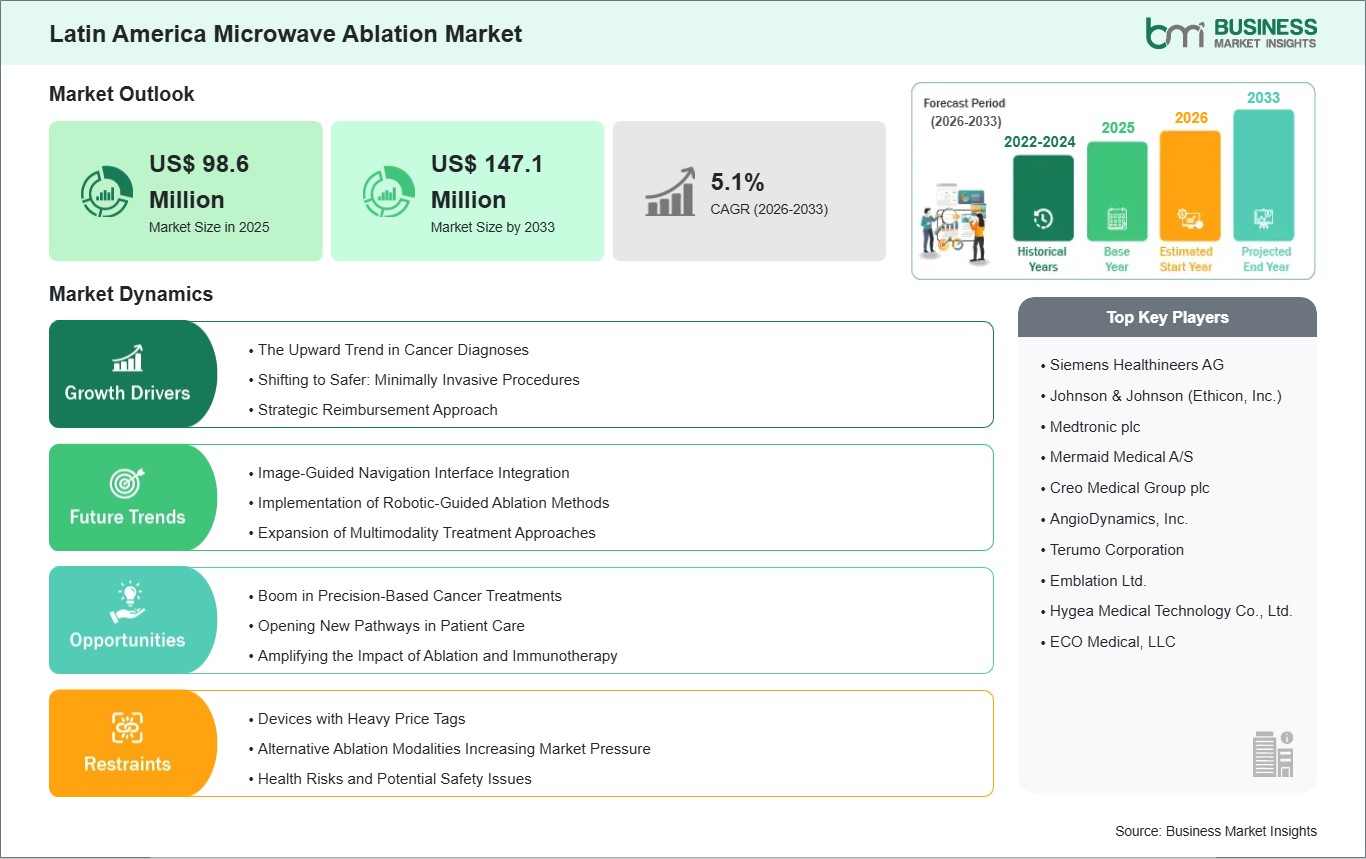
The Latin America microwave ablation market is evolving steadily as hospitals and clinics in the region increasingly embrace minimally invasive therapies for oncology and soft tissue disorders. The demand for procedures that reduce hospitalization time, enhance patient comfort, and improve recovery outcomes is a major factor driving adoption. Growing awareness among clinicians about the benefits of microwave ablation such as precise tumor targeting and compatibility with image-guided systems is also contributing to market momentum. In addition, expanding healthcare infrastructure in key metropolitan areas supports the integration of advanced ablation devices into interventional radiology and oncology departments.
However, market growth faces some restraints. Access to specialized medical equipment remains uneven across the region, with rural areas often lacking advanced interventional facilities. There is also a limited pool of trained clinicians proficient in performing microwave ablation procedures, which can slow adoption outside leading urban hospitals. Variations in healthcare policies and reimbursement frameworks among countries add another layer of complexity, influencing how quickly institutions can implement this technology. Despite these challenges, the region shows strong potential for expansion, as the trend toward minimally invasive therapies continues to shape clinical practice and hospital investment priorities.
Segment Analysis
Latin America Microwave Ablation Market Segmentation
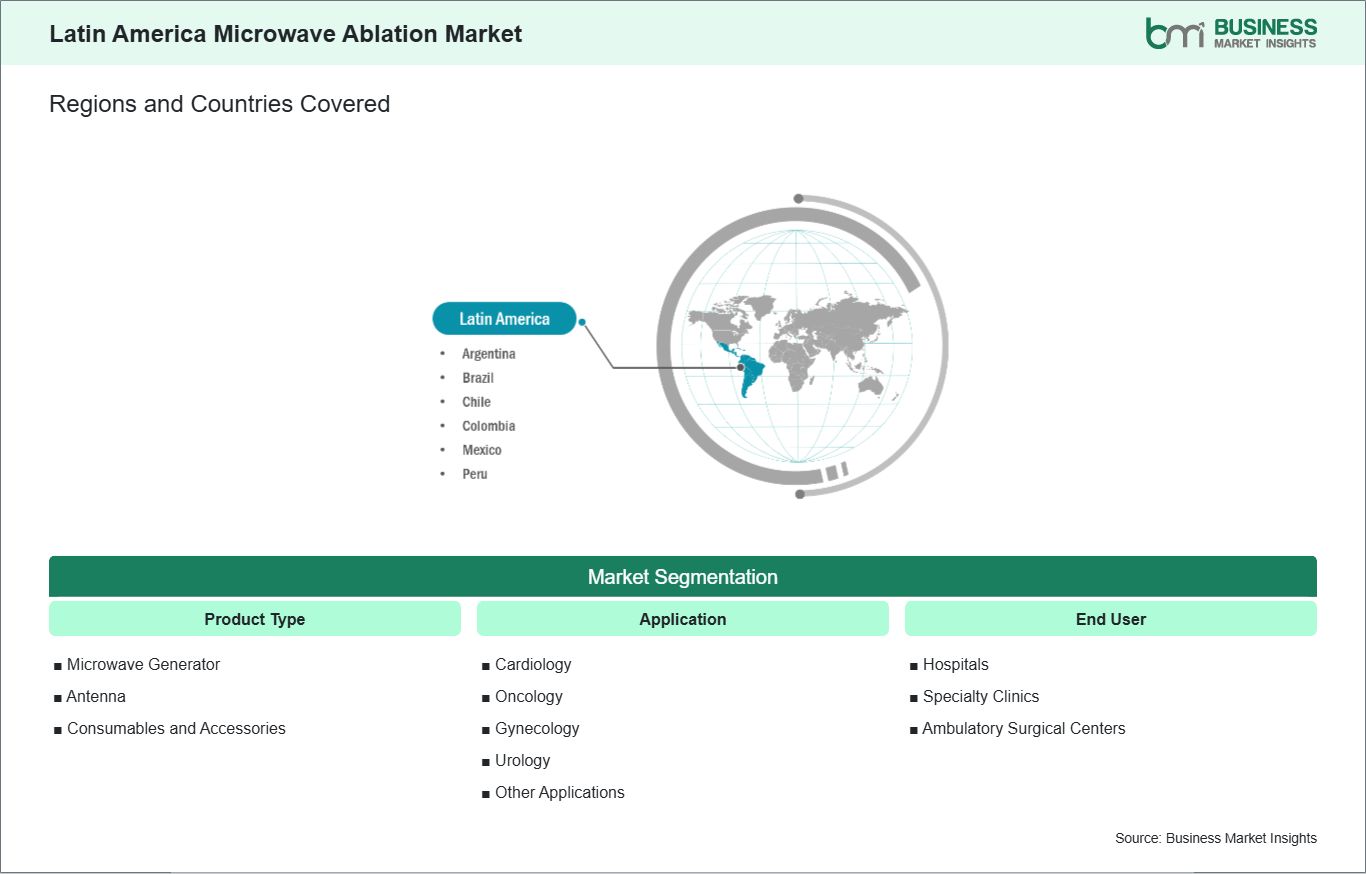
Key segments that contributed to the derivation of the Latin America Microwave Ablation market analysis are product type, application, and end user.
- By product type, the microwave ablation market is segmented into microwave generator, antenna, and consumables & accessories. The antenna segment dominated the market in 2025.
- Based on application, the microwave ablation market is classified into cardiology, oncology, gynecology, urology, and others. The oncology segment dominated the market in 2025.
- In terms of end user, the microwave ablation market is categorized into hospitals, specialty clinics, and ambulatory surgical centers. The hospitals segment dominated the market in 2025.
Market Forces
Latin America Microwave Ablation Market Drivers and Opportunities
The Upward Trend in Cancer Diagnoses
The Latin America microwave ablation market is being shaped by a steady upward trend in cancer diagnoses across the region. As populations grow and life expectancy increases, healthcare systems are witnessing a rise in solid tumor cases, particularly those affecting the liver, lungs, and breast. This rise in oncology caseloads is placing pressure on existing treatment pathways and encouraging clinicians to explore a broader range of therapeutic options that can be delivered with high precision and reduced procedural burden.
Healthcare providers across Latin America are responding to the rising cancer burden by expanding diagnostic and interventional oncology services. In many major urban centers, multidisciplinary cancer care units are integrating advanced image‑guided treatment modalities to support growing patient volumes. Microwave ablation, as a minimally invasive thermal therapy, is gaining traction as a method to treat localized tumors with shorter procedural times and reduced hospital stays compared with traditional open surgery.
At the same time, regional investments in healthcare infrastructure are enabling greater adoption of innovative oncology technologies. Public and private hospitals are upgrading interventional radiology suites and training specialists in ablation techniques to meet evolving clinical needs. As awareness of microwave ablation's clinical benefits increases among oncologists and referring physicians, demand for these systems is expected to grow in proportion to the broader upward trend in cancer diagnoses throughout Latin America.
Boom in Precision-Based Cancer Treatments
Latin America is also experiencing a boom in precision‑based cancer treatments as clinicians place greater emphasis on individualized care strategies. Oncologists are increasingly tailoring therapeutic plans according to tumor characteristics, patient health status, and lifestyle considerations rather than relying on uniform treatment protocols. This shift toward precision oncology is driving interest in technologies that allow targeted interventions with improved safety profiles.
Across the region, multidisciplinary cancer care teams are collaborating more closely to identify the most appropriate treatment pathways for each patient. This collaborative model has encouraged the integration of advanced imaging and ablation technologies, enabling clinicians to deliver thermal therapy tailored to the size and location of individual tumors. Microwave ablation's flexibility in energy delivery and compatibility with real‑time image guidance aligns well with efforts to customize treatment, particularly for patients seeking alternatives to extensive surgery.
Patient awareness and engagement in treatment decisions are also contributing to growth in precision‑based care. Many patients in Latin America are increasingly informed about minimally invasive options that can offer effective tumor control while minimizing downtime and procedural risk. The demand for treatments that support quality of life and faster recovery is rising, and microwave ablation's profile as an adaptable, patient‑centric therapy supports its expanding role in personalized oncology. As precision‑based cancer treatments continue to gain momentum, the microwave ablation market in Latin America is poised for sustained growth.
Size and Share Analysis
Latin America Microwave Ablation Market Size and Share Analysis
The Latin America microwave ablation market demonstrates steady growth, with size and share analysis highlighting evolving trends and competitive dynamics among key players. The report evaluates important subsegments categorized within product type, application, and end user, highlighting their respective contributions to overall market performance.
By product type, the antenna subsegment dominated the market in 2025. There is a recurring need for high-performance, precise antennas during MWA procedures, which are essential for effective thermal ablation of tumors, making them a key revenue driver for manufacturers.
In terms of application, the oncology subsegment dominated the market in 2025. Oncology applications lead because of a rising prevalence of cancer cases, increasing preference for minimally invasive tumor ablation techniques, and growing awareness among healthcare providers about the effectiveness of MWA in treating liver, lung, and other solid tumors.
Based on end user, the hospitals subsegment dominated the market in 2025. Hospitals maintain a stronghold due to their well-established oncology and surgical departments, access to advanced MWA equipment, trained interventional radiologists and staff, and the capability to manage complex ablation procedures with comprehensive patient care.
Report Coverage
Latin America Microwave Ablation Market Report Coverage and Deliverables
The "Latin America Microwave Ablation Market Size and Forecast (2022-2033)" report provides a detailed analysis of the market covering below areas:
- Latin America Microwave Ablation market size and forecast at regional and country levels for all market segments covered under the scope
- Latin America Microwave Ablation market trends, as well as drivers, restraints, and opportunities
- Latin America Microwave Ablation market analysis covering key trends, regional framework, major players, regulations, and recent developments
- Industry landscape and competition analysis covering market concentration, heat map analysis, prominent players, and recent developments for the Latin America Microwave Ablation market
- Detailed company profiles, including SWOT analysis
Geographic Insights
Latin America Microwave Ablation Market Geographic Insights
The geographical scope of the Latin America Microwave Ablation market report is divided into Brazil, Mexico, Argentina, Colombia, Chile, and Peru. Mexico held the largest share in 2025.
Mexico is the leading market for microwave ablation in Latin America, largely due to its well-developed healthcare infrastructure and concentration of advanced medical centers in major cities. Hospitals in Mexico have been early adopters of minimally invasive oncology technologies, integrating microwave ablation into routine care for liver, lung, and kidney tumors. Clinicians in Mexico value the technology for its precision, reduced procedural time, and improved patient comfort compared with traditional surgical interventions. Training initiatives and the presence of multidisciplinary teams in urban hospitals have facilitated the development of expertise in microwave ablation, allowing complex procedures to be performed safely and effectively. Additionally, patient awareness about minimally invasive treatment options has increased, further driving adoption in private and public healthcare facilities. While smaller hospitals may face challenges with equipment investment and availability of trained personnel, the concentration of advanced interventional centers in Mexico ensures that the country remains the dominant hub for microwave ablation in the region.
Industry Activity
Recent Developments
The Latin America Microwave Ablation market is evaluated by gathering qualitative and quantitative data post primary and secondary research, which includes important corporate publications, association data, and databases. A few of the key developments in the Latin America Microwave Ablation market are:
- In July 2025, ECO Medical Technology held a microwave ablation workshop in Argentina (Córdoba) focused on thyroid ablation, engaging nearly 35 doctors from the region. These hands‑on sessions strengthen ECO's presence in Latin America and promote wider clinical adoption of microwave ablation technologies.
- In April 2024, ECO Medical Technology held a successful thyroid microwave ablation workshop in Mexico City with participation from local radiologists and interventional specialists. The initiative, organized with a local partner, Dr. Joel, aimed to bolster clinical training and early adoption of microwave ablation techniques across Latin American healthcare providers.
Trust & Transparency
Research Methodology
The market analysis combines proprietary research with secondary data from government agencies, company disclosures, regulatory filings, industry databases and expert interviews. Market estimates are validated through data triangulation, cross-market benchmarking and analyst
review.
View Full Research Methodology
Key Sources Referred:
The World BankWorld Health Organization (WHO)Center for Disease Control and Prevention (CDC)Food and Drug Administration (FDA)European Database on Medical Devices (EUDAMED)European Society of Cardiology (ESC)American College of Cardiology (ACC)American Heart Association (AHA)Company WebsitesCompany Annual ReportsCompany Investor Presentations