Market Summary
Executive Summary and Market Analysis
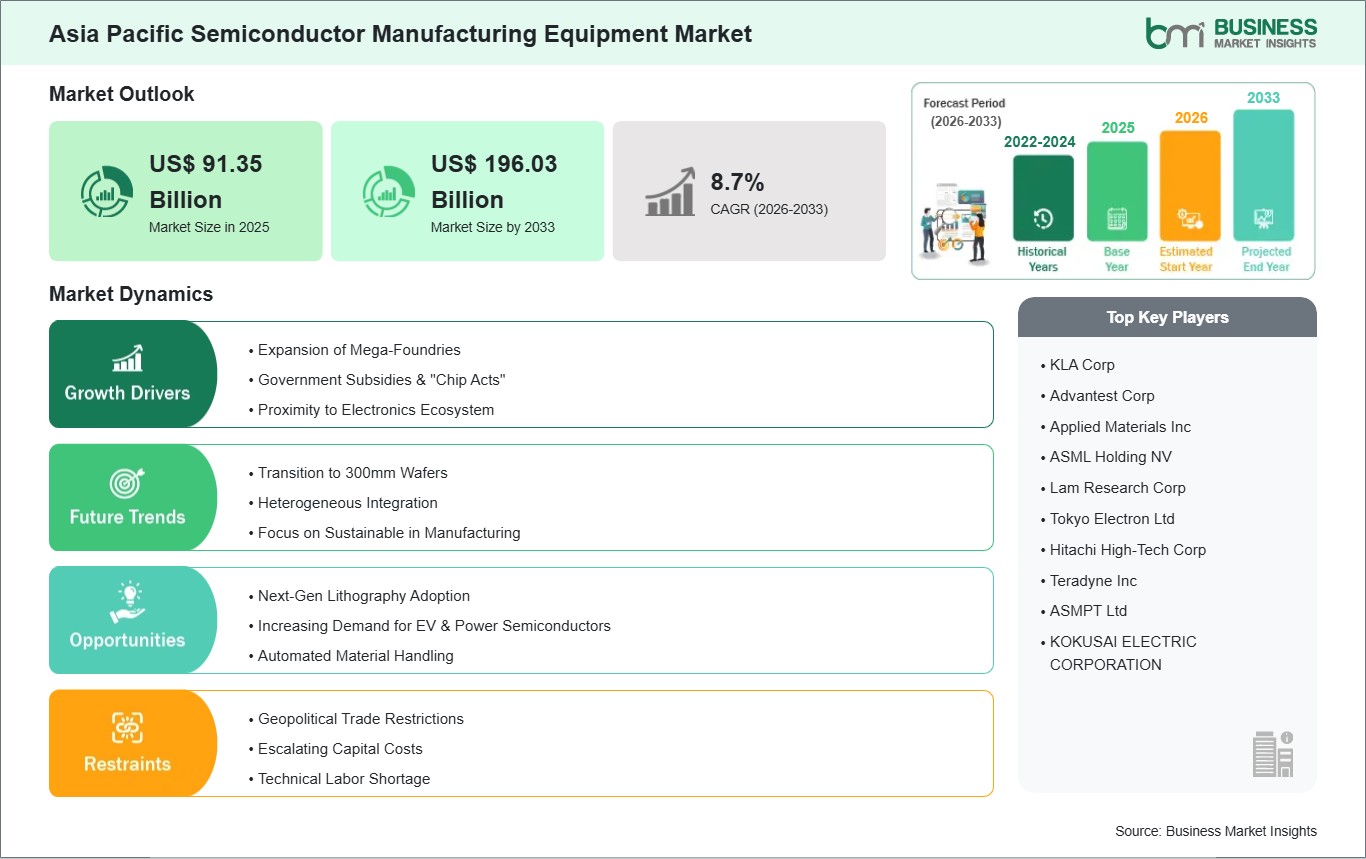
The Asia Pacific semiconductor manufacturing equipment market has witnessed robust growth, driven by rising demand for advanced semiconductor devices and significant investments in fabrication facilities across key economies such as China, Taiwan, South Korea, and Japan. Strong government initiatives and strategic incentives aimed at strengthening domestic chip production capabilities have accelerated capacity expansions and technology upgrades within the region. The surge in demand for consumer electronics, automotive applications, and edge computing has further bolstered the need for cutting‑edge manufacturing equipment. Notably, the shift toward next‑generation process nodes and the adoption of EUV lithography and advanced packaging technologies are reshaping competitive dynamics, with major global and regional players intensifying R&D to capture market share. However, supply chain disruptions and geopolitical uncertainties pose challenges to sustained growth. Overall, the Asia Pacific semiconductor manufacturing equipment market is poised for continued expansion, underpinned by strong structural demand, policy support, and technological innovation, positioning the region as a central hub in the global semiconductor value chain.
Segment Analysis
Asia Pacific Semiconductor Manufacturing Equipment Market Segmentation
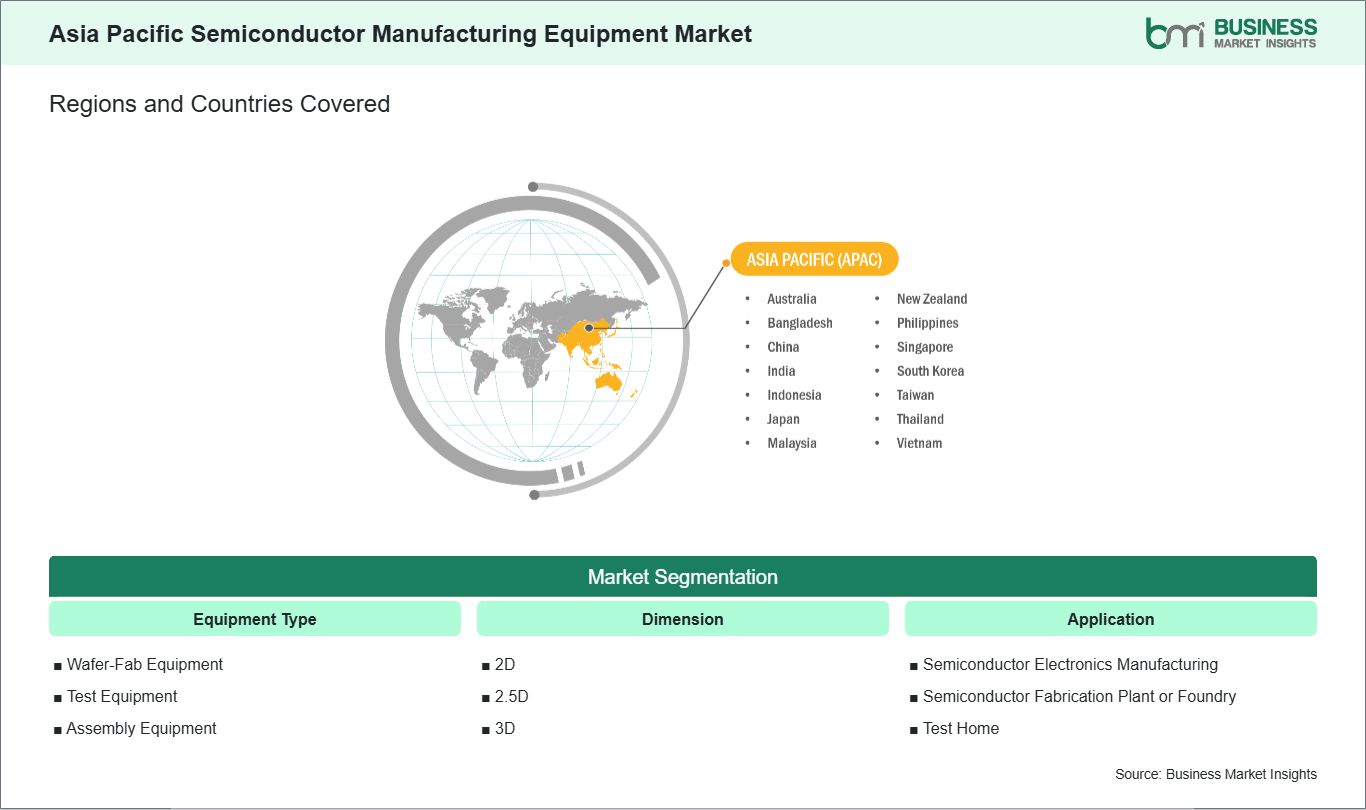
Key segments that contributed to the derivation of the Asia Pacific semiconductor manufacturing equipment market analysis are equipment type, dimension, and application.
- By equipment type, the Asia Pacific semiconductor manufacturing equipment market is bifurcated into wafer-fab equipment, test equipment, and assembly equipment. The wafer-fab equipment segment dominated the market in 2025.
- By dimension, the market is segmented into 2D, 2.5D, and 3D. The 2D segment held the largest share of the market in 2025.
- By application, the market is segmented into semiconductor electronics manufacturing, semiconductor fabrication plant/foundry, and test home. The semiconductor electronics manufacturing segment held the largest share of the market in 2025.
Market Forces
Asia Pacific Semiconductor Manufacturing Equipment Market Drivers and Opportunities
Expansion of Mega Foundries
The expansion of mega‑foundries across Asia Pacific is a pivotal driver of growth in the semiconductor manufacturing equipment market. Countries such as China, Taiwan, South Korea, and increasingly Japan and Singapore, are aggressively investing in large‑scale fabrication facilities to meet booming global demand for advanced chips in AI, 5G, automotive, and IoT applications. This expansion requires substantial capital expenditure on cutting‑edge equipment—from lithography systems to etchers, deposition tools, and metrology solutions—creating sustained demand for OEMs. Government incentives, strategic national policies, and supply chain localization efforts further accelerate capacity build‑outs. Additionally, competition among regional players to achieve technology leadership encourages frequent equipment upgrades and new facility construction. As these mega‑foundries scale up production nodes at 7 nm, 5 nm and beyond, equipment manufacturers benefit from increased orders, long‑term service contracts, and opportunities to co‑innovate with fabricators on specialized tooling and automation, reinforcing Asia Pacific’s centrality in the semiconductor ecosystem.
Next-Gen Lithography Adoption
The adoption of next‑generation lithography technologies—particularly extreme ultraviolet (EUV) and high‑NA EUV—is a key opportunity shaping the semiconductor manufacturing equipment market in Asia Pacific. As global demand shifts toward smaller, more efficient, and powerful integrated circuits, foundries and logic fabs in the region must deploy advanced lithography systems to remain competitive. EUV’s ability to pattern sub‑7 nm structures with high precision unlocks performance gains critical for AI accelerators, high‑performance computing, and mobile processors. Asia Pacific’s robust ecosystem of semiconductor manufacturers, combined with government and private investments in R&D, positions the region as an early adopter of these next‑gen tools. This transition stimulates demand not only for the lithography machines themselves—largely supplied by a few specialized vendors—but also for supporting equipment and software, such as mask inspection, pellicles, and process control solutions. Consequently, suppliers aligned with next‑gen lithography benefit from long growth cycles, premium pricing, and strategic partnerships that embed them deeply into future technology roadmaps.
Size and Share Analysis
Asia Pacific Semiconductor Manufacturing Equipment Market Size and Share Analysis
By equipment type, the Asia Pacific semiconductor manufacturing equipment market is divided into wafer-fab equipment, assembly equipment, and test equipment. The wafer-fab equipment segment dominated the market in 2025. Asia Pacific shows strong wafer-fab equipment adoption, driven by China, South Korea, Taiwan, and Japan. Heavy investments in advanced lithography, etching, and deposition tools support high-volume production for global semiconductor supply chains, while emerging economies are scaling local capacities.
By dimension, the market is segmented into 2D, 2.5D, and 3D. The 2D segment held the largest share of the market in 2025. Asia Pacific leads global 2D adoption due to large-scale manufacturing, smart cities, and rapid digitalization. 2D technologies are critical in electronics, healthcare imaging, logistics automation, and consumer services across both developed and emerging economies.
By application, the market is segmented semiconductor electronics manufacturing, semiconductor fabrication plant/foundry, and test home. The semiconductor electronics manufacturing segment held the largest share of the market in 2025. Asia Pacific dominates semiconductor electronics manufacturing with extensive fabrication, packaging, and supply-chain integration. Strong demand from consumer electronics, 5G, automotive, and AI technologies, supported by government incentives, positions the region as the global manufacturing powerhouse.
Report Coverage
Asia Pacific Semiconductor Manufacturing Equipment Market Report Coverage and Deliverables
The "Asia Pacific Semiconductor Manufacturing Equipment Market Size and Forecast (2022-2033)" report provides a detailed analysis of the market covering below areas:
- Asia Pacific semiconductor manufacturing equipment market size and forecast at regional, and country levels for all the key market segments covered under the scope
- Asia Pacific semiconductor manufacturing equipment market trends, as well as market dynamics such as drivers, restraints, and key opportunities
- Asia Pacific semiconductor manufacturing equipment market analysis covering key market trends, global and regional framework, major players, regulations, and recent market developments
- Industry landscape and competition analysis covering market concentration, heat map analysis, prominent players, and recent developments for the air circuit breaker market
- Detailed company profiles, including SWOT analysis
Geographic Insights
Asia Pacific Semiconductor Manufacturing Equipment Market Geographic Insights
The geographical scope of the Asia Pacific semiconductor manufacturing equipment market report is expected to grow significantly during the forecast period.
The demand for semiconductor manufacturing equipment in the Asia Pacific region has been rapidly increasing due to several interrelated factors. First, the region is home to some of the world’s largest semiconductor producers, such as Taiwan, South Korea, and China, which continuously invest in advanced fabrication facilities to meet global chip demand. Second, the growing adoption of emerging technologies—including 5G, artificial intelligence, Internet of Things (IoT), and electric vehicles—has significantly amplified the need for high-performance semiconductors, driving expansion in production capacity. Third, government initiatives and incentives in countries like China, Japan, and South Korea to boost domestic semiconductor manufacturing have encouraged investments in state-of-the-art equipment. Additionally, the ongoing global chip shortage has highlighted the strategic importance of localizing semiconductor production, prompting companies to modernize and expand their fabs. Collectively, these factors are fueling robust growth in the semiconductor manufacturing equipment market across Asia Pacific, making it a critical hub for global chip production.
Industry Activity
Recent Developments
The Asia Pacific semiconductor manufacturing equipment market is evaluated by gathering qualitative and quantitative data post primary and secondary research, which includes important corporate publications, association data, and databases. A few of the key developments in the Asia Pacific semiconductor manufacturing equipment market are:
- For instance, on October, 2025, Applied Materials, Inc. introduced new semiconductor manufacturing systems that enhance the performance of advanced logic and memory chips, which are foundational to AI computing. The new products target three critical areas in the race to deliver ever more powerful AI chips: leading-edge logic including Gate-All-Around (GAA) transistors, high-performance DRAM including high-bandwidth memory (HBM), and advanced packaging to create highly integrated systems-in-a-package that optimize chip performance, power consumption and cost.
- For instance, in February 2025, Advantest Corporation announced that it had entered into a partnership agreement with Micronics Japan Co., Ltd. (“MJC”). As semiconductors are expected to become increasingly advanced and complex, close collaboration within the semiconductor supply chain is essential to meet future market demands. Under this agreement, MJC and Advantest will leverage their respective expertise to provide innovative semiconductor test solutions, contributing to the optimization of customers' test processes and test costs. Additionally, Advantest plans to acquire a minority stake in MJC as part of this agreement.
Trust & Transparency
Research Methodology
The market analysis combines proprietary research with secondary data from government agencies, company disclosures, regulatory filings, industry databases and expert interviews. Market estimates are validated through data triangulation, cross-market benchmarking and analyst
review.
View Full Research Methodology
Key Sources Referred:
World Bank - Global Trade Indicators World Trade Organization (WTO) International Monetary Fund (IMF) International Trade Administration (ITA) Company website Company annual reports Company investor presentations