Market Summary
Executive Summary and Market Analysis
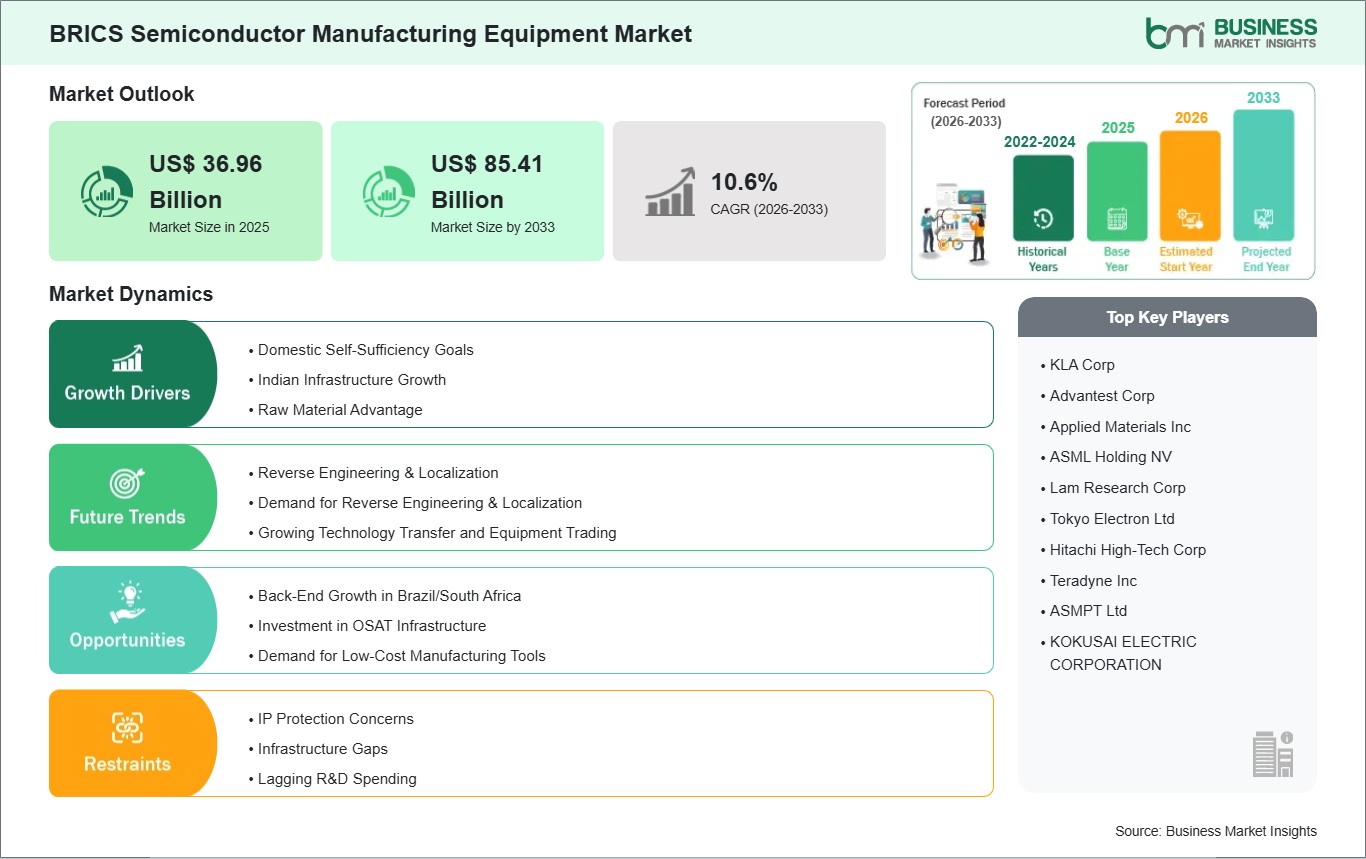
The BRICS semiconductor manufacturing equipment market is rapidly emerging as a pivotal segment in the global semiconductor supply chain, driven by strategic investments and government initiatives across Brazil, Russia, India, China, and South Africa. With increasing demand for advanced electronics, automotive applications, and digital infrastructure, BRICS nations are prioritizing localized semiconductor production capabilities to reduce dependency on imports and enhance technological sovereignty. China remains the dominant force within the bloc, leveraging substantial R&D expenditure and established fabrication facilities to attract equipment suppliers and foster innovation. India’s semiconductor policy and incentives are catalyzing new manufacturing ventures, while Brazil and Russia focus on capacity expansion and niche technology segments. South Africa’s participation emphasizes ecosystem development and skills enhancement. However, the market faces challenges including supply chain fragmentation, limited domestic high‑end equipment producers, and geopolitical complexities. Overall, the BRICS market presents significant growth potential for semiconductor equipment manufacturers, supported by collaborative frameworks and rising regional demand for cutting‑edge chips.
Segment Analysis
BRICS Semiconductor Manufacturing Equipment Market Segmentation
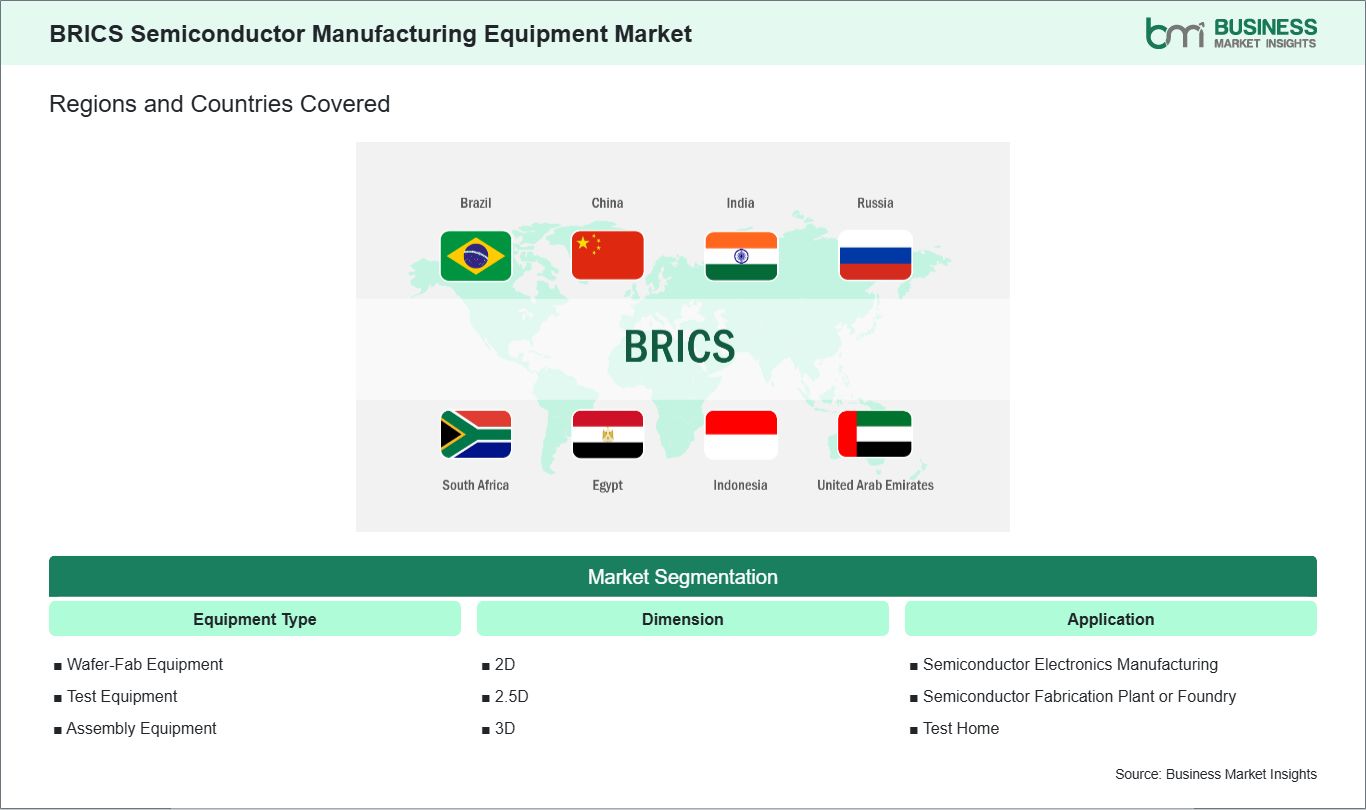
Key segments that contributed to the derivation of the BRICS semiconductor manufacturing equipment market analysis are equipment type, dimension, and application.
- By equipment type, the BRICS semiconductor manufacturing equipment market is bifurcated into wafer-fab equipment, test equipment, and assembly equipment. The wafer-fab equipment segment dominated the market in 2025.
- By dimension, the market is segmented into 2D, 2.5D, and 3D. The 2D segment held the largest share of the market in 2025.
- By application, the market is segmented into semiconductor electronics manufacturing, semiconductor fabrication plant/foundry, and test home. The semiconductor electronics manufacturing segment held the largest share of the market in 2025.
Market Forces
BRICS Semiconductor Manufacturing Equipment Market Drivers and Opportunities
Domestic Self-Sufficiency Goals
BRICS nations (Brazil, Russia, India, China, South Africa) are increasingly focused on reducing dependency on foreign semiconductor supply chains, driving strong demand for semiconductor manufacturing equipment. Geopolitical tensions, export controls, and supply disruptions highlighted vulnerabilities in relying on external sources for chips and fabrication tools. In response, governments across BRICS have launched ambitious technology and industrial policies to build indigenous semiconductor capabilities—from design and R&D to wafer fabrication and packaging. This strategic push has fueled capital investment in fabs and testing facilities, prompting procurement of advanced SME to establish localized production ecosystems. Incentives, subsidies, and public‑private partnerships are accelerating technology transfer and infrastructure build‑outs. As domestic self‑sufficiency becomes a priority for national security and economic competitiveness, demand for state‑of‑the‑art manufacturing tools—lithography, etch, deposition, and inspection equipment—continues to expand, strengthening the BRICS SME market and attracting global and regional equipment suppliers.
Back-End Growth in Brazil/South Africa
While front‑end wafer fabrication draws headlines, back‑end semiconductor activities—assembly, packaging, testing, and quality assurance—are emerging as significant opportunities in Brazil and South Africa. These countries possess strengths in advanced manufacturing niches, engineering talent, and existing industrial bases that can support scalable back‑end operations. Back‑end processes are essential for value capture in the semiconductor value chain, and demand is growing for packaging solutions that meet requirements for automotive electronics, IoT devices, and renewable energy systems. Investments in back‑end infrastructure require specialized equipment (wire bonders, package testers, inspection systems), creating a robust market for SME vendors. Additionally, proximity to regional electronics markets offers logistical advantages, lowering lead times and improving cost competitiveness. As multinational companies look to diversify production footprints beyond Asia, Brazil and South Africa are well‑positioned to attract back‑end manufacturing partnerships and strengthen local ecosystems, thereby driving steady growth in semiconductor equipment demand focused on downstream value chain segments.
Size and Share Analysis
BRICS Semiconductor Manufacturing Equipment Market Size and Share Analysis
By equipment type, the BRICS semiconductor manufacturing equipment market is divided into wafer-fab equipment, assembly equipment, and test equipment. The wafer-fab equipment segment dominated the market in 2025. BRICS nations are increasingly adopting wafer-fab equipment, with China, India, and Russia leading. Investments support domestic semiconductor manufacturing, high-tech industrial growth, and import substitution, driven by government initiatives and strategic focus on technological sovereignty and advanced fabrication capabilities.
By dimension, the market is segmented into 2D, 2.5D, and 3D. The 2D segment held the largest share of the market in 2025. BRICS nations demonstrate growing 2D adoption driven by industrial expansion, urbanization, and digital transformation. 2D technologies support manufacturing, infrastructure development, healthcare access, and large-scale logistics across diverse and rapidly evolving markets.
By application, the market is segmented semiconductor electronics manufacturing, semiconductor fabrication plant/foundry, and test home. The semiconductor electronics manufacturing segment held the largest share of the market in 2025. BRICS countries are rapidly adopting semiconductor manufacturing to support industrial growth and technological independence. Large domestic markets, government investments, and expanding electronics demand across automotive, telecom, and consumer sectors drive regional semiconductor ecosystem development.
Report Coverage
BRICS Semiconductor Manufacturing Equipment Market Report Coverage and Deliverables
The "BRICS Semiconductor Manufacturing Equipment Market Size and Forecast (2022-2033)" report provides a detailed analysis of the market covering below areas:
- BRICS semiconductor manufacturing equipment market size and forecast at regional, and country levels for all the key market segments covered under the scope
- BRICS semiconductor manufacturing equipment market trends, as well as market dynamics such as drivers, restraints, and key opportunities
- BRICS semiconductor manufacturing equipment market analysis covering key market trends, global and regional framework, major players, regulations, and recent market developments
- Industry landscape and competition analysis covering market concentration, heat map analysis, prominent players, and recent developments for the air circuit breaker market
- Detailed company profiles, including SWOT analysis
Geographic Insights
BRICS Semiconductor Manufacturing Equipment Market Geographic Insights
The geographical scope of the BRICS semiconductor manufacturing equipment market report is expected to grow significantly during the forecast period.
The demand for semiconductor manufacturing equipment in the BRICS (Brazil, Russia, India, China, South Africa) has surged due to several strategic, economic, and technological factors. First, governments within the BRICS bloc are prioritizing semiconductor self‑sufficiency to reduce reliance on imports and strengthen national security, leading to large policy‑driven investments in local fabs and research facilities. Rapid digital transformation across sectors such as telecommunications, automotive, consumer electronics, and renewable energy has increased the need for advanced chips, thereby driving investment in production capacity and state‑of‑the‑art fabrication tools. Additionally, rising foreign direct investment and global supply chain diversification strategies have encouraged multinational equipment makers to partner with local firms, boosting demand for cutting‑edge manufacturing systems. The expansion of 5G networks, AI, Internet of Things (IoT), and electric vehicles has further intensified the need for advanced semiconductor technologies. Together, these factors are positioning BRICS nations as pivotal growth centers in the global semiconductor equipment market.
Industry Activity
Recent Developments
The BRICS semiconductor manufacturing equipment market is evaluated by gathering qualitative and quantitative data post primary and secondary research, which includes important corporate publications, association data, and databases. A few of the key developments in the BRICS semiconductor manufacturing equipment market are:
- For instance, on October, 2025, Applied Materials, Inc. introduced new semiconductor manufacturing systems that enhance the performance of advanced logic and memory chips, which are foundational to AI computing. The new products target three critical areas in the race to deliver ever more powerful AI chips: leading-edge logic including Gate-All-Around (GAA) transistors, high-performance DRAM including high-bandwidth memory (HBM), and advanced packaging to create highly integrated systems-in-a-package that optimize chip performance, power consumption and cost.
- For instance, in February 2025, Advantest Corporation announced that it had entered into a partnership agreement with Micronics Japan Co., Ltd. (“MJC”). As semiconductors are expected to become increasingly advanced and complex, close collaboration within the semiconductor supply chain is essential to meet future market demands. Under this agreement, MJC and Advantest will leverage their respective expertise to provide innovative semiconductor test solutions, contributing to the optimization of customers' test processes and test costs. Additionally, Advantest plans to acquire a minority stake in MJC as part of this agreement.
Trust & Transparency
Research Methodology
The market analysis combines proprietary research with secondary data from government agencies, company disclosures, regulatory filings, industry databases and expert interviews. Market estimates are validated through data triangulation, cross-market benchmarking and analyst
review.
View Full Research Methodology
Key Sources Referred:
World Bank - Global Trade Indicators World Trade Organization (WTO) International Monetary Fund (IMF) International Trade Administration (ITA) Company website Company annual reports Company investor presentations