Market Summary
Executive Summary and Market Analysis
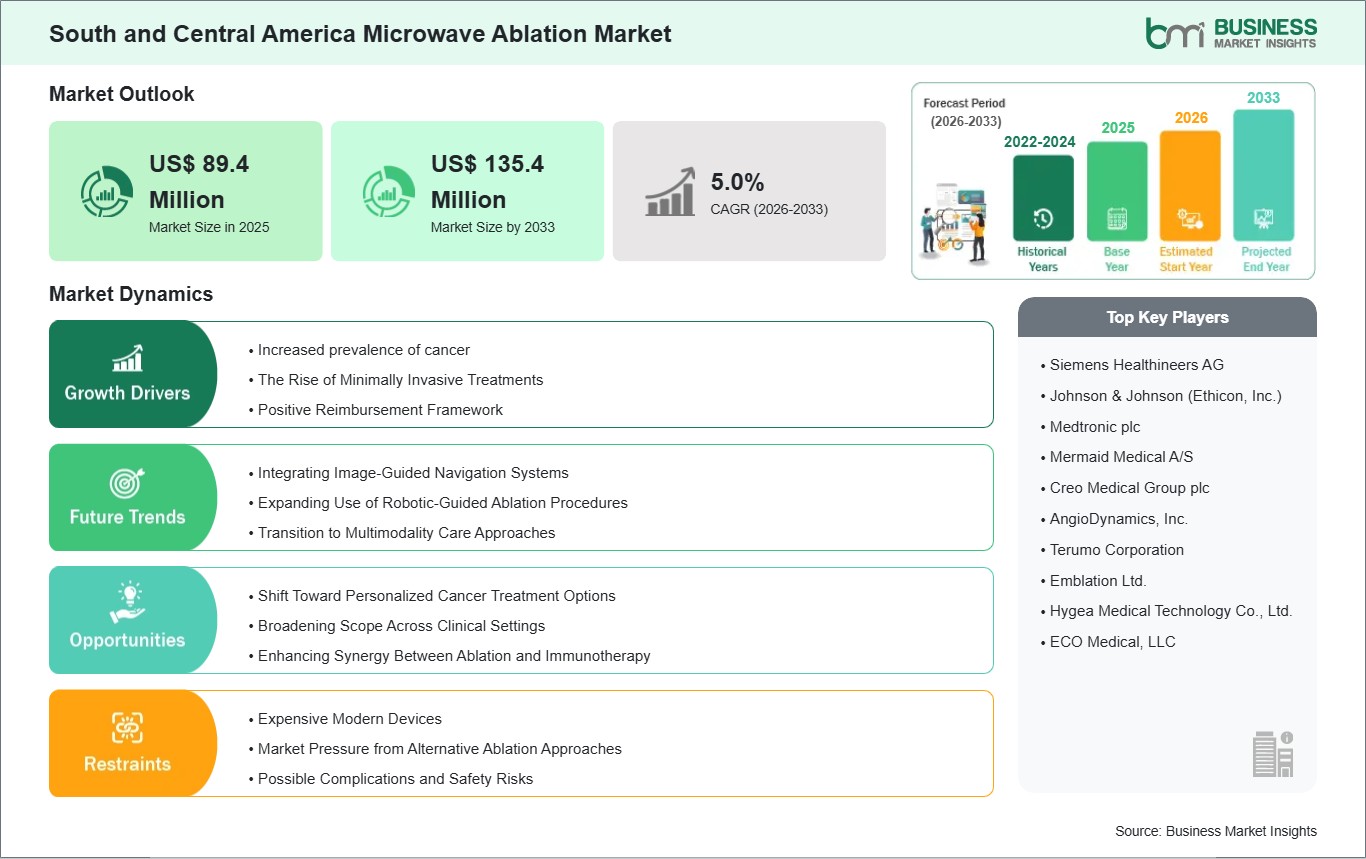
The South and Central America microwave ablation market is steadily gaining momentum as minimally invasive cancer treatment options expand across the region. Microwave ablation has become an attractive alternative to conventional surgical procedures for treating tumors in the liver, lungs, kidneys, and other soft tissues, offering benefits such as shorter recovery times, reduced complications, and suitability for patients who cannot undergo traditional surgery. Urban hospitals and specialized oncology centers are increasingly integrating microwave ablation into their treatment portfolios, driven by growing patient awareness and demand for innovative therapies. Physicians are also recognizing the clinical advantages of this technique, with professional networks and local training programs helping to build expertise and confidence.
However, the market faces some challenges. Reimbursement policies are uneven across public and private healthcare systems, making widespread adoption slower in certain countries and rural regions. Additionally, the high cost of advanced ablation equipment and associated imaging systems can be a barrier for smaller hospitals and clinics. Limited procedural awareness outside major cities also impacts penetration. Despite these challenges, investment in healthcare infrastructure and collaborations between international device providers and regional hospitals are strengthening the market, laying the foundation for broader adoption of microwave ablation technologies across South and Central America.
Segment Analysis
South and Central America Microwave Ablation Market Segmentation
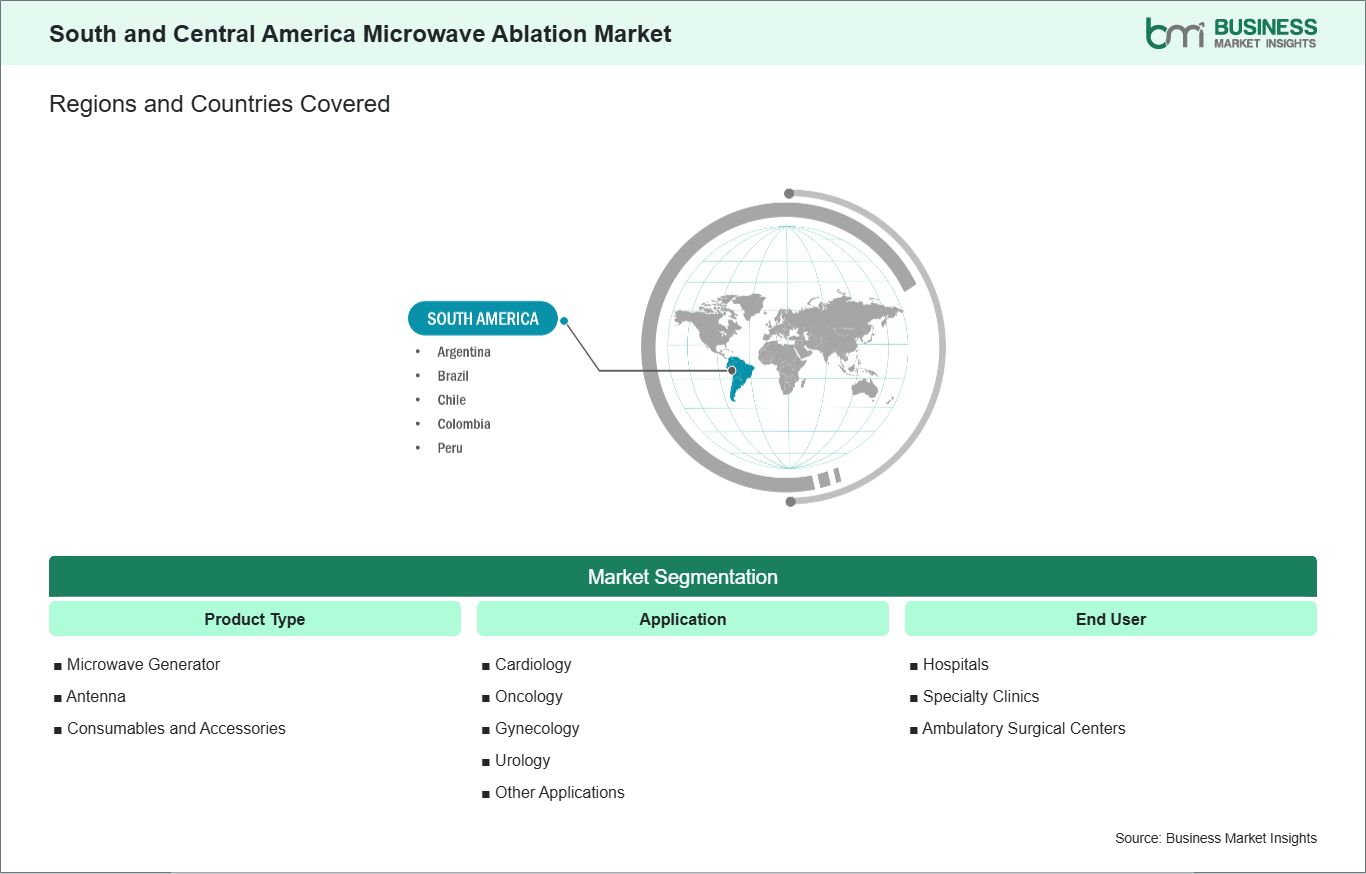
Key segments that contributed to the derivation of the South and Central America microwave ablation market analysis are product type, application, and end user.
- By product type, the microwave ablation market is segmented into microwave generator, antenna, and consumables & accessories. The antenna segment dominated the market in 2025.
- Based on application, the microwave ablation market is classified into cardiology, oncology, gynecology, urology, and others. The oncology segment dominated the market in 2025.
- In terms of end user, the microwave ablation market is categorized into hospitals, specialty clinics, and ambulatory surgical centers. The hospitals segment dominated the market in 2025.
Market Forces
South and Central America Microwave Ablation Market Drivers and Opportunities
Increased prevalence of cancer
The South and Central America microwave ablation market is being shaped by a noticeable rise in cancer prevalence throughout the region. With demographic transitions, urban lifestyle changes, and improvements in diagnostic screening, healthcare systems are identifying increased cases of solid tumors such as liver, lung, and breast cancers. This growing disease burden has increased pressure on oncology services to offer a wider spectrum of effective treatment options beyond traditional surgical and systemic therapies.
Healthcare providers in the region are responding to this trend by broadening access to interventional oncology procedures as part of comprehensive cancer care. Hospitals and specialty clinics are investing in image‑guided treatment technologies that can manage localized tumors with less invasive approaches. Microwave ablation, in particular, is gaining recognition due to its ability to deliver targeted thermal therapy with shorter procedural times and reduced inpatient recovery compared with conventional surgery.
At the same time, regional efforts to strengthen cancer infrastructure and enhance clinical training are supporting broader adoption of advanced treatment modalities. As oncology departments expand capacity to address rising patient volumes, technologies that improve procedural efficiency and clinical outcomes are being prioritized. Against the backdrop of increasing cancer prevalence, the microwave ablation market in South and Central America is positioned for steady growth.
Shift Toward Personalized Cancer Treatment Options
There is a marked shift in South and Central America toward personalized cancer treatment options as clinicians emphasize tailoring therapies to individual patient and tumor characteristics. Oncologists and interdisciplinary care teams are increasingly collaborating to design treatment plans that balance therapeutic efficacy with patient‑specific considerations such as tumor size, location, and overall health status. This shift has fueled interest in technologies that can be adapted to distinct clinical needs, with microwave ablation emerging as a valuable component of personalized care strategies.
Advanced imaging and diagnostic tools are being leveraged more frequently to support tailored interventions that align with individualized treatment goals. Microwave ablation's compatibility with real‑time image guidance and adjustable energy delivery makes it suitable for situations where surgical intervention may not be ideal or when organ preservation is a priority. As multidisciplinary planning becomes more commonplace, clinicians in the region are increasingly incorporating ablation techniques into nuanced patient‑centric care pathways.
Patient expectations are also contributing to the demand for personalized cancer therapies in South and Central America. Individuals and referring physicians are showing greater interest in minimally invasive procedures that offer effective tumor control while minimizing recovery time and procedural impact. Microwave ablation's profile as a targeted, adaptable treatment resonates with these preferences, reinforcing its appeal within evolving oncology care paradigms. As personalized cancer treatment options continue to gain traction, the market for microwave ablation systems and procedures in South and Central America is expected to expand in tandem with clinical adoption and patient demand.
Size and Share Analysis
South and Central America Microwave Ablation Market Size and Share Analysis
The South and Central America microwave ablation market demonstrates steady growth, with size and share analysis highlighting evolving trends and competitive dynamics among key players. The report evaluates important subsegments categorized within product type, application, and end user, highlighting their respective contributions to overall market performance.
By product type, the antenna subsegment dominated the market in 2025. There is a recurring need for high-performance, precise antennas during MWA procedures, which are essential for effective thermal ablation of tumors, making them a key revenue driver for manufacturers.
In terms of application, the oncology subsegment dominated the market in 2025. Oncology applications lead because of a rising prevalence of cancer cases, increasing preference for minimally invasive tumor ablation techniques, and growing awareness among healthcare providers about the effectiveness of MWA in treating liver, lung, and other solid tumors.
Based on end user, the hospitals subsegment dominated the market in 2025. Hospitals maintain a stronghold due to their well-established oncology and surgical departments, access to advanced MWA equipment, trained interventional radiologists and staff, and the capability to manage complex ablation procedures with comprehensive patient care.
Report Coverage
South and Central America Microwave Ablation Market Report Coverage and Deliverables
The "South and Central America Microwave Ablation Market Size and Forecast (2022-2033)" report provides a detailed analysis of the market covering below areas:
- South and Central America Microwave Ablation market size and forecast at regional and country levels for all market segments covered under the scope
- South and Central America Microwave Ablation market trends, as well as drivers, restraints, and opportunities
- South and Central America Microwave Ablation market analysis covering key trends, regional framework, major players, regulations, and recent developments
- Industry landscape and competition analysis covering market concentration, heat map analysis, prominent players, and recent developments for the South and Central America Microwave Ablation market
- Detailed company profiles, including SWOT analysis
Geographic Insights
South and Central America Microwave Ablation Market Geographic Insights
The geographical scope of the South and Central America microwave ablation market report is divided into Brazil, Argentina, Chile, Colombia, Peru, and the Rest of South and Central America. Brazil held the largest share in 2025.
Brazil leads the microwave ablation market in South and Central America. Major urban hospitals and specialty cancer centers in cities such as São Paulo, Rio de Janeiro, and Brasília are early adopters of microwave ablation, driven by the demand for minimally invasive procedures and improved patient outcomes. The country's healthcare infrastructure, both public and private, supports the integration of advanced technologies, allowing hospitals to offer microwave ablation alongside traditional surgical and other thermal ablation treatments. Within Brazil, metropolitan hospitals typically lead adoption due to better access to high-end imaging systems, trained specialists, and procedural expertise. Smaller hospitals in less populated regions are gradually incorporating these technologies as awareness grows and clinician training expands. Physician education programs and partnerships with international device providers help bridge the knowledge gap, ensuring safe and effective use of microwave ablation. Patients' preference for shorter recovery times and less invasive treatments, coupled with urban hospitals' capacity to implement new technologies, contributes to market growth in Brazil.
Industry Activity
Recent Developments
The South and Central America Microwave Ablation market is evaluated by gathering qualitative and quantitative data post primary and secondary research, which includes important corporate publications, association data, and databases. A few of the key developments in the South and Central America Microwave Ablation market are:
- In July 2025, ECO Medical Technology announced a microwave ablation workshop in Argentina (in Córdoba), bringing together specialists to further training efforts in thyroid microwave ablation, reflecting growing clinical engagement and regional activity around microwave ablation procedures in South America.
- In April 2024, ECO Medical Technology completed a thyroid microwave ablation workshop in Mexico, where local interventional radiologists participated in hands‑on sessions to learn and adopt microwave ablation techniques, demonstrating increased educational outreach and clinical interest in MWA technology in the region.
Trust & Transparency
Research Methodology
The market analysis combines proprietary research with secondary data from government agencies, company disclosures, regulatory filings, industry databases and expert interviews. Market estimates are validated through data triangulation, cross-market benchmarking and analyst
review.
View Full Research Methodology
Key Sources Referred:
The World BankWorld Health Organization (WHO)Center for Disease Control and Prevention (CDC)Food and Drug Administration (FDA)European Database on Medical Devices (EUDAMED)European Society of Cardiology (ESC)American College of Cardiology (ACC)American Heart Association (AHA)Company WebsitesCompany Annual ReportsCompany Investor Presentations