Market Summary
Executive Summary and Market Analysis
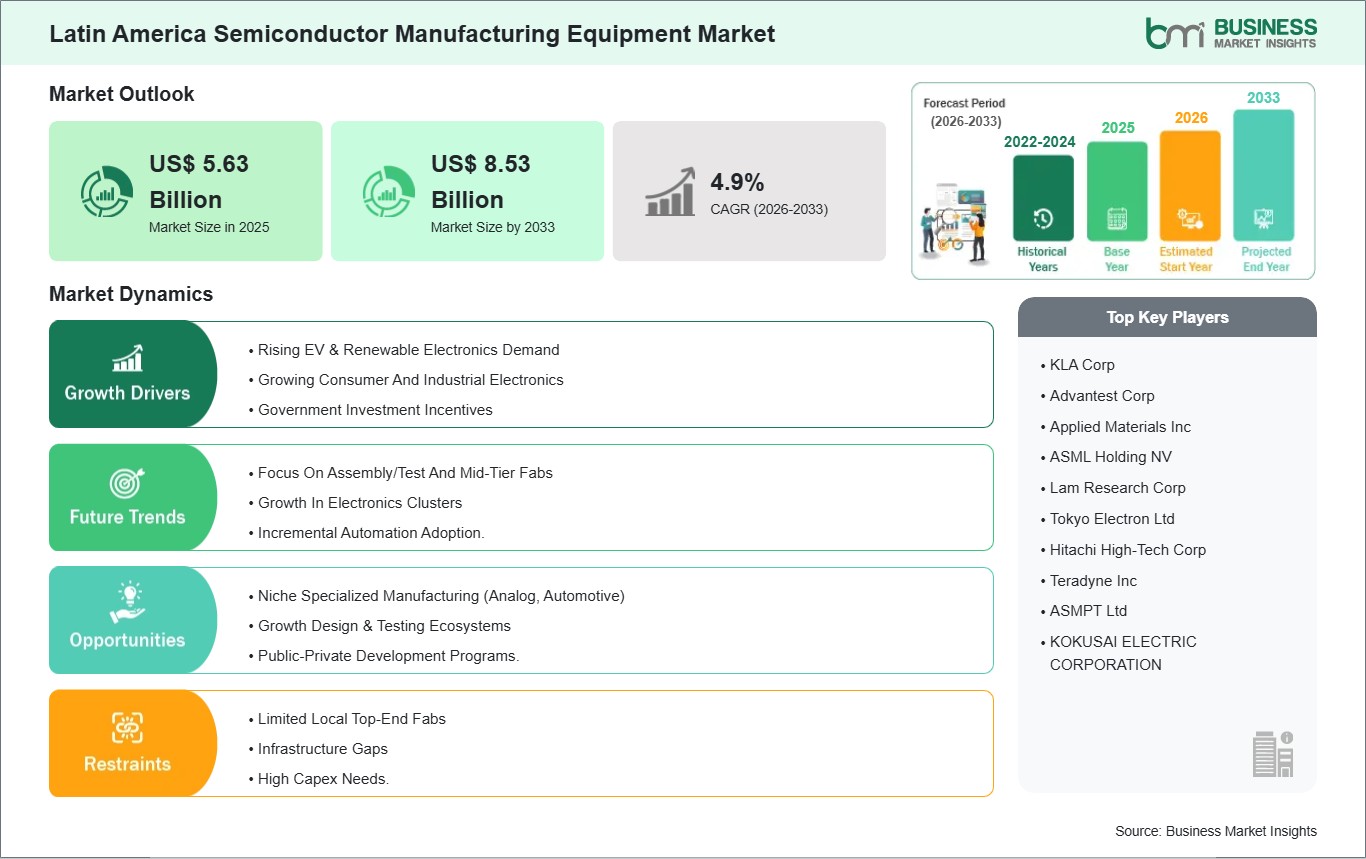
The Latin America semiconductor manufacturing equipment market is experiencing cautious yet promising growth, driven by increased regional investments in semiconductor fabrication capabilities and supportive government initiatives aimed at reducing dependency on imports. Rising demand for consumer electronics, automotive applications, and industrial automation is encouraging local OEMs and global equipment suppliers to expand operations and partnerships across key markets such as Brazil and Mexico. However, the region still faces significant challenges, including limited local infrastructure, scarce talent skilled in advanced semiconductor technologies, and competition from established Asian and North American supply chains. Despite these obstacles, government incentives and trade collaborations are gradually enhancing the ecosystem, enabling incremental adoption of advanced manufacturing tools. As a result, major global equipment vendors are exploring tailored solutions to meet regional cost sensitivities and technological requirements. Overall, the market is poised for steady expansion, supported by long‑term strategic investments and gradual enhancement of local production capabilities.
Segment Analysis
Latin America Semiconductor Manufacturing Equipment Market Segmentation
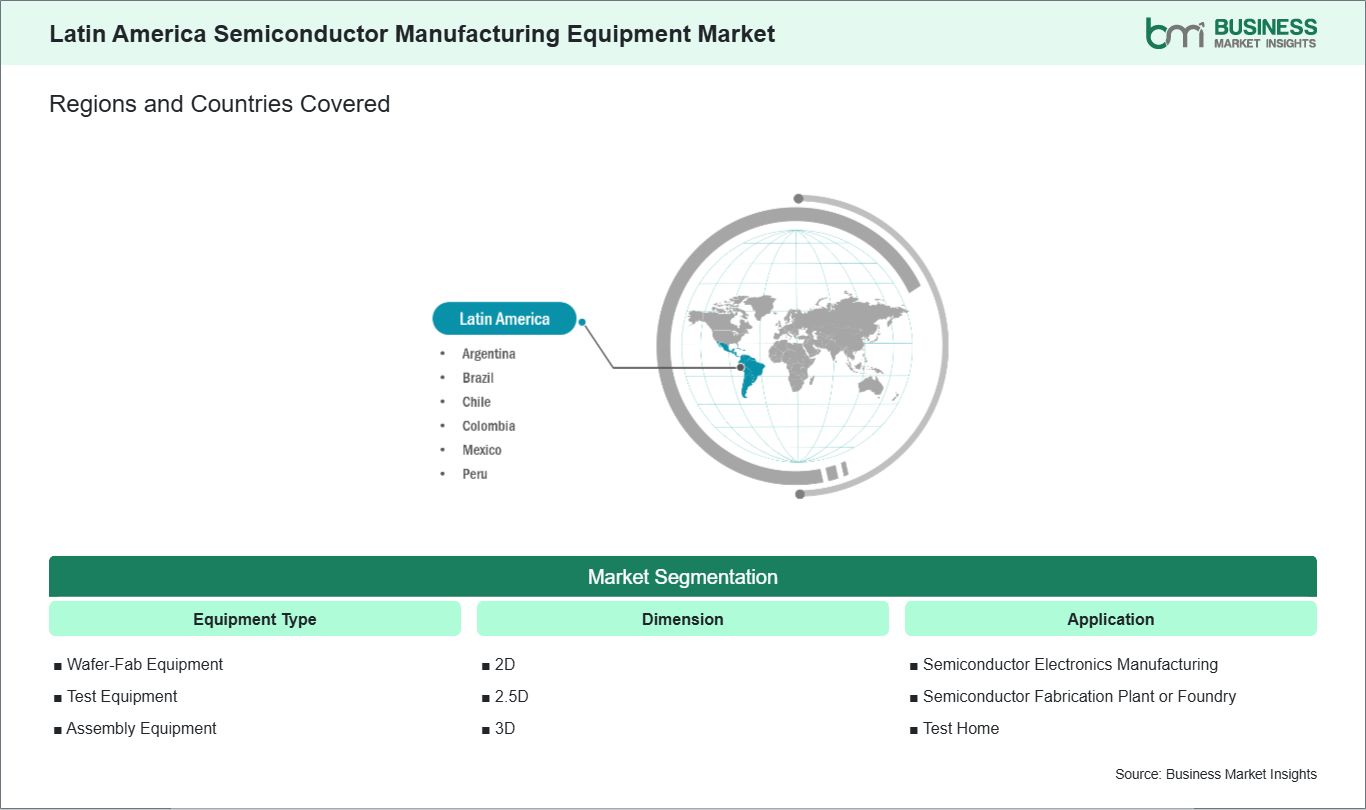
Key segments that contributed to the derivation of the Latin America semiconductor manufacturing equipment market analysis are equipment type, dimension, and application.
- By equipment type, the Latin America semiconductor manufacturing equipment market is bifurcated into wafer-fab equipment, test equipment, and assembly equipment. The wafer-fab equipment segment dominated the market in 2025.
- By dimension, the market is segmented into 2D, 2.5D, and 3D. The 2D segment held the largest share of the market in 2025.
- By application, the market is segmented into semiconductor electronics manufacturing, semiconductor fabrication plant/foundry, and test home. The semiconductor electronics manufacturing segment held the largest share of the market in 2025.
Market Forces
Latin America Semiconductor Manufacturing Equipment Market Drivers and Opportunities
Rising EV & Renewable Electronics Demand
The accelerating adoption of electric vehicles (EVs) and renewable energy technologies across Latin America is a major driver of demand for semiconductor manufacturing equipment. As countries like Brazil, Chile, and Mexico pursue cleaner energy goals and expand EV infrastructure, the need for advanced power electronics, battery management systems, inverters, and sensors has surged. These components rely on sophisticated semiconductor devices such as wide‑bandgap (SiC/GaN) power semiconductors, microcontrollers, and analog ICs, prompting regional manufacturers to upgrade or expand production facilities. Moreover, renewable energy systems—solar inverters, wind turbine controls, and energy storage—require highly reliable, efficient semiconductors tailored for harsh environments. This shift creates a sustained pull for state‑of‑the‑art lithography, etching, deposition, and testing equipment, as local and multinational fabs invest to meet rising volume and quality requirements. Consequently, the confluence of EV and renewable electronics demand is structurally reshaping Latin America’s semiconductor equipment landscape.
Niche Specialized Manufacturing (Analog, Automotive)
Niche specialized manufacturing in analog and automotive semiconductor segments presents a compelling opportunity for the semiconductor manufacturing equipment market in Latin America. Unlike digital logic chips, analog and automotive semiconductors require unique fabrication processes and high‑precision equipment to meet stringent performance and reliability standards. The automotive sector—increasingly electrified and software‑defined—is driving demand for specialized ICs such as power management, sensors, and automotive‑grade microcontrollers. Latin American fabs can capitalize on this trend by focusing investments on equipment tailored for analog and automotive chip production rather than competing head‑on with large‑scale digital logic manufacturers. Such specialization enables regional players to build expertise, attract targeted capital, and form partnerships with global auto OEMs and Tier‑1 suppliers. Additionally, niche manufacturing provides resilience against broader market cyclicality, as specialized products often have longer development cycles and stickier customer relationships. By aligning with verticals that value customization and performance, Latin America can elevate its semiconductor ecosystem and justify advanced equipment procurement.
Size and Share Analysis
Latin America Semiconductor Manufacturing Equipment Market Size and Share Analysis
By equipment type, the Latin America semiconductor manufacturing equipment market is divided into wafer-fab equipment, assembly equipment, and test equipment. The wafer-fab equipment segment dominated the market in 2025. Latin American adoption of wafer-fab equipment remains nascent but growing, driven by tech startups, automotive electronics, and government incentives. Brazil and Mexico are leading, investing in localized production facilities, while supply chain partnerships and international collaborations aim to enhance domestic semiconductor capabilities.
By dimension, the market is segmented into 2D, 2.5D, and 3D. The 2D segment held the largest share of the market in 2025. Latin America’s 2D adoption is fueled by digital commerce, mobile payments, and logistics modernization. Businesses leverage 2D technologies for supply chain visibility, healthcare access, and retail efficiency, supported by growing smartphone penetration and regional digital inclusion initiatives.
By application, the market is segmented semiconductor electronics manufacturing, semiconductor fabrication plant/foundry, and test home. The semiconductor electronics manufacturing segment held the largest share of the market in 2025. Latin America is adopting semiconductor electronics manufacturing through nearshoring, assembly, and testing operations. Competitive labor costs, expanding consumer electronics markets, and proximity to North America drive regional growth, especially in automotive electronics and industrial applications.
Report Coverage
Latin America Semiconductor Manufacturing Equipment Market Report Coverage and Deliverables
The "Latin America Semiconductor Manufacturing Equipment Market Size and Forecast (2022-2033)" report provides a detailed analysis of the market covering below areas:
- Latin America semiconductor manufacturing equipment market size and forecast at regional, and country levels for all the key market segments covered under the scope
- Latin America semiconductor manufacturing equipment market trends, as well as market dynamics such as drivers, restraints, and key opportunities
- Latin America semiconductor manufacturing equipment market analysis covering key market trends, global and regional framework, major players, regulations, and recent market developments
- Industry landscape and competition analysis covering market concentration, heat map analysis, prominent players, and recent developments for the air circuit breaker market
- Detailed company profiles, including SWOT analysis
Geographic Insights
Latin America Semiconductor Manufacturing Equipment Market Geographic Insights
The geographical scope of the Latin America semiconductor manufacturing equipment market report is expected to grow significantly during the forecast period.
The demand for semiconductor manufacturing equipment in Latin America has been steadily increasing due to several key factors. First, the rapid growth of the electronics and automotive sectors in countries like Brazil and Mexico is driving higher semiconductor consumption, necessitating advanced manufacturing capabilities. Second, the global semiconductor shortage has highlighted the need for regional production, prompting Latin American governments and private companies to invest in local fabrication facilities to reduce dependency on imports. Third, technological advancements such as 5G, artificial intelligence, and the Internet of Things (IoT) are fueling demand for more sophisticated chips, which in turn requires state-of-the-art manufacturing equipment. Additionally, supportive government initiatives, incentives, and partnerships with international semiconductor firms are encouraging investment in production infrastructure. Finally, increasing digitalization, rising consumer electronics adoption, and industrial automation trends further contribute to the growing need for efficient and high-quality semiconductor manufacturing machinery in the region.
Industry Activity
Recent Developments
The Latin America semiconductor manufacturing equipment market is evaluated by gathering qualitative and quantitative data post primary and secondary research, which includes important corporate publications, association data, and databases. A few of the key developments in the Latin America semiconductor manufacturing equipment market are:
- For instance, on October, 2025, Applied Materials, Inc. introduced new semiconductor manufacturing systems that enhance the performance of advanced logic and memory chips, which are foundational to AI computing. The new products target three critical areas in the race to deliver ever more powerful AI chips: leading-edge logic including Gate-All-Around (GAA) transistors, high-performance DRAM including high-bandwidth memory (HBM), and advanced packaging to create highly integrated systems-in-a-package that optimize chip performance, power consumption and cost.
- For instance, in February 2025, Advantest Corporation announced that it had entered into a partnership agreement with Micronics Japan Co., Ltd. (“MJC”). As semiconductors are expected to become increasingly advanced and complex, close collaboration within the semiconductor supply chain is essential to meet future market demands. Under this agreement, MJC and Advantest will leverage their respective expertise to provide innovative semiconductor test solutions, contributing to the optimization of customers' test processes and test costs. Additionally, Advantest plans to acquire a minority stake in MJC as part of this agreement.
Trust & Transparency
Research Methodology
The market analysis combines proprietary research with secondary data from government agencies, company disclosures, regulatory filings, industry databases and expert interviews. Market estimates are validated through data triangulation, cross-market benchmarking and analyst
review.
View Full Research Methodology
Key Sources Referred:
World Bank - Global Trade Indicators World Trade Organization (WTO) International Monetary Fund (IMF) International Trade Administration (ITA) Company website Company annual reports Company investor presentations