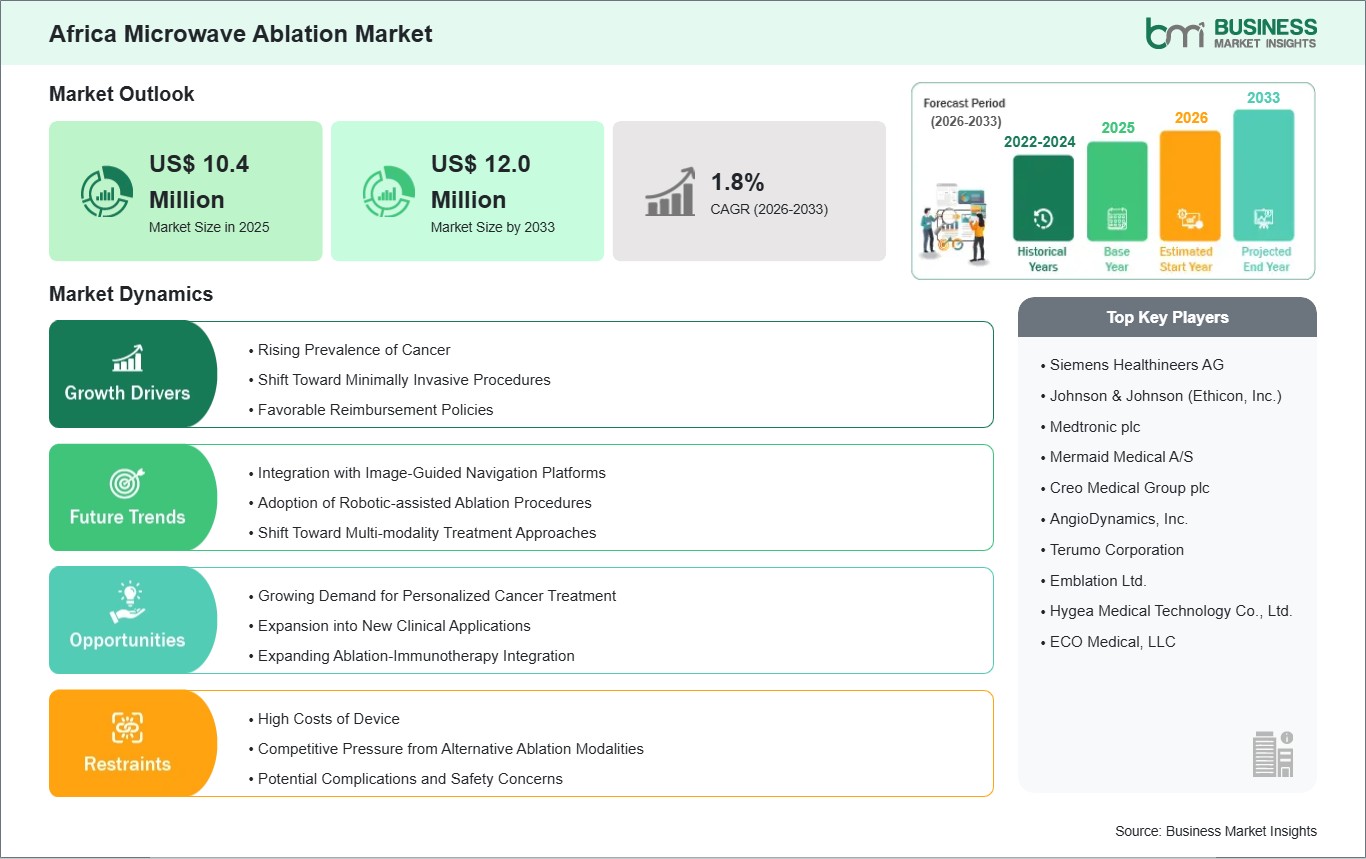
The Africa microwave ablation market size is expected to reach US$ 12.0 million by 2033 from US$ 10.4 million in 2025. The market is estimated to record a CAGR of 1.8% from 2026 to 2033.
The Africa microwave ablation market is driven by an increasing need for minimally invasive treatment options across key disease areas. In recent years, healthcare systems throughout the continent have been progressively shifting toward advanced therapeutic procedures that reduce hospital stays, lower procedural risk, and improve patient comfort. Microwave ablation offers precise thermal destruction of tumors with shorter recovery timelines compared to traditional surgery. Market growth is supported by an expanding base of trained interventional radiologists and oncologists who are gaining familiarity with ablation modalities, coupled with rising awareness among patients seeking alternatives to open surgery.
Despite a positive trajectory, the market faces notable challenges. Infrastructure limitations and uneven distribution of medical technology across countries restrict adoption in rural and underfunded regions. Reimbursement frameworks in many African healthcare systems are still developing, which can slow acquisition decisions by public hospitals and private clinics. High upfront costs of microwave ablation units, relative to budget constraints in several health facilities, also temper rapid expansion. Overall, the market presents a blend of opportunities and constraints progressive clinical adoption in urban centers is counterbalanced by systemic barriers that require strategic engagement from manufacturers and healthcare providers alike.

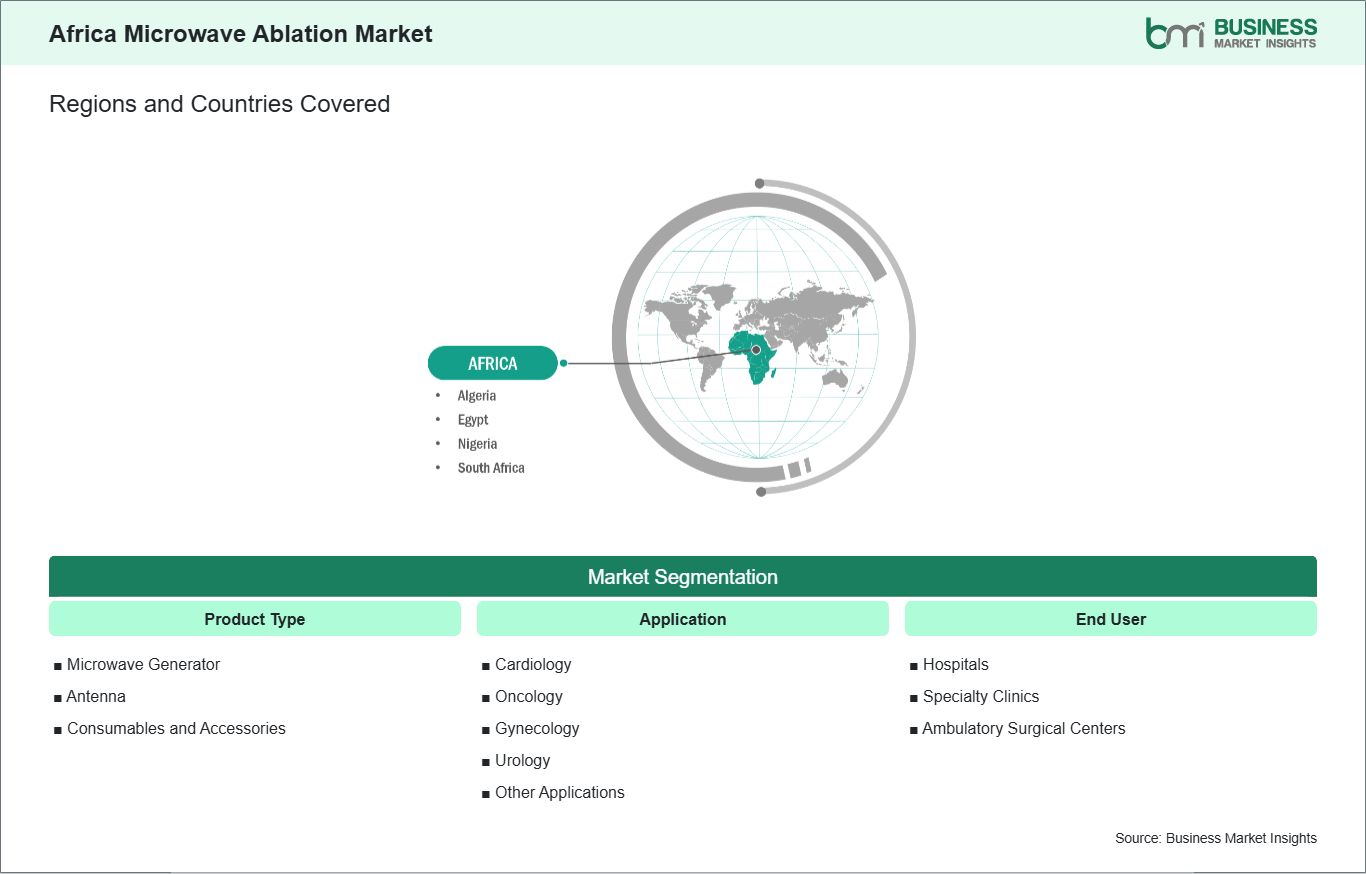
Key segments that contributed to the derivation of the Africa microwave ablation market analysis are product type, application, and end user.
The Africa microwave ablation market is strongly influenced by the steady rise in cancer cases across the continent. Rapid population growth, increasing life expectancy, and urban lifestyle transitions have contributed to a higher incidence of non-communicable diseases, including liver, breast, colorectal, and prostate cancers. In many African countries, late-stage diagnosis remains common, creating a pressing need for treatment options that can manage advanced or inoperable tumors. Microwave ablation is gaining recognition as a minimally invasive alternative for patients who may not be ideal candidates for conventional surgery.
Urban centers such as Johannesburg, Cairo, Lagos, and Nairobi are witnessing growing patient volumes in oncology departments, placing pressure on existing surgical infrastructure. As a result, hospitals and specialty clinics are exploring technologies that reduce hospital stays and procedural complexity. Microwave ablation systems which can be used in image-guided interventional oncology suites offer an efficient solution for treating solid tumors with reduced recovery times. This efficiency aligns well with healthcare systems that are working to optimize limited surgical resources while improving patient throughput.
Additionally, government health reforms and expanding private healthcare networks are increasing awareness and availability of modern cancer therapies. South Africa, Egypt, and Kenya are investing in oncology centers and upgrading diagnostic capabilities, indirectly supporting demand for advanced therapeutic tools. As cancer care becomes a higher public health priority across Africa, the adoption of minimally invasive ablation technologies is expected to expand, particularly in tertiary hospitals and private specialty facilities.
There is a gradual shift toward individualized cancer management approaches. Oncologists are increasingly emphasizing treatment strategies tailored to tumor type, stage, and patient condition rather than relying solely on standardized protocols. Microwave ablation supports this trend by enabling precise, localized treatment of tumors while preserving surrounding healthy tissue. This precision is particularly valuable in complex cases where surgical resection may pose significant risks.
Leading healthcare institutions in countries such as South Africa and Egypt are incorporating multidisciplinary tumor boards and advanced imaging techniques into treatment planning. These developments allow clinicians to better identify patients who may benefit from targeted interventions like microwave ablation. The ability to customize probe placement, energy delivery, and treatment cycles makes the technology adaptable to individual patient anatomy and tumor characteristics, reinforcing its role in personalized oncology care.
Patient preferences are also shaping the demand for tailored and less invasive treatments. Many individuals seek options that minimize disruption to daily life, reduce complications, and shorten recovery periods. Microwave ablation aligns with these expectations, offering outpatient or short-stay procedures in select cases. As awareness of personalized cancer therapies grows across Africa's urban healthcare markets, it is positioned to benefit from this evolving, patient-centric treatment landscape.

The African microwave ablation market is experiencing steady growth, with market size and share analysis reflecting evolving treatment preferences and competitive dynamics among key players. The report evaluates important subsegments categorized within product type, application, and end user, highlighting their respective contributions to overall market performance.
By product type, the antenna subsegment dominated the market in 2025. There is a recurring need for high-performance, precise antennas in MWA procedures, which are essential for effective thermal ablation of tumors, making them a key revenue driver for manufacturers.
In terms of application, the oncology subsegment dominated the market in 2025. Oncology applications lead because of a rising prevalence of cancer cases, increasing preference for minimally invasive tumor ablation techniques, and growing awareness among healthcare providers about the effectiveness of MWA in treating liver, lung, and other solid tumors.
Based on end user, the hospitals subsegment dominated the market in 2025. Hospitals maintain a stronghold due to their well-established oncology and surgical departments, access to advanced MWA equipment, trained interventional radiologists and staff, and the capability to manage complex ablation procedures with comprehensive patient care.
| Report Attribute | Details |
|---|---|
| Market size in 2025 | US$ 10.4 Million |
| Market Size by 2033 | US$ 12.0 Million |
| CAGR (2026 - 2033) | 1.8% |
| Historical Data | 2022-2024 |
| Forecast period | 2026-2033 |
| Segments Covered | By Product Type
|
|
Regions and Countries Covered
| |
| Africa | Egypt, South Africa, Nigeria, Algeria |
| Market leaders and key company profiles |
|
The "Africa Microwave Ablation Market Size and Forecast (2022-2033)" report provides a detailed analysis of the market covering below areas:
The geographical scope of the Africa microwave ablation market report is divided into Nigeria, Egypt, South Africa, and Algeria. South Africa held the largest share in 2025.
South Africa stands out as the dominant market for microwave ablation across the African continent, largely due to its relatively advanced healthcare infrastructure and well-established private hospital networks. The country's medical community has increasingly embraced image-guided therapies for oncology and liver disease management, positioning microwave ablation alongside other minimally invasive interventions. Leading tertiary care centers in metropolitan areas serve as onboarding hubs for new technologies, supported by specialists who collaborate with international peers to refine clinical protocols. This professional expertise has helped create a favorable environment for adoption, with clinicians recognizing the clinical benefits of microwave ablation in terms of precision and reduced trauma when treating early-stage tumors.
Market progression in South Africa is further reinforced by robust medical education frameworks and active participation in regional conferences and training workshops. These factors enhance clinician confidence and patient referrals for ablation techniques. While urban centers show strong clinical uptake, smaller provincial hospitals often lag due to budgetary and staffing limitations. Additionally, public sector procurement cycles can be lengthy, influencing how quickly new ablation systems enter broader circulation. Collaboration between device manufacturers and key opinion leaders continues to be instrumental in driving awareness and expanding utilization. Thus, South Africa remains a critical anchor for microwave ablation technology within Africa, shaping best practices and serving as a reference point for neighboring markets exploring similar interventions.

The Africa microwave ablation market is evaluated by gathering qualitative and quantitative data post primary and secondary research, which includes important corporate publications, association data, and databases. A few of the key developments in the Africa Microwave Ablation market are:
The Africa Microwave Ablation Market is valued at US$ 10.4 Million in 2025, it is projected to reach US$ 12.0 Million by 2033.
As per our report Africa Microwave Ablation Market, the market size is valued at US$ 10.4 Million in 2025, projecting it to reach US$ 12.0 Million by 2033. This translates to a CAGR of approximately 1.8% during the forecast period.
The Africa Microwave Ablation Market report typically cover these key segments-
The historic period, base year, and forecast period can vary slightly depending on the specific market research report. However, for the Africa Microwave Ablation Market report:
The Africa Microwave Ablation Market is populated by several key players, each contributing to its growth and innovation. Some of the major players include:
The Africa Microwave Ablation Market report is valuable for diverse stakeholders, including:
Essentially, anyone involved in or considering involvement in the Africa Microwave Ablation Market value chain can benefit from the information contained in a comprehensive market report.
Please tell us your area of interest
(Market Segments/ Regions and Countries/ Companies)