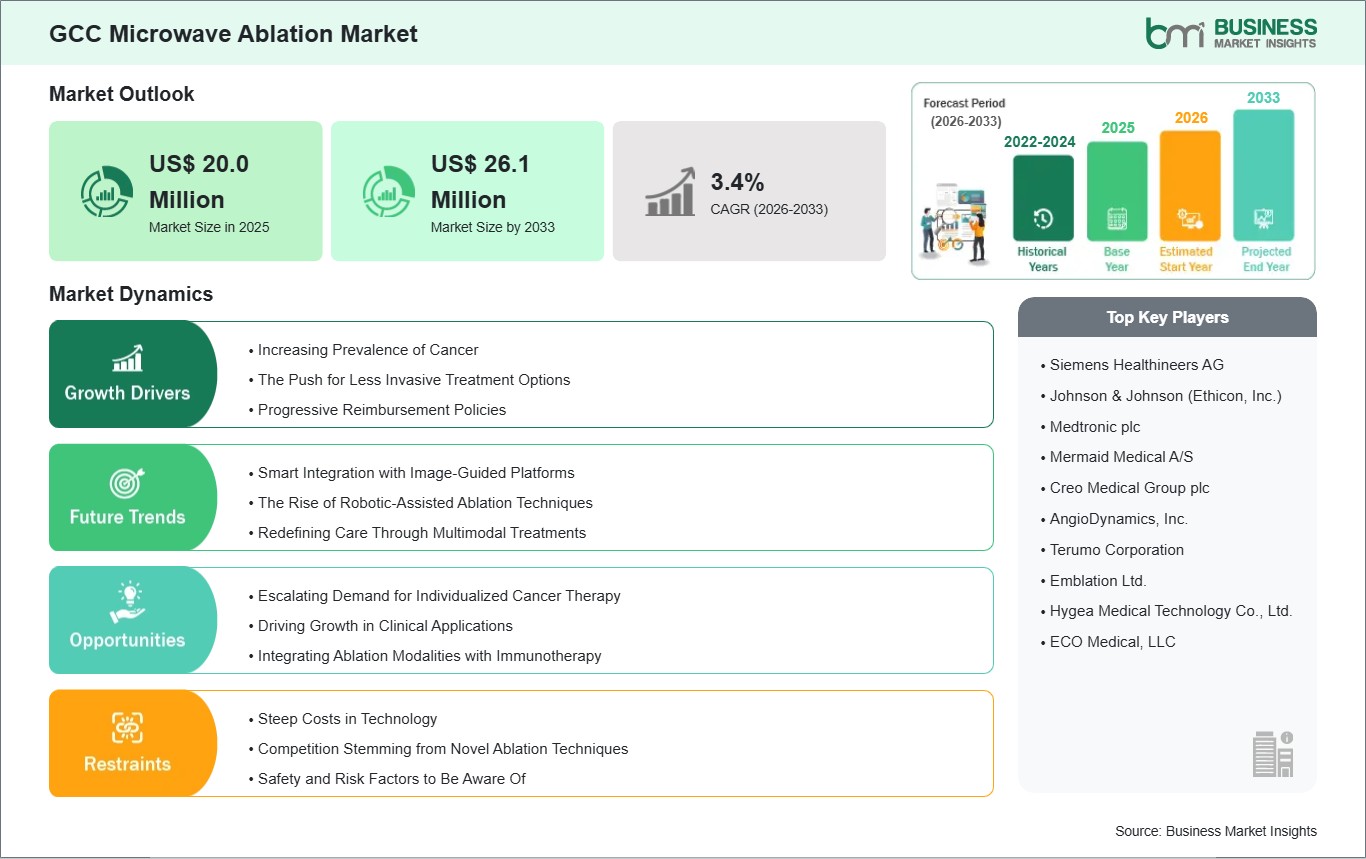
The GCC microwave ablation market size is expected to reach US$ 26.1 million by 2033 from US$ 20.0 million in 2025. The market is estimated to record a CAGR of 3.4% from 2026 to 2033.
The GCC microwave ablation market is witnessing notable momentum as healthcare systems in the region shift toward advanced, minimally invasive treatment modalities for oncology and soft tissue disorders. Growing investment in state‑of‑the‑art medical infrastructure, combined with increasing patient preference for procedures that reduce hospital stays and promote quicker recovery, has elevated the appeal of microwave ablation across the Gulf region. Governments in the GCC are prioritizing healthcare modernization under national development agendas, prompting both public and private hospitals to adopt sophisticated energy‑based therapeutic solutions. A key market driver is the rising incidence of liver and renal tumors, alongside expanding awareness among clinicians regarding the clinical benefits of microwave ablation compared with conventional surgical methods.
Despite this robust interest, the market encounters challenges related to workforce capacity and clinical training. While technology acquisition is progressing, a limited pool of specialists trained in advanced interventional oncology techniques constrains utilization in some facilities. Additionally, cost considerations surrounding the procurement and integration of ablation platforms remain a barrier for smaller hospitals within the region. Variations in reimbursement policies across the GCC also influence the pace of adoption, with more progressive models emerging in wealthier member states. Nonetheless, strategic partnerships between healthcare providers and device manufacturers, along with growing local expertise, are strengthening the ecosystem for microwave ablation in the Gulf.

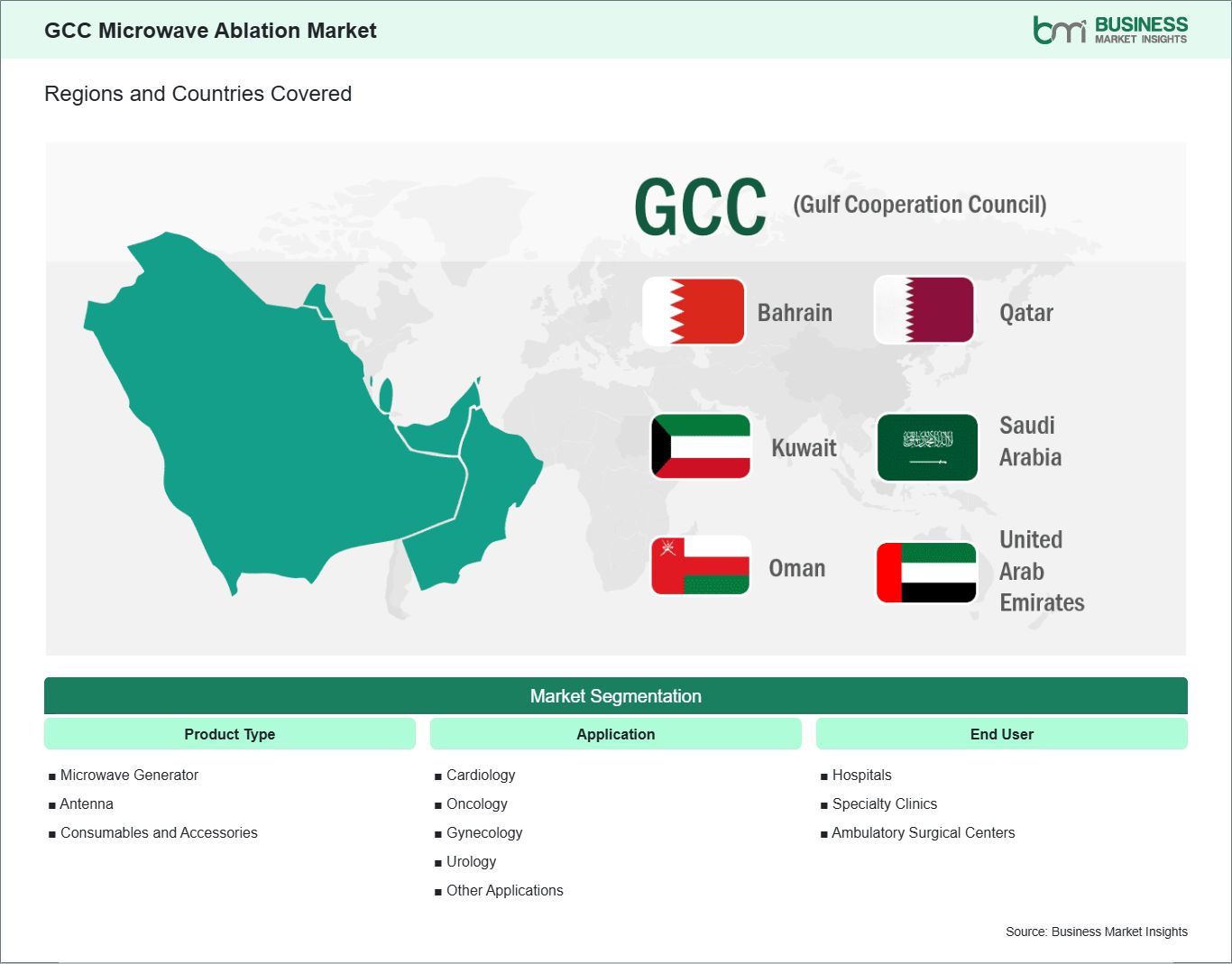
Key segments that contributed to the derivation of the GCC microwave Ablation market analysis are product type, application, and end user.
The GCC microwave ablation market is being influenced by steadily rising cancer prevalence across the region. Rapid urbanization, lifestyle shifts, and demographic changes have contributed to increases in solid tumor diagnoses, particularly in organs such as the liver, lungs, and breast. Healthcare providers are observing larger volumes of oncology cases in both public and private settings, which is driving interest in a broader range of treatment modalities that can complement existing surgical and systemic therapy options.
Healthcare systems in the GCC have placed strong emphasis on strengthening cancer care infrastructure, with new oncology centers and diagnostic facilities emerging to meet growing demand. Within these expanding services, interventional oncology techniques like image‑guided ablation are gaining recognition for their ability to treat localized tumors with reduced procedural impact. Microwave ablation in particular is being evaluated as an effective option for patients who may benefit from minimally invasive intervention, especially where conventional surgical resources are constrained by caseload or patient risk profiles.
Additionally, regional health authorities and hospital networks are prioritizing strategic investments in technologies that can improve operational efficiency while maintaining therapeutic quality. As clinicians seek scalable and less invasive treatment approaches, microwave ablation systems are becoming part of oncology service portfolios across the GCC. The confluence of increasing cancer burden and enhanced clinical capability is supporting a positive market outlook for microwave ablation devices and procedural uptake.
There is growing demand across the GCC for personalized cancer therapy, as clinicians emphasize treatment strategies tailored to individual patient characteristics and tumor biology. Precision oncology is taking on greater importance in treatment planning, with multidisciplinary teams collaborating to select therapies that optimize efficacy and preserve quality of life. In this context, technologies that support adaptable interventions are gaining traction, and microwave ablation is emerging as an attractive option within personalized care pathways.
Oncology specialists are increasingly employing advanced imaging and diagnostic tools to map tumor location and characteristics with greater accuracy, enabling more precise application of thermal ablation techniques. This trend has encouraged the adoption of technologies that allow clinicians to tailor energy delivery and procedural parameters to the specifics of each case. Microwave ablation's flexibility in application makes it well-suited for customized treatment strategies that can be adjusted based on tumor size, location, and patient health status.
Patient awareness and expectations are also shaping the demand for individualized therapy. Many patients are seeking alternatives to extensive surgery and are interested in treatment options that offer reduced recovery times and fewer side effects. The minimally invasive nature of microwave ablation aligns with these preferences, supporting its consideration alongside other individualized cancer therapies. As personalized oncology continues to gain prominence in clinical practice throughout the GCC, the market for microwave ablation solutions is expected to grow in tandem with evolving treatment paradigms.

The GCC microwave ablation market demonstrates steady growth, with size and share analysis highlighting evolving trends and competitive dynamics among key players. The report evaluates important subsegments categorized within product type, application, and end user, highlighting their respective contributions to overall market performance.
By product type, the antenna subsegment dominated the market in 2025. There is a recurring need for high-performance, precise antennas during MWA procedures, which are essential for effective thermal ablation of tumors, making them a key revenue driver for manufacturers.
In terms of application, the oncology subsegment dominated the market in 2025. Oncology applications lead because of a rising prevalence of cancer cases, increasing preference for minimally invasive tumor ablation techniques, and growing awareness among healthcare providers about the effectiveness of MWA in treating liver, lung, and other solid tumors.
Based on end user, the hospitals subsegment dominated the market in 2025. Hospitals maintain a stronghold due to their well-established oncology and surgical departments, access to advanced MWA equipment, trained interventional radiologists and staff, and the capability to manage complex ablation procedures with comprehensive patient care.
| Report Attribute | Details |
|---|---|
| Market size in 2025 | US$ 20.0 Million |
| Market Size by 2033 | US$ 26.1 Million |
| CAGR (2026 - 2033) | 3.4% |
| Historical Data | 2022-2024 |
| Forecast period | 2026-2033 |
| Segments Covered | By Product Type
|
|
Regions and Countries Covered
| |
| GCC | UAE, Bahrain, Saudi Arabia, Oman, Qatar, Kuwait |
| Market leaders and key company profiles |
|
The "GCC Microwave Ablation Market Size and Forecast (2022-2033)" report provides a detailed analysis of the market covering below areas:
The geographical scope of the GCC microwave ablation market report is divided into Saudi Arabia, the United Arab Emirates (UAE), Qatar, Kuwait, Bahrain, and Oman. Saudi Arabia held the largest share in 2025.
Saudi Arabia stands out as the dominant market for microwave ablation within the GCC, driven by substantial investments in healthcare capacity and ambitious initiatives to enhance clinical capabilities nationwide. The country's vision‑aligned focus on expanding specialized care centers and reducing reliance on treatment abroad has led to accelerated adoption of minimally invasive oncology therapies, with microwave ablation emerging as a preferred option in tertiary care settings. Leading medical institutions in Saudi Arabia have been early adopters of ablation technologies, leveraging their benefits for managing complex tumors with improved precision and patient comfort.
The availability of multidisciplinary teams and structured training programs has enabled Saudi clinicians to build proficiency in image‑guided ablation procedures, further reinforcing the country's leadership role in the region. Additionally, supportive health policy frameworks and improved reimbursement pathways for advanced procedures have encouraged public and private providers to integrate microwave ablation into treatment protocols. Collaborations with international clinical centers have also facilitated knowledge transfer and procedural standardization. While competitive alternatives such as radiofrequency ablation continue to be prevalent, Saudi Arabia's strategic emphasis on innovation and quality of care positions microwave ablation as a key therapeutic growth area in its evolving oncology landscape.

The GCC Microwave Ablation market is evaluated by gathering qualitative and quantitative data post primary and secondary research, which includes important corporate publications, association data, and databases. A few of the key developments in the GCC Microwave Ablation market are:
The GCC Microwave Ablation Market is valued at US$ 20.0 Million in 2025, it is projected to reach US$ 26.1 Million by 2033.
As per our report GCC Microwave Ablation Market, the market size is valued at US$ 20.0 Million in 2025, projecting it to reach US$ 26.1 Million by 2033. This translates to a CAGR of approximately 3.4% during the forecast period.
The GCC Microwave Ablation Market report typically cover these key segments-
The historic period, base year, and forecast period can vary slightly depending on the specific market research report. However, for the GCC Microwave Ablation Market report:
The GCC Microwave Ablation Market is populated by several key players, each contributing to its growth and innovation. Some of the major players include:
The GCC Microwave Ablation Market report is valuable for diverse stakeholders, including:
Essentially, anyone involved in or considering involvement in the GCC Microwave Ablation Market value chain can benefit from the information contained in a comprehensive market report.
Please tell us your area of interest
(Market Segments/ Regions and Countries/ Companies)