Market Summary
Executive Summary and Market Analysis
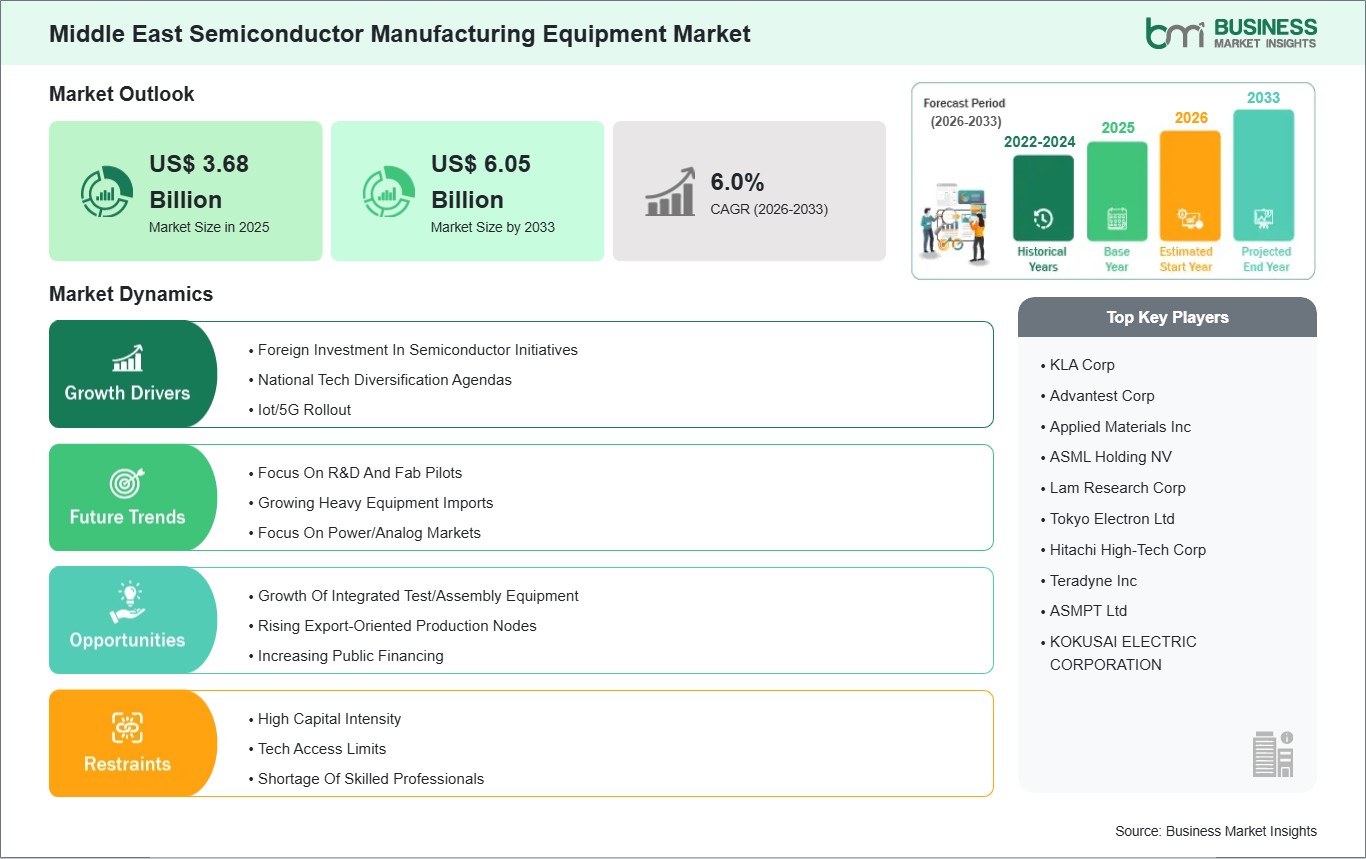
The Middle East semiconductor manufacturing equipment market is experiencing notable growth driven by regional government initiatives, strategic investments, and a push toward technological self‑sufficiency. Countries such as the United Arab Emirates and Saudi Arabia are prioritizing technological diversification through substantial funding in semiconductor fabs, accelerating demand for advanced manufacturing equipment. This expansion is further supported by partnerships with leading global technology providers to transfer expertise and enhance local capabilities. The market is characterized by robust spending on photolithography systems, etchers, and deposition tools, reflecting increasing fabrication activities. Geopolitical dynamics and supply chain realignment are motivating Middle Eastern stakeholders to reduce dependency on external sources, positioning the region as an emerging hub for semiconductor production. However, challenges persist, including the high capital intensity of semiconductor equipment, limited skilled workforce, and fierce competition from established Asian markets. Overall, the Middle East is poised for accelerated growth in semiconductor manufacturing equipment, underpinned by strategic economic planning and international collaboration.
Segment Analysis
Middle East Semiconductor Manufacturing Equipment Market Segmentation
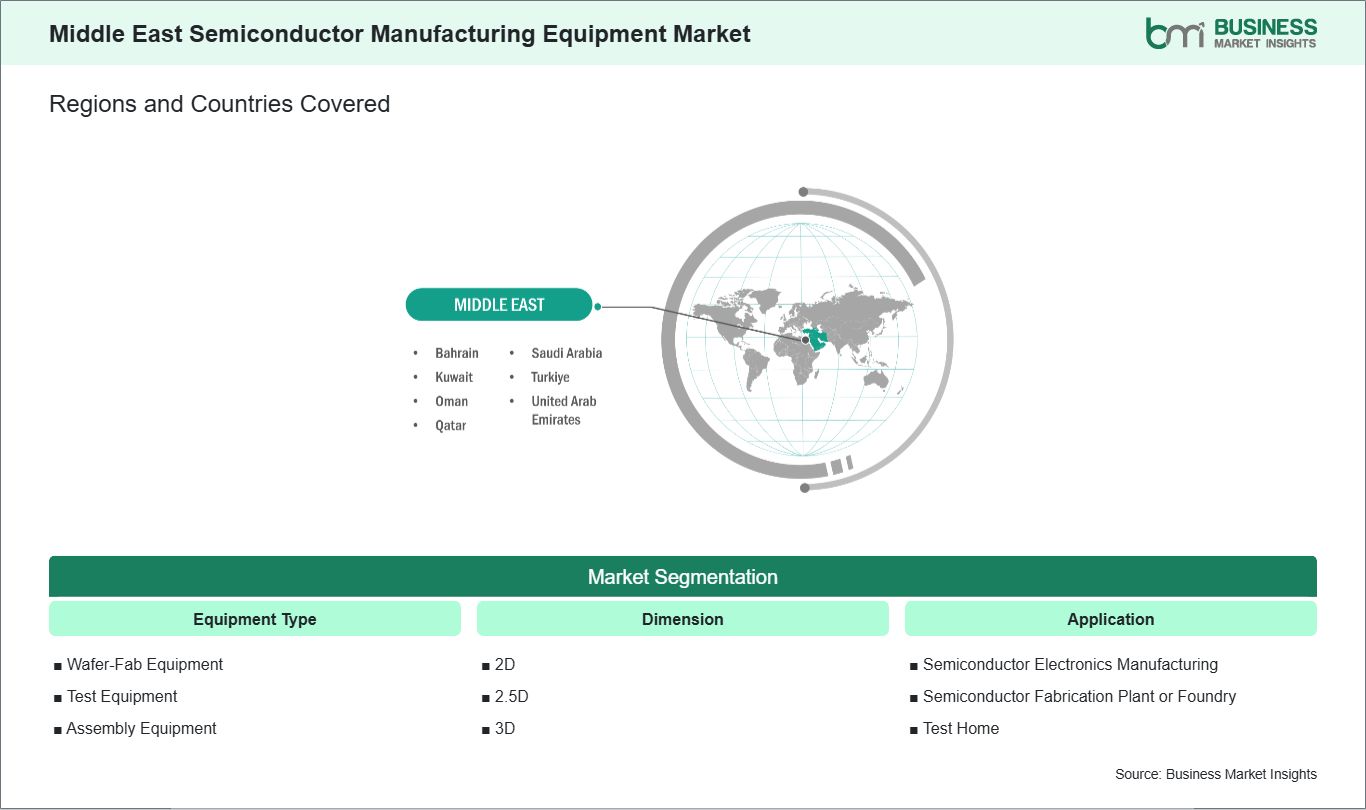
Key segments that contributed to the derivation of the Middle East semiconductor manufacturing equipment market analysis are equipment type, dimension, and application.
- By equipment type, the Middle East semiconductor manufacturing equipment market is bifurcated into wafer-fab equipment, test equipment, and assembly equipment. The wafer-fab equipment segment dominated the market in 2025.
- By dimension, the market is segmented into 2D, 2.5D, and 3D. The 2D segment held the largest share of the market in 2025.
- By application, the market is segmented into semiconductor electronics manufacturing, semiconductor fabrication plant/foundry, and test home. The semiconductor electronics manufacturing segment held the largest share of the market in 2025.
Market Forces
Middle East Semiconductor Manufacturing Equipment Market Drivers and Opportunities
Foreign Investment in Semiconductor Initiatives
Foreign investment plays a pivotal role in accelerating the Middle East’s semiconductor manufacturing equipment market by injecting capital, technology, and expertise into nascent domestic ecosystems. Governments in key markets such as the UAE and Saudi Arabia are actively offering incentives, strategic partnerships, and regulatory support to attract global semiconductor players, which creates demand for advanced manufacturing tools and equipment. For example, initiatives like Saudi Arabia’s National Semiconductor Hub and deep‑tech venture funds aim to attract at least 50 semiconductor design firms by 2030 with significant investment backing, making the region more attractive to foreign equipment suppliers. In parallel, the UAE’s industrial strategies encourage international firms to establish local manufacturing and R&D operations, leveraging favorable business environments and strategic geographic positioning. As foreign players enter or expand within the region, their equipment needs — from lithography and deposition systems to metrology and test tools — drive growth in the local semiconductor manufacturing equipment market and help build a more robust supply chain.
Growth of Integrated Test/Assembly Equipment
The rising importance of integrated test and assembly equipment presents a major opportunity for the semiconductor manufacturing equipment market in the Middle East. As the region develops its backend capabilities — particularly assembly, packaging, and testing operations — demand surges for specialized tools that ensure quality, performance, and yield of semiconductor products. The global Outsourced Semiconductor Assembly and Test (OSAT) segment is forecast to grow rapidly, reflecting broader industry trends toward outsourcing complex packaging and high‑throughput testing, which Middle Eastern manufacturers can tap into. Within the Middle East & Africa, testing infrastructure is gaining traction, with countries like Israel and the UAE increasing investments in analog and system‑level testers to support niche manufacturing clusters. Additionally, as automotive electronics, IoT, and AI‑driven applications proliferate regionally, integrated test and assembly equipment becomes essential for validating sophisticated chips and heterogeneous packages. This creates a targeted growth segment for equipment vendors and positions the Middle East to capture value beyond basic fabrication, expanding its role across more stages of the semiconductor value chain.
Size and Share Analysis
Middle East Semiconductor Manufacturing Equipment Market Size and Share Analysis
By equipment type, the Middle East semiconductor manufacturing equipment market is divided into wafer-fab equipment, assembly equipment, and test equipment. The wafer-fab equipment segment dominated the market in 2025. In the Middle East, wafer-fab equipment adoption is on the rise, emphasizing strategic tech sovereignty. Nations focus on developing semiconductor clusters, advanced manufacturing capabilities, and R&D centers, integrating cutting-edge fabrication tools to meet local demand and global technology standards.
By dimension, the market is segmented into 2D, 2.5D, and 3D. The 2D segment held the largest share of the market in 2025. The Middle East rapidly adopts 2D technologies through smart cities, e-government platforms, and advanced healthcare systems. Strong investment in digital infrastructure drives 2D usage in transportation, security, retail analytics, and construction planning across urban developments.
By application, the market is segmented semiconductor electronics manufacturing, semiconductor fabrication plant/foundry, and test home. The semiconductor electronics manufacturing segment held the largest share of the market in 2025. The Middle East is rapidly adopting semiconductor electronics manufacturing through investments in advanced technology hubs and smart infrastructure. Demand from defense, aerospace, renewable energy, and AI applications, combined with strong government support, fuels regional electronics production growth.
Report Coverage
Middle East Semiconductor Manufacturing Equipment Market Report Coverage and Deliverables
The "Middle East Semiconductor Manufacturing Equipment Market Size and Forecast (2022-2033)" report provides a detailed analysis of the market covering below areas:
- Middle East semiconductor manufacturing equipment market size and forecast at regional, and country levels for all the key market segments covered under the scope
- Middle East semiconductor manufacturing equipment market trends, as well as market dynamics such as drivers, restraints, and key opportunities
- Middle East semiconductor manufacturing equipment market analysis covering key market trends, global and regional framework, major players, regulations, and recent market developments
- Industry landscape and competition analysis covering market concentration, heat map analysis, prominent players, and recent developments for the air circuit breaker market
- Detailed company profiles, including SWOT analysis
Geographic Insights
Middle East Semiconductor Manufacturing Equipment Market Geographic Insights
The geographical scope of the Middle East semiconductor manufacturing equipment market report is expected to grow significantly during the forecast period.
The demand for semiconductor manufacturing equipment in the Middle East is rapidly increasing due to several interrelated factors. Firstly, governments in the region are heavily investing in technological infrastructure and semiconductor fabrication plants as part of economic diversification strategies, reducing reliance on oil revenues. Countries like the UAE and Saudi Arabia are implementing ambitious initiatives to develop local chip production capabilities, driving demand for advanced manufacturing equipment. Secondly, the rising adoption of emerging technologies such as 5G, artificial intelligence, Internet of Things (IoT), and electric vehicles in the region is increasing the need for high-performance semiconductors, which, in turn, fuels demand for production tools. Additionally, global supply chain disruptions have highlighted the importance of regional semiconductor self-sufficiency, prompting investments in local production capacity. Finally, favorable government policies, tax incentives, and strategic partnerships with leading semiconductor equipment manufacturers are further accelerating market growth in the Middle East.
Industry Activity
Recent Developments
The Middle East semiconductor manufacturing equipment market is evaluated by gathering qualitative and quantitative data post primary and secondary research, which includes important corporate publications, association data, and databases. A few of the key developments in the Middle East semiconductor manufacturing equipment market are:
- For instance, on October, 2025, Applied Materials, Inc. introduced new semiconductor manufacturing systems that enhance the performance of advanced logic and memory chips, which are foundational to AI computing. The new products target three critical areas in the race to deliver ever more powerful AI chips: leading-edge logic including Gate-All-Around (GAA) transistors, high-performance DRAM including high-bandwidth memory (HBM), and advanced packaging to create highly integrated systems-in-a-package that optimize chip performance, power consumption and cost.
- For instance, in February 2025, Advantest Corporation announced that it had entered into a partnership agreement with Micronics Japan Co., Ltd. (“MJC”). As semiconductors are expected to become increasingly advanced and complex, close collaboration within the semiconductor supply chain is essential to meet future market demands. Under this agreement, MJC and Advantest will leverage their respective expertise to provide innovative semiconductor test solutions, contributing to the optimization of customers' test processes and test costs. Additionally, Advantest plans to acquire a minority stake in MJC as part of this agreement.
Trust & Transparency
Research Methodology
The market analysis combines proprietary research with secondary data from government agencies, company disclosures, regulatory filings, industry databases and expert interviews. Market estimates are validated through data triangulation, cross-market benchmarking and analyst
review.
View Full Research Methodology
Key Sources Referred:
World Bank - Global Trade Indicators World Trade Organization (WTO) International Monetary Fund (IMF) International Trade Administration (ITA) Company website Company annual reports Company investor presentations