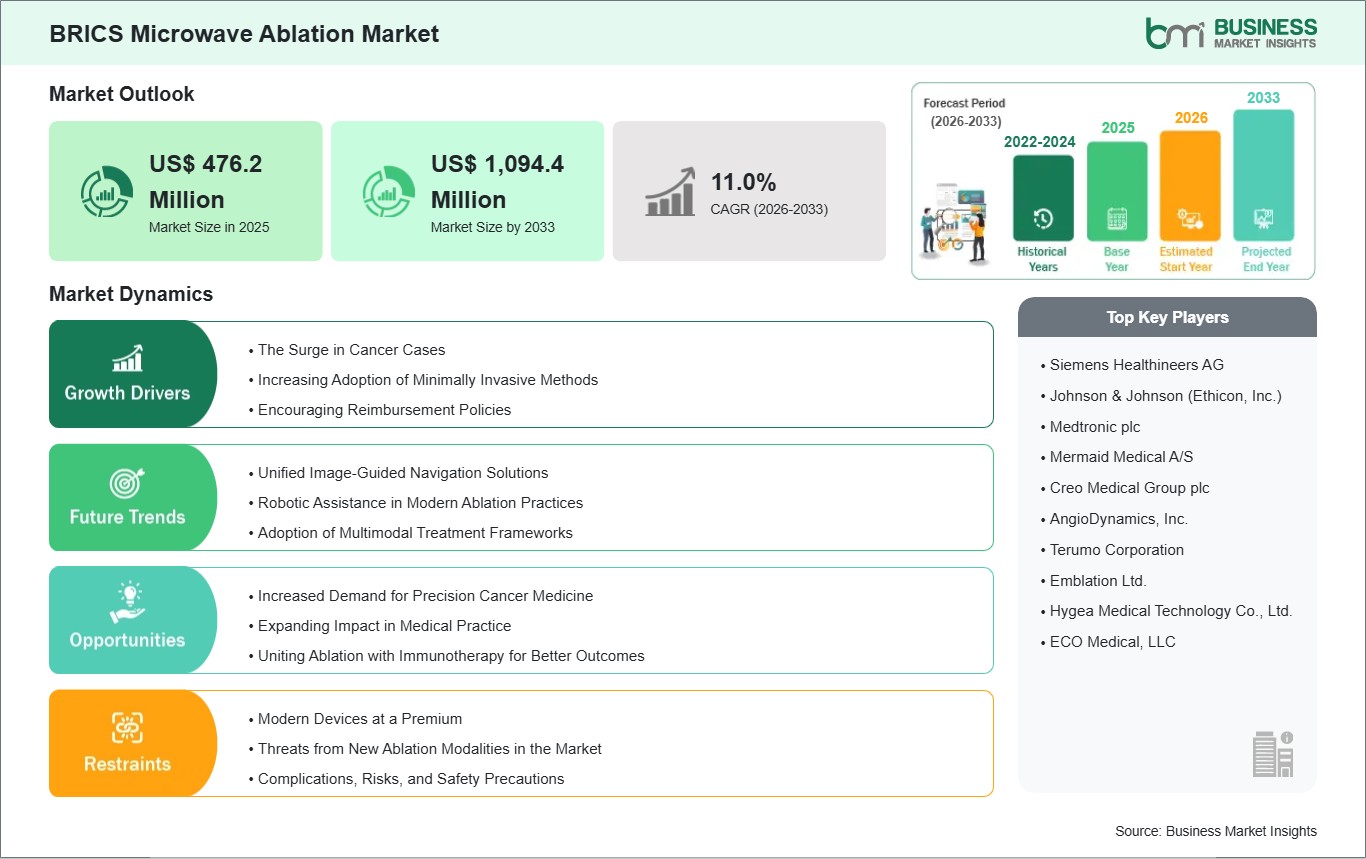
The BRICS microwave ablation market size is expected to reach US$ 1,094.4 million by 2033 from US$ 476.2million in 2025. The market is estimated to record a CAGR of 11.0% from 2026 to 2033.
The BRICS microwave ablation market reflects a trend toward more sophisticated healthcare systems, with minimally invasive therapies playing an increasingly important role. In these countries, microwave ablation is recognized for its precision in targeting tumors while preserving healthy tissue, offering patients shorter recovery times and fewer complications compared to conventional surgery. Expansion of advanced hospital infrastructure, improved imaging capabilities, and rising awareness among clinicians about minimally invasive oncology solutions are key factors driving adoption across the region. Training programs and professional workshops are also helping healthcare providers gain confidence in performing image-guided procedures, contributing to wider clinical integration.
However, the market faces certain challenges. Disparities in healthcare infrastructure and accessibility between urban centers and rural or less-developed areas can limit adoption. Additionally, there are variations in regulatory frameworks and reimbursement policies among BRICS nations, which can affect the pace at which microwave ablation technologies are introduced into clinical practice. Despite these barriers, the BRICS countries demonstrate strong potential for adoption of advanced therapeutic technologies, with nations like China serving as regional leaders in clinical expertise, infrastructure development, and training, helping to set benchmarks for minimally invasive treatments across the group.

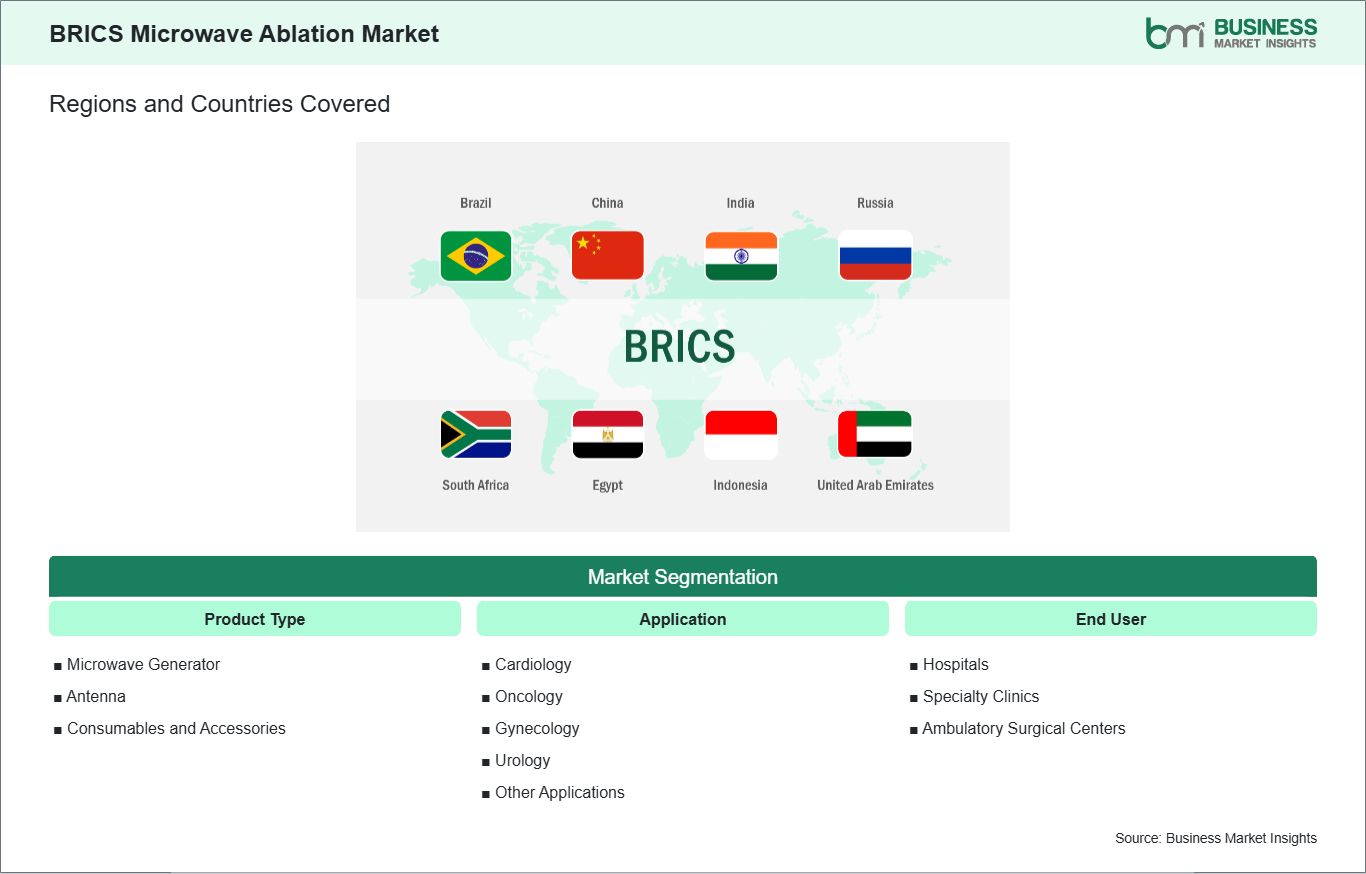
Key segments that contributed to the derivation of the Africa Microwave Ablation market analysis are product type, application, and end user.
The BRICS microwave ablation market is being shaped by a rapid rise in cancer incidence across member countries, driven by demographic changes, urbanization, and shifts in lifestyle patterns. The majority of the aging population is at higher risk of cancer, resulting in substantial increases in diagnoses of common solid tumors. Healthcare systems are thus encountering greater demand for effective treatment options that can address a widening spectrum of oncological needs, particularly where conventional surgery may carry elevated risk or resource strain.
Healthcare providers are responding to this surge by expanding capacity for interventional oncology services. In many major medical centers, there is a clear trend toward adopting minimally invasive therapies that can help manage growing caseloads without overextending surgical infrastructure. Microwave ablation has emerged as a compelling choice in this context, offering a less invasive alternative for treating tumors in organs such as the liver and lungs while supporting shorter recovery times compared with traditional open surgery.
At the same time, governments and healthcare institutions are increasingly prioritizing investment in cancer care infrastructure, including diagnostic imaging and interventional technologies. This focus not only enhances early detection and treatment planning but also expands clinical pathways where technologies like microwave ablation can be utilized. As the overall cancer burden continues to rise, demand for microwave ablation systems and procedural capability is expected to grow in parallel with broader efforts to strengthen oncology care systems across the region.
Precision cancer medicines are treatment strategies tailored to the biological and clinical characteristics of individual patients. Clinicians are increasingly moving away from one‑size‑fits‑all approaches, instead favoring therapies that can be adapted to tumor type, patient health status, and expected treatment response. Microwave ablation fits well within this paradigm, providing targeted treatment that can be customized to the size and location of tumors while minimizing impact on surrounding healthy tissue.
Multidisciplinary care models are gaining traction in BRICS healthcare settings, with teams of oncologists, interventional specialists, and diagnostic radiologists working collaboratively to design tailored treatment plans. This integrated approach encourages the incorporation of technologies that support precise intervention, particularly for patients who may benefit from localized tumor destruction without extensive surgical intervention. Microwave ablation’s compatibility with real‑time imaging and its ability to deliver controlled thermal energy align with clinicians’ goals for precision and adaptability.
Patient expectations are also contributing to the rising demand for personalized cancer therapies. As awareness of minimally invasive and targeted treatment options grows, many patients and referring physicians are seeking alternatives that offer effective tumor control with fewer complications and faster recovery. Microwave ablation’s profile as a patient‑centric therapy, which can be adjusted to individual clinical conditions, resonates with this demand. As a result, the market for microwave ablation in the BRICS region is anticipated to expand, supported by both clinical preference for precision medicine and patient‑driven interest in tailored cancer care.

The BRICS microwave ablation market demonstrates steady growth, with size and share analysis highlighting evolving trends and competitive dynamics among key players. The report evaluates important subsegments categorized within product type, application, and end user, highlighting their respective contributions to overall market performance.
By product type, the antenna subsegment dominated the market in 2025. There is a recurring need for high-performance, precise antennas during MWA procedures, which are essential for effective thermal ablation of tumors, making them a key revenue driver for manufacturers.
In terms of application, the oncology subsegment dominated the market in 2025. Oncology applications lead because of a rising prevalence of cancer cases, increasing preference for minimally invasive tumor ablation techniques, and growing awareness among healthcare providers about the effectiveness of MWA in treating liver, lung, and other solid tumors.
Based on end user, the hospitals subsegment dominated the market in 2025. Hospitals maintain a stronghold due to their well-established oncology and surgical departments, access to advanced MWA equipment, trained interventional radiologists and staff, and the capability to manage complex ablation procedures with comprehensive patient care.
| Report Attribute | Details |
|---|---|
| Market size in 2025 | US$ 476.2 Million |
| Market Size by 2033 | US$ 1,094.4 Million |
| CAGR (2026 - 2033) | 11.0% |
| Historical Data | 2022-2024 |
| Forecast period | 2026-2033 |
| Segments Covered | By Product Type
|
|
Regions and Countries Covered
| |
| BRICS | Russia, Brazil, South Africa, India, China, Egypt, Indonesia, Saudi Arabia, United Arab Emirates |
| Market leaders and key company profiles |
|
The "BRICS Microwave Ablation Market Size and Forecast (2022-2033)" report provides a detailed analysis of the market covering below areas:
The geographical scope of the BRICS microwave ablation market report is divided into Russia, Brazil, South Africa, India, China, Egypt, Indonesia, Saudi Arabia, and the UAE. China held the largest share in 2025.
China is the dominant country for microwave ablation within the BRICS region, driven by a combination of advanced healthcare infrastructure, government support for modern medical technologies, and growing clinical expertise. Major urban hospitals in cities such as Beijing, Shanghai, and Guangzhou serve as centers of excellence for interventional radiology and oncology, integrating microwave ablation into treatment pathways for liver, lung, and other solid tumors. These institutions act as hubs for training and knowledge-sharing, enabling clinicians across the country to adopt and refine ablation techniques effectively. Chinese healthcare providers are increasingly incorporating microwave ablation into clinical practice due to its minimally invasive nature, precision, and ability to reduce hospital stays. Collaborative efforts between hospitals and medical device manufacturers have further facilitated professional education and hands-on training programs, strengthening the skill set of interventional radiologists. While access to these procedures is concentrated in urban areas, ongoing initiatives aim to expand expertise and availability across secondary cities and regional hospitals. China’s emphasis on modern oncology care and precision medicine positions it as a market leader in the BRICS region, setting the standard for microwave ablation adoption and influencing clinical practices in neighboring member countries.

The BRICS Microwave Ablation market is evaluated by gathering qualitative and quantitative data post primary and secondary research, which includes important corporate publications, association data, and databases. A few of the key developments in the BRICS Microwave Ablation market are:
The BRICS Microwave Ablation Market is valued at US$ 476.2 Million in 2025, it is projected to reach US$ 1,094.4 Million by 2033.
As per our report BRICS Microwave Ablation Market, the market size is valued at US$ 476.2 Million in 2025, projecting it to reach US$ 1,094.4 Million by 2033. This translates to a CAGR of approximately 11.0% during the forecast period.
The BRICS Microwave Ablation Market report typically cover these key segments-
The historic period, base year, and forecast period can vary slightly depending on the specific market research report. However, for the BRICS Microwave Ablation Market report:
The BRICS Microwave Ablation Market is populated by several key players, each contributing to its growth and innovation. Some of the major players include:
The BRICS Microwave Ablation Market report is valuable for diverse stakeholders, including:
Essentially, anyone involved in or considering involvement in the BRICS Microwave Ablation Market value chain can benefit from the information contained in a comprehensive market report.
Please tell us your area of interest
(Market Segments/ Regions and Countries/ Companies)