Market Summary
Executive Summary and Market Analysis
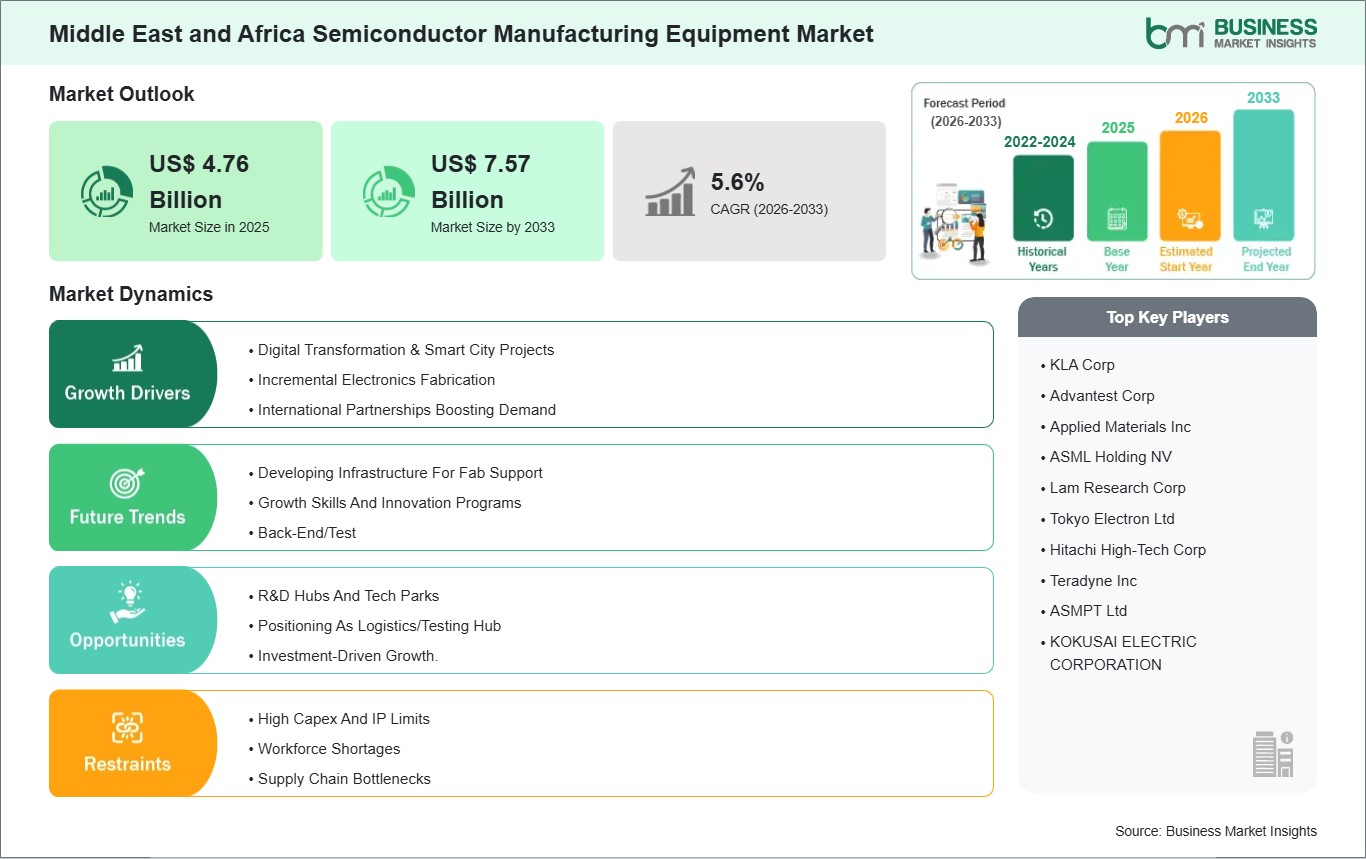
The Middle East and Africa (MEA) semiconductor manufacturing equipment market is experiencing measured growth driven by increasing regional investments in technology infrastructure, diversification of economies, and strategic national initiatives to reduce reliance on imported semiconductors. Governments across the MEA, particularly in the Gulf Cooperation Council (GCC), are incentivizing local fabrication capabilities through funding, public‑private partnerships, and special economic zones focused on high‑tech manufacturing. While current production capacity remains limited compared to Asia and North America, rising demand for consumer electronics, automotive semiconductors, and data center expansion is prompting procurement of advanced manufacturing tools and process equipment. Challenges include high capital expenditure requirements, supply chain constraints, and a shortage of skilled workforce capable of supporting complex semiconductor fabrication. Nevertheless, technology transfer agreements and collaborations with established equipment suppliers are facilitating capacity building. Overall, the market trajectory for semiconductor manufacturing equipment in MEA is positive, with incremental adoption expected as regional stakeholders prioritize self‑sufficiency, innovation ecosystems, and integration into global semiconductor value chains.
Segment Analysis
Middle East and Africa Semiconductor Manufacturing Equipment Market Segmentation
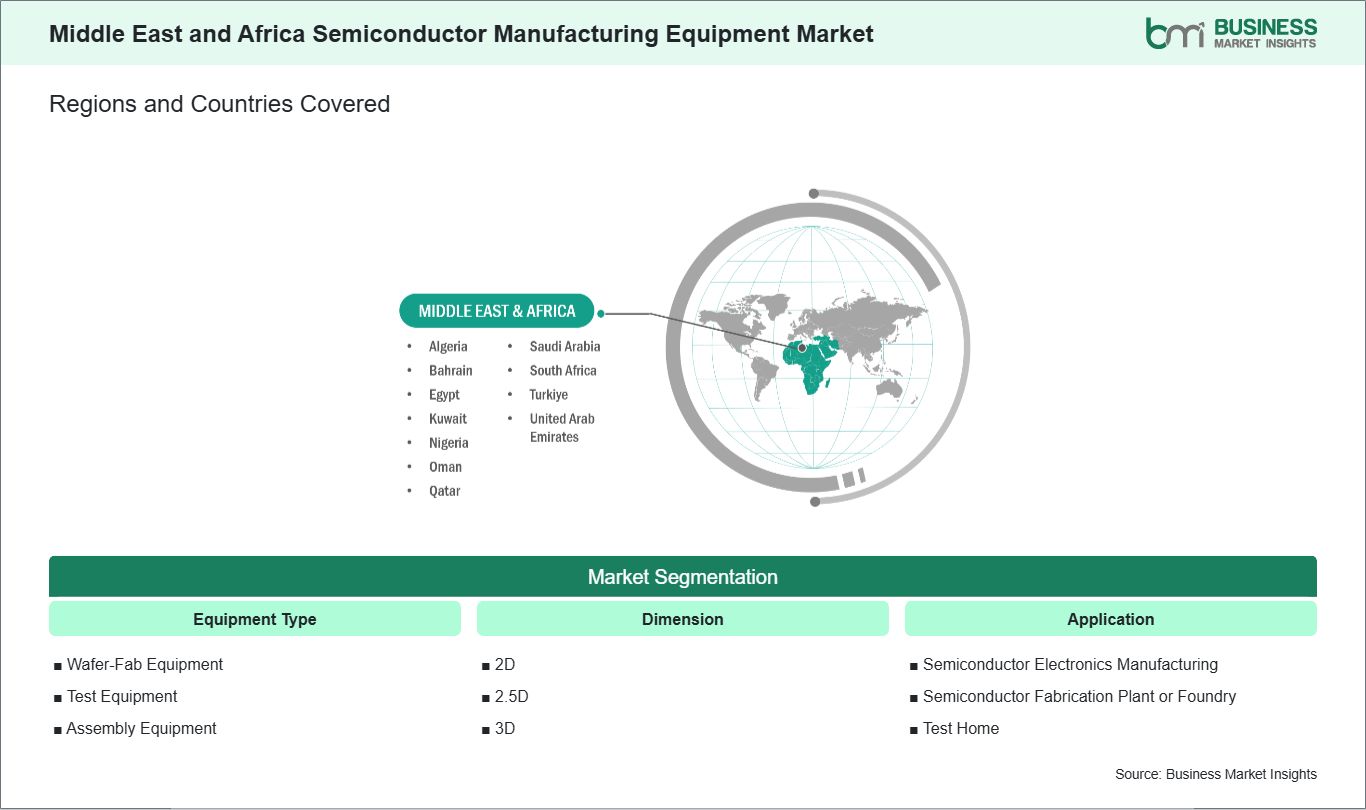
Key segments that contributed to the derivation of the Middle East and Africa semiconductor manufacturing equipment market analysis are equipment type, dimension, and application.
- By equipment type, the Middle East and Africa semiconductor manufacturing equipment market is bifurcated into wafer-fab equipment, test equipment, and assembly equipment. The wafer-fab equipment segment dominated the market in 2025.
- By dimension, the market is segmented into 2D, 2.5D, and 3D. The 2D segment held the largest share of the market in 2025.
- By application, the market is segmented into semiconductor electronics manufacturing, semiconductor fabrication plant/foundry, and test home. The semiconductor electronics manufacturing segment held the largest share of the market in 2025.
Market Forces
Middle East and Africa Semiconductor Manufacturing Equipment Market Drivers and Opportunities
Digital Transformation & Smart City Projects
In the Middle East and Africa, rapid digital transformation and the rollout of smart city initiatives are significant drivers of semiconductor manufacturing equipment demand. Governments and corporate sectors are investing heavily in digital infrastructure, driven by the need for enhanced connectivity, automation, and data analytics across industries such as utilities, healthcare, transportation, and manufacturing. National visions such as Saudi Vision 2030 and UAE’s Smart Dubai strategy emphasize digital ecosystems that rely on advanced electronics and intelligent systems. Smart city projects require high‑performance chips for IoT sensors, AI systems, 5G networks, and edge computing platforms, which in turn boosts regional demand for domestic semiconductor manufacturing capabilities and related equipment. As reliance on digital services grows — from autonomous transport networks to digital governance platforms — the deployment of advanced fabrication, assembly, and testing equipment becomes essential. This creates a strategic impetus for MEA countries to strengthen local semiconductor supply chains, reduce import dependence, and accelerate technological self‑sufficiency.
R&D Hubs And Tech Parks
The establishment of research and development hubs and technology parks across the Middle East and Africa represents a compelling opportunity for the semiconductor manufacturing equipment market. Initiatives such as innovation districts, science parks, and collaborative research centers are increasingly attracting global tech firms, startups, and academic institutions. These ecosystems encourage the development of advanced materials, nanoelectronics, and semiconductor design capabilities by providing specialized facilities, funding, and talent pools. As countries aim to diversify their economies beyond hydrocarbons, they are investing in these knowledge‑centric environments to foster indigenous innovation and high‑tech manufacturing. The presence of R&D hubs stimulates demand for state‑of‑the‑art semiconductor fabrication tools, characterization systems, and testing apparatus that enable prototyping and scaling of next‑generation chips. Furthermore, partnerships between local governments, multinational corporations, and universities can accelerate technology transfer and skill development, enhancing regional competitiveness. By embedding semiconductor research and production within technology parks, MEA economies can leverage global supply chain integration while building resilient domestic capabilities.
Size and Share Analysis
Middle East and Africa Semiconductor Manufacturing Equipment Market Size and Share Analysis
By equipment type, the Middle East and Africa semiconductor manufacturing equipment market is divided into wafer-fab equipment, assembly equipment, and test equipment. The wafer-fab equipment segment dominated the market in 2025. MEA adoption of wafer-fab equipment is slowly expanding, propelled by industrial diversification initiatives. Countries like Israel, UAE, and South Africa invest in fabrication plants, leveraging international expertise to develop local semiconductor capacity for automotive, defense, and ICT sectors.
By dimension, the market is segmented into 2D, 2.5D, and 3D. The 2D segment held the largest share of the market in 2025. The MEA region shows rising 2D adoption across smart infrastructure, healthcare imaging, and digital identity systems. Governments and enterprises use 2D technologies to improve efficiency, transparency, and service delivery, supported by rapid urbanization and expanding digital ecosystems.
By application, the market is segmented semiconductor electronics manufacturing, semiconductor fabrication plant/foundry, and test home. The semiconductor electronics manufacturing segment held the largest share of the market in 2025. Middle East and Africa show rising semiconductor manufacturing adoption supported by digital transformation, energy projects, and smart infrastructure. Government incentives, technology partnerships, and growing demand for electronics in telecom, healthcare, and mobility are strengthening regional manufacturing capabilities.
Report Coverage
Middle East and Africa Semiconductor Manufacturing Equipment Market Report Coverage and Deliverables
The "Middle East and Africa Semiconductor Manufacturing Equipment Market Size and Forecast (2022-2033)" report provides a detailed analysis of the market covering below areas:
- Middle East and Africa semiconductor manufacturing equipment market size and forecast at regional, and country levels for all the key market segments covered under the scope
- Middle East and Africa semiconductor manufacturing equipment market trends, as well as market dynamics such as drivers, restraints, and key opportunities
- Middle East and Africa semiconductor manufacturing equipment market analysis covering key market trends, global and regional framework, major players, regulations, and recent market developments
- Industry landscape and competition analysis covering market concentration, heat map analysis, prominent players, and recent developments for the air circuit breaker market
- Detailed company profiles, including SWOT analysis
Geographic Insights
Middle East and Africa Semiconductor Manufacturing Equipment Market Geographic Insights
The geographical scope of the Middle East and Africa semiconductor manufacturing equipment market report is expected to grow significantly during the forecast period.
The demand for semiconductor manufacturing equipment in the Middle East and Africa is rising rapidly due to several strategic economic and technological factors. Governments across the region are prioritizing digital transformation and economic diversification, reducing dependency on oil and gas revenues by investing in high‑tech industries, including semiconductor fabrication. Large public and private investments in technology parks, research centers, and industrial zones are encouraging local chip production capabilities. Additionally, the global semiconductor shortage highlighted vulnerabilities in supply chains, prompting nations in the region to strengthen domestic manufacturing and attract foreign direct investment from major semiconductor companies. Growing consumer demand for advanced electronics, 5G infrastructure, and Internet of Things (IoT) applications is driving the need for more localized semiconductor production. Furthermore, favorable policy frameworks, tax incentives, and strategic partnerships with global technology leaders are making the region increasingly attractive for semiconductor equipment suppliers and manufacturers seeking new markets and production bases.
Industry Activity
Recent Developments
The Middle East and Africa semiconductor manufacturing equipment market is evaluated by gathering qualitative and quantitative data post primary and secondary research, which includes important corporate publications, association data, and databases. A few of the key developments in the Middle East and Africa semiconductor manufacturing equipment market are:
- For instance, on October, 2025, Applied Materials, Inc. introduced new semiconductor manufacturing systems that enhance the performance of advanced logic and memory chips, which are foundational to AI computing. The new products target three critical areas in the race to deliver ever more powerful AI chips: leading-edge logic including Gate-All-Around (GAA) transistors, high-performance DRAM including high-bandwidth memory (HBM), and advanced packaging to create highly integrated systems-in-a-package that optimize chip performance, power consumption and cost.
- For instance, in February 2025, Advantest Corporation announced that it had entered into a partnership agreement with Micronics Japan Co., Ltd. (“MJC”). As semiconductors are expected to become increasingly advanced and complex, close collaboration within the semiconductor supply chain is essential to meet future market demands. Under this agreement, MJC and Advantest will leverage their respective expertise to provide innovative semiconductor test solutions, contributing to the optimization of customers' test processes and test costs. Additionally, Advantest plans to acquire a minority stake in MJC as part of this agreement.
Trust & Transparency
Research Methodology
The market analysis combines proprietary research with secondary data from government agencies, company disclosures, regulatory filings, industry databases and expert interviews. Market estimates are validated through data triangulation, cross-market benchmarking and analyst
review.
View Full Research Methodology
Key Sources Referred:
World Bank - Global Trade Indicators World Trade Organization (WTO) International Monetary Fund (IMF) International Trade Administration (ITA) Company website Company annual reports Company investor presentations