Market Summary
Executive Summary and Market Analysis
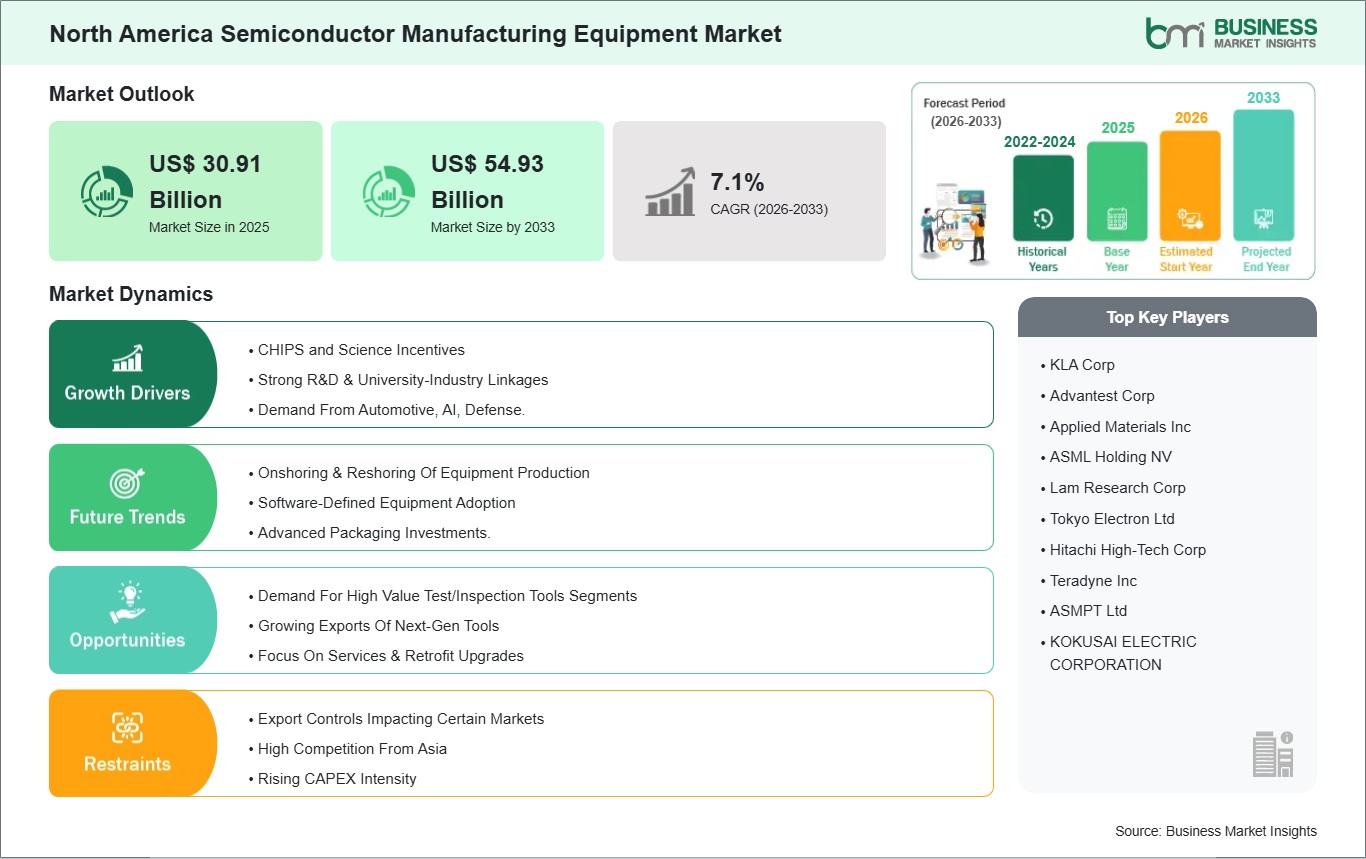
The North America semiconductor manufacturing equipment market is experiencing robust expansion driven by increasing domestic chip production, government incentives, and rising demand for advanced technologies such as AI, 5G, EVs, and IoT. The market generated significant revenue in 2025 and is forecast to grow steadily through the early 2030s, underpinned by large‑scale fab investments and onshoring initiatives aimed at strengthening regional semiconductor self‑sufficiency. Front‑end equipment dominates the regional landscape, accounting for the largest share of installations, while expanding fabrication capacity in the U.S., Canada, and Mexico continues to bolster tool demand. Government policies, including federal funding and tax incentives, are catalyzing capacity expansion and R&D. However, the industry faces challenges such as high capital costs for advanced lithography and metrology systems, supply chain bottlenecks, and a shortage of skilled workforce, which may constrain growth. Despite these obstacles, sustained investments and technological advancements position North America as a key market for semiconductor equipment across the forecast period.
Segment Analysis
North America Semiconductor Manufacturing Equipment Market Segmentation
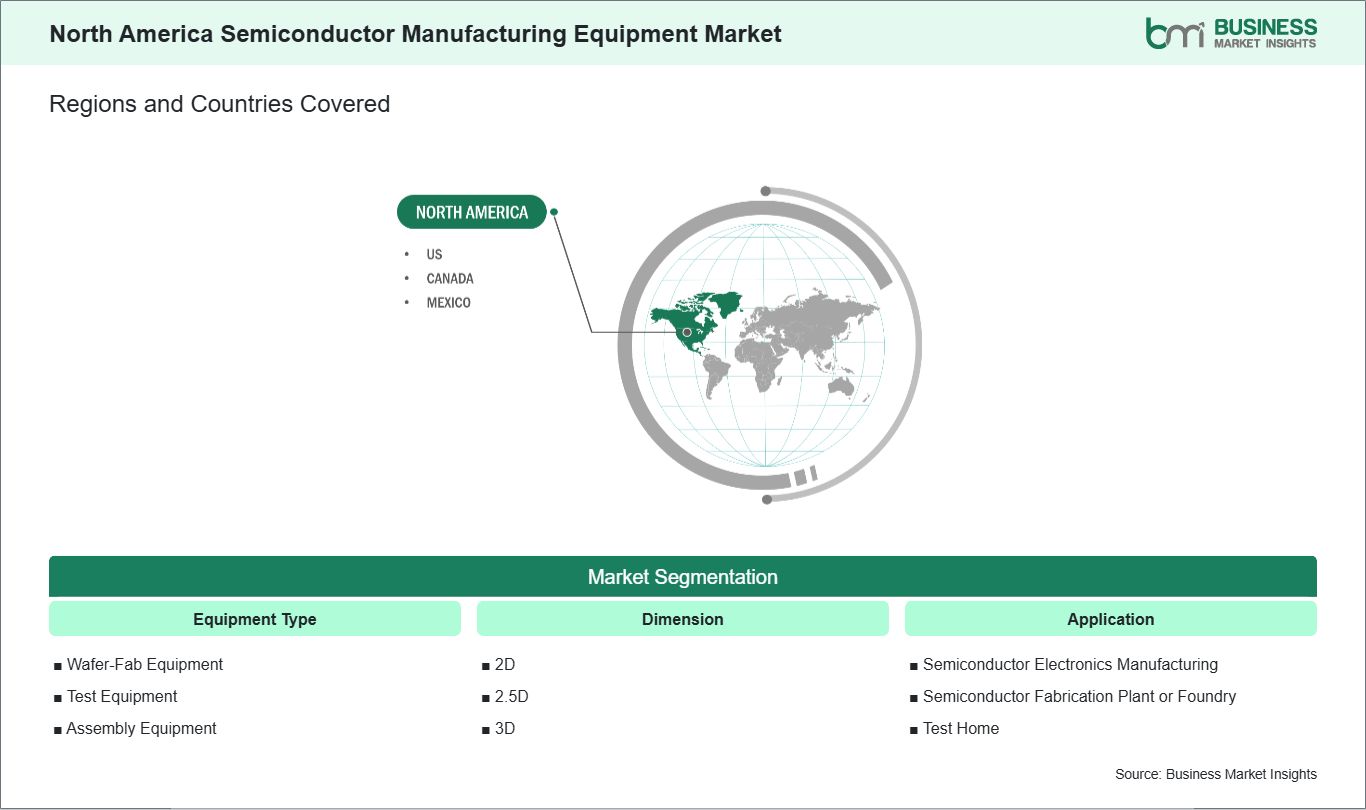
Key segments that contributed to the derivation of the North America semiconductor manufacturing equipment market analysis are equipment type, dimension, and application.
- By equipment type, the North America semiconductor manufacturing equipment market is bifurcated into wafer-fab equipment, test equipment, and assembly equipment. The wafer-fab equipment segment dominated the market in 2025.
- By dimension, the market is segmented into 2D, 2.5D, and 3D. The 2D segment held the largest share of the market in 2025.
- By application, the market is segmented into semiconductor electronics manufacturing, semiconductor fabrication plant/foundry, and test home. The semiconductor electronics manufacturing segment held the largest share of the market in 2025.
Market Forces
North America Semiconductor Manufacturing Equipment Market Drivers and Opportunities
CHIPS and Science Incentives
The CHIPS and Science Act has emerged as a cornerstone driver for North America’s semiconductor manufacturing equipment (SME) market by catalyzing substantial federal investment in domestic chip fabrication capacity. With over US$52 billion allocated to bolster semiconductor research, design, and production, the Act aims to reduce dependence on foreign suppliers, strengthen supply chain resilience, and secure technological leadership. This legislative backing not only incentivizes new fab construction but also stimulates demand for advanced manufacturing equipment—from lithography and deposition tools to advanced packaging and assembly systems. Equipment vendors benefit as chipmakers reinvest in upgrading existing facilities and stand up new ones to meet capacity expansion mandates tied to incentives. Additionally, the policy’s emphasis on cutting‑edge nodes and innovation accelerates adoption of next‑generation tools, fostering long‑term growth in capital expenditures. The resulting ecosystem revitalization attracts global suppliers to establish a stronger North American presence, nurturing local innovation and creating a virtuous cycle of investment and technological advancement.
Demand for High-Value Test/Inspection Tools Segments
The escalating complexity of semiconductor devices—driven by advanced nodes, 3D architectures, and heterogeneous integration—has amplified the need for high‑value test and inspection tools, creating significant market opportunities in North America. As chips shrink and performance demands grow, precise defect detection, yield optimization, and reliability assurance become mission‑critical, pushing manufacturers to invest in cutting‑edge metrology, failure analysis, and electrical test equipment. This trend is particularly pronounced in segments such as advanced logic, automotive, and AI accelerators, where even minor defects can translate to costly field failures. The rise of AI/ML‑enhanced inspection systems also opens new revenue streams for tool vendors specializing in optical, e‑beam, and X‑ray modalities. Moreover, stringent quality standards from end markets like automotive and aerospace further elevate the importance of robust test frameworks, underpinning sustained demand. With fab expansions underway in the region—supported by policy initiatives—the proliferation of high‑end test and inspection technologies not only enhances yield and throughput but also reinforces North America’s competitive advantage in producing next‑generation semiconductors.
Size and Share Analysis
North America Semiconductor Manufacturing Equipment Market Size and Share Analysis
By equipment type, the North America semiconductor manufacturing equipment market is divided into wafer-fab equipment, assembly equipment, and test equipment. The wafer-fab equipment segment dominated the market in 2025. North America remains a leader in wafer-fab equipment adoption, dominated by the U.S. and Canada. Cutting-edge lithography, etching, and deposition tools are widely used in high-volume fabs, driven by semiconductor, automotive, and defense technology innovation.
By dimension, the market is segmented into 2D, 2.5D, and 3D. The 2D segment held the largest share of the market in 2025. North America leads in 2D adoption driven by technological innovation, automation, and large-scale digital ecosystems. 2D technologies are integral to healthcare diagnostics, manufacturing quality control, retail analytics, logistics, and advanced research and development activities.
By application, the market is segmented semiconductor electronics manufacturing, semiconductor fabrication plant/foundry, and test home. The semiconductor electronics manufacturing segment held the largest share of the market in 2025. North America has highly adopted semiconductor manufacturing through advanced fabrication, strong design leadership, and large-scale investments. Robust demand from AI, automotive, aerospace, and consumer electronics, combined with reshoring initiatives, reinforces the region’s global semiconductor leadership.
Report Coverage
North America Semiconductor Manufacturing Equipment Market Report Coverage and Deliverables
The "North America Semiconductor Manufacturing Equipment Market Size and Forecast (2022-2033)" report provides a detailed analysis of the market covering below areas:
- North America semiconductor manufacturing equipment market size and forecast at regional, and country levels for all the key market segments covered under the scope
- North America semiconductor manufacturing equipment market trends, as well as market dynamics such as drivers, restraints, and key opportunities
- North America semiconductor manufacturing equipment market analysis covering key market trends, global and regional framework, major players, regulations, and recent market developments
- Industry landscape and competition analysis covering market concentration, heat map analysis, prominent players, and recent developments for the air circuit breaker market
- Detailed company profiles, including SWOT analysis
Geographic Insights
North America Semiconductor Manufacturing Equipment Market Geographic Insights
The geographical scope of the North America semiconductor manufacturing equipment market report is expected to grow significantly during the forecast period.
The increasing demand for semiconductor manufacturing equipment in North America is driven by several interrelated factors. Rapid technological advancements in electronics, including the proliferation of artificial intelligence, 5G networks, and Internet of Things (IoT) devices, are fueling the need for more sophisticated and high-performance semiconductors. Additionally, North American governments and corporations are investing heavily in domestic semiconductor production to reduce dependency on overseas suppliers, particularly in response to global supply chain disruptions highlighted during the COVID-19 pandemic. The rise of electric vehicles and autonomous driving technologies also contributes to higher semiconductor consumption, necessitating advanced fabrication equipment. Furthermore, the expansion of data centers and cloud computing infrastructure in the region is increasing demand for cutting-edge chips, which require specialized manufacturing machinery. Collectively, these factors are driving semiconductor manufacturers to upgrade and expand their production capabilities, leading to sustained growth in the semiconductor manufacturing equipment market in North America.
Industry Activity
Recent Developments
The North America semiconductor manufacturing equipment market is evaluated by gathering qualitative and quantitative data post primary and secondary research, which includes important corporate publications, association data, and databases. A few of the key developments in the North America semiconductor manufacturing equipment market are:
- For instance, on October, 2025, Applied Materials, Inc. introduced new semiconductor manufacturing systems that enhance the performance of advanced logic and memory chips, which are foundational to AI computing. The new products target three critical areas in the race to deliver ever more powerful AI chips: leading-edge logic including Gate-All-Around (GAA) transistors, high-performance DRAM including high-bandwidth memory (HBM), and advanced packaging to create highly integrated systems-in-a-package that optimize chip performance, power consumption and cost.
- For instance, in February 2025, Advantest Corporation announced that it had entered into a partnership agreement with Micronics Japan Co., Ltd. (“MJC”). As semiconductors are expected to become increasingly advanced and complex, close collaboration within the semiconductor supply chain is essential to meet future market demands. Under this agreement, MJC and Advantest will leverage their respective expertise to provide innovative semiconductor test solutions, contributing to the optimization of customers' test processes and test costs. Additionally, Advantest plans to acquire a minority stake in MJC as part of this agreement.
Trust & Transparency
Research Methodology
The market analysis combines proprietary research with secondary data from government agencies, company disclosures, regulatory filings, industry databases and expert interviews. Market estimates are validated through data triangulation, cross-market benchmarking and analyst
review.
View Full Research Methodology
Key Sources Referred:
World Bank - Global Trade Indicators World Trade Organization (WTO) International Monetary Fund (IMF) International Trade Administration (ITA) Company website Company annual reports Company investor presentations