Market Summary
Executive Summary and Market Analysis
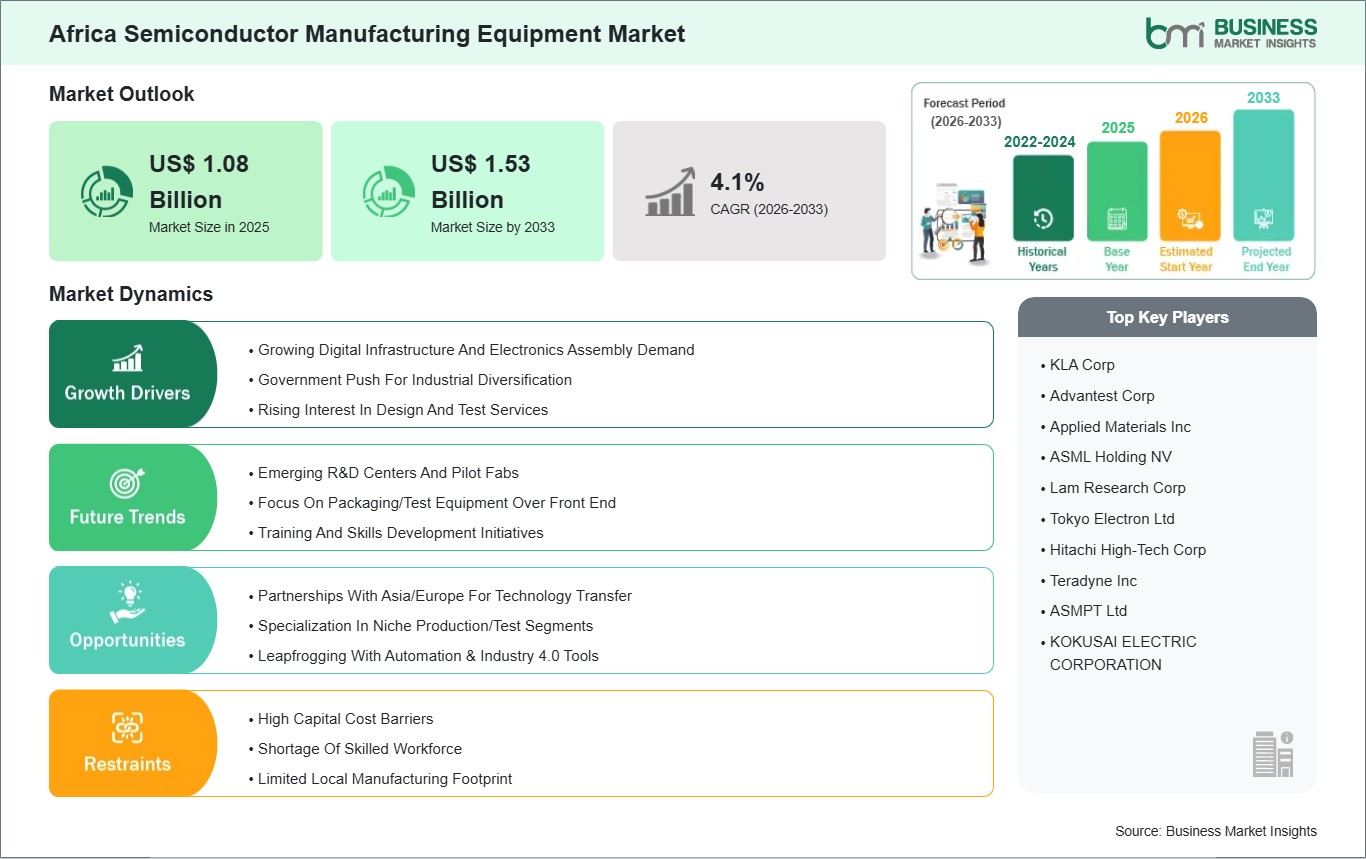
The Africa semiconductor manufacturing equipment market is emerging as a strategic growth frontier amid global supply chain realignment and increased technology investment across the continent. While Africa currently represents a small share of global semiconductor fabrication capacity, several countries are prioritizing infrastructure development, skills enhancement, and favorable industrial policies to attract semiconductor manufacturing and equipment deployment. Growing demand for consumer electronics, telecommunications infrastructure, automotive electronics, renewable energy systems, and digital services is driving the need for localized production capabilities and advanced manufacturing tools. Key market drivers include government incentives, foreign direct investments from Asian and Western technology firms, and partnerships aimed at technology transfer and workforce training. However, challenges such as limited existing fabrication facilities, inconsistent power supply, and the need for substantial capital investment remain significant. As ecosystem maturity advances through targeted policy support and investment ecosystems, Africa’s semiconductor manufacturing equipment market is poised for steady growth, offering opportunities for global equipment suppliers and regional technology development initiatives.
Segment Analysis
Africa Semiconductor Manufacturing Equipment Market Segmentation
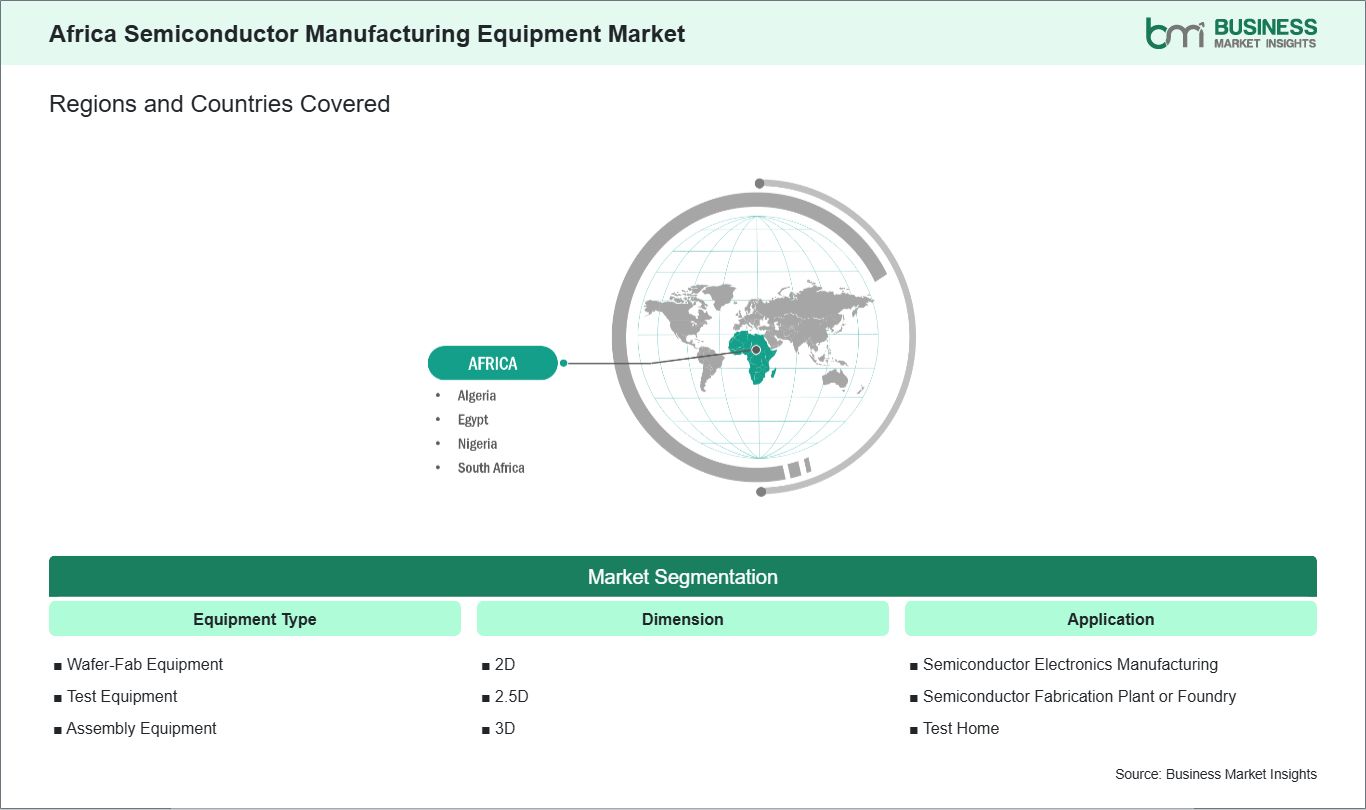
Key segments that contributed to the derivation of the construction robots market analysis are equipment type, dimension, and application.
- By type, the market is segmented into traditional robot, robotic arm, and exoskeleton. The robotic arm segment held the largest share of the market in 2025.
- By function, the market is segmented into demolition, bricklaying, material handling, and others. The material handling segment held the largest share of the market in 2025.
- By end use, the market is segmented into industrial, residential, and commercial. The industrial segment held the largest share of the market in 2025.
Market Forces
Africa Semiconductor Manufacturing Equipment Market Drivers and Opportunities
Growing Digital Infrastructure and Electronics Assembly Demand
The rapid expansion of digital infrastructure across Africa is a key driver for the semiconductor manufacturing equipment (SME) market. Governments and private sectors are investing heavily in data centers, broadband networks, and smart technologies to support digital transformation, creating an escalating demand for semiconductors and related assembly services. As connectivity increases and affordability improves, more African consumers adopt smartphones, IoT devices, and digital services, prompting local electronics assembly facilities to scale up production. This shift reduces reliance on imported components and places emphasis on building in-region capabilities. To support this ecosystem, advanced manufacturing equipment — such as lithography systems, etchers, and testing platforms — becomes essential. Investments in digital infrastructure also encourage the emergence of tech parks and innovation hubs, stimulating demand for localized semiconductor fabrication and assembly. Together, these trends form a reinforcing cycle: expanding digital infrastructure fuels electronics manufacturing growth, which in turn drives demand for sophisticated SME technologies.
Partnerships With Asia/Europe for Technology Transfer
Strategic partnerships between African entities and established semiconductor ecosystems in Asia and Europe represent a significant opportunity to accelerate local SME market development. Leading semiconductor nations such as Taiwan, South Korea, Japan, and Germany possess advanced manufacturing expertise, deep supply chains, and cutting-edge SME technologies. By forging collaborations — through joint ventures, licensing agreements, research alliances, and capacity-building programs — African countries can access this technological know-how more rapidly and cost-effectively than developing indigenous capabilities from scratch. These partnerships enable knowledge transfer in areas like precision fabrication, quality control, and automated production systems, while also fostering skills development among local engineers and technicians. Additionally, co-development initiatives help align African market requirements with global standards, enhancing competitiveness and export potential. With tailored support from international collaborators, Africa can leapfrog traditional barriers, strengthen its semiconductor value chain, and attract further foreign direct investment into high-tech manufacturing sectors.
Size and Share Analysis
Africa Semiconductor Manufacturing Equipment Market Size and Share Analysis
By equipment type, the Africa semiconductor manufacturing equipment market is divided into wafer-fab equipment, assembly equipment, and test equipment. The wafer-fab equipment segment dominated the market in 2025. Wafer-fab equipment adoption in Africa is growing steadily, driven by emerging electronics manufacturing, government-backed industrialization programs, and rising demand for semiconductors in telecommunications, energy systems, and consumer electronics across key developing economies.
By dimension, the market is segmented into 2D, 2.5D, and 3D. The 2D segment held the largest share of the market in 2025. Africa shows strong 2D adoption driven by mobile-first ecosystems, digital payments, and low-cost imaging solutions. 2D technologies support logistics, healthcare diagnostics, agriculture mapping, and identity systems, enabling scalable innovation across emerging and rapidly urbanizing markets.
By application, the market is segmented semiconductor electronics manufacturing, semiconductor fabrication plant/foundry, and test home. The semiconductor electronics manufacturing segment held the largest share of the market in 2025. Africa is increasingly adopting semiconductor electronics manufacturing through investments in assembly, testing, and electronics integration. Growing digital infrastructure, renewable energy projects, and automotive electronics demand are driving capacity building, supported by skills development initiatives and international partnerships.
Report Coverage
Africa Semiconductor Manufacturing Equipment Market Report Coverage and Deliverables
The "Africa Semiconductor Manufacturing Equipment Market Size and Forecast (2022-2033)" report provides a detailed analysis of the market covering below areas:
- Africa semiconductor manufacturing equipment market size and forecast at regional, and country levels for all the key market segments covered under the scope
- Africa semiconductor manufacturing equipment market trends, as well as market dynamics such as drivers, restraints, and key opportunities
- Africa semiconductor manufacturing equipment market analysis covering key market trends, global and regional framework, major players, regulations, and recent market developments
- Industry landscape and competition analysis covering market concentration, heat map analysis, prominent players, and recent developments for the air circuit breaker market
- Detailed company profiles, including SWOT analysis
Geographic Insights
Africa Semiconductor Manufacturing Equipment Market Geographic Insights
The geographical scope of the Africa semiconductor manufacturing equipment market report is expected to grow significantly during the forecast period.
The demand for semiconductor manufacturing equipment in Africa is rising due to a combination of technological, economic, and strategic factors. Governments across the continent are increasingly prioritizing digital transformation and industrialization, recognizing that local semiconductor fabrication can reduce dependence on imports and strengthen technological sovereignty. Investments in infrastructure, special economic zones, and supportive policies are attracting foreign direct investment from global chipmakers and equipment suppliers. Additionally, the rapid growth of the consumer electronics market, driven by expanding internet access and a youthful population, is fueling demand for locally produced chips. The automotive and renewable energy sectors are also contributing to this trend, as electric vehicles and smart grid technologies require sophisticated semiconductors. Furthermore, international partnerships and development initiatives are facilitating knowledge transfer and financing for high-tech manufacturing facilities. As a result, Africa’s semiconductor ecosystem is evolving, leading to greater demand for state-of-the-art manufacturing equipment needed to build competitive and sustainable local production capabilities.
Industry Activity
Recent Developments
The Africa semiconductor manufacturing equipment market is evaluated by gathering qualitative and quantitative data post primary and secondary research, which includes important corporate publications, association data, and databases. A few of the key developments in the Africa semiconductor manufacturing equipment market are:
- For instance, on October, 2025, Applied Materials, Inc. introduced new semiconductor manufacturing systems that enhance the performance of advanced logic and memory chips, which are foundational to AI computing. The new products target three critical areas in the race to deliver ever more powerful AI chips: leading-edge logic including Gate-All-Around (GAA) transistors, high-performance DRAM including high-bandwidth memory (HBM), and advanced packaging to create highly integrated systems-in-a-package that optimize chip performance, power consumption and cost.
- For instance, in February 2025, Advantest Corporation announced that it had entered into a partnership agreement with Micronics Japan Co., Ltd. (“MJC”). As semiconductors are expected to become increasingly advanced and complex, close collaboration within the semiconductor supply chain is essential to meet future market demands. Under this agreement, MJC and Advantest will leverage their respective expertise to provide innovative semiconductor test solutions, contributing to the optimization of customers' test processes and test costs. Additionally, Advantest plans to acquire a minority stake in MJC as part of this agreement.
Trust & Transparency
Research Methodology
The market analysis combines proprietary research with secondary data from government agencies, company disclosures, regulatory filings, industry databases and expert interviews. Market estimates are validated through data triangulation, cross-market benchmarking and analyst
review.
View Full Research Methodology
Key Sources Referred:
World Bank - Global Trade Indicators World Trade Organization (WTO) International Monetary Fund (IMF) International Trade Administration (ITA) Company website Company annual reports Company investor presentations