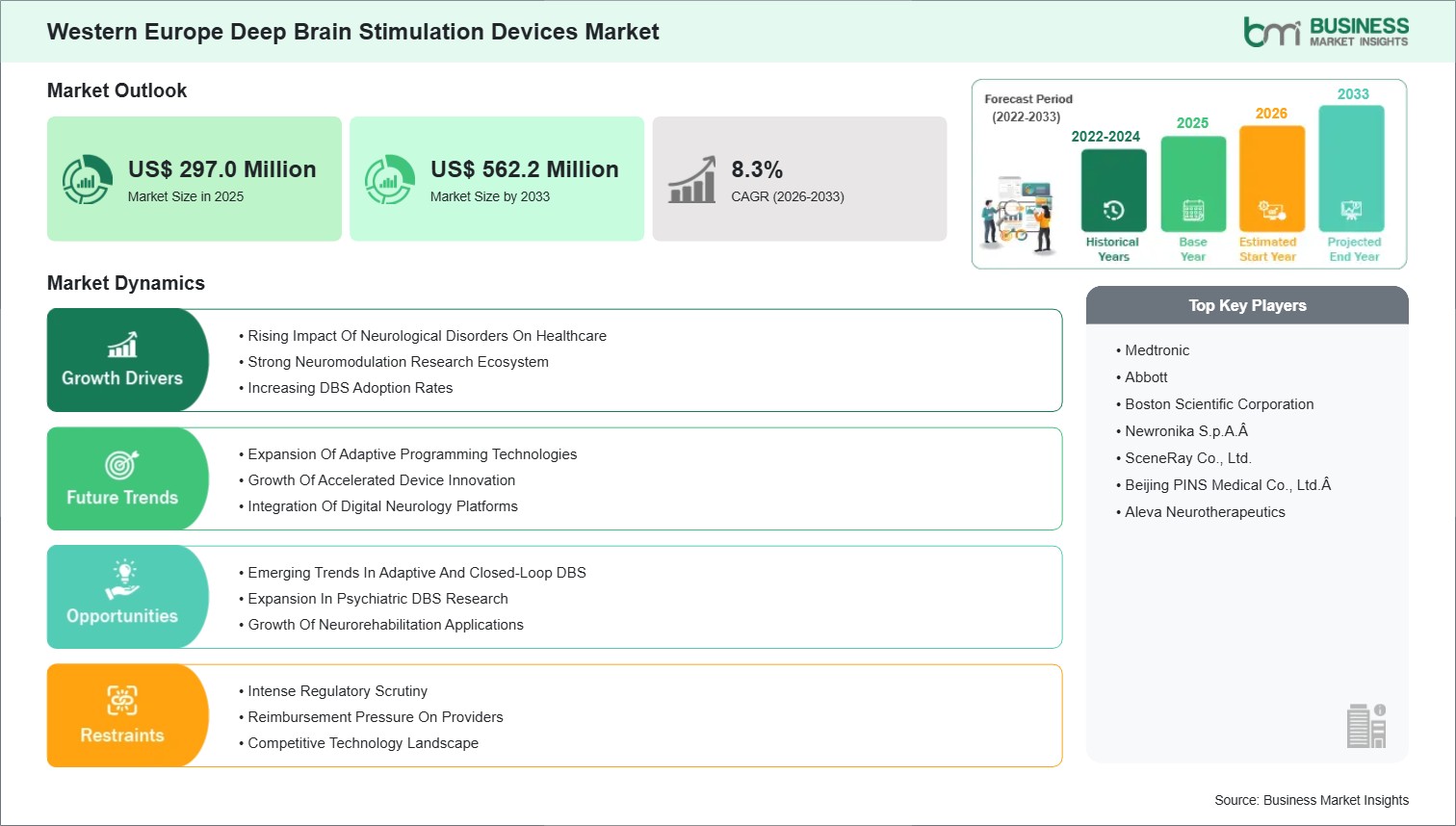
The Western Europe deep brain stimulation devices market size is expected to reach US$ 562.2 million by 2033 from US$ 297.0 million in 2025. The market is estimated to record a CAGR of 8.3% from 2026 to 2033.
Western Europe is characterized by an organized neurological care infrastructure, in which therapy selections are predominantly protocol-driven, focusing on chronic disease management as opposed to acute symptom relief. The indication for DBS is viewed as the next step in the evolution of care after pharmacological treatments become ineffective due to disease progression. Integration of DBS into the existing neurology care pathways is high within university hospitals and accredited movement disorder clinics.
A high level of clinical specialization from an early age and referral-based care delivery allow systematic patient selection of suitable candidates for neuromodulation treatments. There is consistent development of precision medicine in the region, where the emphasis on personalized treatment programs and adaptive devices for improving patients' quality of life is seen as the main focus of clinicians over a long period of time. Medical cooperation between the borders in Western Europe can lead to knowledge transfer and standardization of best practices for procedures, indirectly affecting their consistency. Adoption is restrained by restrictive policies of cost containment in public health care systems, which involve conservative treatment plans prior to the use of procedures such as DBS. Healthcare systems in certain countries adopt novel DBS solutions at a slower rate, owing to budget approval processes and general conservatism regarding fast-changing innovations.

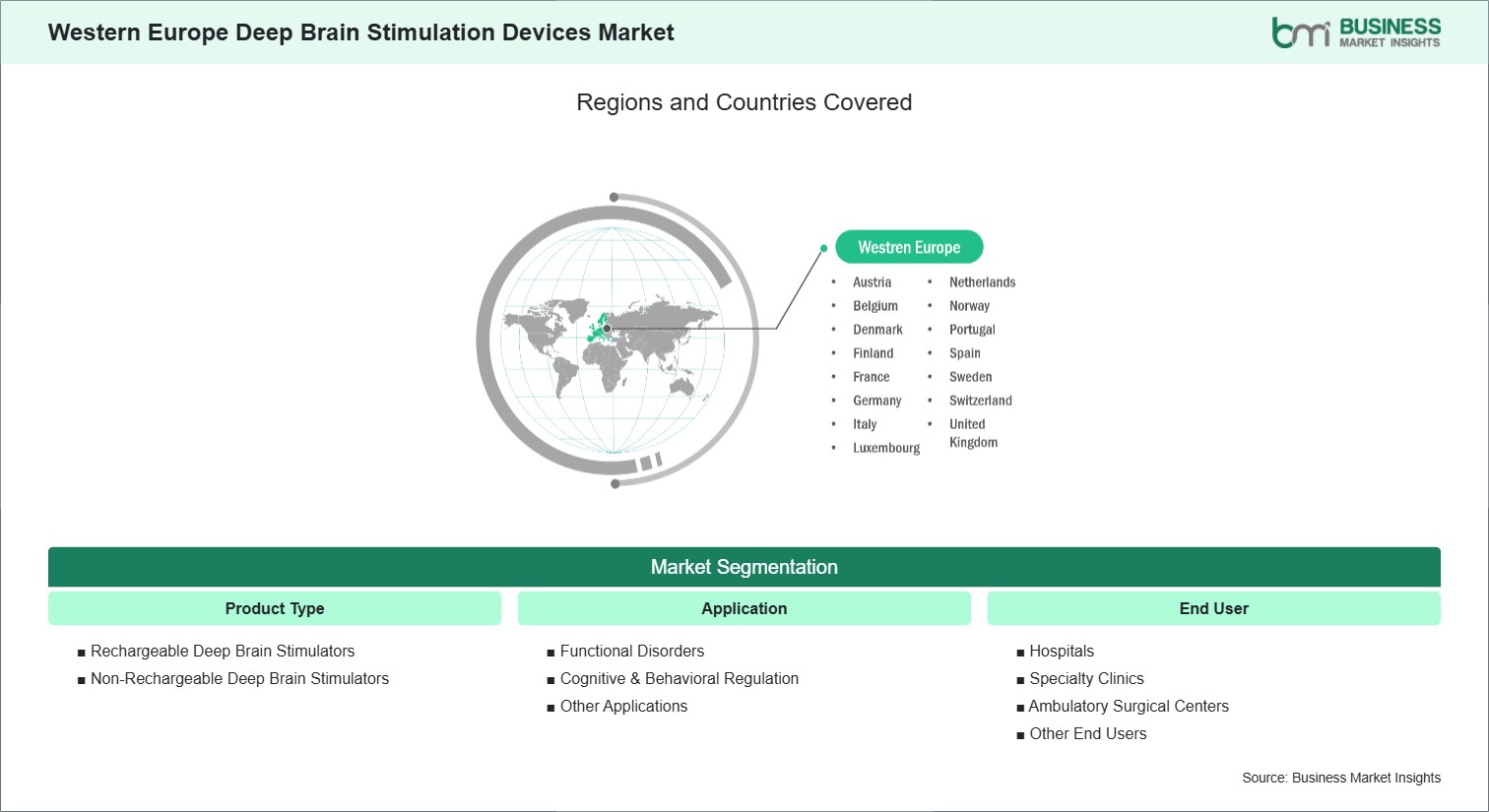
Key segments that contributed to the derivation of the Western Europe deep brain stimulation devices market analysis are product type, application, and end user.
Western Europe is experiencing a steadily increasing burden of neurological disorders such as Parkinson's disease, essential tremor, dystonia, epilepsy, and treatment-resistant psychiatric conditions, which is placing greater pressure on healthcare systems and driving demand for deep brain stimulation (DBS) devices. Aging populations in Germany, France, Italy, Spain, and the UK are a key factor, as neurodegenerative diseases become more prevalent with longer life expectancy and improved chronic disease management. In advanced neurology centers such as those in Paris, London, and Munich, DBS is integrated into treatment pathways for advanced movement disorders.
Healthcare facilities are experiencing an increase in the diagnosis rates because of efficient neurological screening and established patient referral programs. Patients are being referred to multidisciplinary movement disorder clinics, which help in the detection of individuals who no longer benefit from pharmacological treatment. This process helps in ensuring that patients are referred for surgical intervention such as DBS, resulting in continuous implementation procedures. Heart disease, stroke, and diabetes have resulted in more neurological problems among aging patients. These diseases contribute to an increased risk for the worsening of motor function and reduced efficacy of the medication. Thus, DBS is viewed by medical practitioners as a potential treatment method for the management of long-term neurological disorders, especially patients with Parkinson's disease exhibiting fluctuating symptoms.
Western Europe is adopting advanced neuromodulation technologies, particularly adaptive and closed-loop DBS systems that represent the next generation of brain stimulation therapy. Unlike conventional constant-output devices, these systems adjust stimulation in real time based on neural activity, allowing for more precise symptom control and improved patient outcomes. This feature is especially relevant for Parkinson's disease patients experiencing fluctuating motor symptoms throughout the day.
Prominent neurological and neurosurgery clinics in Germany, the UK, the Netherlands, and the Western European hospital clusters under Nordic influence are integrating directional leads, rechargeable implantable pulse generators, and magnetic resonance imaging (MRI)-compatible deep brain stimulators. The enhanced precision, reduced battery change requirements, and improved treatment management from these technologies promote their adoption, especially since the region possesses a robust scientific research environment that facilitates clinical validation through hospital studies.
Digital health integration is becoming important in DBS therapy management across Western Europe. Remote programming and tele-neurology tools are being used to optimize stimulation settings without requiring frequent in-person visits, improving convenience for patients and reducing strain on specialized neurology centers. As healthcare systems continue focusing on precision medicine and digitally enabled chronic disease management, adaptive and closed-loop DBS technologies are expected to play an expanding role in neurological care pathways across the region.

The Western Europe deep brain stimulation devices market is experiencing steady growth, with market size and share analysis reflecting evolving treatment preferences and competitive dynamics among key players. The report evaluates important subsegments categorized within product type, application, and end user, highlighting their respective contributions to overall market performance.
By product type, the rechargeable deep brain stimulators subsegment dominated the market in 2025, driven by the growing preference for long-lasting and patient-friendly neurostimulation solutions. These devices offer extended battery life, reduced frequency of replacement surgeries, and improved convenience for patients, making them the preferred choice for the management of chronic neurological disorders.
Based on application, the functional disorders subsegment dominated the market in 2025, propelled by the rising prevalence of neurological conditions such as Parkinson's disease, essential tremor, and dystonia, along with increasing adoption of deep brain stimulation therapy for effective symptom management and improved quality of life.
In terms of end user, the hospitals subsegment dominated the market in 2025 due to their advanced neurology and neurosurgery departments, availability of skilled healthcare professionals, and access to technologically advanced deep brain stimulation devices and surgical infrastructure.
| Report Attribute | Details |
|---|---|
| Market size in 2025 | US$ 297.0 Million |
| Market Size by 2033 | US$ 562.2 Million |
| CAGR (2026 - 2033) | 8.3% |
| Historical Data | 2022-2024 |
| Forecast period | 2026-2033 |
| Segments Covered | By Product Type
|
|
Regions and Countries Covered
| |
| Western Europe | Belgium, Netherlands, Luxembourg, Germany, France, Italy, Spain, Switzerland, Sweden, Austria, United Kingdom, Denmark, Portugal, Norway, Finland |
| Market leaders and key company profiles |
|
The "Western Europe Deep Brain Stimulation Devices Market Size and Forecast (2022-2033)" report provides a detailed analysis of the market covering below areas:
The geographical scope of the Western Europe Deep Brain Stimulation Devices market report is divided into: Belgium, the Netherlands, Luxembourg, Germany, France, Italy, Spain, Switzerland, Sweden, Austria, the UK, Denmark, Portugal, Norway, and Finland. Germany held the largest share in 2025.
In Germany, a close relationship exists between the academic investigation of neuroscience in universities and clinical application in hospitals. Neurocentres serve as centers of treatment and innovation, whose operations are based on surgical and device improvements.
The nation's referral system is based on a multi-stage evaluation of patients prior to considering them candidates for DBS. Although this contributes to high surgical success rates, it results in an exclusion from treatment of the patients who have not been adequately characterized yet. There is noticeable cooperation between engineers and medical professionals that leads to constant but gradual improvement of stimulation technology and electrodes. In Germany, there is a balanced adoption of procedures in public hospitals and private hospitals supported by insurance companies. There is a need for thorough validation of new approaches before their wide adoption, especially when it comes to new DBS systems. Despite this, Germany serves as a model for methodological perfectionism in the region and influences adoption.

The Western Europe Deep Brain Stimulation Devices market is evaluated by gathering qualitative and quantitative data post primary and secondary research, which includes important corporate publications, association data, and databases. A few of the key developments in the Western Europe deep brain stimulation devices market are:
The Western Europe Deep Brain Stimulation Devices Market is valued at US$ 297.0 Million in 2025, it is projected to reach US$ 562.2 Million by 2033.
As per our report Western Europe Deep Brain Stimulation Devices Market, the market size is valued at US$ 297.0 Million in 2025, projecting it to reach US$ 562.2 Million by 2033. This translates to a CAGR of approximately 8.3% during the forecast period.
The Western Europe Deep Brain Stimulation Devices Market report typically cover these key segments-
The historic period, base year, and forecast period can vary slightly depending on the specific market research report. However, for the Western Europe Deep Brain Stimulation Devices Market report:
The Western Europe Deep Brain Stimulation Devices Market is populated by several key players, each contributing to its growth and innovation. Some of the major players include:
The Western Europe Deep Brain Stimulation Devices Market report is valuable for diverse stakeholders, including:
Essentially, anyone involved in or considering involvement in the Western Europe Deep Brain Stimulation Devices Market value chain can benefit from the information contained in a comprehensive market report.
Please tell us your area of interest
(Market Segments/ Regions and Countries/ Companies)