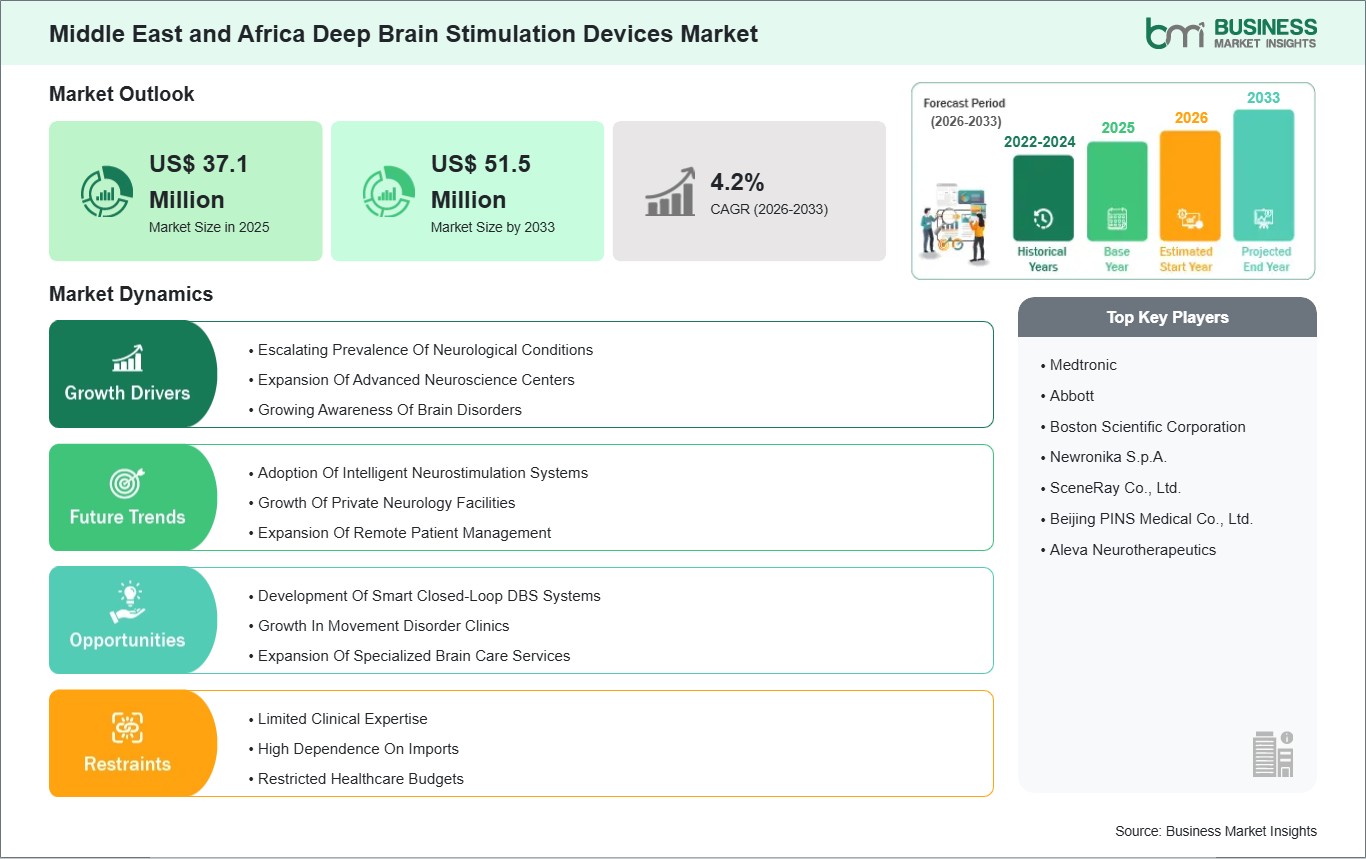
The Middle East and Africa deep brain stimulation devices market size is expected to reach US$ 51.5 million by 2033 from US$ 37.1 million in 2025. The market is estimated to record a CAGR of 4.2% from 2026 to 2033.
The MEA market of DBS devices is gradually evolving, since selected countries are still continuously developing specialized services in neurology and neurosurgery. The main driver of demand for these products is growing awareness regarding the prevalence of movement disorders, such as Parkinson's disease and other neurological complications caused by epilepsy, dystonia, in urban areas with improved diagnostic capacities. The market growth is also associated with tertiary care hospitals and institutes, where functional neurosurgery is being introduced.
The adoption of new technology and training of physicians is one of the major growth factors for the region due to the high levels of investments being made. Collaborations between international companies specializing in neuromodulation devices are assisting regional healthcare facilities in upgrading their surgical skills and introducing sophisticated DBS systems. Besides, patient knowledge about minimally invasive treatment methods is prompting patients to undergo DBS procedures where eligible. Even with all these positive changes, the market continues to be restricted by the unequal distribution of healthcare facilities. The procedures are only being offered by a few specialized centers, thus limiting their availability to remote regions and poorer communities. Costly treatments, reliance on foreign medical equipment, and a lack of functional neurosurgeons in some African and Middle Eastern nations have continued to restrict the adoption of the procedures.

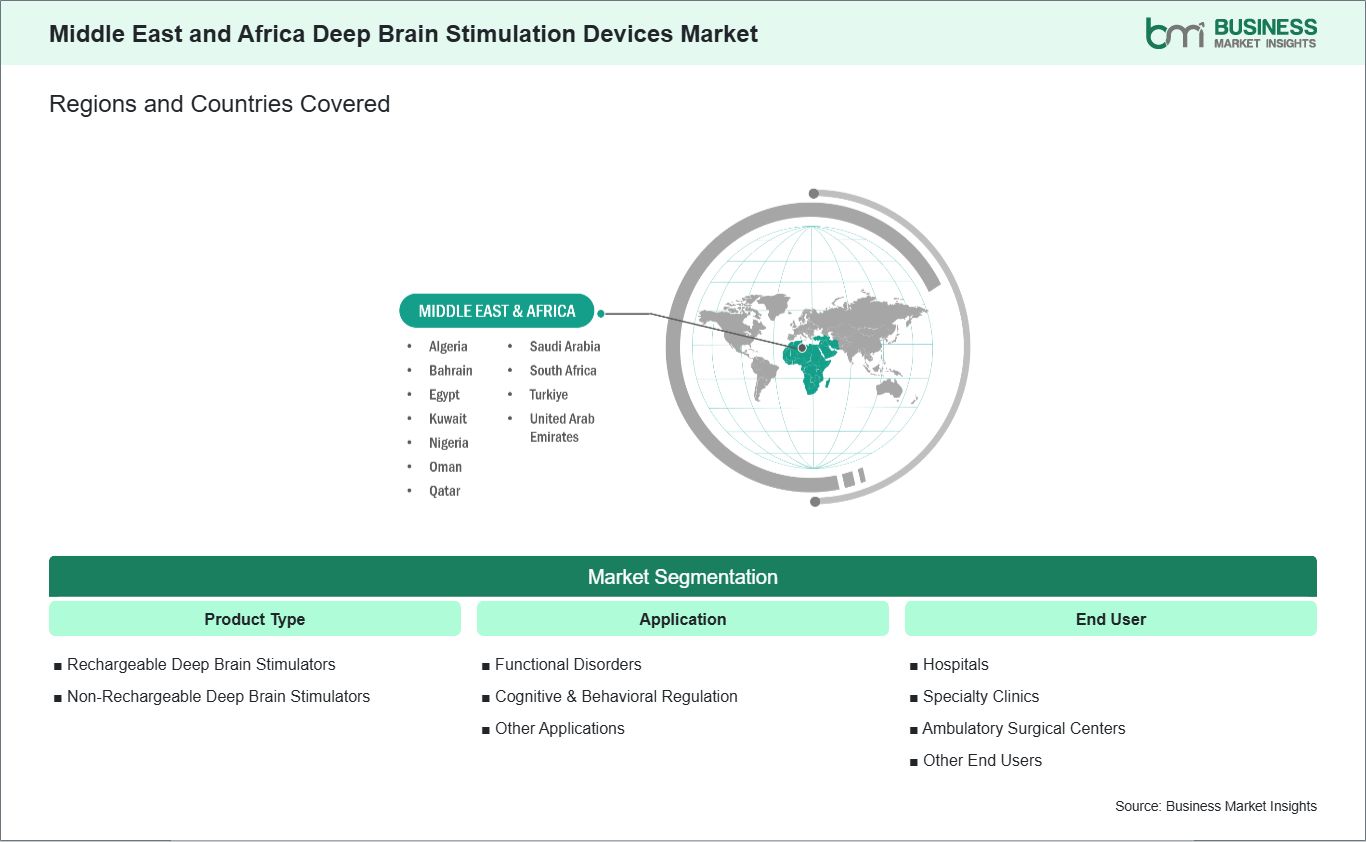
Key segments that contributed to the derivation of the Middle East and Africa deep brain stimulation devices market analysis are product type, application, and end user.
In the Middle East and Africa region, there has been an increase in neurological conditions like Parkinson's disease, epilepsy, dystonia, and essential tremor, thus resulting in more demand for deep brain stimulation (DBS) devices. The aging population in countries around the Gulf region, along with increased awareness regarding healthcare and better diagnosis of conditions, results in an increase in the identification of movement disorders as well as other neurological conditions.
Neurological problems caused by lifestyle issues have also been instrumental in exacerbating the increasing number of neurological disease cases. Increased incidences of diabetes, obesity, hypertension, and stroke cases are resulting in neurological disorders that need prolonged treatment. In some instances, drug treatments become inefficient for the diseases and thus, medical professionals turn to DBS therapy as an alternative method to reduce symptoms.
The establishment of a healthcare infrastructure in the Middle East and some regions of Africa is another key factor fueling growth in the market. There is significant investment in neurology facilities, neurosurgical equipment, and training of medical professionals. Saudi Arabia, the UAE, South Africa, and Egypt are countries focusing on developing neurological treatment capacities by using minimally invasive surgical treatments.
Technological advancements are becoming a key driver in the Middle East and Africa deep brain stimulation devices market, particularly with the emergence of smart closed-loop DBS systems. Unlike traditional stimulation devices that deliver fixed electrical impulses, closed-loop systems can monitor brain activity and automatically adjust stimulation levels in real time. This allows for more precise symptom management, reduced side effects, and improved therapy efficiency for patients with complex neurological conditions.
Hospitals and neuroscience centers across the region are gradually adopting advanced DBS technologies equipped with rechargeable implantable pulse generators, directional leads, and sophisticated programming software. These systems enable clinicians to personalize treatment settings according to individual patient needs, improving overall treatment outcomes. Growing interest in precision medicine and minimally invasive neurological therapies is further encouraging the use of next-generation DBS devices in specialized healthcare facilities.
Integration of technology in the healthcare sector is equally impacting the future of DBS therapy across the Middle East and Africa. Tele-neurology systems and remote monitoring systems have been aiding doctors to better control DBS therapy, especially for patients who reside far away from centers specializing in DBS therapy. The use of smart DBS devices, which allow for wireless programming and real-time monitoring, is proving to be helpful in providing follow-up care while minimizing the need to visit hospitals frequently.

The Middle East and Africa deep brain stimulation devices market is experiencing steady growth, with market size and share analysis reflecting evolving treatment preferences and competitive dynamics among key players. The report evaluates important subsegments categorized within product type, application, and end user, highlighting their respective contributions to overall market performance.
By product type, the rechargeable deep brain stimulators subsegment dominated the market in 2025, driven by the growing preference for long-lasting and patient-friendly neurostimulation solutions. These devices offer extended battery life, reduced frequency of replacement surgeries, and improved convenience for patients, making them the preferred choice for the management of chronic neurological disorders.
Based on application, the functional disorders subsegment dominated the market in 2025, propelled by the rising prevalence of neurological conditions such as Parkinson's disease, essential tremor, and dystonia, along with increasing adoption of deep brain stimulation therapy for effective symptom management and improved quality of life.
In terms of end user, the hospitals subsegment dominated the market in 2025 due to their advanced neurology and neurosurgery departments, availability of skilled healthcare professionals, and access to technologically advanced deep brain stimulation devices and surgical infrastructure.
| Report Attribute | Details |
|---|---|
| Market size in 2025 | US$ 37.1 Million |
| Market Size by 2033 | US$ 51.5 Million |
| CAGR (2026 - 2033) | 4.2% |
| Historical Data | 2022-2024 |
| Forecast period | 2026-2033 |
| Segments Covered | By Product Type
|
|
Regions and Countries Covered
| |
| Middle East and Africa | Saudi Arabia, United Arab Emirates, Kuwait, Bahrain, Qatar, Oman, Turkiye, South Africa, Egypt, Nigeria, Algeria |
| Market leaders and key company profiles |
|
The "Middle East and Africa Deep Brain Stimulation Devices Market Size and Forecast (2022-2033)" report provides a detailed analysis of the market covering below areas:
The geographical scope of the Middle East and Africa Deep Brain Stimulation Devices market report is divided into: Saudi Arabia, the United Arab Emirates, Kuwait, Bahrain, Qatar, Oman, Turkiye, South Africa, Egypt, Nigeria, Algeria, and the Rest of MEA. Turkiye held the largest share in 2025.
Turkey is the leading market for DBS devices in the MEA region, owing to its relatively well-equipped and highly skilled neurosurgical system. In addition, Turkey has proven to be the neurological treatment hub in the region, which is backed by the availability of university hospitals, neuroscience centers, and neurosurgeons who can carry out the intricate process of DBS implantation.
The Turkish healthcare sector has incorporated innovative neuromodulation treatments in the management of Parkinson's disease and other movement disorders. Metropolitan cities including Istanbul, Ankara, and Izmir, have emerged as centers of DBS, where hospitals have introduced highly developed imaging-guided surgery procedures and neurological treatment protocols. The country is also favored by the emergence of the medical tourism industry, which attracts international patients, especially from neighboring Middle East, Central Asia, and Eastern Europe regions, seeking cost-effective DBS treatment options. Nevertheless, the uptake of DBS treatments is more prominent in urban healthcare facilities than in regional hospitals, with the latter not equipped with surgical capabilities. Currency fluctuations and reliance on imported neurostimulation devices might also affect acquisition processes and prices. Turkiye has remained the leading country in the MEA DBS devices market owing to its outstanding clinical skills and medical infrastructure.

The Middle East and Africa Deep Brain Stimulation Devices market is evaluated by gathering qualitative and quantitative data post primary and secondary research, which includes important corporate publications, association data, and databases. A few of the key developments in the Middle East and Africa Deep Brain Stimulation Devices market are:
The Middle East and Africa Deep Brain Stimulation Devices Market is valued at US$ 37.1 Million in 2025, it is projected to reach US$ 51.5 Million by 2033.
As per our report Middle East and Africa Deep Brain Stimulation Devices Market, the market size is valued at US$ 37.1 Million in 2025, projecting it to reach US$ 51.5 Million by 2033. This translates to a CAGR of approximately 4.2% during the forecast period.
The Middle East and Africa Deep Brain Stimulation Devices Market report typically cover these key segments-
The historic period, base year, and forecast period can vary slightly depending on the specific market research report. However, for the Middle East and Africa Deep Brain Stimulation Devices Market report:
The Middle East and Africa Deep Brain Stimulation Devices Market is populated by several key players, each contributing to its growth and innovation. Some of the major players include:
The Middle East and Africa Deep Brain Stimulation Devices Market report is valuable for diverse stakeholders, including:
Essentially, anyone involved in or considering involvement in the Middle East and Africa Deep Brain Stimulation Devices Market value chain can benefit from the information contained in a comprehensive market report.
Please tell us your area of interest
(Market Segments/ Regions and Countries/ Companies)