Market Summary
Executive Summary and Global Market Analysis
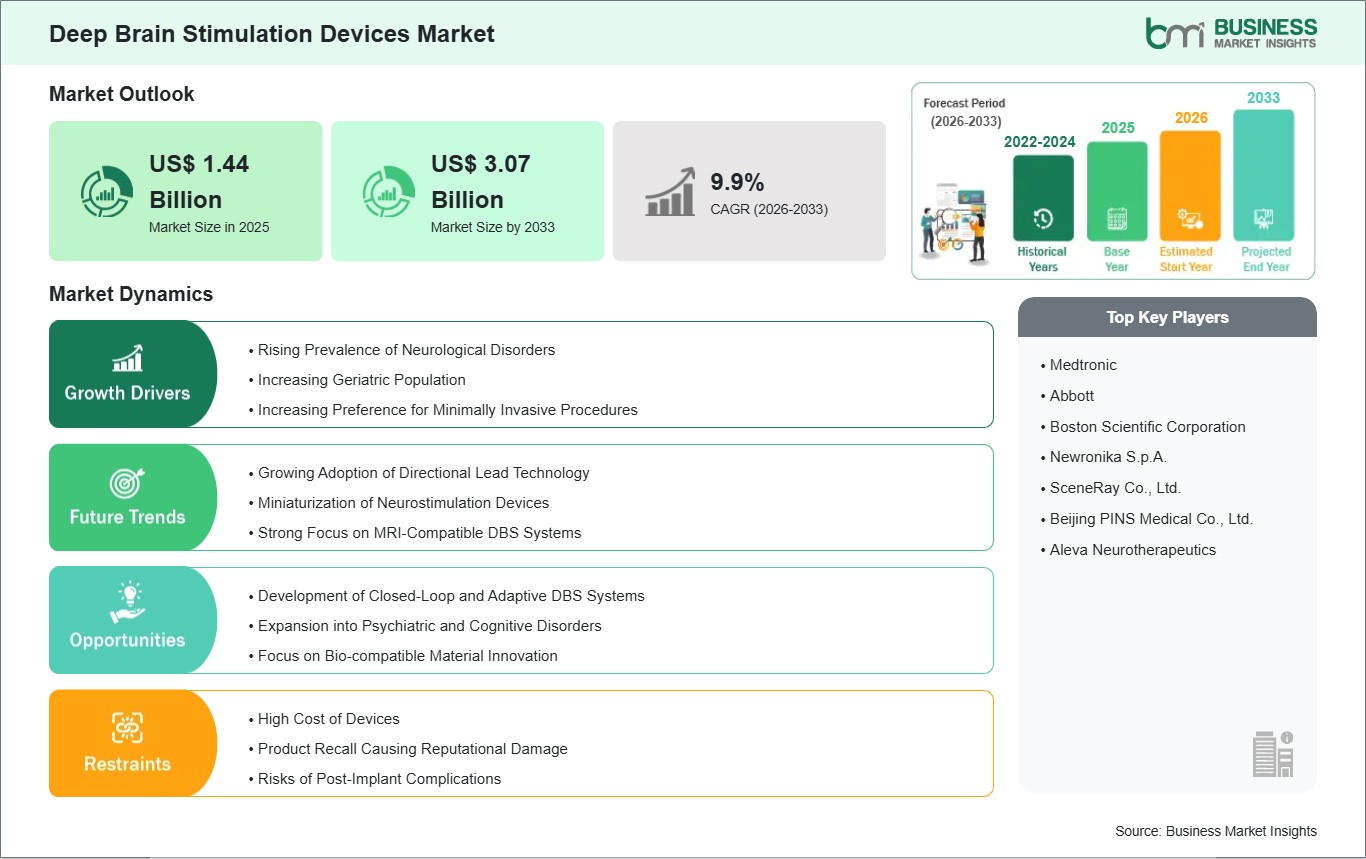
The global DBS devices market is experiencing consistent growth due to the increasing incidence of chronic neurologic and neuropsychiatric disorders, including Parkinson's disease, essential tremor, dystonia, epilepsy, and treatment-resistant depression. The use of DBS therapy as a sophisticated neuromodulation technique for those patients who fail to achieve satisfactory results with medication is gaining recognition, boosting its acceptance in neurosurgical practice.
Constant innovation in technology, in terms of advancements in pulse generator implants, battery life, and the development of adaptive or closed-loop stimulation systems, increases the accuracy of the treatment and efficacy of the therapy. The rise in the trend toward minimally invasive neurosurgery procedures is pushing patients as well as doctors toward considering DBS earlier in the treatment process.
Certain disadvantages that come along with this procedure include the high cost of procedures and their unavailability due to the lack of resources in healthcare systems. The technicality involved in surgically inserting the device and post-procedural monitoring may not allow for wide implementation, especially in less developed regions. Issues associated with device malfunctions and neurological knowledge are major constraints.
Segment Analysis
Deep Brain Stimulation Devices Market Segmentation
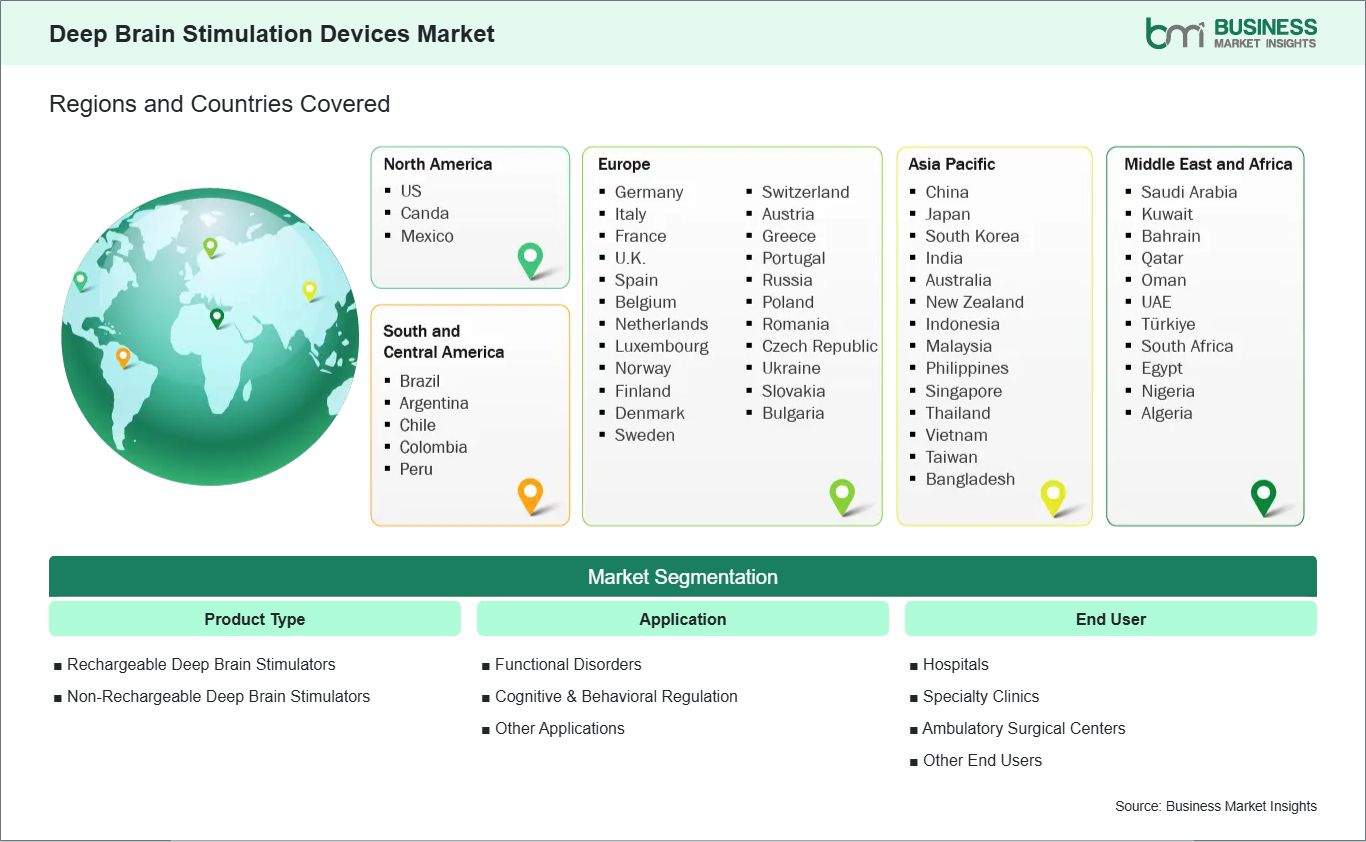
Key segments that contributed to the derivation of the deep brain stimulation devices market analysis are product type, application, and end user.
- By product type, the deep brain stimulation devices market is segmented into rechargeable deep brain stimulators and non-rechargeable deep brain stimulators. The rechargeable deep brain stimulators segment dominated the market in 2025.
- Based on application, the deep brain stimulation devices market is classified into functional disorders, cognitive & behavioral regulation, and other applications. The functional disorders segment dominated the market in 2025.
- In terms of end user, the deep brain stimulation devices market is categorized into hospitals, specialty clinics, ambulatory surgical centers, and other end users. The hospitals segment dominated the market in 2025.
Market Forces
Deep Brain Stimulation Devices Market Drivers and Opportunities
Rising Prevalence of Neurological Disorders
Disorders such as Parkinson's disease are being diagnosed increasingly often due to an aging population and improvements in early diagnosis by healthcare facilities. There is an increasing trend of patients requiring advanced therapy once their condition reaches the stage where medicines cease to have any effect on it. Rising awareness about neurological health among people in India is resulting in the rise of diagnosis numbers in urban and semi-urban areas of cities such as Mumbai, Delhi, and Bengaluru.
Epilepsy and essential tremor have emerged as important causes for an increase in the number of DBS candidates. Numerous patients suffering from difficult-to-control cases of these conditions are being referred to specialized neurosurgical units that can help them. In the context of India's growing private healthcare industry, more hospitals are beginning to establish dedicated functional neurosurgery units equipped to conduct DBS.
Psychiatric disorders such as treatment-resistant depression and obsessive-compulsive disorder are emerging as additional areas of DBS application. In select clinical environments, particularly research hospitals and premium care facilities, DBS is being explored when conventional therapies fail. This growing clinical acceptance is broadening the therapeutic scope of DBS technology.
Development of Closed-Loop and Adaptive DBS Systems
The emergence of closed-loop and adaptive deep brain stimulation technology is revolutionizing the market through its ability to deliver therapy with increased precision and adaptability. The systems provide continuous monitoring and adaptation of neural activity in real time, providing better therapeutic results than the conventional deep brain stimulation technology that uses fixed output. In India, top-tier neurological hospitals and institutions are assessing the efficacy of these innovations in treating movement disorders such as Parkinson's disease.
Artificial intelligence and advanced signal processing are playing an important role in enhancing DBS performance. By analyzing brain signals dynamically, these systems help clinicians fine-tune stimulation parameters with greater accuracy and reduced manual intervention. This feature is relevant in emerging healthcare markets where specialist availability may be limited, making automation a valuable support tool for long-term patient management.
Manufacturers are focusing on fully integrated implantable systems that combine sensing and stimulation capabilities within a single device. These innovations allow continuous feedback-driven therapy and reduce the need for frequent clinical adjustments. In India, where access to long-term neurological follow-up can be challenging, such adaptive systems are expected to improve treatment continuity and expand the adoption of DBS therapies.
Size and Share Analysis
Deep Brain Stimulation Devices Market Size and Share Analysis
The deep brain stimulation devices market is experiencing steady growth, with market size and share analysis reflecting evolving treatment preferences and competitive dynamics among key players. The report evaluates important subsegments categorized within product type, application, and end user, highlighting their respective contributions to overall market performance.
By product type, the rechargeable deep brain stimulators subsegment dominated the market in 2025, driven by the growing preference for long-lasting and patient-friendly neurostimulation solutions. These devices offer extended battery life, reduced frequency of replacement surgeries, and improved convenience for patients, making them the preferred choice for the management of chronic neurological disorders.
Based on application, the functional disorders subsegment dominated the market in 2025, propelled by the rising prevalence of neurological conditions such as Parkinson's disease, essential tremor, and dystonia, along with increasing adoption of deep brain stimulation therapy for effective symptom management and improved quality of life.
In terms of end user, the hospitals subsegment dominated the market in 2025 due to their advanced neurology and neurosurgery departments, availability of skilled healthcare professionals, and access to technologically advanced deep brain stimulation devices and surgical infrastructure.
Report Coverage
Deep Brain Stimulation Devices Market Report Coverage and Deliverables
The "Deep Brain Stimulation Devices Market Size and Forecast (2022-2033)" report provides a detailed analysis of the market covering below areas:
- Market size and forecast at global, regional, and country levels for all the key market segments covered under the scope
- Market trends, as well as drivers, restraints, and opportunities
- Market analysis covering key trends, global and regional framework, major players, regulations, and recent developments
- Market concentration, heat map analysis, prominent players, and recent developments for the Market
- Detailed company profiles, including SWOT analysis
Geographic Insights
Deep Brain Stimulation Devices Market Geographic Insights
The geographical scope of the deep brain stimulation devices market report is divided into five regions: North America, Asia Pacific, Europe, the Middle East & Africa, and South & Central America.
North America holds the leading position in the market, supported by its advanced neurological care infrastructure, high procedural adoption rates, and strong presence of key medical device manufacturers. The region benefits from early integration of innovative neuromodulation technologies and a well-established ecosystem of neurosurgical expertise, particularly in the treatment of Parkinson's disease and other movement disorders.
The prevalence of neurological diseases and high levels of awareness about treatment modalities contribute to the dominance of the region. The region exhibits a higher level of diagnosis and treatment, which contributes to an earlier adoption of DBS than in other regions of the world. The favorable reimbursement scenario and insurance coverage contribute to the reduction of cost-related barriers in DBS procedures. Robust research and development activities are other factors contributing to the dominance of the region.
Clinical trial programs by leading academic healthcare providers and neurology centers focus on increasing the scope of DBS beyond the treatment of movement disorders. These centers are partnering with device manufacturers to conduct research in order to bring innovations and improvements to DBS devices.
Industry Activity
Recent Developments
The Deep Brain Stimulation Devices market is evaluated by gathering qualitative and quantitative data post primary and secondary research, which includes important corporate publications, association data, and databases. A few of the key developments in the Deep Brain Stimulation Devices market are:
- In February 2025, Medtronic announced that it had received US FDA approval for its BrainSense Adaptive Deep Brain Stimulation (aDBS) system. This next-generation DBS technology automatically adjusts stimulation in real time using brain signal feedback to improve treatment precision for Parkinson's disease.
- In January 2024, Abbott announced that it had received US FDA approval for its Liberta RC rechargeable deep brain stimulation system, a compact DBS device designed to treat movement disorders such as Parkinson's disease and essential tremor, featuring remote programming capabilities and improved battery longevity.
Trust & Transparency
Research Methodology
The market analysis combines proprietary research with secondary data from government agencies, company disclosures, regulatory filings, industry databases and expert interviews. Market estimates are validated through data triangulation, cross-market benchmarking and analyst
review.
View Full Research Methodology
Key Sources Referred:
The World Bank World Health Organization (WHO) Center for Disease Control and Prevention (CDC) Food and Drug Administration (FDA) European Database on Medical Devices (EUDAMED) American Association of Neurological Surgeons (AANS) American Academy of Neurology (AAN) Company Websites Company Annual Reports Company Investor Presentations