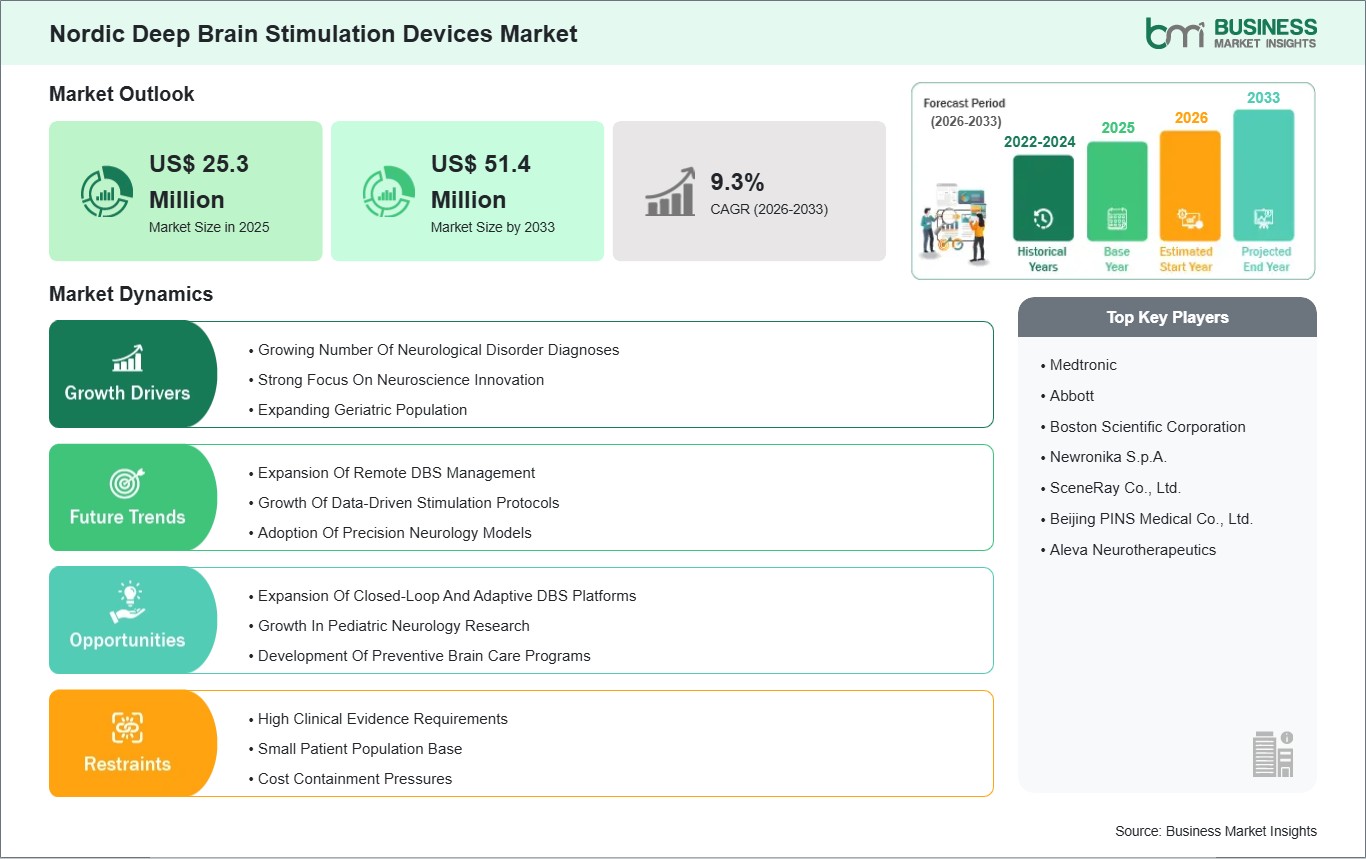
The Nordic deep brain stimulation devices market size is expected to reach US$ 51.4 million by 2033 from US$ 25.3 million in 2025. The market is estimated to record a CAGR of 9.3% from 2026 to 2033.
The Nordic DBS neuromodulation devices market is one of the leading innovation-driven markets in the wider domain of neuromodulation. This region has a well-developed healthcare infrastructure with an early adaptability to the use of precise medicine tools and advanced technologies for diagnostics. In addition, the well-structured public healthcare system ensures that patients can receive proper treatment using innovative devices. One of the main reasons for the high adoption rate in this market is the increased emphasis on treating movement disorders like Parkinson's disease, essential tremor, or other neurological diseases resistant to pharmacological treatment.
Moreover, favorable reimbursement policies and structured referral processes make sure that patients gain access to the latest neurosurgical procedures. The availability of experienced neurosurgeons and movement disorder teams increases the chances of success and ensures continued adoption. Nonetheless, there are some restraints faced by this market, such as complicated procedures, fewer specialty surgery centers, and careful patient selection processes. Apart from this, ethical and regulatory issues concerning implantable neurostimulation devices also affect the pace of adoption. Even with these challenges, continuous technological improvements in adaptive stimulation procedures and minimally invasive surgeries make the future prospects of DBS adoption look promising in the Nordic countries.

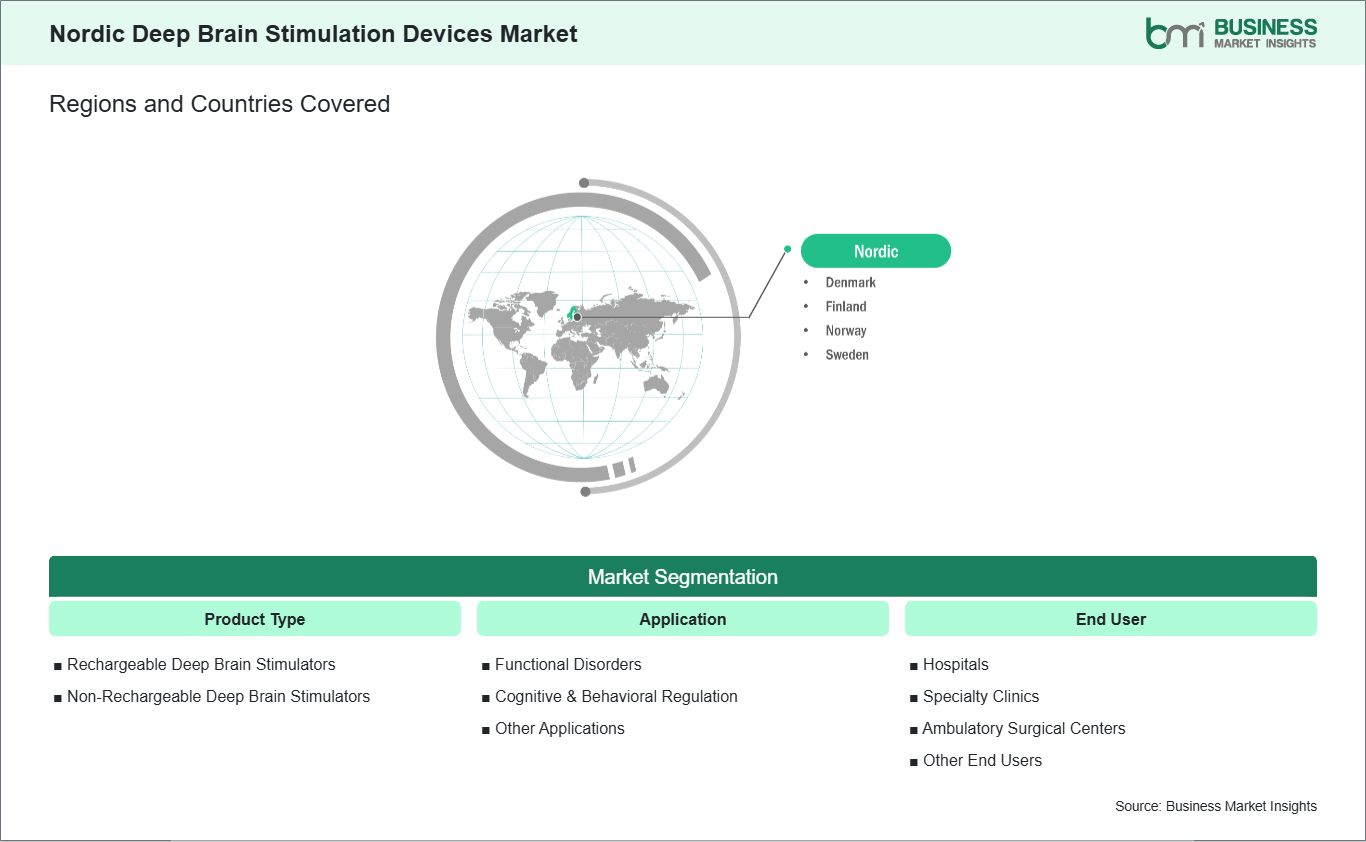
Key segments that contributed to the derivation of the Nordic deep brain stimulation devices market analysis are product type, application, and end user.
Neurological disorders are rising within the Nordic region in terms of diagnosed patients with diseases including Parkinson's disease, essential tremor, dystonia, and refractory epilepsy; there is increased use of DBS devices. The healthcare system in countries like Sweden, Norway, Denmark, Finland, and Iceland is structured and well-organized, providing patients access to neurological assessment and identification of movement disorders. At specialized centers like Oslo University Hospital and Karolinska University Hospital, DBS is one of the steps involved in advanced Parkinson's disease care.
One reason for the increased number of diagnoses is the aging demographic nature of the population in the Nordic region, especially in Sweden and Finland. Life expectancy in these two Nordic nations is amongst the highest in Europe, implying more people with neurodegenerative problems, hence the need for advanced treatment. There is a well-functioning referral mechanism ensuring that all individuals suffering from complications associated with medication end up at specialized facilities.
In addition, high awareness levels among neurologists and the broad availability of standardized treatment pathways help reinforce high rates of diagnoses. The presence of developed national health registries and neurological networks is also favorable for Nordic countries in terms of managing cases of Parkinson's disease patients. In this regard, more cases are currently diagnosed at an early stage, qualifying the patients for DBS devices.
In the Nordic region, there is a growing trend towards more sophisticated neuromodulation devices, especially those involving adaptive and closed-loop stimulations, where the therapy adjusts itself according to real-time feedback. While conventional DBS devices have been extensively employed, there is a move towards employing advanced DBS systems in hospitals in countries such as Sweden and Norway.
In addition to the development in the USA, some top-rated centers in Scandinavia, namely, Uppsala, Stockholm, and Copenhagen, have recently embraced the use of directional leads along with rechargeable implantable pulse generators to increase flexibility in programming and prolong the duration of use of devices. It should be mentioned that this approach is consistent with the general principles of providing quality care in these countries based on evidence.
The digitalization of treatment can be considered yet another trend, as more advanced remote programming and follow-up techniques are implemented in order to adjust the level of electrical brain stimulation without the need for repeated patient visits to the hospital. Such an approach is especially effective in regions of Norway and Finland where patients live at considerable distances from hospitals.

The Nordic deep brain stimulation devices market is experiencing steady growth, with market size and share analysis reflecting evolving treatment preferences and competitive dynamics among key players. The report evaluates important subsegments categorized within product type, application, and end user, highlighting their respective contributions to overall market performance.
By product type, the rechargeable deep brain stimulators subsegment dominated the market in 2025, driven by the growing preference for long-lasting and patient-friendly neurostimulation solutions. These devices offer extended battery life, reduced frequency of replacement surgeries, and improved convenience for patients, making them the preferred choice for the management of chronic neurological disorders.
Based on application, the functional disorders subsegment dominated the market in 2025, propelled by the rising prevalence of neurological conditions such as Parkinson's disease, essential tremor, and dystonia, along with increasing adoption of deep brain stimulation therapy for effective symptom management and improved quality of life.
In terms of end user, the hospitals subsegment dominated the market in 2025 due to their advanced neurology and neurosurgery departments, availability of skilled healthcare professionals, and access to technologically advanced deep brain stimulation devices and surgical infrastructure.
| Report Attribute | Details |
|---|---|
| Market size in 2025 | US$ 25.3 Million |
| Market Size by 2033 | US$ 51.4 Million |
| CAGR (2026 - 2033) | 9.3% |
| Historical Data | 2022-2024 |
| Forecast period | 2026-2033 |
| Segments Covered | By Product Type
|
|
Regions and Countries Covered
| |
| Nordic | Sweden, Denmark, Norway, Finland |
| Market leaders and key company profiles |
|
The "Nordic Deep Brain Stimulation Devices Market Size and Forecast (2022-2033)" report provides a detailed analysis of the market covering below areas:
The geographical scope of the Nordic Deep Brain Stimulation Devices market report is divided into: Sweden, Norway, Denmark, and Finland. Sweden held the largest share in 2025.
The Swedish market serves as the primary destination for DBS systems, largely owing to the highly advanced neurological care infrastructure in place within the country. This is complemented by the strong focus on clinical studies related to movement disorders. Sweden enjoys a highly centralized healthcare system, which allows for the effective referral of patients to specialist centers dealing with neurosurgery, where DBS procedures take place. The leading university hospitals and neuroscience centers in Sweden are instrumental in formulating and refining DBS clinical protocols and selecting appropriate patients.
Moreover, the superiority of Sweden as an innovative region is supported by the high adoption rates of innovations in medical practice as well as cooperation between healthcare providers and companies specializing in developing medical innovations. The presence of qualified multidisciplinary teams, including neurologists, functional neurosurgeons, and rehabilitators, helps ensure comprehensive care for patients prior to and following implantation. In addition, Sweden's advanced approaches to providing such services lead to greater effectiveness of the devices and, ultimately, improvement in the lives of patients. However, Sweden still has some barriers to overcome, since the procedure itself is rather sophisticated and requires careful examination of patients as well as special qualifications of professionals involved in the procedure.

The Nordic Deep Brain Stimulation Devices market is evaluated by gathering qualitative and quantitative data post primary and secondary research, which includes important corporate publications, association data, and databases. A few of the key developments in the Nordic Deep Brain Stimulation Devices market are:
The Nordic Deep Brain Stimulation Devices Market is valued at US$ 25.3 Million in 2025, it is projected to reach US$ 51.4 Million by 2033.
As per our report Nordic Deep Brain Stimulation Devices Market, the market size is valued at US$ 25.3 Million in 2025, projecting it to reach US$ 51.4 Million by 2033. This translates to a CAGR of approximately 9.3% during the forecast period.
The Nordic Deep Brain Stimulation Devices Market report typically cover these key segments-
The historic period, base year, and forecast period can vary slightly depending on the specific market research report. However, for the Nordic Deep Brain Stimulation Devices Market report:
The Nordic Deep Brain Stimulation Devices Market is populated by several key players, each contributing to its growth and innovation. Some of the major players include:
The Nordic Deep Brain Stimulation Devices Market report is valuable for diverse stakeholders, including:
Essentially, anyone involved in or considering involvement in the Nordic Deep Brain Stimulation Devices Market value chain can benefit from the information contained in a comprehensive market report.
Please tell us your area of interest
(Market Segments/ Regions and Countries/ Companies)