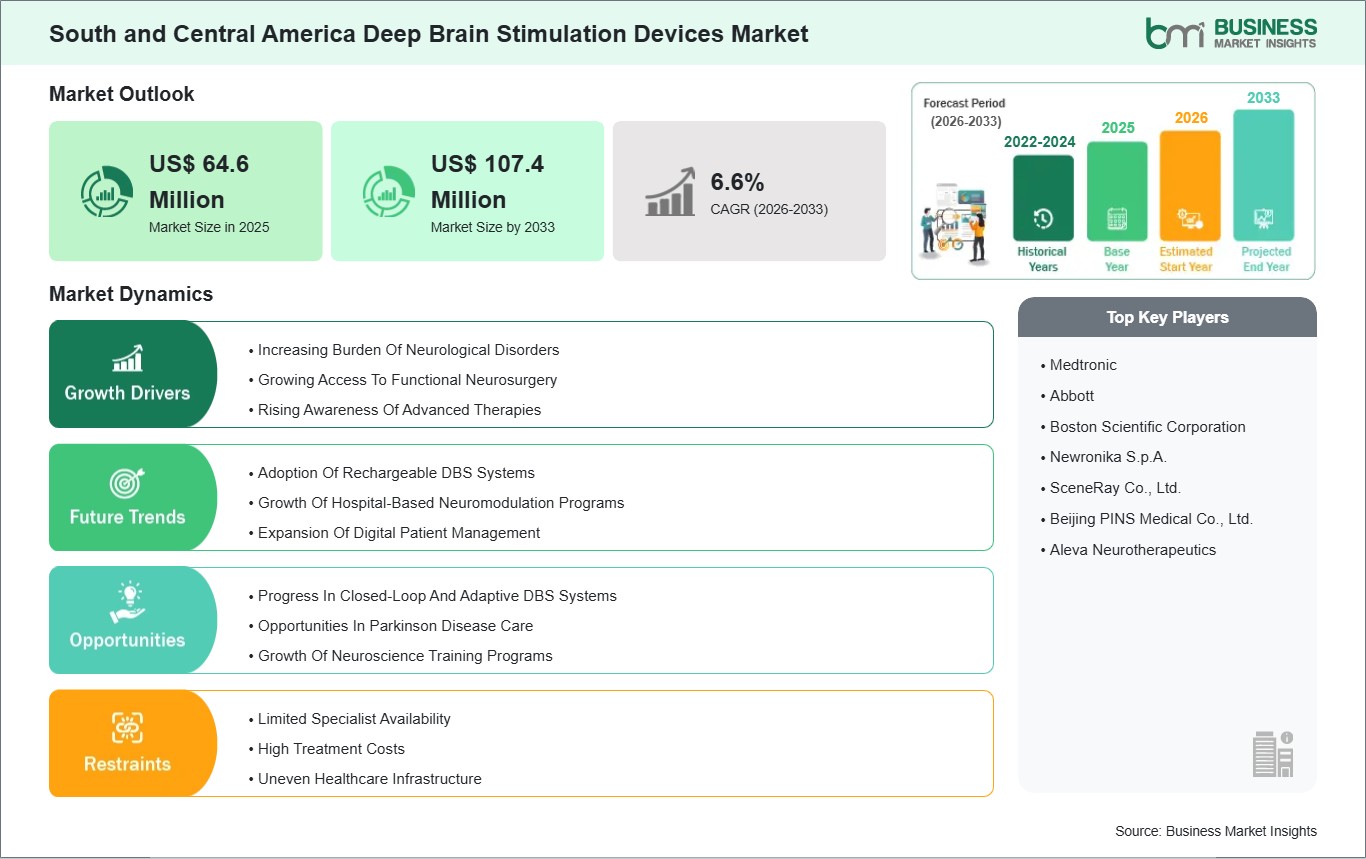
The South and Central America deep brain stimulation devices market size is expected to reach US$ 107.4 million by 2033 from US$ 64.6 million in 2025. The market is estimated to record a CAGR of 6.6% from 2026 to 2033.
The deep brain stimulation (DBS) devices market in South and Central America is progressively growing due to high levels of awareness regarding innovative neurological treatments and increased emphasis on advancing neurosurgical procedures. There is an increasing trend toward treating movement disorders, including Parkinson's disease and essential tremor, especially because of the aging population in the region and increased awareness of neurological disorders. Although the adoption level of DBS treatment is at a nascent stage in comparison to other developed regions, there is a gradually growing interest in major urban centers of health care where neurosurgery is practiced.
The development of healthcare facilities in the private sector is another factor that contributes to the market growth. These developments allow patients to use expensive and highly sophisticated medical devices such as DBS implants. Furthermore, the availability of experienced neurosurgeons in selected tertiary hospitals improves the accessibility of procedures and promotes the adoption of DBS treatment as an alternative method once the efficacy of pharmacotherapy has been reduced. Nevertheless, the lack of insurance coverage in almost all countries impedes the access of patients to DBS treatment because the costs of such procedures are extremely high for them. The uneven distribution of specialized facilities also hampers the diffusion of DBS treatments in remote areas.

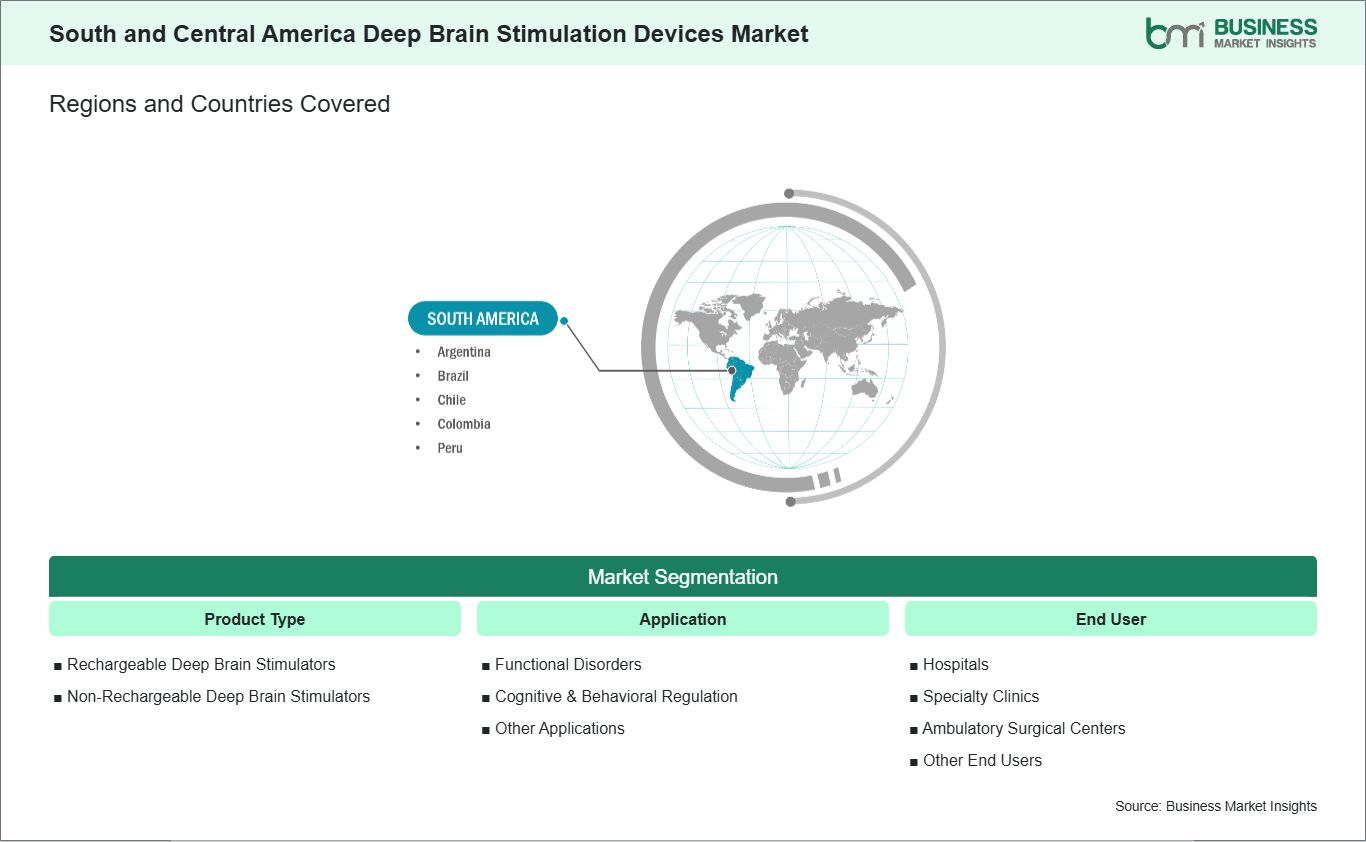
Key segments that contributed to the derivation of the South and Central America deep brain stimulation devices market analysis are product type, application, and end user.
South and Central America are experiencing a steady rise in neurological disorders such as Parkinson's disease, essential tremor, epilepsy, and dystonia, which is increasing the demand for deep brain stimulation (DBS) devices. The region's aging population, particularly in countries like Brazil, Argentina, Chile, and Colombia, is contributing to a higher number of neurodegenerative cases requiring long-term management. Parkinson's disease prevalence in Latin America has been consistently identified as a growing concern due to improved diagnosis and longer life expectancy among elderly populations.
Urbanization and lifestyle-related health conditions are also worsening neurological outcomes across the region. Rising rates of diabetes, hypertension, and stroke are indirectly increasing the incidence of movement disorders and post-stroke neurological complications. In major cities such as São Paulo, Mexico City, and Buenos Aires, neurological clinics are reporting more complex cases where conventional drug therapy becomes less effective, particularly in advanced Parkinson's disease, making DBS a more relevant treatment option.
Disparities in healthcare access in South and Central America further contribute to the differences seen in the burden of these diseases. Metropolitan cities have state-of-the-art facilities related to neurology and neurosurgery, whereas other places might experience late diagnosis and a lack of specialists. However, due to an increased number of tertiary care hospitals in nations such as Brazil and Mexico, more candidates are being found who qualify for DBS treatment.
The South and Central America DBS market is gradually moving toward more advanced neuromodulation technologies, including closed-loop and adaptive stimulation systems. These next-generation devices are designed to adjust electrical impulses based on real-time neural signals, improving symptom control while minimizing unnecessary stimulation. This is particularly valuable for Parkinson's patients with fluctuating motor symptoms, where conventional continuous stimulation may not provide optimal results.
Leading neurosurgical centers in Brazil, Mexico, and Chile are beginning to integrate advanced DBS platforms featuring directional leads, rechargeable pulse generators, and improved programming systems. Hospitals in São Paulo and Mexico City, which serve as regional referral hubs, are increasingly adopting these technologies as part of specialized movement disorder programs. These advancements are helping clinicians deliver more personalized treatment strategies for patients with complex neurological conditions.
Digital integration is also becoming more relevant in DBS management across the region. Telemedicine adoption in South America has accelerated neurological consultations, enabling remote follow-ups and programming support for DBS patients. This is particularly important for geographically large countries such as Brazil, where patients outside major urban centers may have limited access to specialized neurology services. As digital healthcare infrastructure continues to expand, adaptive DBS systems are expected to see broader clinical acceptance across the region.

The South and Central America deep brain stimulation devices market is experiencing steady growth, with market size and share analysis reflecting evolving treatment preferences and competitive dynamics among key players. The report evaluates important subsegments categorized within product type, application, and end user, highlighting their respective contributions to overall market performance.
By product type, the rechargeable deep brain stimulators subsegment dominated the market in 2025, driven by the growing preference for long-lasting and patient-friendly neurostimulation solutions. These devices offer extended battery life, reduced frequency of replacement surgeries, and improved convenience for patients, making them the preferred choice for the management of chronic neurological disorders.
Based on application, the functional disorders subsegment dominated the market in 2025, propelled by the rising prevalence of neurological conditions such as Parkinson's disease, essential tremor, and dystonia, along with increasing adoption of deep brain stimulation therapy for effective symptom management and improved quality of life.
In terms of end user, the hospitals subsegment dominated the market in 2025 due to their advanced neurology and neurosurgery departments, availability of skilled healthcare professionals, and access to technologically advanced deep brain stimulation devices and surgical infrastructure.
| Report Attribute | Details |
|---|---|
| Market size in 2025 | US$ 64.6 Million |
| Market Size by 2033 | US$ 107.4 Million |
| CAGR (2026 - 2033) | 6.6% |
| Historical Data | 2022-2024 |
| Forecast period | 2026-2033 |
| Segments Covered | By Product Type
|
|
Regions and Countries Covered
| |
| South and Central America | Brazil, Argentina, Chile, Colombia, Peru |
| Market leaders and key company profiles |
|
The "South and Central America Deep Brain Stimulation Devices Market Size and Forecast (2022-2033)" report provides a detailed analysis of the market covering below areas:
The geographical scope of the South and Central America Deep Brain Stimulation Devices market report is divided into: Brazil, Argentina, Chile, Colombia, Peru, and the Rest of South and Central America. Brazil held the largest share in 2025.
Brazil stands out as the major market for DBS device technology among all countries in South and Central America, with its rather developed medical system as well as an expanding number of clinics specializing in the treatment of neurological diseases. Brazil is characterized by an extensive network of public and private hospitals, with cities like Sao Paulo and Rio de Janeiro serving as main centers for conducting operations on patients requiring DBS implantation. One of the reasons behind the success of Brazil's DBS market is associated with the involvement of experienced neurosurgeons and universities engaged in neurological research and implementing innovative treatment technologies. DBS operations are mainly conducted in complicated hospitals involving multidisciplinary teams managing the cases of patients with movement disorders.
The private healthcare system has a significant impact on the development of DBS therapy because it ensures rapid access to innovative surgical procedures that are not available under the public system. Nevertheless, financial constraints limit the accessibility of the treatment to most people, thereby affecting the wider utilization. The approval process and differences in insurance coverage between public and private health systems affect treatment accessibility. Brazil is becoming increasingly dominant by slowly improving its infrastructure for specialized neurology clinics, physician knowledge base, and neuromodulation approaches for neurological disorders.

The South and Central America Deep Brain Stimulation Devices market is evaluated by gathering qualitative and quantitative data post primary and secondary research, which includes important corporate publications, association data, and databases. A few of the key developments in the South and Central America Deep Brain Stimulation Devices market are:
The South and Central America Deep Brain Stimulation Devices Market is valued at US$ 64.6 Million in 2025, it is projected to reach US$ 107.4 Million by 2033.
As per our report South and Central America Deep Brain Stimulation Devices Market, the market size is valued at US$ 64.6 Million in 2025, projecting it to reach US$ 107.4 Million by 2033. This translates to a CAGR of approximately 6.6% during the forecast period.
The South and Central America Deep Brain Stimulation Devices Market report typically cover these key segments-
The historic period, base year, and forecast period can vary slightly depending on the specific market research report. However, for the South and Central America Deep Brain Stimulation Devices Market report:
The South and Central America Deep Brain Stimulation Devices Market is populated by several key players, each contributing to its growth and innovation. Some of the major players include:
The South and Central America Deep Brain Stimulation Devices Market report is valuable for diverse stakeholders, including:
Essentially, anyone involved in or considering involvement in the South and Central America Deep Brain Stimulation Devices Market value chain can benefit from the information contained in a comprehensive market report.
Please tell us your area of interest
(Market Segments/ Regions and Countries/ Companies)