Market Summary
Executive Summary and Market Analysis
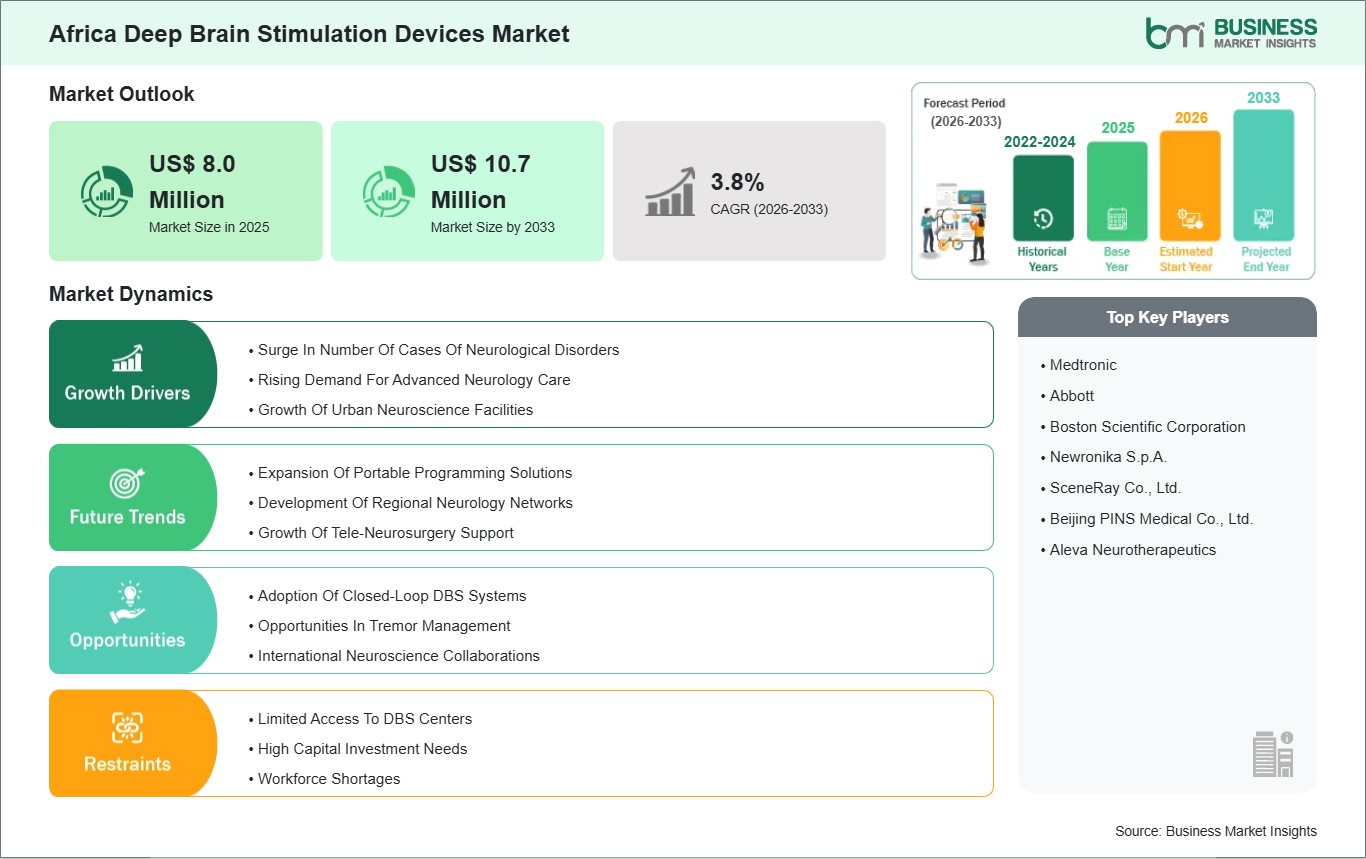
The growth in the demand for DBS devices is propelled by the rising incidence of movement disorders such as Parkinson's Disease, Essential Tremor, Epilepsy, and Dystonia. There is surging awareness about modern neuromodulation techniques among neurologists and neurosurgeons. Hospitals and neuroscience centers in several African nations have adopted minimally invasive neurological surgeries.
South Africa continues to be the dominant player in the region owing to its developed health care system, well-established network of private hospitals, and increased availability of advanced neurology services. There is an increased need for functional neurosurgical procedures in urban health care facilities in cities such as Johannesburg, Cape Town, and Pretoria. Collaborations between hospitals and international companies specializing in developing devices used in functional surgery have increased the availability of technologically sophisticated DBS systems. High costs associated with procedures and devices continue to pose a significant challenge in poor economies that lack reimbursement schemes for advanced neurosurgical treatment. The shortage of neurosurgeons skilled in performing DBS operations in poor regions on the continent is another challenge.
Segment Analysis
Africa Deep Brain Stimulation Devices Market Segmentation
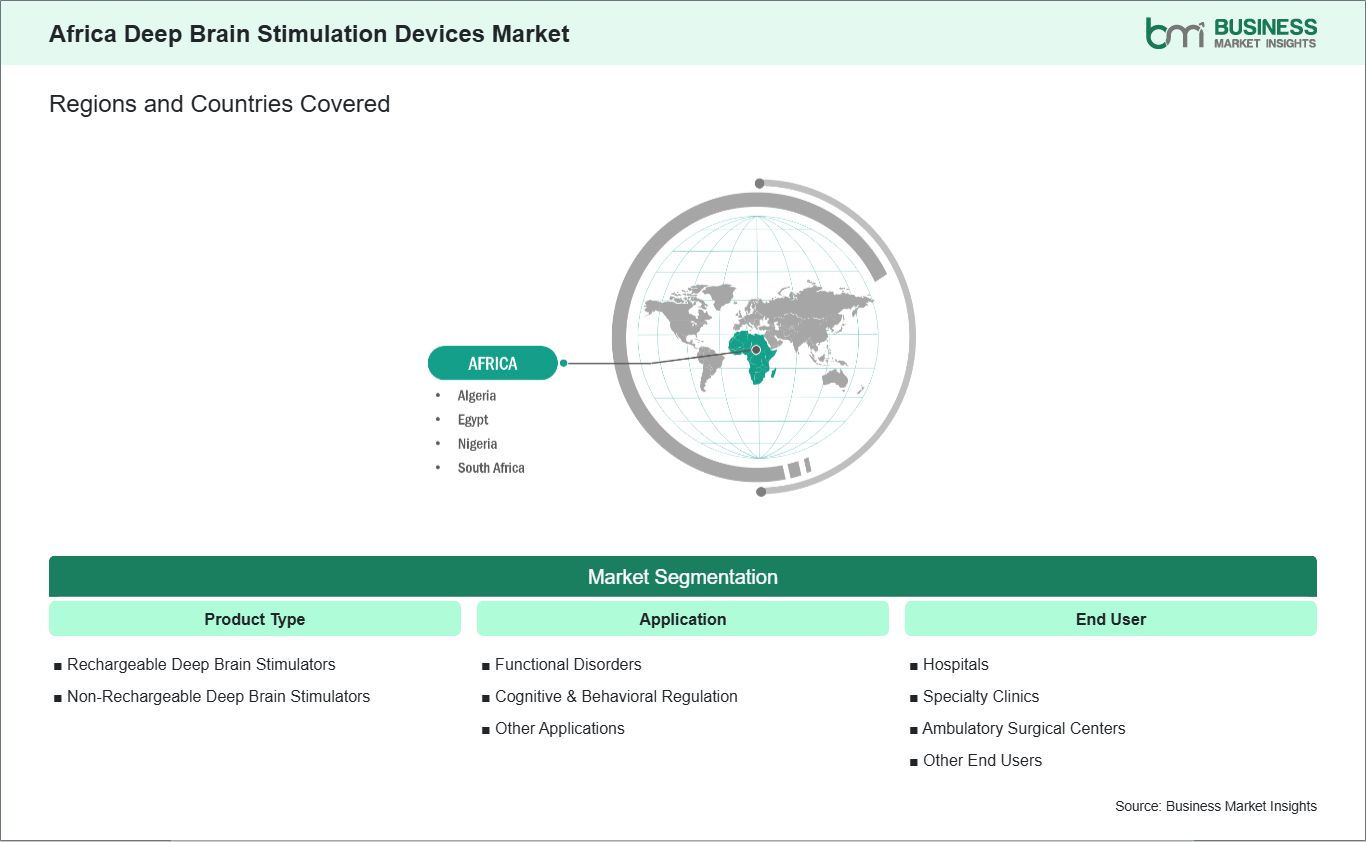
Key segments that contributed to the derivation of the Africa deep brain stimulation devices market analysis are product type, application, and end user.
- By product type, the deep brain stimulation devices market is segmented into rechargeable deep brain stimulators and non-rechargeable deep brain stimulators. The rechargeable deep brain stimulators segment dominated the market in 2025.
- Based on application, the deep brain stimulation devices market is classified into functional disorders, cognitive & behavioral regulation, and other applications. The functional disorders segment dominated the market in 2025.
- In terms of end user, the deep brain stimulation devices market is categorized into hospitals, specialty clinics, ambulatory surgical centers, and other end users. The hospitals segment dominated the market in 2025.
Market Forces
Africa Deep Brain Stimulation Devices Market Drivers and Opportunities
Surge in number of cases of Neurological Disorders
Urbanization, changing lifestyles, and increasing life expectancy are contributing to a gradual rise in age-related neurological conditions, particularly in countries such as South Africa, Egypt, and Morocco. As awareness regarding neurological health improves, more patients are seeking advanced treatment solutions beyond conventional medication-based therapies.
The healthcare systems are focusing more on building expertise in neurology and neurosurgery. Large hospitals and healthcare providers in the private sector are making investments in the neurological departments, enabling patients to get diagnoses and treatments related to movement disorders. In Kenya and Nigeria, the availability of MRI scanning technology has helped detect neurological disorders, thereby providing a basis for DBS surgery.
International collaborations, physician training programs, and growing participation in global neuroscience initiatives are contributing to increased awareness of DBS therapy among healthcare professionals. While access to advanced neurological treatments remains uneven across the continent, major metropolitan areas are witnessing higher demand for minimally invasive therapies that improve patients' quality of life. The increasing focus on long-term management of chronic neurological disorders is expected to continue supporting the adoption of DBS devices across Africa.
Adoption of Closed-Loop DBS Systems
The developments taking place in the field of neuromodulation have been contributing to the growth of the deep-brain stimulation devices industry in Africa. Medical device companies are developing closed-loop and adaptive deep-brain stimulation (DBS) devices that can adjust their stimulation intensity based on the activity of neurons.
The incorporation of these advanced DBS devices into hospitals and specialized neurological institutes in South Africa and the UAE is attributed to the ongoing process of upgrading the country's health care systems. It includes the development of rechargeable devices for implantable pulse generators, directional leads, and wireless programming. These innovations improve device efficiency while reducing surgical procedures. They are more significant in areas where it is difficult to access specialist medical facilities for follow-up appointments.
The integration of artificial intelligence and remote monitoring capabilities is expected to improve patient management across geographically dispersed populations. Adaptive DBS systems can support more precise symptom control while minimizing side effects associated with continuous stimulation therapies. As healthcare infrastructure continues to develop an awareness regarding advanced neuromodulation technologies, next-generation DBS systems are anticipated to gain wider acceptance among neurologists and neurosurgeons.
Size and Share Analysis
Africa Deep Brain Stimulation Devices Market Size and Share Analysis
The Africa deep brain stimulation devices market is experiencing steady growth, with market size and share analysis reflecting evolving treatment preferences and competitive dynamics among key players. The report evaluates important subsegments categorized within product type, application, and end user, highlighting their respective contributions to overall market performance.
By product type, the rechargeable deep brain stimulators subsegment dominated the market in 2025, driven by the growing preference for long-lasting and patient-friendly neurostimulation solutions. These devices offer extended battery life, reduced frequency of replacement surgeries, and improved convenience for patients, making them the preferred choice for the management of chronic neurological disorders.
Based on application, the functional disorders subsegment dominated the market in 2025, propelled by the rising prevalence of neurological conditions such as Parkinson's disease, essential tremor, and dystonia, along with increasing adoption of deep brain stimulation therapy for effective symptom management and improved quality of life.
In terms of end user, the hospitals subsegment dominated the market in 2025 due to their advanced neurology and neurosurgery departments, availability of skilled healthcare professionals, and access to technologically advanced deep brain stimulation devices and surgical infrastructure.
Report Coverage
Africa Deep Brain Stimulation Devices Market Report Coverage and Deliverables
The "Africa Deep Brain Stimulation Devices Market Size and Forecast (2022-2033)" report provides a detailed analysis of the market covering below areas:
- Market size and forecast at global, regional, and country levels for all the key market segments covered under the scope
- Market trends, as well as drivers, restraints, and opportunities
- Market analysis covering key trends, global and regional framework, major players, regulations, and recent developments
- Market concentration, heat map analysis, prominent players, and recent developments for the Market
- Detailed company profiles, including SWOT analysis
Geographic Insights
Africa Deep Brain Stimulation Devices Market Geographic Insights
The geographical scope of the Africa Deep Brain Stimulation Devices market report is divided into Nigeria, Egypt, South Africa, and Algeria. South Africa held the largest share in 2025.
The market is dominated by South Africa, owing to its developed health care infrastructure along with a relatively large number of neurological specialists. South Africa can be considered a nerve center when it comes to neurosurgery operations as well as the adoption of medical technologies. Leading private players, along with the renowned hospitals situated in Johannesburg and Cape Town, have begun to incorporate DBS treatments for the management of conditions such as Parkinson's disease.
Private health care establishments are responsible for promoting DBS due to their financial capacity to afford more expensive neuromodulation machines and robotic surgical systems. South Africa enjoys better regulation of imported medical equipment as well as a higher level of developed infrastructure when compared to other nations. DBS device makers favor South Africa as the location of distribution due to a more developed market of medical tools there than elsewhere in Africa. Higher levels of understanding of neurological diseases among specialists and patients alike are boosting demand for procedures. Functional neurosurgery studies conducted at universities, as well as training programs, are contributing to market growth. Nevertheless, the gap in accessibility to treatment in private and public healthcare segments continues to be a major impediment. DBS surgeries are performed in private urban facilities, with few procedures offered in the public sector.
Industry Activity
Recent Developments
The Africa Deep Brain Stimulation Devices market is evaluated by gathering qualitative and quantitative data post primary and secondary research, which includes important corporate publications, association data, and databases. A few of the key developments in the Africa Deep Brain Stimulation Devices market are:
- In September 2024, Medtronic announced that it would showcase new real-world applications of its BrainSense DBS technology and latest Parkinson's disease research at the International Congress of Parkinson's Disease and Movement Disorders, highlighting continued innovation in the global DBS market, including emerging regions such as Africa.
- In August 2024, Medtronic announced FDA approval for its Asleep Deep Brain Stimulation surgery option, allowing DBS implantation procedures under general anesthesia and strengthening the company's advanced neuromodulation offerings for international regions, including the Middle East & Africa.
Trust & Transparency
Research Methodology
The market analysis combines proprietary research with secondary data from government agencies, company disclosures, regulatory filings, industry databases and expert interviews. Market estimates are validated through data triangulation, cross-market benchmarking and analyst
review.
View Full Research Methodology
Key Sources Referred:
The World BankWorld Health Organization (WHO)Center for Disease Control and Prevention (CDC)Food and Drug Administration (FDA)European Database on Medical Devices (EUDAMED)American Association of Neurological Surgeons (AANS)American Academy of Neurology (AAN)Company WebsitesCompany Annual ReportsCompany Investor Presentations