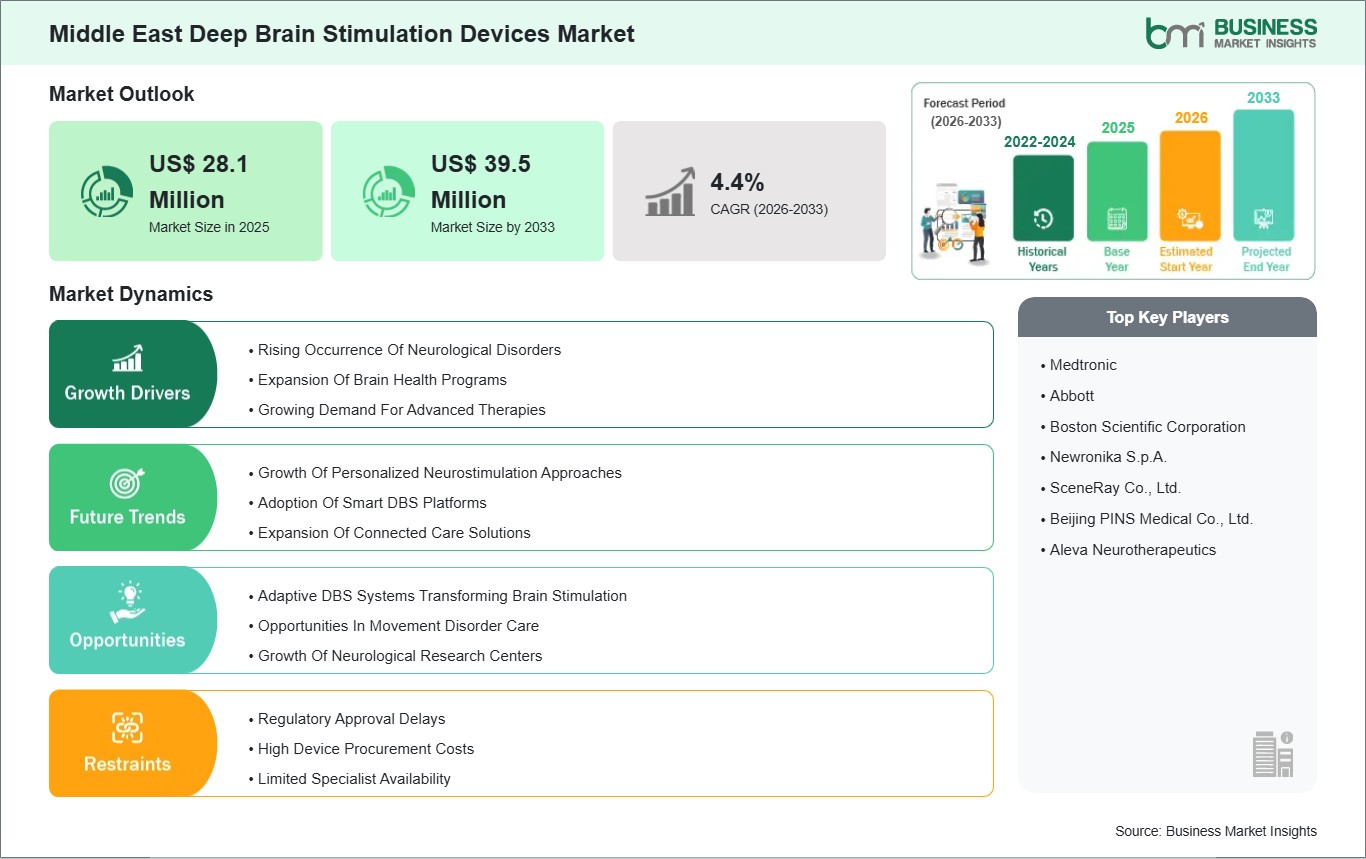
The Middle East deep brain stimulation devices market size is expected to reach US$ 39.5 million by 2033 from US$ 28.1 million in 2025. The market is estimated to record a CAGR of 4.4% from 2026 to 2033.
The Middle Eastern Market for Deep Brain Stimulation (DBS) Systems is slowly growing as countries in the region invest in their healthcare sectors in order to develop their neurology and neurosurgery. The major factor influencing the growth of the market is the increase in the prevalence rate of neurodegenerative diseases, including Parkinson's disease, among others, because of increased diagnosis of the disease and aging of the urban population in the region. Healthcare organizations are increasingly setting up neuroscience facilities in the region to facilitate the use of advanced neuromodulation techniques such as DBS.
One of the important factors that contribute to growth includes the tendency towards the acceptance of the latest technologies in medicine, along with heavy healthcare investments and partnerships with leading foreign device companies. The emergence of tertiary hospitals and medical educational centers increases the capabilities for performing surgeries, and training courses conducted in collaboration with global neurosurgeons help to develop skills necessary for implanting DBS and handling the post-operation process. Demand from medical tourists is also an aspect worth consideration; the patients from other countries choose Middle Eastern hospitals to get their neurology issues treated through the latest medical advancements. Nevertheless, the lack of specialist neurosurgeons and the localization of DBS operations only in top-tier hospitals are barriers to further market development. Moreover, the high price of medical devices and treatment processes hinder its accessibility in public healthcare organizations of some Middle Eastern countries.

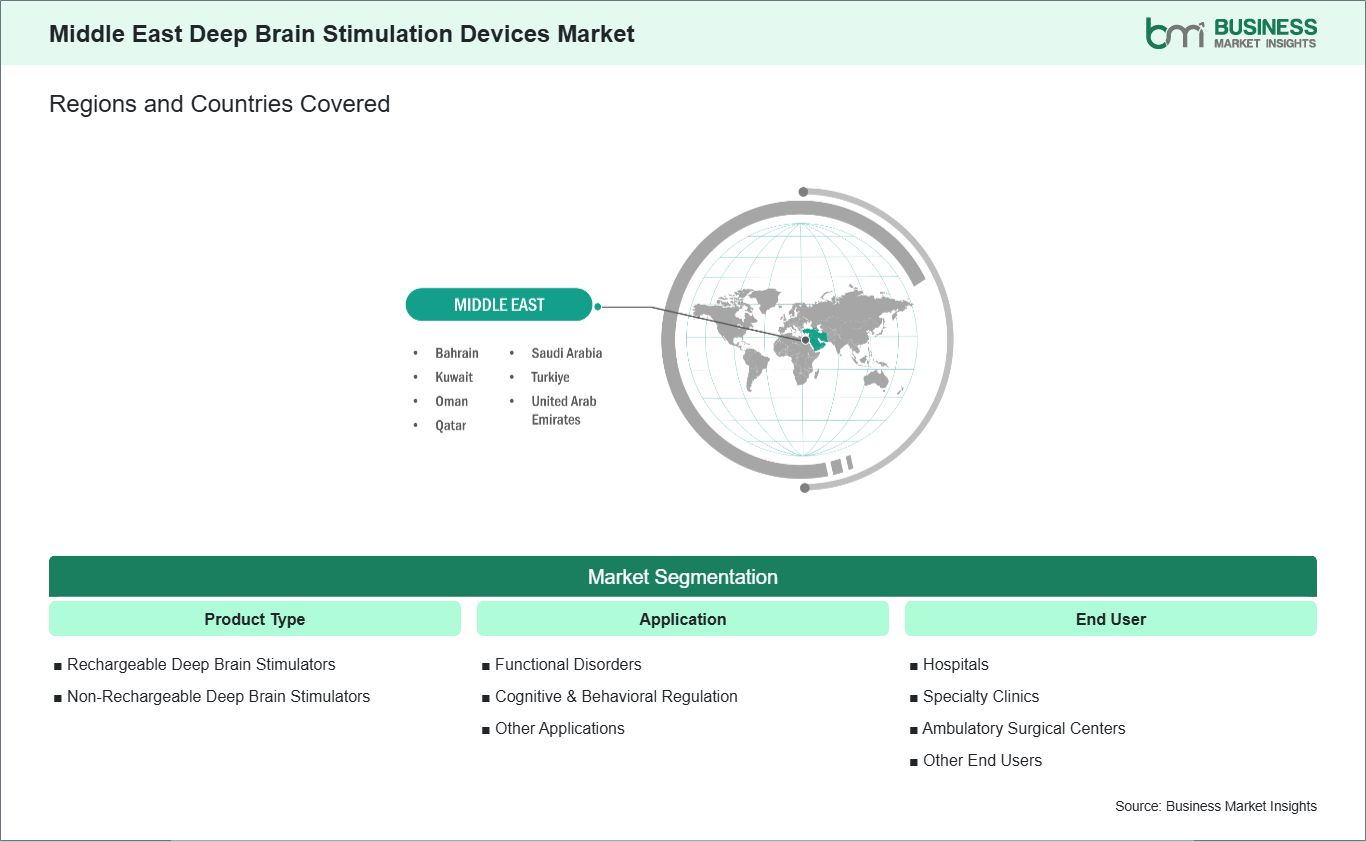
Key segments that contributed to the derivation of the Middle East deep brain stimulation devices market analysis are product type, application, and end user.
The Middle East is witnessing a steady increase in neurological conditions such as Parkinson's disease, epilepsy, dystonia, and essential tremor, which is driving greater interest in deep brain stimulation (DBS) devices. Aging populations in countries like Saudi Arabia and the UAE, combined with improved life expectancy and better diagnostic capabilities, are contributing to higher detection rates of movement disorders. In tertiary hospitals across Riyadh, Dubai, and Abu Dhabi, clinicians are increasingly identifying patients in advanced disease stages who may benefit from surgical intervention.
Other risk factors linked to lifestyle changes are increasingly important in causing diseases in the area. The increase in diabetes, obesity, heart diseases, and strokes has contributed to the increase in conditions related to movement problems and other neurodegenerative diseases. These illnesses lower the efficiency of medical treatments in controlling symptoms in patients with advanced Parkinson's disease, leading doctors to explore DBS as an alternative treatment approach.
The development of healthcare systems in the Middle Eastern region is facilitating the implementation of DBS technology. This has been seen through heavy investment in specialist centers focusing on neurology and neurosurgery, especially within healthcare system transformation initiatives like vision strategies. Top healthcare providers in Saudi Arabia, UAE, and Qatar are enhancing their services in movement disorders as well as setting up better referral mechanisms for difficult neurological cases.
The Middle East DBS landscape is increasingly shaped by the adoption of adaptive and next-generation stimulation technologies. Unlike conventional DBS systems that provide continuous electrical impulses, adaptive DBS can adjust stimulation dynamically based on real-time brain activity. This improves precision in symptom management, reduces side effects, and enhances overall treatment efficiency, making it highly suitable for complex neurological cases seen in advanced healthcare centers.
The major neurosurgical and neuroscience hospitals in the region are increasingly employing sophisticated DBS techniques like directional electrodes, rechargeable IPGs, and AI-based programming solutions. The hospitals in the UAE and Saudi Arabia are leading in terms of embracing such technological advances, backed by significant investments made in digital healthcare facilities and minimally invasive surgeries.
The digital integration has similarly changed the management of patients who have undergone DBS surgery in the Middle East. Telemedicine technologies are being deployed for adjustment of stimulation settings without having to visit hospitals frequently, especially for those residing in areas other than the large metropolitan centers. With the increased focus on smart hospital ecosystems in healthcare organizations, the adaptation of DBS therapies is expected to become a key component of neurological treatments in the region.

The Middle East deep brain stimulation devices market is experiencing steady growth, with market size and share analysis reflecting evolving treatment preferences and competitive dynamics among key players. The report evaluates important subsegments categorized within product type, application, and end user, highlighting their respective contributions to overall market performance.
By product type, the rechargeable deep brain stimulators subsegment dominated the market in 2025, driven by the growing preference for long-lasting and patient-friendly neurostimulation solutions. These devices offer extended battery life, reduced frequency of replacement surgeries, and improved convenience for patients, making them the preferred choice for the management of chronic neurological disorders.
Based on application, the functional disorders subsegment dominated the market in 2025, propelled by the rising prevalence of neurological conditions such as Parkinson's disease, essential tremor, and dystonia, along with increasing adoption of deep brain stimulation therapy for effective symptom management and improved quality of life.
In terms of end user, the hospitals subsegment dominated the market in 2025 due to their advanced neurology and neurosurgery departments, availability of skilled healthcare professionals, and access to technologically advanced deep brain stimulation devices and surgical infrastructure.
| Report Attribute | Details |
|---|---|
| Market size in 2025 | US$ 28.1 Million |
| Market Size by 2033 | US$ 39.5 Million |
| CAGR (2026 - 2033) | 4.4% |
| Historical Data | 2022-2024 |
| Forecast period | 2026-2033 |
| Segments Covered | By Product Type
|
|
Regions and Countries Covered
| |
| Middle East | UAE, Saudi Arabia, Bahrain, Oman, Kuwait, Qatar, Turkiye |
| Market leaders and key company profiles |
|
The "Middle East Deep Brain Stimulation Devices Market Size and Forecast (2022-2033)" report provides a detailed analysis of the market covering below areas:
The geographical scope of the Middle East Deep Brain Stimulation Devices market report is divided into: the UAE, Saudi Arabia, Bahrain, Oman, Kuwait, Qatar, and Turkiye. Turkiye held the largest share in 2025.
Turkish society stands out as the lead nation within the Middle Eastern region's DBS devices industry owing to its neurosurgical competence, as well as its highly developed capacity in performing functional brain surgery. Turkey has positioned itself as the leading nation in neuromodulation treatments within the Middle East, backed up by highly advanced university hospitals and neurological institutions.
The major health centers of Istanbul, Ankara, and Izmir play a crucial role in implementing DBS by providing patients with a coordinated approach that utilizes innovative technologies of neuro-imaging and surgery planning, and a multi-disciplinary approach after the procedure. The well-developed health sector in Turkiye and international cooperation in research have made the country even more attractive to foreigners who need advanced medical treatment. Moreover, Turkiye enjoys a favorable influx of foreigners who travel abroad to receive high-quality but affordable neurosurgery services. Even with such an advantage, the penetration of DBS technology into smaller regions is rather poor, while the dependency on foreign-made DBS systems is still influencing decision-making.

The Middle East Deep Brain Stimulation Devices market is evaluated by gathering qualitative and quantitative data post primary and secondary research, which includes important corporate publications, association data, and databases. A few of the key developments in the Middle East Deep Brain Stimulation Devices market are:
The Middle East Deep Brain Stimulation Devices Market is valued at US$ 28.1 Million in 2025, it is projected to reach US$ 39.5 Million by 2033.
As per our report Middle East Deep Brain Stimulation Devices Market, the market size is valued at US$ 28.1 Million in 2025, projecting it to reach US$ 39.5 Million by 2033. This translates to a CAGR of approximately 4.4% during the forecast period.
The Middle East Deep Brain Stimulation Devices Market report typically cover these key segments-
The historic period, base year, and forecast period can vary slightly depending on the specific market research report. However, for the Middle East Deep Brain Stimulation Devices Market report:
The Middle East Deep Brain Stimulation Devices Market is populated by several key players, each contributing to its growth and innovation. Some of the major players include:
The Middle East Deep Brain Stimulation Devices Market report is valuable for diverse stakeholders, including:
Essentially, anyone involved in or considering involvement in the Middle East Deep Brain Stimulation Devices Market value chain can benefit from the information contained in a comprehensive market report.
Please tell us your area of interest
(Market Segments/ Regions and Countries/ Companies)